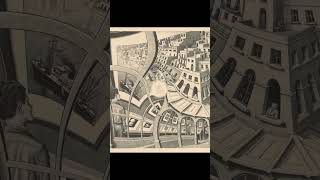

Escher's Mind-Bending Infinite Loop
45sThe visual paradox of a man viewing a gallery that contains himself creates an immediate 'wow' factor that begs to be shared.
▶ Play Clip"The title promises a mind-bending piece, and the video delivers a fascinating analysis, though it's a short teaser that leaves viewers wanting more."
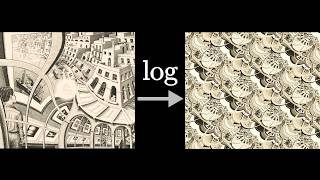
This video explores M.C. Escher's 1956 lithograph 'The Print Gallery,' a mind-bending work that depicts a man viewing a picture containing a gallery that includes the same man viewing the same picture, creating an infinite loop. The video highlights a 2003 mathematical analysis by De Smit and Lenstra that reveals a hidden structure involving the logarithm of an image, which explains the mysterious blank hole in the center of the artwork.
The lithograph shows a man looking at a picture of a boat in a harbor, which contains a gallery where the same man is again staring at the same picture, creating a recursive visual paradox.
Escher called this work 'the most peculiar thing that I have ever done,' indicating his awareness of its unusual nature.
In 2003, mathematicians De Smit and Lenstra provided a detailed analysis of the picture, uncovering a beautiful mathematical idea that Escher himself did not realize.
The crux of the analysis involves taking the logarithm of an image, a concept that sounds nonsensical but is actually a reasonable and cool mathematical operation when explained properly.
The analysis answers the question of what exactly is in the blank hole in the middle of the artwork, which seems paradoxical because different perspectives suggest different interpretations (town, picture frame, or print gallery).
All the ambiguity about the viewer's position in the scene is compressed into that blank spot, making it a focal point of the artwork's paradox.
The creator mentions that the full video on this topic is one of their favorites and encourages viewers to watch it for a deeper dive.
The video presents a fascinating intersection of art and mathematics, showing how a mathematical analysis can reveal hidden structures in a famous artwork. It teases a deeper exploration in a full video, inviting viewers to engage with the content beyond the short format.
What is the name of the M.C. Escher lithograph discussed in the video?
The Print Gallery
00:01
In what year was the lithograph created?
1956
00:01
What did Escher call this work in a letter to his son?
The most peculiar thing that I have ever done.
00:14
Who provided a mathematical analysis of the picture in 2003?
De Smit and Lenstra
00:28
What mathematical concept is central to the analysis?
Taking the logarithm of an image.
00:42
Infinite Loop in Art
Illustrates a recursive visual paradox that challenges perception.
00:01Mathematical Analysis
Shows how mathematics can uncover hidden structures in art.
00:28Logarithm of an Image
Introduces a non-obvious but powerful mathematical tool for image analysis.
00:42Central Hole Paradox
Demonstrates how ambiguity can be compressed into a single point.
00:54[00:01] art I think I've ever seen. It's M.C. Escher's 1956 lithograph, The Print Gallery. And it takes a little moment to wrap your head around what's going on. We have a man looking at a picture of a boat. That boat is in a harbor of a
[00:14] buildings. And you go over and one of those buildings is a gallery full of artwork. And down the hall, here we find the same man staring at a picture of a boat. In a letter to his son, Escher called this "the most peculiar thing
[00:28] that I have ever done." Which for him is saying a lot. In 2003, the mathematicians De Smit and Lenstra offered a really delightful analysis of scenes of this picture. And it's something Escher himself didn't even
[00:42] realize. The crux involves a very beautiful idea that can be summarized as taking the logarithm of an image. That might sound like nonsense, but I promise, if you explain it the right way, it's actually a really cool and
[00:54] abundantly reasonable thing to do. One conclusion that popped out of this analysis is an answer to a question that doesn't even feel like it should have an answer, which is what exactly goes in this hole in the middle? If you think
[01:06] about it, that almost seems paradoxical because if you come at it from above, it town. But if you come at it from the left, it's more fitting to be part of the picture frame. Come at it from below and it seems more like part of the print
[01:18] gallery. So somehow all of the ambiguity about where exactly you are in this whole scene is compressed into that blank spot in the middle. The full video I made about this topic is really one of my favorites in a long
[01:31] time. So next time you're in the mood to be out of the shorts feed and sitting a lot to me if you considered taking a look.

⚡ Saved you 0h 01m reading this? Transcribe any YouTube video for free — no signup needed.