[00:00]
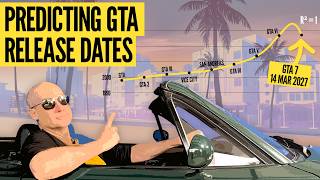
After an over 13-year wait and so many memes, Grand Theft Auto VI is finally coming out this 19th of November. I cannot refilm this. [laughs]
[00:14]
can we predict Yes. We're gonna run the numbers, do some mathematics, extrapolate, And I am driving down the street right now.
[00:29]
is being swept back in the wind. [upbeat music] The very first Grand Theft Auto came out in 1997 and started a very neat two-year
[00:47]
Two years after that, GTA III. Then one year to Vice City, but that was kind of a spin-off, but not, of GTA III. And then two years until San Andreas, and that was the end of the neat bit.
[01:04]
I'm ignoring re-releases and different consoles and all that jazz. Although it does now mean when That took a bit longer.
[01:20]
And now it starts to spiral, 5.4 years until GTA V, But we can still put those We draw a straight line through them,
[01:36]
where that line for GTA VII hits the vertical year axis, and it's the 4th of October in 2022, the past. Because there was such a big wait until
[01:52]
GTA VI, averaging the data out, we need one from the past. So the official extrapolation is GTA VII will have had come out in the year 2022.
[02:05]
[upbeat music] Now, that prediction is obviously wrong because it's negative, and predicting things in the future, extrapolating,
[02:19]
"Does that actually make sense?" But it's not just art, it is also science, which in that case is 0.822, and that's kind of a measure of how close the
[02:35]
line is to the data points, 'cause it's not gonna go through all of them. And if that R squared value was one, that would be bang on through all the points. If we were to upgrade to a quadratic, ooh, that's fancy,
[02:53]
now our R squared value is 0.955. It says we're gonna get GTA VI on the 1st of May in the year
[03:05]
But we are also being led astray, potentially. where I was trying to extrapolate data, and I said how a quadratic always fits
[03:17]
better than a linear just because there's more parts to a quadratic in the equation. You've got more levers and dials to move around to match it, and in fact, the higher the order of your polynomial, the better it will match just by default.
[03:31]
In fact, if we increase the order of our polynomial, it gets closer and closer and closer until order seven, perfect match. That predicts the 14th of April in the year 2068.
[03:48]
If you have n data points, you can always find a polynomial of order n minus one, so one less, that goes exactly through every data point with an R squared value
[04:02]
I can actually pick any future date So this equation here, that predicts that GTA VII will come out on Pi Day
[04:16]
It's not going to. a polynomial which will predict any future data point you want, So this is not helping.
[04:31]
[upbeat music] We're gonna take the two-year original release cycle as the baseline,
[04:46]
and that ran until San Andreas, which came out 728 days, And if we look at the increasing gaps after that, we can try and extrapolate the gap size.
[05:01]
And if we use these values, we predict that the gap from GTA VI to VII will be 5,430 days, which puts it on the 1st of October in the year Is that plausible?
[05:16]
I wouldn't be that surprised if GTA VII came out in the 2040s. Again, we can play the same game.
[05:28]
We can go, "Oh, what if we make this exponential?" We can try and fit loads of At this point, I feel like we're just looking at the data and we're
[05:40]
over-fitting. We're just, like, looking at I feel like Hey, quickly, it's me, Matt, from a future video about darts.
[05:54]
I'm just here to say if you're a Patreon supporter who gets a physical Christmas After that, you'll still get a card, and it's gonna be your own unique dartboard
[06:08]
I'm very excited. Oh, digital cards, don't worry about that. Okay, so what do we do if the raw numbers aren't helping us?
[06:22]
See if there's a reason why one prediction is better than the others. so I'm just looking at, like, the delay beyond the two-year cycle,
[06:37]
which does give us one fewer data point, 'cause one of them goes to zero. the overhead that's been increasing, and you apply an exponential fit, It's e.
[06:53]
It's, like, I think 4% off e. If GTA VII had come out on the 6th so close. If you're not familiar with e,
[07:09]
it's the unexpected number that shows up when pi is not available. predicting growth into the future is e, And if you continue the e extrapolation, GTA VII will come out on the
[07:25]
So That's the official Stand-up Maths prediction. 2057,
[07:39]
Now, did I just analyse loads and loads of ways you could extrapolate the data and see if any of Maybe some of the gaps were weirdly close [laughs]
[07:54]
But no, I'm sticking with it. You can't argue against a fit that good, so there you are. into the future.
[08:09]
[upbeat music] And if you're new here, all my maths videos are just like this one,
[08:24]
[clanging] [upbeat music]