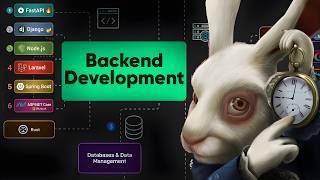

Stop Wasting Time on the Wrong Backend Framework
46sChallenges the audience's current choice and promises a surprising number one, driving curiosity.
▶ Play Clip"The title accurately promises a ranking and explanation of six frameworks, which the video delivers, though the 'surprise' pick is not particularly shocking."
This video ranks six back-end frameworks from beginner-friendly to advanced, helping developers choose the right one based on their skill level, project needs, and career goals. The ranking considers job demand, learning curve, and future growth.
The video ranks six back-end frameworks from the one to learn first to the one to avoid until ready.
Runs JavaScript on the server, paired with Express or NestJS. Non-blocking architecture handles thousands of users, ideal for real-time apps. Without structure, large projects become messy.
Python-based, batteries-included philosophy with built-in admin panels, database tools, and security. Great for beginners and startups, but overkill for lightweight APIs.
Java-based, used by banks and Fortune 500 companies for stability and scalability. Steep learning curve but non-negotiable for enterprise roles.
PHP framework with clean syntax, built-in routing, authentication, and migrations. Easy for beginners to build web apps quickly, but not suited for large-scale microservices.
Microsoft's modern framework using C#, fast and cross-platform. Best for teams in the Microsoft ecosystem; beginners may find C# formal.
Modern async Python framework, lightweight with automatic API documentation. Ideal for AI services, data pipelines, and microservices; ranked number one.
1. FastAPI, 2. Django, 3. Node.js, 4. Laravel, 5. Spring Boot, 6. ASP.NET Core. Best framework depends on goal: AI tools → FastAPI, full-stack → Node.js or Django, enterprise → Spring Boot.
The best back-end framework depends on your specific goals: FastAPI for AI, Node.js or Django for full-stack web apps, and Spring Boot for enterprise systems.
What is the main advantage of Node.js for back-end development?
It uses JavaScript for both front-end and back-end, enabling faster learning and shipping.
0:26
Which framework follows a 'batteries-included' philosophy?
Django.
1:04
What is the primary use case for Spring Boot?
Enterprise systems like banks and Fortune 500 companies requiring stability and scalability.
1:34
What is the killer feature of FastAPI?
Automatic API documentation generated as you code.
3:01
What is the final ranking order of the six frameworks?
1. FastAPI, 2. Django, 3. Node.js, 4. Laravel, 5. Spring Boot, 6. ASP.NET Core.
3:24
Node.js for Real-Time Apps
Highlights the non-blocking architecture that handles thousands of users, making it ideal for chat and live dashboards.
0:26Django's Batteries-Included Philosophy
Explains how Django's built-in features guide beginners and speed up development for startups.
1:04Spring Boot for Enterprise
Emphasizes its role in banking and Fortune 500 companies, showcasing its stability and scalability.
1:34FastAPI's Automatic Documentation
Killer feature that simplifies API development, especially for AI and data engineering.
3:01[00:00] Most developers waste months learning
[00:02] the wrong back-end framework. I'm going
[00:04] to rank six of them from the one you
[00:06] should learn first to the one you should
[00:08] avoid until you're ready. By the end of
[00:10] this video, you'll know exactly which
[00:12] framework fits your level, your project,
[00:14] and your career. Stick around because
[00:16] the number one pick might actually
[00:17] surprise you. Before we dive in, drop a
[00:20] comment right now. Which back-end
[00:22] framework are you using or learning? I
[00:24] read every single one. First up,
[00:26] Node.js. If you already know JavaScript,
[00:28] this one feels like home because it
[00:30] literally is. It runs the same language
[00:32] you use in the browser, but on the
[00:34] server. Paired with Express or NestJS,
[00:37] it becomes a powerful engine for
[00:39] building fast APIs. The biggest reason
[00:41] it exploded, one language for both
[00:43] front-end and back-end. Faster learning,
[00:46] faster shipping. It's non-blocking
[00:48] architecture handles thousands of users
[00:50] at once, making it perfect for real-time
[00:52] apps like chat platforms and live
[00:54] dashboards. The catch, without proper
[00:56] structure, large projects become a mess
[00:59] fast. If you're past beginner level, go
[01:01] with NestJS for better architecture.
[01:04] Next, Django. Built on Python, it
[01:06] follows a batteries-included philosophy.
[01:09] Activation, admin panels, database
[01:11] tools, and security all come built-in.
[01:14] For beginners, Django is like a senior
[01:16] developer guiding every decision. That's
[01:18] why startups and SaaS platforms love it.
[01:21] You move fast without cutting corners on
[01:23] security. For intermediate developers,
[01:25] it's a reliable, scalable workhorse. The
[01:27] only trade-off, if you just need a
[01:29] lightweight API, Django can feel like
[01:32] overkill. Spring Boot. This is where
[01:34] things get serious. Built on Java, it
[01:37] powers banks, financial institutions,
[01:39] and Fortune 500 companies. If you've
[01:42] ever used a banking app, Spring Boot is
[01:44] likely running somewhere behind it. It's
[01:46] built for stability and long-term
[01:48] scalability. The kind of system that
[01:50] needs to run without failure for years.
[01:52] The learning curve is steep. Java is
[01:55] strict and opinionated, but that's
[01:57] exactly why enterprises trust it. For
[01:59] developers targeting enterprise or
[02:01] microservices roles, Spring Boot is
[02:03] non-negotiable. Laravel made PHP cool
[02:06] again, and I mean that. It has clean,
[02:09] readable syntax with built-in routing,
[02:11] authentication, and database migrations
[02:14] ready out of the box. For beginners,
[02:16] it's one of the most enjoyable
[02:17] frameworks to learn. You can build a
[02:19] working web app in hours. It's the go-to
[02:22] for business websites, e-commerce
[02:24] platforms, and admin dashboards. Where
[02:26] it falls short, large-scale distributed
[02:29] microservices aren't its strength.
[02:30] Building the next Netflix? This isn't
[02:32] your tool. ASP.NET Core is Microsoft's
[02:36] modern back-end framework, and it's
[02:38] genuinely impressive. Built with C#,
[02:40] it's fast, cross-platform, and deeply
[02:43] integrated with the Microsoft ecosystem.
[02:45] If your team is already on Azure or
[02:47] Microsoft SQL Server, this is a natural,
[02:50] powerful fit. Beginners may find C# a
[02:53] bit formal at first, but the tooling,
[02:55] documentation, and Visual Studio support
[02:58] are world-class. And finally, FastAPI,
[03:01] the one quietly taking over AI and data
[03:03] engineering. It's a modern async Python
[03:06] framework. Blazing-fast, lightweight,
[03:08] and its killer feature is automatic API
[03:11] documentation generated as you code. For
[03:14] developers building AI services, data
[03:16] pipelines, or microservices, FastAPI is
[03:19] the future. Its growth is steep, and it
[03:22] is not slowing down. Here's the final
[03:24] ranking based on job demand, learning
[03:26] curve, and future growth. Number one,
[03:28] FastAPI. Number two, Django. Number
[03:31] three, Node.js. Number four, Laravel.
[03:34] Number five, Spring Boot. Number six,
[03:37] ASP.NET Core. The best framework is
[03:39] always the one that matches your goal.
[03:41] AI tools? FastAPI. Full-stack web apps?
[03:45] Node.js or Django. Enterprise systems?
[03:47] Spring Boot.
⚡ Saved you 0h 03m reading this? Transcribe any YouTube video for free — no signup needed.