
Why Rear Delts Belong on Pull Day
39sFitness fans constantly debate rear delt placement, so this clear rule will spark comments and saves.
▶ Play Clip"Accurately covers the five main splits in a dense 10 minutes, though 'every' overstates it slightly."
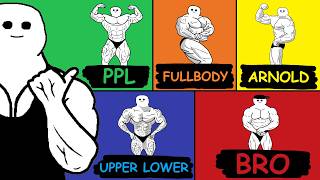
This video provides a concise overview of the five most common training splits — Push Pull Legs, Full Body, Arnold Split, Upper Lower, and Bro Split — detailing the muscles each targets, the pros and cons, and the ideal weekly frequency for each.
Training is organized into three movement patterns: pushing, pulling, and leg-focused movements. This makes training efficient, simple, and aids recovery.
Push day targets chest, shoulders (side delts), and triceps through presses and isolation exercises, working muscles that naturally cooperate.
On pull day, push muscles rest and recover because they aren't being trained directly, which is the main recovery benefit of the split.
Pull day trains back, biceps, and rear delts (not trained on push day). Typical exercises include pull-ups/lat pull-downs, rows, rear delt flys, face pulls, and curls.
Leg day targets quads, hamstrings, glutes, and calves. The classic combo is squats and leg extensions; add Romanian deadlifts, hamstring curls, hip thrusts, and calf raises.
Running PPL only three times a week doesn't hit each body part twice. The most popular version is 6 days a week, but it can be modified to 4–5 days to still achieve double frequency.
Full body training involves hitting all body parts each session. To keep it time-efficient, focus on main compound lifts and cut out fluff; it can be done just 3 days a week.
Full body is beginner-friendly, provides the perfect environment to learn basic lifts, and easily achieves twice-per-week frequency. Recovery is generally not an issue.
A classic bodybuilding split that separates chest/shoulders and back/biceps to avoid overlapping fatigue. It's very effective but usually requires 6 days to hit muscles twice; can be adjusted to 4 days.
Divides workouts into upper body and lower body days. The sweet spot is 4 days per week. Upper days are longer; balance by placing extra work like abs on lower days.
"The biggest problem with going to the gym isn't actually training there, it's getting there."
The bro split trains one body part per day, but muscles recover in ~48 hours. Waiting a week wastes growth time; it's not recommended. You could add a dedicated day for a lagging body part instead.
The video summarizes the main splits and encourages trying them (except bro split). Free plans are available via the link in the description.
What are the three movement categories in Push Pull Legs?
Pushing, pulling, and leg-focused movements.
00:02
Which muscles are trained on push day?
Chest, shoulders (side delts), and triceps.
00:14
Why are rear delts trained on pull day instead of push day?
Because they are heavily involved in back exercises, so training them on push day would interfere with recovery.
01:22
What are the main back exercises recommended for pull day?
Pull-up or lat pull-down and a rowing exercise.
01:47
What exercises are recommended for rear delts?
Rear delt fly, reverse pec deck, or face pull.
01:59
What is the classic quad combo on leg day?
Squats and leg extensions.
02:26
How does the full body split make hitting each muscle twice per week easy?
Because all body parts are trained in each workout, you only need 3 days per week to hit each muscle twice.
05:20
What is the secret to making a full body split time-efficient?
Use main compound lifts and cut out fluff.
04:38
What is the Arnold split?
A three-day bodybuilding split that trains chest and shoulders on different days, and back and biceps on different days, to avoid overlapping fatigue.
05:58
What is the sweet spot frequency for the upper lower split?
4 days per week.
08:02
What is the main problem with the bro split?
Training each body part only once per week wastes growth time because muscles recover in about 48 hours.
09:18
Movement Patterns Principle
Organizing training by push, pull, and legs provides a simple, efficient framework that naturally aligns with how muscles work together.
00:14Full Body Builds Fundamentals
The full body split is ideal for beginners because it strips training down to a few main lifts, creating a distraction-free environment to learn proper form.
05:33Avoiding Overlapping Fatigue
Separating chest/shoulders and back/biceps prevents one muscle from being pre-fatigued, allowing maximal effort in each session.
06:22Upper Lower Frequency Sweet Spot
Four days per week hits every muscle twice while keeping workouts long enough to be productive, striking the ideal balance for most lifters.
08:02Time Underutilization in Bro Split
The bro split's once-per-week frequency leaves muscles recovered but untrained for days, wasting potential growth opportunities.
09:19[00:02] is all about organizing your workouts based on movement patterns. Instead of just randomly grouping muscles, it divides training into three categories. You got your pushing movements, pulling movements, and leg focused movements.
[00:14] This makes training really efficient and helps you recover faster. And most importantly, it's really simple. The push day focuses on exercises that push the weight away from your body, obviously, which means your chest,
[00:27] shoulders, and triceps. So, this will mainly include various chest and shoulder presses and a lot of different isolation exercises. For the chest, that shoulders, that would be the side delt isolation, but not the rear delt
[00:40] isolation. But more on that in a second. And for the triceps, that includes lateral and long head isolation. All of these muscles naturally work together them in the same session makes a lot of sense and is a big reason behind why you
[00:55] Legs split. Because once you are done go do your pull day, all the pushing muscles can still be resting and recovering because you are not directly training them in any of the other days.
[01:08] And talking about the pull day, this is what you need to know. Pull day targets weight towards your body, which means the back and the biceps, but also the rear delts, which are not a part of the push days. You really need to keep that
[01:22] in mind. I know that it sounds a little illogical when the push day already reasons. The rear delts perfectly fit getting hit when you train the back. So, it would make no sense to train rear
[01:35] delts on your push days when they would get hit again on your pull days. That would kind of ruin the whole Push Pull Legs scheme that allows you to recover so well. These are the typical exercises you would use in a pull day. For the
[01:47] back, that is some variation of the pull-up or lat pull-down and a rowing exercise of your choice. Then, of course, you got the rear delts. Here, I would recommend exercises like the rear delt fly, reverse back deck, or the face
[01:59] pull. And the last piece of the pull day is biceps. Here you can really choose from a lot of exercises, but the main two exercises to include would be either the barbell, easy bar, or the dumbbell curl. And then one type of curl to
[02:11] brachioradialis, which could be the hammer curl or any curl with the overhand grip. Now for the leg day. Here your goal is to obviously target the quads, hamstrings, glutes, and calves. For the quads, the most used exercise is
[02:26] the squats together with leg extensions. That is the classic combo. For the exercise. So, something like the Romanian deadlift is perfect. Plus you combine this with the hamstring curl. That is the hamstring foundation. For
[02:39] to add anything if you don't want to. As some of the hip hinge exercises will hit your glutes a good amount. But if you really want to focus on your glutes, the hip thrust is a great choice in the
[02:52] place of a hip hinge exercise. And if you wanted, you could then add a glute isolation exercise like the glute kickbacks, for example. And for calves, variation of the calf raise that you like. The leg day might be the most
[03:05] physically demanding day of them all, just because the lower body compound lifts are really taxing. So, it's good to be mindful when constructing your yourself. To make sure that doesn't happen, you could grab the push pull
[03:18] legs on my website, which over the years has been crafted to perfection. Just you will like it. You can click the first link below to learn more. The push pull legs plate is also very flexible, where you have just three different
[03:31] workouts that you can pretty much schedule however you want. But there is only these three workouts per week will not allow you to hit each body part you really want to be in to build the
[03:44] most popular variation of the push pull legs is 6 days a week, where you get to hit this three day cycle twice per week. But, you know how it is. Not everyone can or should work out 6 days a week. So, there can definitely be made some
[03:59] modifications that will make you hit each body part twice per week in just four or five days instead of six. Like I do in my push pull legs, for example. to know about the push pull legs split. Full body. The full body training split
[04:12] is really as simple as it gets. You don't really have to think about the way you are going to separate muscle groups across different days. You just kind of the problem for most people. It It really gives you this overwhelming
[04:25] feeling. So, while it might seem rather straightforward to build your own full body training plan, you quickly come to a realization that it's really difficult to fit all the exercises into your plan without it taking 4 hours. The secret
[04:38] sauce to making the full body split manageable time-wise is to utilize the These are the classic compound lifts that you know very well, like the bench press, overhead press, squat, etc. But, when I talk about the main lifts, I
[04:52] don't mean just the classic compound lifts. I also mean exercises like the really want to focus on the most impactful exercises and just cut out the fluff, because time efficiency is really, really important when it comes
[05:06] to the full body training split. One of the biggest advantages of full body is push pull legs split. When doing full body, you can easily train just 3 days a week, because you hit all the body parts in each workout. So, the requirement
[05:20] each body part twice per week is very easily achievable. And if you wanted to definitely the best option. Plus, the full body split can be very beneficial for beginners, because when you strip it down just to the couple of main lifts,
[05:33] it provides the exact environment you need to learn all the basic exercises without any distractions. And if you are worried about the recovery aspect, because you hit all the body parts in each workout, you don't have to be. As
[05:45] feel more than ready for each workout, no matter how many times per week you train full body. And you already know where to find a plan like that. Arnold split. The Arnold split is a certified old school bodybuilding classic,
[05:58] popularized by the goat Arnold himself. It is designed to really bring out the best out of your upper body, because your chest and your shoulders are never trained on the same day. And you probably know how fried your shoulders
[06:10] or chest can feel if you train both of them in the same workout. It really just beats you up. But because the Arnold split is separated into these three days, everything has a complete freedom to breathe. Because the thing is, chest
[06:22] and shoulders overlap with each other, and back and biceps do the same exact thing. Where they are both taxing the same exact area that is being used by both of the body parts. So in the case of chest and shoulders, your shoulders
[06:35] really get completely fried. And in the case of back and biceps, the biceps gets put on a complete back burner, because all the back exercises takes your biceps a whole lot. So by the time you get to actually training the biceps itself,
[06:49] it's already pretty fatigued. But when you look at the Arnold split layout, you can see that both of these combinations are never trained on the same day. So you can really give it your best and transform into a beast. That is the main
[07:01] reason why this is my favorite split of all time. The layout is just so amazing. But the Arnold split has a similar problem to the push pull legs. Where to hit each body part twice per week, you need to run this three day layout twice
[07:13] per week. Ending up with six workouts per week. But thankfully, it's really easy to modify the Arnold split even into like a four day routine without making it any worse than the six day version. And that's pretty much the only
[07:25] issue with the Arnold split in my opinion, which is easily solvable. So I really can't recommend this split enough. It's just great. Upper lower. The upper lower split, as the name implies, is a training split that
[07:37] divides your workouts into two. In one workout, you only hit the upper body, and in the other, you only hit the lower body. If you don't like mixing upper should be for sure something you should look into. Plus, this setup really makes
[07:50] it almost foolproof, as it is really hard to mess up such a simple setup, because no matter how little experience you have, you know which part of your body is upper and which is lower. To hit each body part twice per week, you
[08:02] four times a week. There are some modifications that allow you to do less or more, but 4 days per week is really the sweet spot for the upper lower split. Really, the only thing that is not so great about the upper lower split
[08:15] is that the upper days take a longer time to complete than the lower body days. But, a good trick to solve this is to put all the extra stuff like ab or forearm training at the end of the lower body days, which will then make both of
[08:27] the upper and lower days roughly the same length. Overall, the upper lower split can be a great choice, especially if you like working out exactly 4 days per week. That's where it really shines. But, if you are someone who likes to
[08:39] work out six times a week, I would not really recommend this one, because when the upper lower layout gets spread across so many days, the workouts become very, very short, especially the lower days. And I think the biggest problem
[08:52] with going to the gym isn't actually training there, it's getting there. You you don't really want to go to the gym, but once you get there, everything is great. Bro split. The bro split, or in other words, the body part split, is a
[09:06] training style where you basically dedicate each workout to a single body part, which sounds pretty sick, but there is a lot of problems with this. If you train just one body part per workout, it will take you a very long
[09:18] time before you get to train it again. You know, there is a lot of body parts, and for example, training your chest just once per week is simply not enough. The chest will most likely fully recover like 48 hours after the workout, but
[09:31] because of how the bro split is laid out, you can't hit it again when it's ready. So, you just end up wasting a lot of growth time in the long run. Don't get me wrong, dedicating one workout to a single body part can feel absolutely
[09:43] amazing. Just imagine a workout where you only hit arms. Sounds like a dream. But, because of what I outlined earlier, this is not really usable if you are makes you think how you could adjust the
[09:56] bro split to be usable. But, the issue is is that after all the adjustments you make, you end up with a completely different split. I know this very well because this is the exact thought process I went through in the past. So,
[10:08] it's just better to stay away from the bro split because the problems it has are very much unfixable. And if you really like that workout day where you only train that one specific body part, just create a designated day for that
[10:20] body part and slide it into your existing training plan. That can be a good way of improving the body part that is lacking the most in your physique or that you would just like to improve even more. And that's every training split
[10:32] explained. If you would like to try any of them, except the bro split because we below and check it out. Thanks for watching and I will see you next time. If you like this video, then you will surely like this one, too.




⚡ Saved you 0h 10m reading this? Transcribe any YouTube video for free — no signup needed.