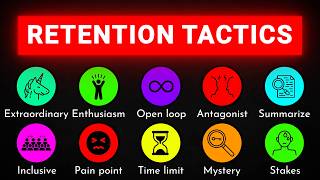

Put the Best Part First (Mr. Beast)
49sShows the most effective hook technique by proving the video is special immediately, a tactic used by top creators.
▶ Play Clip"The title accurately describes the content: the video explains 18 retention tactics with clear examples from popular creators."
The video explains 18 proven audience retention tactics used by top creators like Mr. Beast, Vsauce, and Mark Rober. Each tactic is illustrated with concrete examples, showing how to keep viewers watching from start to finish. The core message is that retention is about maintaining curiosity and proving value throughout the video.
Put the most extraordinary part of your video at the very beginning to prove it's special before viewers click off.
Infectious enthusiasm builds trust and curiosity, making viewers believe the creator has something genuinely special to share.
Never let the viewer feel they know enough; maintain constant clarity about what they'll miss out on if they stop watching.
Introduce an antagonist to create a constant threat of failure and ongoing dramatic conflict.
Make low-conflict parts of the story go by quickly to keep the video exciting.
Ask the most broadly appealing question to hook a wide audience.
Bring up a common pain point before solving it with a lesson to make viewers care.
Introduce a time limit to create urgency and a threat of failure.
Develop a mystery to cause curiosity; give viewers unanswered questions if they leave early.
Share the stakes of something to increase drama and make the audience care about the outcome.
If things get stale, introduce a new challenge to beat.
Enhance natural emotional variations through music, clip duration, and sound design.
Have a clear goal and maintain progressive steps towards it.
Share what might go wrong to create dramatic suspense and curiosity.
Maintain perfect clarity so the audience stays immersed and never gets confused.
Introduce competition to cause drama, curiosity, and excitement.
Highlight something counterintuitive or surprising to spark curiosity.
Create a highlight reel of the best moments to package the story as an emotional roller coaster.
What is the first retention tactic mentioned?
Put the most extraordinary thing of your video as close to the start as possible.
How does enthusiasm help with audience retention?
Infectious enthusiasm from the creator builds trust and curiosity.
1:09
What is the core principle behind tactic #3?
Never let the viewer feel like they know enough about a subject; maintain constant clarity about what they'll miss out on.
2:21
How does introducing an antagonist help retention?
Introduce an antagonist to create a constant threat of failure and ongoing dramatic conflict.
3:24
What should you do with low-conflict parts of a story?
Make the parts of the story that lack conflict go by as quickly as possible.
4:15
What kind of question should you ask at the start of a video?
Ask the most broadly appealing question that's on everyone's minds.
5:04
What is tactic #7?
Bring up a common pain point before solving it with a lesson.
5:52
How does a time limit affect viewer engagement?
Introduce a time limit to cause urgency and a threat of failure.
6:54
What is the purpose of introducing a mystery?
Develop a mystery to cause curiosity; give viewers unanswered questions if they leave early.
7:44
Why should you share stakes in a video?
Share the stakes of something to increase drama and make the audience care.
8:57
What should you do if the video starts to feel stale?
Introduce a new challenge to beat if things ever get stale.
9:56
How should you use music and editing to improve retention?
Pay attention to natural variations in tone and enhance them through editing choices like music, clip duration, and sound design.
10:34
What is tactic #13?
Have something to look forward to and maintain clear progression towards it.
11:35
How does sharing potential failures help retention?
Share what might go wrong to cause dramatic suspense and curiosity.
12:25
Why is clarity important for audience retention?
Maintain perfect clarity for what's happening so the audience always stays immersed.
13:29
Lead with the Extraordinary
This is the foundational tactic that sets the tone for the entire video, proving value immediately.
Maintain Curiosity
The core principle of retention is making viewers feel they'll miss out if they stop watching.
2:21Introduce an Antagonist
Adding conflict creates drama and a reason for the audience to root for the protagonist.
3:24Use Time Limits
Time limits are a simple but powerful way to add urgency and turn boring tasks into thrilling challenges.
6:54Enhance Emotions with Editing
Music and editing choices can dramatically amplify the emotional impact of a scene.
10:34[00:00] Put the most extraordinary thing of your
[00:02] video as close to the start as possible
[00:05] to prove that your video is special
[00:07] before anyone even thinks to click off.
[00:09] Here, check out this classic Mr. Beast
[00:11] intro.
[00:13] >> WOULD YOU RISK PARTY LIFE FOR HALF A
[00:15] MILLION DOLLARS?
[00:16] >> YES, THANKS.
[00:17] >> OKAY, GOOD LUCK, MAN. YOU'RE BRAVER.
[00:18] >> What's happening in this intro is the
[00:21] definition of extraordinary. Most
[00:23] creators save the best thing of their
[00:25] video for last, saying in their intro,
[00:28] "Watch to the end to see X," and then
[00:30] only like 20% of viewers actually make
[00:32] it to the end. But tell me, what's a
[00:34] better hook? A promise that your video
[00:36] is special, or proof that your video is
[00:39] special? You see, you always want to
[00:41] grab attention with the most
[00:43] attentiongrabbing thing you can offer to
[00:46] prove that your video is worth people's
[00:49] time. Now, there's 17 more tactics to
[00:51] get your audience to watch your videos
[00:52] to the end. If you've been wondering
[00:54] what it's going to take to get your next
[00:56] video to finally take off, then you need
[00:58] to know all of these, or else your
[01:00] audience retention is going to suck. You
[01:02] see, the best creators have mastered all
[01:03] of these tactics, and in the next 15
[01:06] minutes or so, you're going to know them
[01:07] all, too. Number two, have infectious
[01:10] enthusiasm. Pay really close attention
[01:12] to how this creator, Vsauce, speaks in
[01:14] his videos.
[01:16] >> Hey, Vsauce, Michael here. A single
[01:19] piece of refined flour is on average
[01:21] just 82.67 microns wide. That means a
[01:25] five pound bag.
[01:26] >> The raw enthusiasm of the creator
[01:29] convinces you that the creator must have
[01:31] something genuinely special to share. So
[01:34] you're curious and you're excited to
[01:36] hear it. And even if you're a creator
[01:37] that no one's heard of before,
[01:39] enthusiasm causes a ton of trust.
[01:42] >> How to make pickle Pepsi at home. Guess
[01:47] how many views that video has? It has 8
[01:50] million views. And that's largely
[01:52] because the creator's enthusiasm
[01:55] convinces people that he must have
[01:57] something worth sharing. By the way, I'm
[01:59] not expecting you to somehow remember
[02:01] each and every one of these tactics and
[02:03] somehow apply all of them perfectly to
[02:05] your next video. So, what I made is an
[02:07] infographic that you can print out and
[02:08] then it's just got the summary of each
[02:10] of these tactics. And then I've also put
[02:11] together some advice on there for how to
[02:13] study these further and then once you
[02:15] get to work on your video, how to apply
[02:17] them accurately. So I put a link to how
[02:18] to get that in the pinned comment or
[02:20] first link in the description. Anyway,
[02:22] on to the next tactic. Number three,
[02:24] never let the viewer feel like they know
[02:26] enough about a subject. I'm going to use
[02:28] an example from one of my videos. So I
[02:30] want you to see how before I begin
[02:32] explaining something, I first tell the
[02:35] viewer what they're missing by not
[02:36] knowing it. Look at this timeline. We've
[02:39] been talking about all these ways to
[02:41] make the video visually addicting to
[02:43] watch, but we've been leaving out the
[02:46] other half of the video. There is a
[02:48] whole another sense for your viewer to
[02:50] experience the video in. You see,
[02:52] audience retention can really be broken
[02:54] down into just one sentence. Maintain
[02:57] constant clarity in the viewer's mind as
[03:00] to what they'll miss out on if they stop
[03:02] watching. To drive this home, here's one
[03:04] more example. You can pause and read it
[03:06] if you want to, but what I'm focused on
[03:08] is the cadence at which Vsauce is
[03:11] sharing a fun fact, then asking a
[03:13] question, then sharing the next fun
[03:15] fact. Because he keeps asking you these
[03:17] really thoughtprovoking questions, you
[03:20] never feel like you know enough about
[03:22] the subject. Number four, introduce an
[03:24] antagonist to the story to create a
[03:27] constant threat of failure and ongoing
[03:29] dramatic conflict. Now, Dreams Minecraft
[03:32] Manhunts are the absolute perfect
[03:34] example of this. This video, I try and
[03:37] speedrun and beat Minecraft while two of
[03:39] my friends try and stop me. Last video,
[03:41] I beat one hunter easily. Now, I move on
[03:43] to phase two.
[03:44] >> By trying to reach a goal, beating
[03:46] Minecraft while people are hunting you
[03:48] down to try and stop you. So many boxes
[03:51] of entertainment are checked off.
[03:53] There's an underdog to root for, the
[03:56] thrill of competition, a series of
[03:59] imposing challenges to get the audience
[04:01] worried only for the protagonist to
[04:03] creatively conquer them in novel awesome
[04:06] ways. You see, I can't wait to do an
[04:07] analysis of a full dream Minecraft
[04:09] manhunt video. So, go ahead and
[04:12] subscribe if you're excited to see that
[04:13] as well. Number five, make the parts of
[04:15] the story that lack conflict go by as
[04:18] quickly as possible. Here's Mark Robbert
[04:20] doing this in a video of him building a
[04:23] maze for squirrels.
[04:25] >> After a year of ruminating on how to
[04:27] avenge that L with a majorly improved
[04:29] version and then two months of planning,
[04:32] my buddy John and I got together for a
[04:34] 20 second build montage.
[04:37] Now, even though a very significant
[04:39] duration of the story was that planning
[04:42] and building phase of the backyard maze,
[04:44] Mark Robber summarized all of that into
[04:47] just 30 seconds. so that way the video
[04:50] could get to the exciting part as soon
[04:52] as possible. Now, this next tactic is
[04:54] honestly pretty hard to spot. So, I want
[04:56] to first show you the example just so
[04:58] you can see how hidden in plain sight it
[05:00] is. So, watch this really closely and
[05:02] tell me what specifically is smart about
[05:04] the question that Marcus asks at the
[05:07] start of this video's intro.
[05:10] All right, so you've seen the unboxing.
[05:13] Now, it's time for the breakdown. What
[05:15] is using the Apple Vision Pro actually
[05:19] like? Marcus begins the video by asking
[05:21] the question that's on everyone's minds.
[05:24] You see, later in the intro, he lists
[05:26] the fascinating facts about the Apple
[05:28] Vision Pro as well as promising there's
[05:30] both details that are absolutely
[05:32] incredible and also some bad stuff. And
[05:35] all of that is just to get us more
[05:36] interested in the Vision Pro. But to
[05:39] begin the discussion, he asked the most
[05:43] broadly appealing question. What is
[05:45] using the Apple Vision Pro actually
[05:49] like?
[05:49] >> Number seven, bring up a common pain
[05:52] point before solving it with a lesson.
[05:54] Check out how in this intro, Johnny
[05:56] Harris says to you, "I understand your
[05:58] problem.
[05:59] >> How to buy the best maps in 2025. You're
[06:02] doing it wrong. You're still using this
[06:04] to navigate life. Embarrassing.
[06:09] I'm so bored right now and I truly hate
[06:12] the way it feels. You're probably bored,
[06:14] too. You clicked on this video trying to
[06:16] feel less bored and all you've got is a
[06:18] guy scrolling on his phone alone in a
[06:20] room here. Let me see if I can help with
[06:23] that.
[06:25] Is this better?
[06:27] Good. It's not just you and me. It's
[06:29] everyone. Now, you can do this whether
[06:31] it's the intro or later in the video.
[06:34] You want to look for those common
[06:36] problems that people have and then prove
[06:39] that you understand them. This causes as
[06:42] many people as possible to care as much
[06:44] as possible about what you have to say,
[06:46] which is exactly what you want. So, do
[06:48] this throughout your video as well as
[06:50] just in the intro. Just whenever you see
[06:52] an opportunity to do it. Number eight,
[06:54] introduce a time limit to cause urgency
[06:57] and a threat of failure, which makes
[06:59] things much more thrilling and dramatic.
[07:02] Mr. Beast does this all the time because
[07:05] it's just so powerful. Here's an example
[07:07] of a time limit.
[07:08] >> What do you think we're about to do?
[07:09] >> Blow up this money if I don't get
[07:10] something accomplished here in a fast
[07:12] amount of time.
[07:13] >> Correct. Basically, you will have
[07:15] exactly 5 minutes to throw this
[07:17] grappling hook
[07:18] >> and drag as many bags of money as you
[07:21] can back onto the bed of this truck.
[07:24] WHEN THAT 5MINUT timer hits zero,
[07:27] that meteor, which will be on fire, is
[07:30] going to crash into this room full of
[07:32] fireworks with your money. Adding a time
[07:34] limit is one of the easiest ways to turn
[07:37] some boring video of you just doing
[07:39] something into some thrilling challenge
[07:42] for you to defeat. Number nine, develop
[07:44] a mystery to cause curiosity. In a video
[07:47] that Ryan Tran made about exploring a
[07:49] cruise ship, at around 3 minutes 45
[07:52] seconds, he introduces this mysterious
[07:55] room, but he doesn't show us what it is.
[07:58] Check this out. And on my way to it, I
[08:01] stumbled across something weird. What
[08:04] room is that?
[08:07] Why are there giant paw prints? Is there
[08:10] a dog in there?
[08:11] >> And then look, he brings it up again 6
[08:13] minutes later.
[08:21] This gives the viewers something to
[08:23] wonder about. So, if they left your
[08:24] video early, they'd have unanswered
[08:27] questions. And look, here's how you can
[08:29] use this tactic in your intros to create
[08:31] highly captivating hooks. Look at how
[08:33] Mark Robber introduces a mystery at the
[08:35] start of his video.
[08:38] I texted this clip to my wife, who
[08:39] wanted proof I wasn't doing anything
[08:41] stupid on a recent trip to the Bahamas.
[08:43] Now, if you're wondering what my feet
[08:44] are doing in sharkinfested waters with a
[08:46] bucket of blood.
[08:48] >> Yeah, those are literally the most
[08:49] intriguing exceptional details he
[08:51] possibly could have brought up, and he
[08:53] did that right at the start of the
[08:54] video. Number 10, share the stakes of
[08:57] something to increase the drama. Check
[08:59] this out.
[09:00] >> But first, why are you trying so hard to
[09:03] land in the fire and add an extra
[09:05] $50,000 to your prize pool?
[09:07] >> My dad's health has been an up and down
[09:09] roller coaster from some cancer to
[09:11] health stuff. this is something that I
[09:13] can use to really invest into giving
[09:15] them a good retirement and helping with
[09:16] their health.
[09:17] >> Mr. Beast not only puts hundreds of
[09:20] thousands of dollars at stake, but tends
[09:22] to ask his contestants to share why it's
[09:24] important for them specifically to win.
[09:26] This makes the audience actually care
[09:28] about what happens. But now, you don't
[09:31] need to put a bunch of money on the line
[09:33] to have stakes in your video. Look at
[09:35] how Ryan adds stakes to this video.
[09:38] >> I bet you can't last a few hours in one
[09:40] of these. Okay, he might be right, but
[09:43] I'm too insecure to accept that. So, I
[09:45] bet him that I could. And whoever loses
[09:47] the bet has to paint themselves green
[09:49] and say in front of all of you,
[09:50] >> "What are you doing in my swamp on
[09:53] camera?"
[09:54] >> Number 11. If things ever get stale,
[09:56] just introduce a new challenge to beat.
[09:58] On that same video of Ryan exploring a
[10:00] cruise ship, he does this at 8 minutes
[10:02] and 45 seconds. Today might have been
[10:06] the best day ever. I made three new
[10:08] friends, Lily, Aaron, and Lorie. It's
[10:11] very likely that none of them know each
[10:12] other, which makes me the nucleus of our
[10:14] little community. If I can take this
[10:16] nucleus of myself and build up enough of
[10:19] a community on this cruise ship, I can
[10:21] throw the coolest party of all time. In
[10:23] addition to exploring an awesome cruise
[10:25] ship, there's now a somewhat challenging
[10:27] objective, giving the audience more to
[10:29] look forward to and also something that
[10:31] could fail. Number 12, pay attention to
[10:34] the natural variations in tone within
[10:37] the underlying content of your video.
[10:40] and then enhance those emotions through
[10:42] editing choices such as the music
[10:44] choice, clip duration, and sound design
[10:46] here. The music choice in this dream
[10:48] video was excellent. Check it out.
[10:58] >> Wait, what?
[10:59] >> Stop.
[11:00] >> George, where are you? George, where are
[11:01] you? Why are you useless? Like, I
[11:02] actually hate
[11:03] >> But this is not just a strategy for
[11:05] storytellers. Look how Vsauce does this
[11:08] in a video that's just about explaining
[11:10] stuff.
[11:10] >> But out of all of these people, out of
[11:12] everyone who has ever existed, this is
[11:15] how many you will ever meet. You are a
[11:19] stranger to your own species. This is a
[11:22] video about how you will be forgotten.
[11:24] >> In both of these examples, the creator
[11:26] switched which music track was playing
[11:28] so that at all times the music was
[11:30] perfectly representing the mood of that
[11:32] moment. Number 13, have something to
[11:35] look forward to and maintain clear
[11:37] progression towards it. Look how Ryan
[11:40] does this in his video about exploring a
[11:42] cruise ship where I boarded and made my
[11:45] way to the cheapest room on this entire
[11:47] boat.
[11:53] Wa.
[11:59] So, this is the economy room on this
[12:01] cruise ship, which is crazy. Brian
[12:03] begins the video with the lamest part of
[12:05] the cruise and explores progressively
[12:08] more awesome rooms. Now, you could also
[12:10] do a top 10 or make the challenge
[12:13] increase in difficulty, like in Mr.
[12:15] Beast's Last to Leave the Circle videos,
[12:17] or in general, just have a clear goal
[12:20] that the video is working towards.
[12:22] Number 14, share what might go wrong to
[12:25] cause dramatic suspense and curiosity.
[12:27] Check out how Mr. Beast does this.
[12:30] >> Pull the pin.
[12:32] >> OH.
[12:32] >> OH.
[12:34] >> OH GOD. HE MISSED. WE ARE CLOSE.
[12:36] >> He landed in between the yellow circle
[12:38] and the ring of fire. Meaning if that
[12:40] was you, the video wouldn't be over and
[12:42] you would have got nothing.
[12:44] >> Yeah.
[12:44] >> Jimmy steps in to clarify what might go
[12:46] wrong and also the stakes. And then
[12:48] here's another example at 10 minutes 41.
[12:51] >> Those aren't real fireworks. They're not
[12:53] a problem. When that meteor falls, the
[12:55] explosions going to be insane. I'm kind
[12:56] of scared. And here's an example of Ryan
[12:58] Tran doing this.
[13:00] >> Good sailing weather.
[13:02] >> Love to hear that the Icelandic ocean is
[13:04] literally freezing and I also can't
[13:06] swim. So they give us this life vest
[13:08] that gives you
[13:09] >> 1 hour to live in the winter time.
[13:12] >> So you always want to tell the viewer
[13:14] what would happen if things failed and
[13:17] tell them all the reasons that things
[13:19] could fail. This maximizes the
[13:21] uncertainty and fear of the audience,
[13:24] getting your viewers on the tips of
[13:25] their seats. Number 15, maintain perfect
[13:29] clarity for what's happening so the
[13:31] audience always stays immersed rather
[13:33] than sometimes getting confused. For
[13:36] example, in Ryan Trey's video about
[13:38] sensory deprivation, he steps in to add
[13:41] some extra context. Check it out.
[13:44] >> The duck woke me up and now it's time to
[13:45] turn off the lights. the light.
[13:54] >> Turning off the lights added a
[13:56] completely new element to this that I
[13:58] genuinely didn't expect to be that
[13:59] dramatic, but it was. Notice how he
[14:01] added a voice over to clarify where we
[14:04] are at in the story and spark up some
[14:06] curiosity at the same time. And now,
[14:08] what other retention tactic was in that
[14:10] clip that we were just talking about
[14:11] like a minute ago? He's progressively
[14:14] eliminating more senses. So, the video
[14:17] is constantly getting more interesting.
[14:20] Number 16, introduce competition to
[14:23] cause drama, curiosity, and excitement.
[14:26] Mr. Beast often uses this because
[14:29] competition between people or sports
[14:31] teams or anything is just fundamentally
[14:34] entertaining.
[14:37] >> Oh, he almost got out of the first one.
[14:40] Okay, they're off. So far, no one is
[14:42] out. We are going until only one
[14:44] remains. THIS IS GOING TO GET US ONE
[14:46] STEP CLOSER TO THE FINAL FOUR.
[14:48] >> You can easily add a competitive element
[14:50] to just about anything. Look how Joshua
[14:53] Weissman made food compete with food.
[14:55] >> So, today we're going to make Taste and
[14:57] Rank the most popular breakfast in every
[14:59] single state in America.
[15:01] >> In both examples, you're curious who or
[15:04] what wins, and there's a dramatic
[15:06] conflict to drive the scenes forward.
[15:08] Number 17, highlight something
[15:11] counterintuitive or surprising to cause
[15:13] curiosity. Here's Vsauce doing this in
[15:16] one of his intros.
[15:18] >> But it made me think, we can send
[15:20] satellites into orbit and people to the
[15:22] moon and predict solar eclipses
[15:25] thousands of years into the future, but
[15:28] yet we cannot reliably predict which way
[15:31] the wind will be blowing in the next
[15:33] hour or so. As a creator, it's your job
[15:37] to seek out these counterintuitive,
[15:39] surprising, and unexpected things. Why?
[15:42] because those things always warrant an
[15:44] explanation. Content is much like a
[15:47] conversation with a viewer, and the best
[15:50] conversation starters are the ones that
[15:52] get people curious. Number 18, create a
[15:55] highlight reel of the best moments of
[15:58] the story or the best information that
[16:00] you have to share. This one,
[16:01] unfortunately, can't be shown in a short
[16:04] clip, but this video was an excellent
[16:07] example.
[16:08] before launching myself off the top rope
[16:10] at Wrestlemania
[16:13] and securing the first win of my career.
[16:17] You might have seen the card I was
[16:19] wearing around my neck. The story itself
[16:21] spanned months and multiple countries,
[16:23] yet was neatly packaged in a 9-minute
[16:27] emotional roller coaster ride. But it
[16:29] doesn't take a big budget to go viral.
[16:31] Look at how I Did a Thing got even more
[16:34] views than Logan by just creating a
[16:36] wooden spoon. He also turned a big
[16:38] project with setbacks and victories and
[16:40] funny moments into a 9-minute emotional
[16:43] roller coaster ride. And which tactics
[16:44] can you already see present in this
[16:46] video before you even watch it? Pause
[16:49] the video right now and count them up.
[16:50] So, first, there's a goal to beat a
[16:52] challenge for the video to maintain that
[16:55] constant clear progression towards. And
[16:58] also, the challenge is something
[17:00] unexpected. It it creates the question,
[17:02] is this even possible? This video didn't
[17:04] take a big budget at all. It was just
[17:07] about finding clever ideas to apply the
[17:09] retention tactics that got it to 13
[17:12] million views. And so I hope these
[17:13] tactics helped out a lot. And then if
[17:15] you want some more help getting them
[17:17] just remembering all of them and being
[17:18] able to apply them to your videos, then
[17:20] I made that infographic for you. You can
[17:22] sign up to uh my email list for free and
[17:24] then get that graphic. And then I'm
[17:26] starting a newsletter for just some more
[17:28] advanced advice and stuff for for
[17:30] growing your channel. So if you want
[17:31] some more free tips, then sign up for
[17:33] that. And then I need your help for just
[17:35] knowing what you want help learning. So
[17:38] if you sign up to the newsletter, then
[17:39] you can just reply to the emails I send
[17:41] to you and ask for more stuff that you
[17:45] want to learn about. And then I can be
[17:46] much more consistent with giving lessons
[17:48] over email. So sign up for that. And
[17:50] then if you haven't seen the clickbait
[17:51] version of this video where I talk about
[17:53] the click-through rate tactics, then go
[17:55] ahead and click here and you can see all
[17:57] I think there's 25 or 26 clickbait
[17:59] tactics. So go check that out.
⚡ Saved you 0h 18m reading this? Transcribe any YouTube video for free — no signup needed.