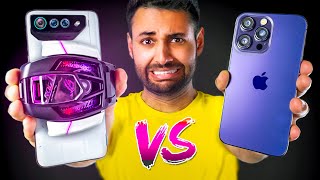

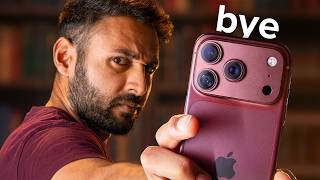
Fastest Android EVER vs iPhone!
45sThe dramatic comparison between the extreme ROG Phone 7 Ultimate and iPhone immediately grabs attention with a spoiler about a 3am battery test.
▶ Play Clip"The title accurately reflects the comparison, though the conclusion favors the iPhone for ecosystem users."
The ROG Phone 7 Ultimate, priced at $1,400, is the fastest and most extreme Android phone, but does it beat the iPhone? This video compares the two across multiple categories including unboxing, audio, battery, charging, camera, Wi-Fi, display, and performance.
The ROG Phone 7 Ultimate is the fastest, most extreme Android phone. The video tests if it beats the iPhone.
The ROG Phone's battery lasted 12 hours 18 minutes, while the iPhone lasted 9 hours 13 minutes.
The ROG Phone comes with a magnetic strap that doubles as a dock for an AR game, a case, charging brick, USB-C cable, and the AeroActive Cooler 7.
The ROG Phone has superior speakers with a subwoofer in the cooler, providing louder and richer sound than the iPhone.
The ROG Phone lasted 12 hours 18 minutes vs iPhone's 9 hours 13 minutes in a mixed usage test.
The ROG Phone charged fully in 1 hour 7 minutes (65W), while the iPhone took longer even with a 27W charger.
The iPhone excels in intelligent processing, face detection, and video quality, while the ROG has natural background blur and 4K slow motion.
The ROG Phone had higher peak speeds but the iPhone was more consistent; overall a draw.
The ROG has a 165Hz display, but the iPhone has higher peak brightness, LTPO for better battery, and symmetrical bezels.
The ROG leads in GPU and overall benchmarks, but the iPhone leads in CPU. Real-world gaming performance is similar.
The ROG Phone 7 Ultimate is an excellent phone for Android users, but not enough to warrant switching ecosystems from iPhone.
What is the battery capacity of the ROG Phone 7 Ultimate?
6000mAh (two 3000mAh batteries).
04:01
How long did the ROG Phone last in the battery test?
12 hours and 18 minutes.
03:49
How long did the iPhone 14 Pro Max last in the same battery test?
9 hours and 13 minutes.
03:36
What is the maximum charging power of the ROG Phone 7 Ultimate?
65 watts.
04:25
What is the maximum charging power of the iPhone 14 Pro Max?
27 watts (with a separately purchased charger).
04:37
How long does it take to fully charge the ROG Phone?
1 hour and 7 minutes.
05:23
What is the refresh rate of the ROG Phone 7 Ultimate display?
165Hz.
08:01
What is the peak brightness of the iPhone 14 Pro Max display?
2000 nits.
08:40
Which phone has a better CPU according to Geekbench?
The iPhone 14 Pro Max.
10:55
Which phone has a better GPU according to GFX Bench?
The ROG Phone 7 Ultimate.
10:29
Audio Showdown
The ROG Phone's speakers are dramatically louder and richer than the iPhone's, surprising the reviewer.
01:39Battery Marathon
The ROG Phone lasted over 12 hours, forcing the reviewer to stay up until 3am to finish the test.
03:49Gaming Reality Check
Despite the ROG Phone's gaming-focused design, real-world gaming performance is similar to the iPhone.
12:43[00:00] This is the brand new ROG Phone 7 Ultimate. $1,400 is the fastest most extreme Android phone to ever exist by a mile, and does it beat the iPhone? Is it binary time for me and other iPhone users to jump switch to Android?
[00:13] Spoiler alert, this is me getting into bed at 3am last night, because one of these phone's batteries would not die during my battery turn. So, starting with the unboxing experience, I can say with a high degree of confidence so far, yes. The phone can package in what looks like an interplanetary Ultra X.
[00:27] This magnetic strap, by the way, is also a dock for the phone that launches an augmented reality video game, which is shockingly well fleshed out for what's basically just a party trick. I mean, these things are actual buttons that control your phone's package.
[00:39] You can use control. There's an insert, there's a case inside of it. It's all designed, but there's shockingly literal material here, considering the beefy size of the phone. You've got the charging brick, the USB-C table, a very sizable pouch, don't even think about it, editors. And that's made to carry the single most ridiculous phone accessory you've ever seen, the Aerolacted Cooler 7.
[00:56] ...and it's the phone. Which, in the case of Skimpy, kind of looks like you've just flipped the bodybuilder into a machine. Now compare that to the unboxing phone into the iPhone 14 Pro Max. I guess, saving on minimalism? But yeah, this point clearly goes to the ROG.
[01:10] Eight more tests to go, let's see if the most extreme flagship phone on the planet can be the most popular flagship phone on the planet. Then we've got audio. In general, I think people are impressed with the speaker quality on the new iPhone. No one can argue that this is almost one of the best sounding phones on the market,
[01:24] on the market, with a pretty powerful combination of its Boston firing speaker and its D-Acee speaker on the front. But, erm, this is something else entirely. Last year's RG Phone 6 already had the best phone speakers on the market, and they say they've now given the speaking unit even more room to be able to move,
[01:39] and therefore push more air, which could result in a convenient sound. Oh wow, okay. Instantly. You should probably hear this, all the way down the box. Wow. This is insane how much better that is in the iPhone.
[01:52] It's louder, the bass is thumping, and the position of the speakers makes it feel like the sound's being fired directly into my ears. So then it just gets really good when you use this. So this R&D company for making coolers like this for generations now, and every time they release a new one, they add a key new key to do it.
[02:08] So at this point, we've got a kickstand, a headphone jack, physical buttons, LED, a portal that opens up on the phone to allow it to pump air directly over the chip itself. But this time round, it's also a subwoofer. Or in other words, a third speaker designed specifically with the base.
[02:22] So just by locking your chin like this, it's adding a whole other layer of warmth and richness to the track. I don't know what else to say. Second point also goes to the ROG. So okay, fine.
[02:34] The unboxing experience, the audio experience, you could say they're still niche features. So, let's test what's arguably the most core fundamental phone feature for all of us. The battery. So, we'll get both phones side by side. These are brand new versions of each phone, by the way,
[02:48] just to make sure they have 100% battery health. I've equalized brightness and put seeker volume at 50%, so we'll see who wins. The plan is we're running great YouTube videos for the first couple of hours. Okay, wow. The iPhone is actually a reasonable amount ahead.
[03:00] Possibly because its display can automatically reduce its refresh rate to lower than the ROG phone can when not needed, since it needs batteries. I also reckon, though, at least some part of this is the fact that Apple's battery indicator does not tell you the truth.
[03:13] I'm pretty sure that iPhones hang on the first few percentage points just to reassure the user that their phones aren't dropping as soon as they've taken out of charge. So now, social media. We do Instagram and TikTok for another couple of hours And after that you can start to see the ROG falling ahead But what really really gonna separate the men from the boys is some proper gaming So we run some Genshin Impact from Doom and just basically keep these games on until the phone calls quick
[03:36] Which, in the live-in case, gives us a total time of 9 hours and 13 minutes. I would say that is towards the upper end of modern Blackface. But it's just not the day. Meanwhile, the ROG is still going. It's still up 37%, for goodness sake.
[03:49] But slowly, surely, if we push it hard enough, it too eventually dies. But it took 12 hours and 18 minutes to get there. Which frankly, is insane. Yes, I threw it around for 12 hours to get this result.
[04:01] So you know, subscribe to appreciate it. We won't regret it. And then you're half surprised by the result. I mean, this thing does have two separate 3000mAh batteries inside it.
[04:13] So, 6000mAh total, which is a lot more than this guy. It's just that, because it's actually the lighter tone between two, You forget how much is in there. But then I was like, well, the phones are down here anyway. They're both at 0% right now.
[04:25] We might as well also test how fast they can charge. Can you see why I ended up sleeping at 3am now? So, a plug-boat in, using the original charging bricks and cables provided with them, which gives the ROG up to 65 watts of power. And the iPhone...
[04:37] Well, technically 0 watts. It doesn't come with a charger. But assuming you'll pay the extra $40 to get the plastic possible charging, this brick can deliver 27 watts of power to an iPhone 14th home. The iPhone is definitely off to a fast start, which might sound strange, but it's not actually unheard of.
[04:53] Because that wattage figure, it doesn't tell you the full story. Because the number only tells you the maximum charging power the phone can reach, not the power that it seeks sustaining the charge at. So anyway, as soon as the ROG phone kicks into gear, it very quickly equalizes,
[05:06] even right to yoga taking after just 10 minutes. And something to think about is that the iPhone also has a far smaller battery capacity too, 4,300 mAh versus 6,000. So there's just less to fill up. And so the fact that it's even close, it sends a very clear message that charging feed is not one of Apple's sorting.
[05:23] And yet, if you look at the final time for the complete charge, the ROG phone flips in at 1 hour 7 minutes. While the iPhone still has a way to go. So, that's another point for the ROG. Now, you might all be thinking, well, of course the ROG phone wins all of this.
[05:35] It's a $1,400 phone. But, this thing comes with 512 gigabytes of storage by default. And if you go to 512 gigabytes on the iPhone, it's the same price as this in the US. and actually the much more expensive phone basically everywhere else.
[05:48] But surely, surely the iPhone wins in the camera department, right? The camera's one of the reasons to buy an iPhone. Well, both phones have one camera on the front, and then a triple camera on the back. And, there's probably not as much in it as you might expect.
[06:02] The ROG has more natural background blur when you're taking selfies. It's just the sharp and 98% situations extremely good at those difficult dynamic range situations. Arguably best on the iPhone. Lots of mention that it has the power to shoot full 4K slow motion,
[06:15] which is far beyond the 1080p that Apple can do. But what the iPhone does pull ahead is intelligent. It's the way it identifies and treats faces so that they're the center of attention. The way it uses all of its sensors to focus on subjects instantly,
[06:27] even for finicky, difficult objects that most phones would struggle with. Plus, just generally, the video. Video requires far more advanced processing to be able to pull off well than a centric photo. And this is where the years that Apple has spent refining really hit off.
[06:40] So that brings the score to 4-1. One thing that I think will be a really interesting experiment between you two is Wi-Fi speed. Because on one hand most of what the average user does on their phone is internet and so you can expect the most popular flagship phone to have that internet aspect completely nailed down But then again this thing is all about shaping off millions of lags when you playing online competitive games
[07:01] So, who actually wins? Let's start with the iPhone, we'll do Google's computer. Wow, okay. Probably shabby considering we're tucked into an attic. And just over 40 megabits up, I'm going to see a G-Found.
[07:13] Ooh. So that was an absolutely enormous drop-off. That's really, really slow in comparison. just to see if I could get a result that felt a little bit more reliable, and also ran the test 10 more times in a controlled environment,
[07:25] but there were actually no consistent ones. The IoT seems to have higher peak speeds, but the iPhone seems to have more consistency, especially when it comes to upload, but there's enough daily news to them that I'd say, call this one a draw.
[07:37] But what's even more important than a bit of slightly reduced latency here and there, is how good everything actually looks on these screens. So they're very key displays. The IoT is actually even slightly larger, but you probably wouldn't notice without a side-by-side,
[07:49] And they're both better in their own ways. So the RG is technically a faster display. You know our phones have been dialing up from standard 60Hz to 90Hz and to now the 120Hz displays that we see on pretty much every 2023 flagship.
[08:01] Well, it's been under 165Hz display. Proportionally, that should be nearly as big as a jump between 60Hz and a 90Hz display, which was huge. And yet, if you scroll your homepages and record using a slow-mo camera, you will absolutely notice the difference.
[08:15] But, my eyes are traveling too. It feels like one of those 50% more effort for 5% more gain type of situations. And to be honest, I think at this point what makes more of a difference is the quality of animation, which Apple really does have nailed down.
[08:28] The RNG does also have a second display on the back, although I would say it's far less useful than the Wii displays on most phones that have it. It doesn't let you preview the camera or check the content of your notifications, it is almost exclusively just for those,
[08:40] hey, look what my phone can do, Mermit. And for the iPhone, we have a higher peak brightness, a 2000 nit versus 1500, which basically covers you for those extra bright algal things, or those extra dark TV shows.
[08:52] Looking at you, Game of Thrones and Ozark. It has LTPO tech, which is why it can lower its refresh rate all the way down to 1Hz when not needed, which, as you've seen, does help it to create some battery. It has a slightly higher resolution, and also... symmetry.
[09:05] I'm fully aware that the reason this ROG phone has these top and bottom bezels is that people like something to grip onto when they're gaming. Not mentioned in order to fit you can must exceed it, but I'm just too much of a sucker for thinking of lines and needs.
[09:18] So for me, I think it's the best display award. But, now it's time for some big questions. Performance. I don't know about you, but I definitely hear a lot about how Apple's Bionic chips use the pack. How they're two years ahead of the competition in terms of power.
[09:32] I mean, Apple's actually reached the point where they started releasing new phones using the previous year's chips. Which, if I've ever seen a sign that a company is comfortable that they're ahead, it's that. But then, this thing is good for performance. Performance is what these ROG's are all about.
[09:46] So, let's start with some benchmarks. Opening with Antutu, which is a very general test that looks at all aspects of your phone and gives you one number to summarise its performance. And for this, the ROG is coming out of a 30% higher.
[09:58] Which is ridiculous. That's more than a generational leap. Bear in mind, I have attached the AeroActive cooler onto it, which can apparently cool its surface by up to 25 degrees Celsius, and so will, naturally, improve its performance. And yeah, that's not completely fair to the algorithm, because that's not being called by anything.
[10:13] But then again the cooler did come in the box so I feel like it would probably be more unfair to not use it So then we got GFX Bench which is going to focus solely on graphics The entire reason we even need to run multiple benchmarks by the way is that while we all do love the idea of just one number that summarizes all performance
[10:29] actually comparing numbers between Android and iOS is a bit weird, because even the benchmarking apps themselves are two different apps built on two different lines of code. That said, if we take multiple tests and we see consistent trends,
[10:42] that should be enough for us to make a conclusion. I'm seeing pretty well so far for the ROG, with it finishing just tests with almost double performance. What? But then with Geekbench, which focuses on the CPU, the iPhone is ahead, and it's not really by a small margin.
[10:55] So to get to the bottom of it, we're just going to run benchmark after benchmark after benchmark until now, where I have a result from confidence in. So, essentially, Apple still has a lead when it comes to CPUs, and no amount of cooling or overclocking on the ROG's end
[11:08] can make up for that gap. But, the top-level Android phones currently have a better GPU for gaming, especially helps buy their cooling. Not to mention faster memory too, so anything that looks at overall system performance is going to rank this phone higher,
[11:20] which really makes the category a draw overall. But it's one thing to have these theoretical numbers, what about the games themselves? Because something I've definitely been told multiple times is how games on iPhone are just more optimised on average than games on Android,
[11:34] and so the numbers don't tell the full story. So, here's my favourite. This is Balloon Tower Defense, and it's going to allow us to basically cover the screen in enemy balloons, creating vast amounts of particles on screen as well as damage calculations that need to be made,
[11:47] to see which phone stops the lag first. Okay, so let's start by sending 999 medium-strand enemies on screen. So right now this is performing millions of calculations per second. You can see a little bit of lag just there, starting to drop a few frames, but it's definitely still playable.
[12:02] So let's see what happens if you send in 999 of the strongest enemies. Yeah, okay, you can see it start to show. You can only be impressed by how much is actually happening on screen at one time. Right, it's time to view what this ROG's needle. You can instantly tell the saturation of the screen is way higher.
[12:16] Let's try the new memory. I think it's either about the same or slightly better. Yeah, you can tell it's not running at its maximum frame rate. Let's try the big boys. I think this is actually lower than the iPhone. There's more lag here. So it could be the iPhone better CPUs, helping out with all these calculations,
[12:30] or potentially just the app being less optimized on Android. So this is not a bad result by any stretch of the imagination, but it is kind of funny. in that you've got this whole game of phone where every single decision about it has been designed with games in mind,
[12:43] you've got a caller that's past the size of my face, and yet the end result is not dissimilar from a phone that just looks like it's not even trying. Which is enough for me to say, this is a really great phone for someone who's already an Android user, but just not quite enough to warrant an entire stick in ecosystem.
[12:58] But whatever phone you decide to use in the end, if you want to make the most of it, this is why I strongly recommend Threshold VPN. See, every single time you connect to the internet, your personal information is being shared with logists or network owners, with every company whose websites you visit.
[13:12] And there's a whole load of situations where you don't want that to happen. Like, it's a pretty common thing for criminals to set up free open public Wi-Fi slots for the sole purpose of collecting people's data. With a VPN though, your data goes to a server before reaching the other parties.
[13:25] And the goal of the server is to basically scramble your details to make you anonymous. That's why I recommend SearchUp particularly. Well, the app is really robust. It's a lot of shoddy VPN apps. This is not one of them. You've got a ton of extra publicity features included with it,
[13:38] and also, it's hugely cheap. It just gives you that peace of mind that's being looked after. Using the code BOSS, you end up at less than $2 a month, which, because that can cover multiple users, per person can end up as a police stent.
⚡ Saved you 0h 13m reading this? Transcribe any YouTube video for free — no signup needed.