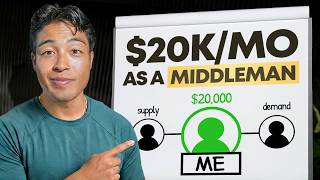

The Middleman Model That Built Uber & Spotify
53sExplains a counterintuitive business model behind trillion-dollar companies and why dropshipping works.
▶ Play Clip"Real, actionable dropshipping advice buried in heavy tool promos and an overpromising title."
In this video, the creator shares a dropshipping framework he claims has helped him earn $20,000 months after failing for over a year as a broke college student. He explains the importance of using a middleman business model, starting with a specific customer problem instead of a flashy product, launching fast, and scaling with multiple customer angles rather than just increasing ad spend. The video also includes a live tutorial on setting up a Shopify store with an AI-powered store builder.
The creator says he spent over a year as a broke college student, but now travels, buys houses, and helps family — not because of a secret strategy or lucky timing, but because he stopped focusing on what typical YouTube videos tell you matters and focused on three core things.
Amazon, Etsy, and eBay don't make the products they sell — they connect buyers with creators and take a cut. This middleman model is also used by Uber, Airbnb, and Spotify and can be applied to nearly any industry.
E-commerce is the fastest growing retail channel, projected to exceed $8 trillion by 2027. Dropshipping has the lowest barrier to entry and the fastest path to cash flow because you never touch inventory or pay upfront.
The creator initially picked products he thought were cool, like a wireless phone charger. He got one sale from a free-plus-shipping offer, then spent hundreds of dollars over the next week with zero sales because he wasn't solving a real problem.
After a friend's advice, he sold hypebeast-style phone cases to streetwear fans (Supreme, Off-White, Gucci culture) and hit his first $1,000 day within weeks. That store did hundreds of thousands in sales before a cease-and-desist letter.
Most people find a cool product and ask 'Who can I sell this to?' That's backwards. Instead, start with a person who has a specific problem, then become the middleman connecting them to a solution. Garrett Camp started Uber from the problem of finding a taxi on a snowy night.
Look for groups already spending money on solutions: new parents dealing with baby sleep, dog owners with separation anxiety, office workers with chronic back pain. Then validate demand using Meta Ad Library.
If a company has been running the same ad for 4-6 weeks and posting multiple creatives, that signals buyers are purchasing. If 3-4+ brands advertise a similar product, the market is proven.
Perfectionism stalls progress. You can't figure out what works by thinking — you need to launch quickly and let the market respond. Every day you don't launch is a day without real feedback.
The biggest scaling mistake is just increasing ad spend on the same audience. Margins get squeezed and you hit a wall. Instead, find different customer types for the same product — e.g., for noise-canceling headphones: home-office workers, college students, new parents, frequent flyers.
Drop a prompt into Claude or ChatGPT to generate distinct customer profiles and emotional hooks for the same product. Each angle can become its own ad campaign. He provides free prompts in a Notion document linked in the description.
The core takeaway is to start with a specific community and their problem, launch a bare-bones store quickly, and let market feedback guide you. Once a product sells, expand by targeting entirely different customer types with new hooks rather than simply increasing ad spend on one audience.
What is the middleman model in business?
It's when a company connects a buyer with a supplier or solution that already exists and takes a percentage of the sale. Examples include Amazon, Uber, Airbnb, and Spotify.
01:49
Why is dropshipping considered the fastest path to cash flow in e-commerce?
It has the lowest barrier to entry and you never touch inventory or pay upfront — you only buy the product from the supplier after the customer pays you.
02:31
What was the creator's first big product mistake?
He chose products he thought looked cool, like a wireless phone charger, instead of solving a specific problem. He got one sale but then spent hundreds of dollars with nothing to show.
03:10
What mindset shift led to the creator's first $1,000 day?
He shifted from starting with a product and asking who to sell it to, to starting with a specific person/community (hypebeast/streetwear fans) and their problem, then selling phone cases that matched their style.
04:43
How can you validate demand for a product using Meta Ad Library?
Look for companies running the same ad for 4-6 weeks and posting multiple creatives. Also check if 3-4+ brands advertise a similar product — that signals real buyers are purchasing.
06:17
Why should you launch your store before it feels perfect?
Because you can't figure out what works by thinking about it. You have to let the market respond in real time, and every day of delay is a day without real feedback.
07:47
What is the scaling mistake most dropshippers make?
They just keep increasing ad spend on the same audience and angle, which raises costs and squeezes margins. Instead, they should find different customer types for the same product.
10:53
How can AI help create ad angles for one product?
You can use a prompt in Claude or ChatGPT to generate distinct customer types and emotional hooks for the same product, such as a developer, a new mom, a frequent flyer, and a college student.
12:27
The middleman model explained
A clear, universal business framework that can be applied to many industries, not just e-commerce.
01:49Start with the problem, not the product
The core counter-intuitive insight that separates winners from people chasing trends.
04:43Launch fast, let the market speak
Actionable advice that prevents perfectionism from stalling a business.
07:47Scale audiences, not just ad spend
Explains why more ad budget stops working and how to expand to new customer types.
10:53Start with a community and their problem
Summarizes the entire strategy in one actionable sentence.
13:23[00:01] endless tutorials, testing different things, burning through cash, I get it. I was in the exact same spot. I spent over a year as a broke college kid grinding on this stuff, spending money on things that just didn't work. And now
[00:15] I travel whenever I want, I buy houses, help my family, live completely on my some secret strategy or got lucky with timing. It's because I stopped focusing on what every YouTube video tells you matters and started focusing on three
[00:30] needle. And it all started with one business model that almost nobody talks went from burning money to making my first 20K profit month within a few months. So, in this video, I'm walking you through exactly what those three
[00:44] Because honestly, if someone would have shown me this on day one, I would have Before I get into these three things, I going to use. Because if you're using the wrong strategy, none of the tactics
[00:57] matter. Look, there's so much out there about making money online. Every day, there is a new video telling you that their model is the best one. But almost no one mentions the most proven business strategy in the world. And I want you to
[01:09] bought something online. You probably went to an online store, maybe Amazon, maybe Etsy, eBay. You paid, the product showed up, and you were happy with your purchase. But here's the thing that most people never really think about. Amazon,
[01:23] they didn't make the product. Etsy didn't make the product, nor did eBay. Every single one of them is just the connection between you and whoever actually makes the thing that you bought. They control the relationship on
[01:35] both sides, and they get a cut of the sale. While the actual creator of the you'll never even hear about. So, what's happening here? They're not creators, they're not manufacturers, they're just sitting in the middle, connecting two
[01:49] sides and taking a percentage. That is the middleman model. And it's the same model that some of the most valuable companies in the world use. Uber, Airbnb, even Spotify, they are the middleman connecting the supplier with
[02:02] is that this same strategy can be applied to almost any industry. Now, what we're going to be doing is applying this model to e-commerce. And the reason for that is pretty simple. E-commerce is still the fastest growing retail channel
[02:16] in the world. And even with AI changing everything and with more competition than ever, e-commerce sales are on track to hit over 8 trillion by 2027. So, middleman model to actually make money. Within e-commerce, dropshipping gives
[02:31] you the lowest barrier to entry and the fastest path to cash flow. Here's how it works. Someone buys from your store, you take their money, and then you buy the product from your supplier, and they ship that directly to the customer. So,
[02:44] you never touch the inventory, you never pay for anything up front. You only buy bought it from you. So, you're just being a middleman connecting a buyer and a solution that already exists. The problem is that most people that are
[02:57] doing dropshipping right now are doing it completely wrong. And honestly, even I did this. When I started, one of the biggest mistakes was that I focused on the wrong thing. My entire strategy was finding products that looked really cool
[03:10] to me, and I was essentially just hoping for the best. Now, I did it because that's what every video that I watched back then was telling me to do. My first product that I ever tested was a wireless phone charger. And I thought it
[03:23] was the coolest thing ever. I'm like, I would totally buy this thing. First day, believe it not, I actually got a sale. And I was using a free plus shipping offer. I don't even know how this dude from Georgia bought the product or why
[03:35] hyped. I was like, you know what? I'm going to be a millionaire. I'm going to But then, I ended up spending multiple hundred dollars over a span of the next week, and then I had nothing to show for it. So, zero sales, nothing, right? And
[03:49] I just assumed that the product didn't work, and then I moved on to the next thing until my buddy, Steven, had told me something completely different. He people obsessed with hypebeast culture, streetwear type of culture, so Supreme,
[04:02] Off-White, Gucci, all that, and that they're buying phone cases that look right? So, they're kind of carrying a piece of their style with, you know, their phone case. So, I started selling these hypebeast style phone cases,
[04:17] airpod cases, all these different types of accessories. Within a few weeks, I actually hit my first $1,000 day, and Steven recorded me at the exact moment that it happened. And that store ended up doing hundreds of thousands sales
[04:30] over the next year until I got a cease and desist letter because of, you know, though I couldn't keep selling that product, the whole experience made me realize something. My entire approach to dropshipping was completely backwards.
[04:43] person does. Look, here's how most find a cool product, and they ask themselves, "Who can I sell this to?" But, that's the reason why most people stay stuck because when you start with a
[04:56] product, you're always chasing the next big trend. Now, when you flip it and start with a person who has a specific problem, everything changes. Now, instead of thinking about how to sell a product, think about how to solve the
[05:08] problem of that person. Now, Garrett Camp didn't think about how he could sell rides to a person when he started Uber. He thought how he could solve the problem of not finding a taxi on a snowy night. Now, he became between people
[05:22] with a problem and the solution. And when you become a middleman, you're not selling a trendy product. Instead, you're serving a community that won't here's how you can find a community with problems. First, you need to forget
[05:35] you want to find is a group of people who are already in a market, already searching for solutions, and pulling out their wallets to buy those solutions. pretty much anywhere. New parents that are dealing with their baby's sleep, dog
[05:49] owners that are worrying about their separation anxiety with their dogs, office workers with chronic back pain from sitting all day. These are all real communities with real ongoing problems. Then, you need to find if that community
[06:03] their problem. And the simplest way to do that is to look at the companies that are advertising to them. What I mean by this is that you would head over to the Meta Ad Library and search for products in that space and look at how long those
[06:17] ads have been running and how many different creatives that company is posting of this solution. If they've been running the same ad for multiple weeks, four, five, six weeks, that is a signal that people are actually buying
[06:29] that product and this company is willing to spend money to advertise to that nobody's just going to spend money on ads that are losing them money. No company's going to do that. Then, you look for brands that are running ads for
[06:43] a similar product. So, if there are three to four more brands, then that is as a middleman. Now, I know finding the right problem to solve isn't as straightforward as it may sound. You can, you know, understand the entire
[06:56] process completely and still wonder, "Is this community big enough? Is the demand actually there? Is it too late to enter?" Those are normal questions, but second-guessing them is what stalls most people at this exact stage. If you want
[07:08] help from people who actually built multiple seven-figure brands and people you whether it's worth testing or not, that is what we do inside of my mentorship program. We'll help you make the right decision on every single step
[07:20] month. Now, I'll leave a link for you guys to apply below and we will figure out if it's the right fit based on wherever you are in your e-commerce community and a product to test, here's the second big mistake that happens. So,
[07:34] when I started, I thought everything needed to be perfect before I launched. my my design, changing the fonts, adjusting the colors, testing different layouts, swapping out images over and over. I was basically trying to build
[07:47] I'd never talked to. And here's the thing, you can't figure out what works by thinking about it. You have to actually test and let the market tell live very fast so that the market can respond. And every day that you spend
[08:00] getting real feedback. And that's the only information that actually matters. So, here is how you actually do this. You want to get something live in minutes so the market can tell you what it wants. And what I like to do is use a
[08:13] tool to make that happen. Now, the first thing that you do need is Shopify. So, you can go into the description of this video right here. I'll link it below to get Shopify for a dollar for 3 months. So, insert your best email just like
[08:25] this. We will then create a password, create account. You're then going to want to pay the $1. You can see that we have a 97% off discount right here. So, I'm just going to insert my credit card information and then pay the $1. And
[08:39] do not need the grow or the advanced. So, we'll do try basic and then we can skip all this. All right, cool. Now that we have our Shopify store set up. So, is go to this link right here. And the tool that we're going to be using is
[08:52] build your store. So, this is the dashboard to go ahead and create your hypothetically, you know, you want to sell a specified product. You can use a competitor store just like this. So, I'll go here, insert the link. What it's
[09:06] doing is it's building up a product score. It's scanning the listing of my competitor. It's figuring out, you know, exactly what this store sells, the marketing angles, the copy. It's dragging all the information along with
[09:18] choose, you know, who I'm selling to, who's going to be my ideal customer. How do you want to sell it? So, the angle. And now it's going to pull the images and then we'll generate my store. All right, so not even 20 seconds and it has
[09:31] produced a store for us. This is what it looks like. It's got the AI images that it has created for us. Has the UGC style images. The structure of the store is really nice. And then if you look at the copy, it does fall in line with the
[09:45] angle that we chose. Now, this is what it looks like on mobile. And what's really cool is how easy they make this to make any adjustments. So, if I want to change the design, so the colors, I can do that. Simply change it like this.
[09:59] The typography, the buttons, so on and so forth. So, all those customization options, it also builds out a pretty nice homepage, just like this, a reviews page. And then if I want to add another product, so let's just say, you know, I
[10:14] they're selling other types of things like this necklace. All I really have to do is take that link just like this and simply copy and paste. And then it'll import that on our own store and build out an entire product page exactly like
[10:28] this one right here. That's of course tailored to said product. Now, if I'm adjustments, all we have to do is press publish right here, connect your store. And then because we already have signed up for Shopify, it's going to publish
[10:41] onto my own Shopify store that we just signed up for. All right. So, now you found your community, you launched your product, you're getting sales. Now what? This is exactly where I made a big mistake that kept me from hitting my
[10:53] first 20K profit month. So, what happened was I just kept scaling the same angle to the same audience thinking that that was the only way to move really just means spending more money on ads. And yeah, that will work for a bit,
[11:08] go up. Your margins, they're going to get squeezed. And then you're going to hit a wall. You can't just keep throwing money at the same audience over and money at ads, what if you found different types of customers for the
[11:22] same product? So, most people they'll miss the fact that one product has three or four completely different customer types. That is why when we looked at One were so many different angles and so many different customer types that you
[11:34] can target. They all want to buy a solution, but each one of them has a And you could just take noise canceling headphones for example. The obvious customer is someone who works from home and who needs to focus, right? That's
[11:49] it works for a while until you hit an audience that gets saturated and expensive. Now, think about who else might need noise canceling headphones. Maybe college students that are living in noisy dorms who can't study. Parents
[12:01] of newborns who might just need a few minutes of silence without leaving the sleep during the day in a house full of noise. And that's the thing, you're not talking to different people about different problems. Now look, figuring
[12:15] out all these different customer types manually would take you forever unless, brain. Like me, you're probably just going to be sitting there brainstorming different angles, writing different hooks for each one, but with AI, you can
[12:27] to show you how. All right, so here's what I would do. I would take this prompt right here and drop it into Claude or ChatGPT and just swap out the it gives you. Four completely different types of customers. The developer that's
[12:42] struggling in an open office. The new mom who can't get mental silence. The frequent flyer showing up in meetings already drained. The college student with loud roommates, right? It's the same headphones for completely different
[12:55] emotional triggers. And the best part is that each one of these could be its own figure out which one works best for you. Now you just take these hooks and you give them to a UGC creator or you use them as your own ads and you test which
[13:08] what I'll do is I'll put all these ChatGPT Claude prompts into a Notion free and a bunch more examples as well. I'll leave it in the description for you look, you've got what you need now. Start with a community and their
[13:23] problem, not the product. Launch fast so that the market can actually tell you that's selling, don't just move on to the next product. Find the other types you can figure this out all on your own.
[13:37] You can test things, you can waste money, eventually get there, right? Or everything with you so that you're not spending months testing the wrong ad that was never going to work in the first place. So, if you're serious about
[13:51] you just kind of want to skip all the BS, I will leave a link below for you you guys watching. I'll see you in the next one. Peace.




⚡ Saved you 0h 14m reading this? Transcribe any YouTube video for free — no signup needed.