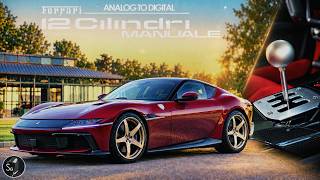

Ferrari's New Manual Is Not What You Think!
60sThe shock value of Ferrari bringing back a manual but with a digital twist sparks curiosity and debate.
▶ Play Clip"Delivers on the promise of exploring Ferrari's digital manual, with detailed engineering insights and driving impressions, though some segments feel padded."
Ferrari's new 12Cilindri reintroduces the manual transmission in a digital, shift-by-wire form, blending the engagement of a traditional gearbox with modern technology. The video explores the engineering philosophy, development process, and real-world driving experience of this first-of-its-kind system.
Federico Kumodin, Ferrari's mechanical testing engineer, introduces the 12Cilindri with a 6.5L naturally aspirated V12 revving to 9500 RPM and producing over 800 horsepower. The video will explain why Ferrari chose a manual transmission for this car and how it works.
The biggest question is why Ferrari didn't bring back a full mechanical setup. The answer: technology has evolved to add more, like an automatic mode, combining the best of both worlds. The driver gets maximum comfort, usability, and reliability while still harnessing the V12's power.
The project started four years ago, with continuous mechanical and software design. The last two years were the most intricate, with driver feedback being the primary source for every adjustment. The development was largely trial-and-error, focusing on subjective feel like force curves and pedal engagement.
The philosophy was not to imitate an existing manual but to define the feeling of a manual-by-wire system. The load curve was a byproduct of creating the right connection between driver and gearbox. The force on the lever had to be coherent with the car's expected behavior.
The challenge was converting the dual-clutch transmission into a single-clutch experience. Unlike a dual-clutch, where shifts are repeatable, this system must detect driver intent and guide the gearbox accordingly. The software's key was establishing a one-to-one connection between the lever and the gearbox.
The system uses a high-strength alloy steel core machined to high tolerance. A sensor detects lever movement. A self-centering mechanism uses eccentric rollers on spring-loaded pistons to return the lever to neutral with consistent force feedback. A detent prevents accidental reverse engagement.
Two sets of cams create the desired force characteristic: initial preload, engagement, and detent. A solenoid actively prevents shifting into disallowed gears (e.g., overrevving on downshift). The system can switch between automatic (white backlight) and manual (amber) modes.
The clutch pedal uses a spring-loaded piston with a cam and roller to provide mechanical feedback. The force characteristic is designed to make the clutch engagement point feel natural and instinctive, calibrated with software for the most natural experience.
The driver notes that the mechanical connection, pedal forces, and shift lever feel are 'supernatural'—you wouldn't know it's not a traditional manual. It doesn't feel like a sim; it has an automotive feel, with the sound of the shift and smooth starts. It even stalls like a normal car.
There's no rev matching or auto-restart; you have to drive it like a real manual. The only safeguards are common-sense ones, like preventing a money shift from 6th to 1st. This makes it a forgiving but engaging driving tool.
In traffic, you can switch to full automatic mode. The first six gears are the same ratios as the regular 12Cilindri. The driver believes this is the future of manual gearboxes, allowing manufacturers to offer manuals without recrash testing, potentially bringing manuals back in an electromechanical form.
When driven flat out, the engagement is something you can't get with a dual-clutch. The car is designed to be comfortable but also makes you 'giggle like an idiot.' It's quick to rotate and entertaining, especially with all assists off.
The clutch responds like a normal clutch, allowing for smooth or abrupt shifts. It adapts to different driving styles, either penalizing you or rewarding skill, just like a regular manual. This is far from gimmicky.
This is the first manual in a regular series production Ferrari since the 599 in 2012. The combination of a big V12 and a manual is a unique driving experience. The system is so good that you'd have a hard time believing it's not a true mechanical unit.
The only criticisms are in throttle pedal calibration, particularly for heel-toe downshifts. There's a smoothing or dead zone at the throttle that spikes, making rev-matched downshifts difficult. Owners will need practice, but it's amazing as is.
This system gives many brands a true entry point to bring back the manual transmission without recrash testing or developing a new platform. It opens the door for manuals to return in an electromechanical form, though it's a bittersweet reality of modern engineering.
Ferrari's manual-by-wire system in the 12Cilindri successfully replicates the feel of a traditional manual while adding modern convenience and safety. It represents a significant engineering achievement that could pave the way for other manufacturers to reintroduce manuals in the digital era.
Philosophy: Define, Don't Imitate
This principle guided the entire development, focusing on creating a new feel rather than replicating an old one.
05:29One-to-One Connection
The software's core challenge was ensuring a direct, real-time link between lever input and gearbox action, crucial for authenticity.
07:49No Assistance, Just Safeguards
This design choice preserves the driver's responsibility and skill requirement, making it feel like a true manual.
13:40Template for the Industry
This system could enable other manufacturers to offer manuals without costly recrash testing, potentially reviving the manual transmission.
20:12[00:10] We're at the BLCO proving ground and I am Federrico Kumodin, mechanical testing engineer for Ferrari and we are here with Dodic Manuel.
[00:41] different. They want to bring back the manual transmission, but they wanted to put it in a special vehicle, their Dichi cylindry, a 6.5 L [music] V12 that's cylindry, a 6.5 L [music] V12 that's naturally aspirated. It revs to 9500 RPM
[00:56] and makes over 800 horsepower. We already did a video on the full automatic version with the dual clutch. So, why put a manual transmission in this car? What is [music] it? We're going to answer those questions in this
[01:09] video, but one thing I can tell you is we are in the full analog to digital conversion age. This manual transmission is their [music] first implementation of shift by wire. They're going to explain why. We're going to talk about how they
[01:22] did it and we're going to take it for a drive to explain whether or not this new tech for them works and are we going to see it in other cars in the future. So, when a majority of people heard that Ferrari was bringing back a manual
[01:36] transmission, everyone was excited. And then we learned that it wasn't a true mechanical unit. So, I think the one of the biggest questions was why not bring back a full mechanical setup instead of this? Well, there are two particular
[01:52] standpoints we need to get into. The first is technology has gone beyond that to take the traditional manual gearbox and to add something more. For example, in this particular case, we have a manual gearbox with an automatic mode
[02:07] which is something that was unthinkable of some years ago as the golden age of the gated shifter was roaring. So, we have the best of both worlds combined into one transmission. The driver of this car must experience the maximum
[02:22] comfort and of course the usability and reliability of the transmission while still able to put on the ground all the power that the normally aspirated V12 can generate especially at high revs. that when you look at this from start to
[02:35] finish, the assembly process from the base all the way to almost the near that goes into this. And one of the first things I was wondering is how long did you sweat the details of trying to
[02:49] balance the mechanical perfection of a manual transmission and combining the real? What was the development time and what was that like for you? Yeah, this this project this particular project started four years ago and from
[03:05] then it has been a continuous flow of mechanical and software designing like the two were growing side by side. I think that the last two years were the
[03:17] most intricated in terms of design choices and in term of development of both the hardware and the software based directly onto the feedback of our drivers that they were the primary source for every feedback and every
[03:31] steering that we have to do to the whole system. In the modern automotive world, a lot of systems like this are now designed in the digital domain. And when going to be simulation and digital design that goes into every part, but a
[03:47] piece like this that is subjectively human uh in terms of force curves in the pedal, in the feel. How much of the time of development was spent on that trial
[03:59] and error of trying to find that perfect weight, that perfect engagement point, foot? >> I would say most of it in fact the only the only part was digitalized in terms of defining the best characteristics.
[04:14] This the initial setting like we had to start somewhere from there on it was all a trial, feedback and correction. So, as I said before, our our drivers, their
[04:27] I said before, our our drivers, their sensibility was vital to finding the the sensibility was vital to finding the the correct balance between not being too soft with the load or not being too harsh, to finding the correct balance
[04:40] that best suited the car. >> And where how did you land on that? I this because it is very subjective. It's very human. um from your vehicle dynamics team to your development drivers to your internal engineers that
[04:53] worked on this. You know, modern transmissions or manual transmissions, if if you've gotten into many of them, they're very soft. They don't feel very mechanical. They're often cable actuated. And this is when you look at
[05:05] the the physicality of it. Where do you find the perfect balance of a modern car find the perfect balance of a modern car like this that has to be high-tech and in some cases lower effort? How do you get blend the old of the analog days to
[05:17] the new? What was the philosophy? >> Well, the philosophy was not to imitate something that existed. It was to define what was to be the feeling of the manual
[05:29] by wire, which is a subtle difference, but it was fundamental in the terms that we had to to create something that was the right connection between the driver the right connection between the driver and the gearbox. So
[05:44] what came after with this kind of load curve characteristic was the byproduct curve characteristic was the byproduct of this. So a lot of focus was put into of this. So a lot of focus was put into defining what was the correct force to
[05:57] exert on the lever based on the conditions but that force had to be coherent with was the car was expected to do. So you're kind of explain the concept of taking the existing dual clutch transmission and essentially
[06:11] trying to turn it into a single clutch experience. How is the control side of that in terms of actu clutch actuation bite point where all these things feel real without cheating and using haptics and uh some of the gimmicks that you
[06:25] would you would anticipate a system like this having. Um explain that process. Well, that was no easy task. Mainly because the dual clutch gearbox is created with a different usage in mind. Like in a semi-automatic dual clutch
[06:41] transmission, every single shift is repeatable from point A to point B. Now with this kind of transmission, we know what point A is, but we don't do not
[06:53] know anticipately where the point B is. So most of the development that was made was to make a gearbox that needed to know what the arriving point was able to accept a variety of conditions in which
[07:09] a driver would have put itself into. So development was made into detecting development was made into detecting driver intent with similar logic to how for example throttle throttle by wire pedals are made today and uh to
[07:24] correctly interpret it and to guide the gearbox into its own actuations to follow suit as closely as possible because anything else would be not real
[07:37] because anything else would be not real not the real thing. One of the major key points of this whole work that was done in terms of whole work that was done in terms of software was to to establish a
[07:49] one-on-one connection between what the liver does and what the gearbox does. And that was the difficult part in the software architecture. software architecture. [music]
[08:06] All right. So here we have the main component of the core of our manual by wire system. We have a machine piece of high strength alloy steel which is machined to high tolerance in in order to have the correct precision in all the
[08:21] phases of the shift. This allows us to correctly install all the different components on this with the tightest tolerances that we can allow on this kind of component. On this, a sensor is mounted to detect this side by side
[08:36] movement of the lever. And then this whole assembly oscillates back and forth as soon as the gear is shifted in position. As we put this gear gear first layer we encounter is a self-centering mechanism which is the
[08:52] mechanism who allows the sidebyside movement with its own distinct force feedback and the centering of the lever in neutral. So here we see that we have two sets of eccentric rollers which run on a spring loaded piston. The action is
[09:10] just to turn the lever in the middle position in neutral as precisely as possible while giving a consistent force feedback. Moreover, we have a dive mechanism permits the transition towards the reverse which is otherwise prevented
[09:25] by detent. So we wanted to make sure that the action of putting the liver in reverse was deliberate. The oscillation assembly is then mounted onto its own chassis which includes the gates and this particular shifter assembly which
[09:40] characteristics of the shifting movement. As you can see going back and movement. As you can see going back and forth there are two sets of mechanisms which intervene in the creation of the overall force characteristics. One at
[09:53] the back and one at the front. There are two sets of cams shaped so that the resulting characteristic of the sum of the contributions of the two cams is the desired characteristic of the shifting movement which is initial preload the
[10:09] engagement of the shifter itself and then the detention of the shifter into his corresponding slot. These two systems are complemented by a solenoid which is used by the gearbox to actively prevent you from putting the liver into
[10:24] some conditions which might not be allowed at the time. For example, you cannot overrev your engine by downshifting where you're not supposed to. Otherwise, movement is allowed in the most natural way possible. A feature
[10:38] of the manual by wire system is the possibility to transition from the automatic to the manual mode and vice versa. By doing so, you have two corresponding backlighting onto the gear knob itself as it transitions from white
[10:51] in the automatic mode and amber in the manual mode. Moreover, as I said earlier, you have a solenoid which actively prevents you from shifting into a gear that is not allowed at the time. As soon as the the conditions are
[11:05] As soon as the the conditions are allowed, the gear shifts into place. To complement the gear shifter, the Vanuel system also includes a clutch by wire pedal. The mechanical feedback is given in the form of a spring-loaded piston
[11:18] with a cam on top. On top of this cam rides a roller which is linked to the pedal. The shape of the force characteristics along the scrution of characteristics along the scrution of the pedal is made so that it is natural
[11:31] instinctive to know where the place of the clutch are supposed to meet. This according with the development and calibration of the software gives the most natural experience possible with this kind of transmission.
[11:51] it's my first digital manual experience in a V12 Ferrari. >> Well, I'm glad you're finally getting to drive this thing for real. This was one of my favorite cars this year. Well, let's see how bad I do with this because
[12:04] uh I had one shot in and it wasn't very smooth for me. So, let's do it.
[12:16] on to be fair. >> That's true. It can't handle the power. >> So, I'm going to walk you through the manual gearbox before I start going flat drive this on the street, right? This is a street car. And I think what they've
[12:32] been able to do with the mechanical connection, the pedal forces, the shift lover force, it's super supernatural. Like just tooling around, you would never know. And I was worried this was going to feel very much like a sim.
[12:46] >> A Logitech or semicube. >> A semi cube or, you know, semicube's bar, but I was worried it was going to be too much like that. Right. I still wanted to have that automotive feel to it. And I think it does. I mean, you can
[12:59] hear the the sound of it like just the ram rod shifting. It feels like >> Yes. >> And you know, smoothness coming off the line. Again, if you do a normal start, you do a start in first gear, it's
[13:14] you do a start in first gear, it's normal. Let's do a start in second gear. >> if there wasn't the I'm going to call it the prindle, the reverse, neutral,
[13:27] have no idea that this wasn't a real manual gearbox for a regular owner. And experienced. >> I literally just stalled it. So, you normal car. It doesn't assist you like when you put it back into drive like a
[13:40] Porsche and restarts for you. You have to drive this. There's no rev matching. It's really they they designed this to really mimic a manual transmission with some safeguards. like I can't just go from six to first and pull a money shift
[13:56] and blow this thing up, right? Like they they put the obvious common sense things in here um just to protect your investment. So I think personally this is an amazing driving tool because one, it's forgiving and two, if you have a
[14:09] not want it but kind of likes the idea of it, you just go into a full automatic >> or you're sitting in traffic or you're sitting in X, Y, and Z. The idea is that to drive this like an like you're just about to start doing, you
[14:23] can leave this in manual experience. The first six gears are the same ratios as the regular 12cylindry with all of its handling character, which we'll briefly you're sitting in traffic, you're sitting in a city, you don't want to
[14:35] deal with it. It just turns into a regular automatic. I I like the idea of it. I understand the thought process of people. Why don't they just make a regular manual? But I imagine in the in
[14:49] the future, this is going to be the way that manufacturers do manual gearboxes test the car. They don't have to recrash test the car, blah blah blah. >> Right. 100%. And I think that's that's the main thing is it it gives them the
[15:04] engineering and put it in other cars too down the road if they so desire to do that. And I think that's a massive win really for everybody that's trying to do this or or is interested in a manual. It kind of
[15:18] kind of a template for other manufacturers to kind of figure out how to do this. I like the engagement part of it. Obviously, when you start to drive this flat out, the engagement part of it is
[15:33] there that you can't get with a dual clutch. I mean, truthfully, the difference other than the safeguards that are in place. And I think that's
[15:46] mean, a first attempt that's taken them over four years to do in development. Also helps that it's paired to this car. We have this conversation with
[15:58] automotive engineers all the time, right? How do you make a car feel right? How do you make a car feel special in the year of our lord 2026? And what Ferrari's done with the Dodichi Cylinder is give you a V12 that makes
[16:12] 800ish horsepower or whatever it is with a engine that revs at 9,500 RPM without a engine that revs at 9,500 RPM without any hybridization, without any turbos in a car that was designed to be not the fastest vehicle in the world as far as
[16:25] setting lap times, but something that is both comfortable, which to be fair, no one's using these the US at least as longist cruisers, [music] but it's a car that makes you giggle like an idiot. like the balance of this car. When you
[16:37] you safe. And then when you turn everything off, this thing is [music] super quick on turn and all it wants to do is rotate in the ass, which is
[16:50] very entertaining. I know Mark, you famously said you're not a man who likes chasing a lot of ass when you drive a car, but just dude, listen to this car, but just dude, listen to this thing.
[17:06] off the clutch, you can slam shift it um and make it you can slam shift it um and make it more abrupt in terms of like how you let the clutch out. You can kind of shotgun blast shift this car or you can be
[17:19] smooth with it. it it does respond like normal clutch takeup. So, it adapts to different driving styles and can either penalize you or you can work on your your driving skill with it, you know, like a regular
[17:32] that's something people were very afraid of when they heard this that was going to be super gimmicky. I think they've went as far away from gimmicks as humanly possible >> within the confines of the deliverables.
[17:45] >> Yeah. Of the confines of the technology that they have here. I think if again the best part about this is that if [music] you didn't know, which obviously you would know because of the the buttons below the shifter,
[18:00] car. It feels exactly like a manual gearbox, which means that's an experience you haven't been able to have in a Ferrari since 2012. This is the first manual, to my understanding, since the 599 in a regular series production
[18:14] the 599 in a regular series production car. and a big V12 compared to a gated manual is a very very unique driving experience. And if you're paying this much money for a car, you want it to feel special. And that's what this does.
[18:37] Italy and talking to the engineers about the system was to see how well it worked. Is it a replacement for a true manual gearbox? And the mechanical part of this, the shifter, the clutch pedal, the brake pedal, and all the inputs, you
[18:50] would never know, uh, if if you didn't, if I didn't tell you that this was a electromechanical system, you'd have a very hard time believing that it wasn't truly one:one real manual gearbox. That's how good the software and the
[19:04] physical mechanical engineering is on this. But because we're looking at the nuance of it and this is a first attempt, there are some things that we about and and almost all of that is in throttle pedal calibration. The way that
[19:18] you heel toe downshift because there's no rev match system built into this at this point. It feels like the throttle pedal curves are set more up for the quite sure. But I'm going to show you a
[19:30] software to show you kind of how that ramp effect when you get to that first like there's a smoothing zone or a dead zone at the throttle and it spikes up. So, it makes it very difficult to have smooth first to second downshift rev
[19:44] matched uh heel totoe rev match downshifts coming into a corner and I I down to there it seems really smooth and down in the second and first and you really have to jam on that throttle so
[19:59] you get these huge throttle spikes. So, I think for the owners of this car, if few people that have this, it's going to take some practice and then muscle are finer details that I think they're going to continue to smooth out and
[20:12] figure out. But it's amazing as it is. And I think this gives many brands a true entry point in bringing back the manual transmission if they have the right dual clutch, if they have the right software, the right people to
[20:24] understand the mechanical engineering of having these physical inputs, right? I think a lot of brands will do this and it's not going to be easy at first, but to have the manual transmission option back for all these sports cars again
[20:38] without having to recrash test your car, without having to develop a this global platform that can't be one thing in one country and has to be something in another. This really opens the door to the manual transmission to come back in
[20:50] an electric mechanical form. Does it sadden me a bit? Yes, of course. But this is the reality of modern engineering and regulations across the globe. And I'm going to leave it at that. Hopefully, we get to test this car
[21:02] in the future in our own environment to give you more feedback as they continue to develop this. But thanks for watching. I'll see you next video.
⚡ Saved you 0h 21m reading this? Transcribe any YouTube video for free — no signup needed.