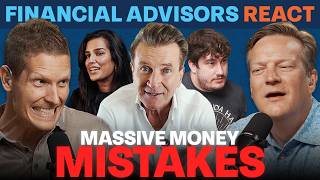

10-Year Car Loan? Financial Advisors React!
60sThe absurdity of a 120-month car loan and the clear financial rules provided make this segment highly relatable and shareable.
▶ Play Clip"Delivers on the premise with real clips and expert reactions, but padded with banter and repetitive advice."
In this video, financial advisors Brian and Bo react to a series of clips featuring individuals discussing their biggest money mistakes. They analyze common pitfalls such as poor car financing, using home equity to consolidate debt, taking on high-interest loans for home improvements, and making impulsive purchases funded by retirement accounts. The advisors emphasize the importance of understanding the specifics of financial decisions, avoiding emotional or peer-pressure-driven choices, and recognizing that personal finance is highly individual.
The advisors recommend putting 20% down, financing for no more than 36 months, and keeping total monthly car payments under 8% of gross income to avoid turning a car into 'financial napalm'.
A clip shows an entrepreneur who borrowed from his property to invest in his clothing business, leading to cash flow issues and foreclosure on his family home. The advisors note that using home equity for business is risky.
Consolidating unsecured debt (credit cards, student loans) into a mortgage converts it to secured debt, putting your house at risk. This adds significant risk to your financial life.
Before major life changes, create a plan for the next 5-7 years with three parts: the dream, the down-to-earth, and the do-do plan. This helps anticipate outcomes and avoid mistakes.
A clip shows someone with $40K left in student loans for a degree they aren't using. The advisors stress the gravity of student loan decisions and the long-term impact on working career.
When choosing a partner, discuss heavy topics like religion, kids, and money. Not talking about these can lead to financial and personal problems.
A clip shows someone who lost money by following a family member's stock tip. The advisors emphasize doing your own research and taking responsibility for your money.
For beginners, following a financial order of operations (like the Money Guy's) can provide a system that prevents wasting money and builds wealth.
Solar panel loans only make sense at interest rates of 2-4%. At 12%, the break-even point is too long, making it a poor financial decision.
A red flag is when people know their monthly payment but not the loan term or interest rate. You must understand the specifics of any debt you take on.
A clip shows someone who bought a condo in 2021-2022, thinking it was an investment, but it's a money pit with negative cash flow. The advisors note that personal finance is personal and homeownership isn't for everyone.
Renting is not throwing money away; it provides flexibility and options. Homeownership can be a good choice but not just because others do it.
Condo fees can be as large as the mortgage and are out of your control, especially in places like Florida where fees are rising due to rehabbing.
Clips show people using credit cards for travel, selling 401k to buy a boat, and other impulsive decisions. The advisors warn against making financial moves without proper planning.
Staying at a job for more than 2 years can mean 3-5% raises, while switching jobs can yield 10-20%. However, not all jobs are created equal, and context matters.
Be careful with 30-second clips of financial advice; what works for one person may not work for you. Use resources like moneyguy.com/resources for personalized guidance.
The video underscores that personal finance is deeply personal, and while common mistakes like poor car loans, debt consolidation, and impulsive purchases are widespread, the key is to understand your own situation, do your research, and avoid making decisions based on emotion or peer pressure.
What are the recommended car buying rules from the advisors?
Put 20% down, finance for no more than 36 months, and keep total monthly car payment under 8% of gross income.
00:28
Why is consolidating unsecured debt into a mortgage risky?
It converts unsecured debt to secured debt, putting your house at risk if you can't pay.
02:02
What are the three parts of the '3D glasses' planning method?
The dream, the down-to-earth, and the do-do plan.
02:43
What interest rate makes solar panel loans viable?
2-4% interest rate.
05:58
What is a red flag when someone is borrowing money?
They know their monthly payment but not the loan term or interest rate.
07:41
Why did the person in the clip consider buying a condo a mistake?
It was not an investment; it was a money pit with negative cash flow.
08:21
What is the average pay raise for staying at a job vs. switching jobs?
Staying: 3-5% per year; switching: 10-20% per year.
12:48
What is the key takeaway about personal finance?
Personal finance is personal; be careful with generic advice and consider your unique situation.
15:32
Car Buying Rules
Provides concrete, actionable guidelines to avoid a common financial pitfall.
00:28Debt Consolidation Risk
Explains a critical distinction between secured and unsecured debt that many overlook.
02:02Do Your Own Research
Highlights the importance of personal responsibility in investing, a core principle.
04:31Condo Purchase Mistake
Illustrates how social pressure and misconceptions can lead to poor financial decisions.
08:21Job Hopping Statistics
Provides data-driven insight into career and salary growth strategies.
12:48[00:02] That's what we're covering today, massive money mistakes. Everyone, I am so excited to see what the content team has in store for us today. rolling. >> And today we got my dog, TK.
[00:15] that energy. >> And we got him approved on this Dodge >> [laughter] >> 10 years? >> Great experience. I highly recommend it. They got me on 300 monthly payments.
[00:28] >> He's going to pay it off and then be able to put an antique tag on that. oh, I >> If it's still rolling, like unlike >> We believe that there's a better way to buy cars. We want you to do 23A. We want
[00:43] you to put 20% down. We don't want you to finance for any more than 3 years or 36 months. By the way, 120 months is more than 36 months. And we do not want your total monthly payment to exceed 8% of your gross income. If you can do
[00:55] that, you can prevent your car from becoming financial napalm in your >> I'm surprised Stevo hasn't figured out how he can slap a tent in the trunk and deduction for how long he's financing these cars.
[01:09] rolling. >> People willingly go in to get >> But the company is very successful. Made it to seven figures. They have no I did was I was borrowing from my property to invest into my clothing
[01:24] didn't know about funding. I didn't even know that I can borrow >> from my own property to invest. So, I was using my own cash. So, when we started to have issues with with cash flow, I wasn't paying my mortgage.
[01:36] >> So, then my house got foreclosed on. And it was a house that I grew up in. It was a house that my grandmother fought for to to to purchase when she moved from, living in New Jersey. So, when I lost that house, bro, I was super
[01:48] Obviously, his was an entrepreneurship thing. He took equity out of his home to invest in a business. But we see this all the time. Someone might have credit debt and they come with this great idea, hey, you know what? My mortgage or
[02:02] that I have on my credit card and lower than the rates I have on my car, lower loans. So, what I'm going to do is I'm going to go take a home equity line, I'm that cash out, and I'm going to consolidate that debt into the mortgage.
[02:16] And one of the problems is if you replace unsecured debt, like credit cards, like student loans, those sorts of things, with secured debt, like a mortgage, which is backed by your house, you have now taken that hole that you've
[02:29] dug and you've put your house at risk to try to satisfy that debt. It is not a sound strategy and it adds a lot more risk to your financial life. about doing anything with an entrepreneur,
[02:43] thinking about even changing jobs, anything that's going to just radically change your life, make sure you put on your 3D glasses. What I mean by that is ways. I actually want you to create a plan for the next five to seven years
[02:56] where you say, "Hey, here's the dream." Everybody's good at doing the dream plan, but then know and then take it from there, go to the down-to-earth, and then don't forget the most important step, the do-do plan. Go ahead and say,
[03:09] come out on the other side?" I think if you had done that, you would have still >> Before you start investing in [music] unique things or executing complicated investment strategies, make sure you understand the ins and outs so you know
[03:23] that what the negative consequences of that decision could be if it happens to mistake? >> Oh god, there's been a few. degree. >> Are you currently using the degree?
[03:37] >> Is Are the loans paid off? >> I got 40K left. >> My ex-wife. >> [laughter] >> Couple million. >> We make one of the biggest financial
[03:50] decisions we'll ever make in terms of how much student loan we take on, not recognizing the gravity of that decision that we can end up taking that student well into our working career. So, you want to make sure you do that well. And
[04:04] you probably want to make sure you do that one well, also. gets you excited because you think they're pretty or attractive. Make sure going to carry you through the future. And then talk about the heavy stuff, you
[04:17] know, don't If you're not talking about religion, kids, and how you do money, lot of the steps. >> Biggest investing mistake I ever made was listening to other people and not my gut feel. Long time ago, one of my
[04:31] family members, who I thought was really smart, told me to buy this stock. I lost all my money. I mean, it wasn't that much money back then, but at the time, it was a lot of money. So, do your
[04:43] own research. The only person responsible for your money is you. You know, I met Oprah one time, and unbelievably, she told me that she signs every check in her company above $10,000. So, it's your money, it's your
[04:59] >> You have to be so careful of what advice you let into your head, and whose advice financial decisions, because not all financial advice is created >> Well, I think Robert needs to differentiate. Entrepreneurship-wise, I
[05:14] biggest things when I was in in accounting and working with small going to know your business like you." So, you can't just skip over everything is. But, I will say for for if you're just starting out on the
[05:29] trying to figure out, "How do I fund my Roth IRA? How do I get into the basics?" >> [music] >> Go let that be your mentorship or step. financial order of operations. That way, you can get your life working for you,
[05:44] and you cannot waste a dollar because the experience is baked into the system. >> Over 30,000. >> Okay. What's the interest rate on them? >> It's 12. >> Oh.
[05:58] >> I sent them all the paperwork FOR IT. >> THERE IS A SMALL WINDOW, small window and I want to be very clear that it is a small window where solar panel loans work and that's when they're like two to three, maybe 4%. This is not [music]
[06:13] returning the value. It can't be. The break even point with the interest rate them has to be a ridiculous amount of time. It has to be. >> We're paying $120 a month. >> Give it for how many months?
[06:25] >> What's your monthly payment? Are you sure? >> 120. >> That's more like a 250 month thing so I >> Well, I didn't >> No, you have no idea what you're talking
[06:38] How many years is that? Dude, this is like a 20 year thing. You have this debt in the house in 21 years statistically. >> We see this all the time. People want to do upgrades to their home, add it, do solar whatever the thing is and they end
[06:53] up financing it this like improvement or this thing they want to do for longer than they're even going to be able to utilize this thing. Solar panels are a great example of people that We've seen in the past where you can do it and you
[07:05] look at the economics and it might make sense but in a lot of cases it is not economically viable to try to do it and yet a lot of people still fall into that >> You have to be careful when things feel like you're doing the right thing
[07:17] and then you get these government subsidies that are also put on top. It feels like well, heck two of the three boxes are checked for why I should go great idea. Otherwise there wouldn't be all these companies doing it, the
[07:29] government wouldn't be incentivizing it and then I I feel good because I'm now going to be self-sufficient and you know, and I'm I'm solar powered but if the math doesn't work and you but don't just skip that step and don't assume the
[07:41] person that's selling you the product is going to do that math for you, too. your incentives. >> A big red flag I see when I'm talking to someone, and I ask them some questions, they always know their payment. And in
[07:54] long? Well, I don't know. What's the interest rate? Oh, I'm not sure. You need to understand the specifics of your financial situation, so you know if decision. If you're borrowing money, you can't tell me for how long, what the
[08:08] is, you don't know enough about the money you're borrowing. >> who else does that? Stevo. Stevo got you rolling into solar. You know, we could we could help you make a payment in this business. Because that's exactly right.
[08:21] focusing on the payment, you don't really know what you're paying for the >> Stevo got me solar. >> I'm going to tell you guys the number one financial mistake I made in my entire life that cost me almost
[08:34] entire life that cost me almost $100,000, and that was buying a condo. I credit this decision to two main factors. Number one, I compared myself coworkers, felt like majority of them own property. Family members, majority
[08:49] of them were homeowners. People that I knew from back in the day, homeowners. know, at the time it mattered. I felt like a failure because I did not own property. Number two, I was under the misconception that owning property, more
[09:04] specifically a condo, was an investment. And let me tell you, >> it's not an investment. I did not know that. Growing up, just everyone around me was always like, "If you own property, that's an investment." An
[09:18] investment is something that generates you income. Buying a condo in 2021, 2022, when I purchased, that is actually just a money pit. And every single year, I have a tenant in my condo right now paying $2,400 a month, that is not
[09:33] covering my overhead costs, like property taxes, mortgage, and condo fees, doesn't even come close. So, every single year I'm out like $6,000. >> Personal finance is personal. Sometimes home ownership does make sense.
[09:46] perhaps buy the condo or whatever that is. But, the reason that she bought it real estate. Just because other people did it or you think it's the next box to check in your financial life. If that's the reason you're doing it, you're not
[10:00] to make sure that I want to be on the home ownership side. It makes sense for my current life situation life stage. And if it doesn't, it's totally okay renting is just throwing money away, throwing money away. I would disagree. I
[10:16] think renting is giving yourself future flexibility and options. And sometimes build equity. >> Condos are unique upon themselves fees. And because, you know, we've seen especially if you're looking at places
[10:30] like Florida where they're now having to do some rehabbing to make sure these state of Florida. So, you're seeing condo association fees go in crazy directions up. And you have zero control over that. And that's a lot different
[10:44] attention to those condo association fees. In a lot of cases, they're getting to be as large as the mortgage is. If cash flow, imagine how hard it is to sell that property with that large condo
[10:58] >> What's been your worst money mistake? >> We took a home equity line out and we >> What was your worst money mistake? >> Buying that stand and then the state >> Maybe trying to to invest too quickly. >> Don't get into it too quick when you
[11:12] don't know what you're investing into. >> What has been your worst money mistake? >> When I was traveling by myself, I used every limit of credit card I had to do time and it multiplies. >> I sold a bunch of my 401k money, paid
[11:26] the penalty to buy my boat. It's very expensive to buy a boat in the Virgin her. and now looking back like, you know, being older with a mortgage, younger, probably. >> Or or or hear me out. Don't do that
[11:39] >> how he met her? >> He did say that's how he met her. >> He got a dividend from his horrible financial decisions. these. A lot of these were like impulsive financial decisions. Hey, I
[11:51] that I could travel cuz I wanted the experience. I pulled money out of my or I paid the penalty, I paid the taxes so that I could buy a boat. Traveling is not bad, buying a boat is not bad. Those inherently are not bad things, but when
[12:05] you're doing them impulsively and you're making poor financial decisions to allow your financial life out of order. >> Don't you wish that they could just put a sign on things? You know, the like a context sign. Everywhere you
[12:19] had down in the Virgin Islands. It had a sign that said, "Finance with my 401k." >> I guarantee she wouldn't have jumped on that that boat train and dating train as as easily. Life would be better if you saw like people with brand new cars and
[12:34] it said, "Finance with a home equity line." You'd be you know, you you just situation people are in. >> The biggest mistake I made when it comes to money is staying at my first job for too long. There is a study
[12:48] that shows people who stay in the same company for more than 2 years on average that stat was based on a 10-year horizon. Career is going to be longer working, the bigger that difference. If you're staying in the same company,
[13:02] you're getting on average 3 to 5% pay rise, whereas if you're moving and switching jobs, you can expect between 10 to 20% of a pay rise. >> [music] >> "If you stay at a job past 2 years,
[13:15] you're making a mistake." What job are you still on? >> Should you have left? >> Oh, man. I man, I bet life would be a a [laughter] years. And here's what I think is interesting, not all jobs are
[13:31] thing that she said, there's a difference in a job, j o b, and a career, something that has a trajectory, a place where you can have an impact and create a future for yourself. Now, you have to make sure the place that you are
[13:44] at allows for those things, but it's not a function of just hopping around. Oh, to leave and go somewhere else, then ipso facto I'm going to be in a better situation. A lot the grass is not greener. The grass is greener where you
[14:00] the job that you have, in the company that you're with, with the firm that you're with, and there are opportunities there, you shouldn't have to constantly there, you shouldn't have to constantly move in order to improve your financial
[14:13] state. Now, there are situations where it does make sense to move and look for life, but there are others where you don't have to do that. And you have to define for yourself where are you, and be realistic about what options are
[14:26] >> Context matters. This is what sometimes, look, we love career changers sometimes for as a as employees, because that way when they get here they go, "Oh, this is Happy as pig in slop." I mean, it is just you just so happy where you are,
[14:41] and you realize this is what I've been looking for. It matters to have the context, and don't just watch somebody say, "Hey, you got to jump jobs every two to three years so you can get the pay raises." Yes, that will work
[14:53] probably in the short term, but I will tell you as an employer, we look for that on the resume. If you look like you're bouncing around, we like, "Why not going to actually set roots and actually be a team, you know, building
[15:07] opportunity for the whole enterprise here?" It's something to pay attention to. I would self-evaluate and really look at the scenario, and of course advocate for yourself if you are getting things aren't going well, but don't just
[15:20] assume because you watch some content that [music] your career of a lifetime that [music] your career of a lifetime opportunity might not be just incredible you need to go change jobs cuz not all jobs are created equally.
[15:32] >> At the end of the day, and I think we saw through all these videos, personal finance is incredibly personal. So, be careful listening to a 30-second clip or a minute clip of somebody telling you something you must do in order for your
[15:45] life to be different cuz it may or may not make sense in your situation, for your unique variables. If you want to know more, if you want to go check out a better way to do money, we have tons of resources out at moneyguy.com/resources.
[15:59] deliverables, all of our free calculators cuz we really do believe that there's a better way to do money. >> A side effect of making mistakes is that you get wisdom. Guys, we load you up every week, so we love creating content.
[16:12] I'm your host, Brian, joined by Mr. Bo. Wisdom and experience, out. >> They got me on 300 [singing and music] bucks a payment, only 2 years.


⚡ Saved you 0h 16m reading this? Transcribe any YouTube video for free — no signup needed.