
Flying Classroom: Inside Cranfield's Airborne Lab
44sUnique concept of a flying classroom at a university airport sparks curiosity and wonder.
▶ Play Clip"Delivers exactly what the title promises—a genuine, immersive look at a flying classroom with real demonstrations."
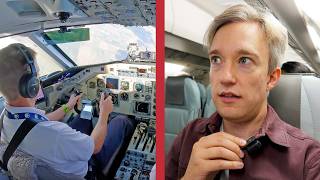
This video takes viewers inside Cranfield University's National Flying Laboratory Centre, a unique facility where students experience real flight dynamics. The creator joins a test flight in a Saab 340B, participating in five exercises that demonstrate non-standard maneuvers, from G-force turns to stall prevention. Along the way, he learns valuable lessons about aviation, human physiology, and the importance of hands-on education.
Cranfield University was originally the College of Aeronautics, located on a former RAF base. It has about 5,000 students, mostly postgraduates.
The flying laboratory is a Saab 340B, a former regional airliner. It flies over 2,000 students a year from 22-23 universities across the UK and Ireland.
The centre also conducts research (virtual flight data recorder, engine propeller, emissions) and STEM outreach, inspiring children who've never been near a plane.
The aircraft has vortex generators added after initial test flights, showing how design evolved without computer simulation in earlier eras.
Students are typically second- or third-year undergraduates who have theory knowledge but need to see how it feels in real life.
Exercise 1: G-force. The plane banked up to 60 degrees, pulling a sustained 2G. The creator made a critical error: turning his head under G-force, causing motion sickness.
Two rules to avoid motion sickness: don't look at the screen during G-force, and don't turn your head. Keep your head still and move your eyes.
Exercise 2: Stick pusher. The plane was pushed towards a stall, and the stick pusher activated at 101 knots, pushing the control column forward to prevent the stall.
Exercise 3: Phugoid pattern. The pilot released the controls, and the plane gently oscillated up and down, damping its own motion. It's a stable, gentle roller coaster.
Exercise 4: A faster phugoid pattern. The pilot pushed and pulled the control column, and the plane corrected itself due to its design.
Exercise 5: Sensory illusion. The pilot performed a slow, steady turn that the creator's brain completely missed, while a sudden maneuver was obvious. This shows how poor our internal senses are at detecting slow changes.
The main lesson: don't turn your head during G-force. This is the second time the creator learned this lesson.
Cranfield University's flying laboratory offers a unique blend of education, research, and outreach, giving students and visitors a firsthand experience of aviation physics that no simulator can replicate.
What is the name of the flying classroom at Cranfield University?
The National Flying Laboratory Centre at Cranfield University.
00:26
What type of aircraft is used as the flying laboratory?
The Saab 340B.
01:46
How many students fly with the National Flying Laboratory Centre each year?
Over 2,000 students a year from universities across the UK and the Republic of Ireland.
01:46
What is the purpose of the stick pusher?
To prevent a stall by pushing the pilot's control column forward.
11:00
At what airspeed did the stick pusher activate during the demonstration?
101 knots.
11:26
What are the two rules to avoid motion sickness under G-force?
Don't turn your head during G-force, and don't look at the screen.
07:32
What is a phugoid pattern?
A phugoid pattern is a gentle, oscillating up-and-down motion where the aircraft pitches up and down, overshooting and undershooting its target speed.
12:04
Why doesn't a plane plunge to the ground when the pilot releases the controls in a phugoid pattern?
The aircraft is designed to be stable and damps down its own motion, gently overshooting and undershooting its target speed.
13:04
Why is it difficult to detect a slow, steady turn without external references?
The human inner ear is poor at detecting slow, gradual changes, making it easy to be fooled by sudden maneuvers.
16:34
Flying Classroom Scale
Reveals the impressive scale of the program, flying over 2,000 students annually from 22-23 universities.
01:46Theory vs. Reality
Highlights the core educational value: bridging the gap between classroom theory and real-world experience.
05:14Motion Sickness Prevention
Provides practical, actionable advice for anyone experiencing G-force: keep your head still and move your eyes.
07:32Stick Pusher Activation Speed
Gives a specific, testable number (101 knots) for when the stick pusher activates, useful for aviation students.
11:26Human Sensory Limitations
Explains why instrument flying is a different skill, based on the human body's poor ability to detect slow changes.
16:34[00:00] My flight is going to go wrong on purpose, as my road trip brings me to Bedfordshire. You might have noticed that the opening drone shot for this episode was a little middle of nowhere.
[00:12] Couldn't get any closer to the filming location, because today's filming location is an airport, and also a university, and it's kind of the same thing. Welcome to Cranfield University.
[00:26] Cranfield was originally the College of Aeronautics. It has about 5,000 students, mostly post graduates, and the main campus is a former Royal Air Force base, RAF Cranfield. And I was visiting the National Flying Laboratory Centre, the flying classroom, which is not the big plane.
[00:44] So we're technically going air side. We are going to be going air side, that's right. Hold on, wait. There are two planes here. Yes. That's the big old plane. This is the one that we're going to be flying in today. Yeah, the 737 is a static aircraft that uses a ground laboratory here.
[01:00] Right. For a whole number of exercises, some being evacuation drills, some being intelligent emergency lighting. It's all sorts of stuff. So they had a trial recently where they looked at, OK, if we can automate the emergency exit lights such that
[01:15] if that exit is not available, we turn the lights off, does that actually encourage the people to go to the exits that are safer? You can volunteer to help test evacuation. procedures, although I suspect one of the problems with that research is the sort of
[01:29] person who gets excited about volunteering to help test evacuation procedures is not exactly representative of the general public. Anyway, that's Rob that I'm talking to. He was the pilot that day. We headed airside and went to the Flying Laboratory, a Saab 340B that used to be a regional airline.
[01:46] We're flying over 2,000 students a year in it at the moment, from all across the UK and the Republic of Ireland. The students from the universities? Yes, universities. So, 22, 23 universities outside of Cranfield.
[02:00] So, if you're doing an aeronautical engineering degree, the chances are you'll fly with us. Be we from Glasgow, Southampton, Swansea, all across the country, at some stage those students will fly with us.
[02:13] And for them, it's probably their only practical flying experience. There was still a couple of weeks until the academic year started, so that day's flight was a couple of things. It was a start of season test for the plane, and it was also a chance to take some grad students, professors, business partners, and visiting people with the camera on the sort of test flight that a student might get to experience.
[02:34] Today, we'd be doing five exercises to demonstrate what could be called non-standard maneuvers, or in other words, things pilots aren't usually meant to do. So first, that plane's a classroom. Second, the other thing we do is research work, and we do a whole load of different research stuff.
[02:50] One of them is the virtual flight data recorder, for example. We did some engine propeller research last year. We did some emissions research work earlier this year. So classroom research.
[03:03] And then the third bit that we're really good at, I think, is STEM outreach work. We can get kids on an airplane. You know, quite often children who have never been close to an airplane, it's so hard to get. No one can get in the flight deck anymore.
[03:15] No. So, but here we've got a 737, we've got the real airplane that flies. You know, for those youngsters who aren't sure what they want to be, but they quite like the STEM stuff, we can really inspire them about getting into aviation.
[03:28] We did a walk around of the plane, which had a couple of modifications. Can you see the vortex generators underneath? Oh, all those little things there, Chris. The spiky thing. Yeah, the spiky thing. So you'll see those. There's a spiky thing at the front.
[03:41] We've got more sections under here. They were all produced after the aircraft first flew, generally. What happens is, back in that day, they'd design the aeroplane, think it's okay, hand it over to the test pilots.
[03:54] The test pilots would fly it and go, hmm, not quite right. No computer simulation. No computer simulation in those days. So they'd go back and they'd fit some vortex generators, hand it back to the test pilots and say, what do you think now?
[04:06] And they'd go, now it's all right. So if you look around on the aeroplane there's all sorts of quirks and things that just identify the era in which it was flown. We went inside and, well, it was a plane. They gave me a mobile of it.
[04:19] The in entertainment was a bit unusual though I holding on to my a tablet here which is held by the demonstrator who sits in the cabin attendant seat And the demonstrator will control the flight
[04:32] He will control what the students see. So depending on what we want to do, we'll have different displays. If you've ever been on a long-haul flight with that moving map display, this was that, but with so much more detail.
[04:45] There are signalers located in every seat pocket. We try not to use them, but we often do use them. I have been told that there are going to be some maneuvers like that. There will be. I'm being given a job here.
[04:59] The same job that, I guess, first-year students would have, or... They are. Well, actually, the students we fly are typically second- or third-year undergraduate students from our university. So they've had a bit of time at university. They understand much more about aerospace and aerodynamics than they did when we started.
[05:14] so that when they fly with us, they can sort of, they've got the theory in their heads, but it's all about what does the real world look and feel like? And that's where this aeroplane is really important.
[05:26] They've got, you know, they've done the lectures, they've done the seminars, but we get them in the aeroplane and say, okay, you've seen it on PowerPoint, this is how it looks and feels and smells in real life. So enjoy it. And they do enjoy it.
[05:38] I mean, even those that maybe don't feel very well, they still have a smile on their face. Oh dear. And they learn things and they feel things that they would never do in a simulator. There was a full and detailed briefing about the flight and about safety.
[05:51] The pilots checked over the flight plan and then we all passed through a working replica of a tracking system and boarding gate, because that is also something that scientists might want to research. Our demonstrator was Simon and he took us out to the plane,
[06:04] gave us a quick rundown about what it could do, and soon enough the engines were starting up, the propellers were spinning, and we were taken to the sky. The plane's going to look a little empty from some camera angles, first because I was trying not to get people's faces in shot too much, and second because only the window seats were
[06:19] occupied. We reached the block of airspace we'd been assigned, and it was time for exercise one, G-force. This was a bit of a warm-up. The pilots were going to bank the plane more and more and more, and the students' job was
[06:31] simply to write down the elevator angle, the force that the pilot was using to pull the stick and the g-force we were undergoing which sounds easy apart from the fact that we were under g-force so just that start so to get the books ready the screen will only pause for 15
[06:47] seconds this was obviously quite simple when we're going straight ahead at one g then we started to bank that's our next stage point 30 degrees doesn't sound like much but
[07:00] the turn then kept getting tighter and tighter and by the end of the first exercise we were turning at a 60 degree bank angle and pulling a sustained 2G. You can see my camera's stabilisation struggling to cope with everything that was going on, and frankly, so was I.
[07:15] First and thank you, end of test. Okay, well done everybody, you made it, well done. Full marks to Rob the pilot there, that was 2.00G. He managed to hit his target to two decimal places, unbelievable. I, on the other hand, had got confused at some point and scrambled
[07:32] my data because I'd made a critical error and it was something I should have known. There are two rules of how not to get motion sick when you're under g-force. The first... Do not look to the screen during g-force. I'll put the tube and the papers.
[07:47] And the second is, don't turn your head during g-force. And I knew that, and I still did it because I wanted to look out the window and see the screen
[08:00] and see my papers and if you're ever in a situation like this keep your head still and move your eyes because turning your head under g-force messes up all the balance stuff in your inner ear and suddenly you will feel sick and as a result i'm pretty sure i would have failed that test
[08:15] as a student my copy book was a mess still four more exercises to go the next one was to demonstrate the stick pusher so for this one i would like to check all those articles are
[08:28] essentially away, there's your tights are strapped in, that's just going to be tight grip, and you should be able to thumbs up or wave to tell me that you are all strapped in. Thanks very much, lots of thumbs up, thank you.
[08:41] I would have loved to have been loosely strapped in because we were going to be pulling a very brief negative G manoeuvre where your feet dropped away from under you But I was on camera and I was behaving There still quite a reaction though It did take us a
[08:56] few minutes to get into position for this one, so while that happens, keeping your computer and internet connection safe is something that I am meant to know about. So when NordVPN asked me to talk about their next gen antivirus, I was sceptical. I spent a long time talking
[09:11] to one of their product and engineering managers talking about security and privacy, and he's convinced me that they know what they're doing. Buy next-gen antivirus, meaning it acts before malicious stuff gets downloaded to your system. So they'll block phishing sites and fake shops
[09:26] and scam sites. If you find lists of leaked or stolen credentials that match yours, they'll warn you, and they'll do it while still maintaining your privacy. They've got independent test results to back up that it works above the protection that's built into your computer
[09:40] or your phone. And of course, the regular VPN is still there too. I'm still using it regularly, and I have done now for years to get around region blocks on content. If I'm in Europe, like I am now, there are American sites that block the entire continent, all but just send
[09:55] me to the local version without an option to switch back. NordVPN runs on Windows, Mac, Linux, iOS, and Android, covering up to 10 devices at the same time, and the 30-day money-back guarantee. Go to nordvpn.com.com, scan the QR code on the screen, or click the link in
[10:09] the description to get the best deal they're currently offering. Right, we have reached the assigned bit of airspace for the stick pusher test. The propellers went to maximum RPM, and the pilots pushed the plane towards the stall.
[10:21] So, if a plane pulls up too fast or travels too slowly, the airflow over the wings can become turbulent, and the lift goes away. It's recoverable, but, you know, bad. Best way I can describe it is, imagine the plane is in normal flight.
[10:35] This angle, absolutely fine. This angle, bad. Not going to work. Now, if the plane's a fighter jet or something going straight up, that angle's absolutely fine, but, you know, this one would be bad.
[10:47] A stall happens at the transition point, when there's too much difference between the direction the aircraft's going and the direction in which the wings work. So, we went into a climb, further and further and further, and our airspeed reduced and reduced and reduced,
[11:00] and we were all waiting for the emergency override to kick in, the stick pusher, which would suddenly push the pilot's control column forward to prevent a stall. If that ever activates in normal flight, that's obviously bad.
[11:14] But today, keep your eyes on the pilot's control column, because just for a moment, Rob won't be the one controlling. Get ready for push. Get ready. Get ready.
[11:26] Here we go. 101. Excellent. 101 knots side up. 101 knots was the airspeed at which the push I did manage to write that down.
[11:39] Everybody okay? Nobody fell out? Everybody still there? Yeah, good. We got all sorts of diagrams and charts about what happened, but Rob was right. There is no substitute for having your chair drop out from under you and your seatbelt pull you down.
[11:52] I've never experienced something close to a source in an aircraft before, and that was quite a strong drop. Do you want to see my face there? I'm used to those now. I like the way it goes these days.
[12:04] If that was unexpected on a commercial flight, that would have caused the screening. Item 3 was the Fugoid pattern, which somehow I'd never heard of before this flight. The pilot's going to raise the nose now, which you can see up there.
[12:17] When we get to about 20 degrees nose up, the pilot will release the control. She's got a bit of negative G initially. Here we go. Stick us a wrist. This was joyful. A gentle, almost zero G moment of floating.
[12:31] floating, but I think most people would assume that if the pilot releases the control, the plane is going to rapidly lose all direction and plunge towards the ground. But in normal conditions, assuming all the settings are dialed in, that's not what happens.
[12:45] Now, the aircraft wants to get back to its turn speed of 180 knots, but you can see we're pitching down now, and speed is building up, losing altitude. But notice that we pass through the speed that the Sonic X did. There's the aircraft over the chutes, building up more lifts, and the start of the
[13:04] disrepair This was lovely like a gentle up and down roller coaster The plane is designed to be stable because of course it is It damps down its own motion gently overshooting and undershooting its target speed And the pilots were calm and just letting the plane do its
[13:20] thing. Pilots need to control this so that they'll sort of recover the structure that they're in. It would probably take some manual intervention to get that oscillation back down to zero, and it is possible to get an unstable fugoid pattern, or for a pilot to
[13:34] panic and make it worse. Fugloids have caused air disasters, but like this? It was really nice. Exercise 4 was a much faster fugloid pattern. Very simply, the pilot was going
[13:46] to pull, and then later push the control column one short motion. And just as before, the plane is designed to stay stable, and every setting chosen would help with that. It was
[13:58] a bit more dramatic, though. Make sure your seatbelts try to snap, so you can fly around. And again, keep your eye on what the pilot is doing. OK, so the pilot is ready. I'm going to count them in this time. OK, so get ready. 3, 2, 1, go.
[14:14] If you don't know about planes, you might have seen that a pilot pushing and pulling the control column like that could cause a disaster. And yes, it's briefly startling, but then the design of the plane corrects for it. This angle of attack causes the change of pitch moment to oppose the input
[14:31] only to flood the airships. It's a very highly downed system so that's what we want the aircraft to do so the pilot doesn't have to make any corrections for this one at all. That would have caused some screening on a commercial flight, that would.
[14:46] It's a lot of fun in this context but... I guess the... So if you could help me out here, if you could lower the window screen split We'll try and get rid of all our external compression spikes for this one.
[15:01] Our last demonstration is a classic. I knew the trick. I understood how it worked, and I was still very bad at it. So what the plant's going to do is start with the exhaust press level. Then we'll do series of maneuvers.
[15:14] And at the end of that, the pilot will say, on condition. And you and I have to work out what is the aircraft doing. With no external reference points, that was difficult. You get to see two things here. What the aircraft's doing and my face as I try and work it out.
[15:30] Here we go. OK, I see you. Lighter. Change the air. Dispensers. Stop. Dispensers. OK, that's a strong turn to the right. That's a very strong fight to the right.
[15:44] Flight chief forces definitely fight to the right. Hard. So, honestly, it feels like we're continuing to fight the sun. Is that right?
[15:56] Has that sound eased off? Now, that feels like we're down the straight. Now, the front back's right here.
[16:08] Did you spot that? Twice, Rob the pilot pulled a strong, sudden manoeuvre up and to the right relative to what we were doing. But my brain had entirely missed the much longer, slow, steady turn down and left.
[16:22] If they are going up and to the right. I knew they were trying to fool us, but I didn't know how or in what direction. And every part of me, balance system, brain, every part agreed.
[16:34] Your internal organs in your head are very poor at identifying slow race changes and very easy to get so excited when you just have external vectors.
[16:47] It's the same trick that motion rides and simulator rides use, and it's the reason that instruments flying at night and in bad weather is a very different skill to flying by eye. That's not the main lesson I took from a flight in Crownfield University's laboratory, though.
[17:02] The thing I learned for the second time in my life was something I should already have known, and as we came into land, I shared it with the camera. If there's one lesson that I would like to impart to everyone watching this video,
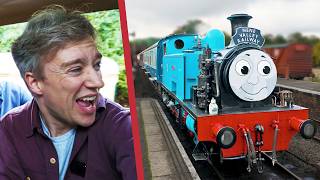
[17:15] don't turn your head during cheese course. Next time, or right now on Nebula, a train that doesn't violate trademarks, and I hold on for dear life in a screaming void.
⚡ Saved you 0h 17m reading this? Transcribe any YouTube video for free — no signup needed.