
SpaceX's Unstoppable Pace: New Records Every Day!
60sHighlights the unprecedented speed of SpaceX's development, sparking awe and curiosity.
▶ Play Clip"The title promises something 'never seen' and delivers a detailed breakdown of rapid testing, though the 'ready to launch every month NOW' is slightly overstated as it's a goal, not a current reality."
SpaceX is accelerating its Starship testing program at an unprecedented pace, completing two full test campaigns in under nine days. The video analyzes the rapid S40 and S41 testing timeline, a modified engine ignition sequence, and the company's goal of monthly Starship launches starting with Flight 13.
SpaceX's progress is now measured in days and hours, not months or weeks, as it prepares for monthly Starship launches.
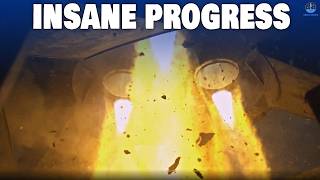
Ship 40 completed a full 60-second static fire with new footage showing wide-angle and close-up views, confirming engines can sustain high thrust for extended periods.
SpaceX appears to have changed the startup sequence from three vacuum Raptors and one sea-level Raptor to two vacuum and one sea-level engine, possibly improving redundancy or aiding booster flip maneuver.
From June 23 to July 2, SpaceX completed two separate test campaigns: S40 (cryo, single-engine static fire, full-duration six-engine static fire) and S41 (two cryo proof tests hours apart).
Gwynne Shotwell indicated Flight 13 is expected to launch this month; with S40's static fire complete, the schedule looks achievable.
B20 completed cryo testing in early June; pad 2 is undergoing upgrades, and a static fire may be imminent, potentially enabling a July launch for Flight 13.
Starting with Flight 13, SpaceX aims to launch Starship every month, requiring continuous manufacturing, testing, and preparation of vehicles.
The real challenge is not building momentum but sustaining it month after month, requiring automation, expanded infrastructure, and logistics.
SpaceX plans to shift from manual assembly to automated manufacturing with laser welding robots, AI-assisted inspection, and automated tile installation.
Multiple operational pads, improved flame trenches, water deluge systems, and chopsticks are needed to support frequent launches and recoveries.
SpaceX is demonstrating a testing cadence that makes monthly Starship launches feel achievable, but sustaining that pace requires a complete overhaul of production, testing, and launch infrastructure. Flight 13 could mark the beginning of a new era in routine spaceflight.
What is the new engine ignition sequence for Starship during staging?
Two vacuum Raptors and one sea-level Raptor instead of three vacuum and one sea-level.
01:45
How many days did it take SpaceX to complete two full test campaigns?
Less than nine days, from June 23 to July 2.
04:47
What is SpaceX's goal starting with Flight 13?
To launch Starship every month.
07:28
What are two possible reasons for the modified engine ignition sequence?
Improved redundancy in case of engine failure, and allowing the plume to interact with Super Heavy during the booster flip maneuver.
02:10
Nine-Day Test Marathon
Demonstrates a dramatic acceleration in SpaceX's testing cadence, completing two campaigns in under nine days.
04:47Engine Ignition Change
A subtle but potentially significant engineering tweak that could improve mission resilience and booster recovery.
01:45Monthly Launch Ambition
Sets a clear, ambitious target that would transform spaceflight operations if achieved.
07:28Automation Push
Highlights the shift from manual assembly to industrial-scale production, essential for sustainability.
09:05[00:09] Honestly, it's becoming difficult to keep up because the company has reached a pace of development unlike anything we've seen before. Progress is no longer measured in months or even weeks. It's unfolding in days and sometimes in just
[00:23] hours as SpaceX lays the foundation for what could soon become monthly Starship launches. So, just how quickly is SpaceX moving? And could monthly Starship flights really begin sooner than any of us expected? Let's dive into it on
[00:37] today's episode of Great SpaceX. Things are changing so quickly that if you look away for a day or two, you might come back to an entirely different Starship program with one rollout already complete before most people even
[00:51] realized it happened. That's exactly why we work to bring you daily updates on everything happening at SpaceX. So, if you haven't already, be sure to really helps support the channel as we continue pushing toward 1 million
[01:06] subscribers. Now, let's head back to Starbase. The recent testing campaign, episode, centered around Ship 40 has been nothing short of remarkable. After completing its latest round of testing,
[01:19] Ship 40 has already returned to the production site and judging by everything we've seen, that's a very encouraging sign. SpaceX also released impressive new footage of the campaign featuring wide angle views, close-up
[01:31] shots of the vehicle, and detailed angles from both above and below the engine section, providing one of the clearest looks yet at Ship 40's full 60-second static fire. Besides confirming that the engines could
[01:45] sustain high thrust for an extended period, the footage also revealed something particularly interesting. SpaceX appears to have modified the engine startup sequence. Instead of igniting three vacuum Raptors and one
[01:57] sea level Raptor during staging, the new sequence appears to use two vacuum engines alongside a single sea level engine. That may seem like a minor adjustment, but it could represent an important evolution in how Starship
[02:10] separates from Super Heavy. There are a couple of possible explanations. First, it could improve redundancy by making the separation process more tolerant of an engine failure like the vacuum Raptor issue seen during flight 12, ensuring
[02:25] the mission can continue even if one engine doesn't cooperate. The second possibility involves the booster itself. Traditionally, Starship separates rapidly using three vacuum Raptors and one sea level Raptor with the sea level
[02:38] engine providing steering through its gimbal system. But reducing the number of vacuum engines at ignition could slightly slow that separation. Oddly beneficial because it could allow Starship's engine plume to interact with
[02:52] Super Heavy for a little longer during the active booster flip maneuver, a technique SpaceX has been refining over several recent flights to help rotate the booster onto its return trajectory while minimizing the propellant required
[03:05] for additional engine burns. Under the original hot staging design, SpaceX could take advantage of this effect by sealing vents on one side of the hot staging ring. The redesigned hot staging system offers several improvements, but
[03:18] one trade-off is that this particular technique becomes much harder to use, so adjusting the engine ignition sequence may be one way to recover some of those benefits. Of course, that's only one possible explanation, and there may be
[03:32] simply don't know yet. What do you think? Could this new ignition sequence serve another purpose? I'd love to hear your theories in the comment section >> As impressive as the testing itself has been, it's only part of the story. The
[03:46] real headline is the incredible speed at which everything happened. Let's rewind the time. S40 first rolled out to Massey's on the evening of the 23rd. By the 25th, it had already completed its single engine static fire. The following
[04:02] morning on the 26th, it unexpectedly returned to Mega Bay 2. At first, many people assumed that meant delays. Instead, SpaceX immediately shifted its Instead, SpaceX immediately shifted its attention to S41. On June 28th, S41
[04:17] rolled out to Massey's and between the afternoon of June 29th and the morning of the 30th, it completed two separate cryogenic proof tests before returning to the production site later that same day. Before anyone had much time to
[04:31] process that, S40 was already heading back to Massey's. It rolled out during the evening of the 30th and on July 1st, it completed its full duration six engine static fire. By the afternoon of the 2nd, S40 was already back at the
[04:47] production site. Think about that timeline for a moment. From June 23rd through July 2nd, a span of less than nine days, SpaceX completed two separate testing campaigns involving two different Starships. S40 completed
[05:02] cryogenic testing, a single engine static fire, and a full duration six engine static fire, while S41 completed two cryogenic proof tests only hours apart. That's an extraordinary pace. Historically, major testing campaigns
[05:17] between Starships or even individual test attempts were often separated by weeks or even months. Now, those same milestones are happening only days apart and sometimes even faster. If you're impressed by this incredible pace, let
[05:31] me know by commenting speed X down below. So, what does all of this actually mean? Last month, SpaceX President Gwynne Shotwell shared two particularly important updates. The first involved flight 13, which she
[05:46] indicated is expected to launch this month, and with S40 already having completed its major static fire testing, that schedule suddenly looks much more achievable. At this point, the remaining work primarily involves installing the
[05:59] payload and the flight termination system before final launch preparations. And if SpaceX can move this quickly with a Starship, there's every reason to believe it can do the same with a booster. That brings us to booster 20.
[06:14] B20 completed cryogenic testing back in early June, and since then, pad two has continued undergoing extensive upgrades and system testing. launch complex running comprehensive checkouts, all strong indications that
[06:30] its static fire may not be far away. Honestly, don't be surprised if you go to bed one night with B20 sitting inside make a bay one, only to wake up and discover it's already standing on pad two preparing for testing. That's just
[06:42] the kind of pace SpaceX has been operating at lately. If B20 completes its static fire next week, a July launch for flight 13 becomes a very realistic possibility. But B20 isn't the only story. Additional surprises could come
[06:57] from B21. With Massey's temporarily available while S41 awaits future testing, B21 may be next in line. And the recent move of its forward section, including the hot staging ring and grid fins into make a bay, strongly suggests
[07:13] Potentially allowing cryogenic testing to begin sooner rather than later. This rapid transition from S41 to B21 also reinforces Gwynne Shotwell's second major announcement. Beginning with flight 13, SpaceX wants the Starship to
[07:28] launch every month, not every few months, but every month. That's an ambitious goal, and reaching it requires far more than simply building rockets. SpaceX must continuously manufacture, test, inspect, and prepare enough
[07:41] vehicles to ensure another flight ready Starship is always waiting in the pipeline. And until full reusability becomes routine, that also means maintaining a steady supply of new hardware whenever additional testing is
[07:53] That's exactly why the recent S40 and S41 campaign is so significant. It isn't just an isolated burst of activity. It's a demonstration of the pace SpaceX hopes to make routine. The obvious question is, when does monthly launching actually
[08:08] become reality? Personally, I think these recent testing campaigns offer an encouraging glimpse of what's possible. If SpaceX can consistently maintain this realistically begin before the end of
[08:21] people expect, especially if flight 14 hardware continues progressing at its current pace, and an August launch becomes achievable. But perhaps the better question isn't whether SpaceX can launch monthly, it's whether the company
[08:36] can keep doing it month after month. That's the real challenge. Building momentum is one thing, sustaining it is something else entirely. To accomplish that, SpaceX needs to strengthen every part of the Starship ecosystem.
[08:51] Production comes first. Building Starships and Super Heavy Boosters can no longer rely primarily on manual assembly, as the long-term goal is a highly automated manufacturing system capable of producing rockets with the
[09:05] efficiency of an industrial assembly line. Facilities like Star Factory and with additional Gigabases expected to follow. Automation will also play an increasingly important role, as laser welding robots, AI-assisted inspection
[09:21] systems, automated tile installation, and standardized manufacturing processes all have the potential to dramatically reduce production time while improving consistency. The ultimate objective is simple, always
[09:34] waiting for their turn. Testing infrastructure must evolve as well. As launch frequency increases, Massy's can no longer function as a single sequential test site, making additional test stands and expanded capabilities
[09:49] essential for supporting multiple vehicles simultaneously. The launch pads present another major challenge. No part of Starship's infrastructure experiences more stress than the launch complex itself, and maintaining a monthly or
[10:02] eventually even higher launch cadence will require multiple operational pads working in parallel. That's exactly why SpaceX continues investing in both Starbase and Florida, where pad redundancy ensures one facility can
[10:16] continue launching even while another undergoes maintenance or upgrades. Continued improvements to the flame trench, water deluge system, chopsticks, and catch tower will also help reduce wear while supporting increasingly
[10:29] frequent launches and recoveries. Behind the scenes, logistics matter just as the scenes, logistics matter just as much. Tank farms must handle enormous of liquid oxygen and methane. Storage capacity must continue expanding,
[10:42] transfer systems must become faster, and transportation networks, including barges and support equipment, must scale alongside rocket production. Launching the world's most powerful rocket every month demands an equally powerful
[10:55] support system. Taken together, it's clear SpaceX isn't simply chasing another record. The company is redesigning the entire process of building, testing, launching, and eventually recovering rockets. The goal
[11:08] isn't simply to launch faster, but to make Starship operations feel as routine and repeatable as commercial airline flights. Looking at everything that's happened over the past couple of weeks from the rapid S40 and S41 test
[11:21] campaigns to the continued expansion of production facilities and launch infrastructure, it's hard not to feel like we're witnessing the beginning of an entirely new era. Monthly Starship launches remain an ambitious goal, but
[11:33] for the first time, they no longer feel like a distant dream. Now, the big question is this: Will flight 13 become the mission that truly kicks off Starship's next chapter? We'll be watching every step of the journey, and
[11:46] anything, it's that when it comes to SpaceX, the next surprise is probably only a few days away. And that brings us to the end of today's episode. Thank you so much for tuning in. As always, this has been Kevin from Great SpaceX. And
[11:59] until next time, keep looking up. Can launch monthly.


⚡ Saved you 0h 12m reading this? Transcribe any YouTube video for free — no signup needed.