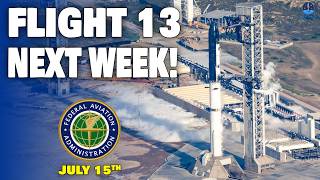

SpaceX's Aggressive Flight 13 Window
45sThe surprising early launch window for Starship Flight 13 sparks curiosity and debate among space enthusiasts.
▶ Play Clip"Delivers on the 'insane news' promise with concrete dates and details, though some padding and subscription asks dilute the value."
SpaceX has revealed an aggressive launch window for Starship Flight 13, targeting mid-July, and has launched the Transporter 17 rideshare mission carrying the first commercially built nuclear-powered payload. This episode covers the readiness of the Starship vehicles, Pad 2 upgrades, Pad 1 reconstruction, and the significance of the nuclear-powered CubeSat.
FAA documentation released July 7 lists July 14 as primary launch opportunity, with backups through July 21. July 15 appears in some docs due to time zone differences. Launch time ~5:45 p.m. Central.
Ship 40 completed single-engine and full six-engine static fire tests. Remaining work: inspections, final integration, payload installation, and flight termination system (FTS) before rollout.
FAA temporary flight restriction for Massey's test site July 9-15 suggests another static fire may occur, possibly for Ship 40 or Ship 41, which could shift the launch date.
Booster 20 completed cryogenic testing but still needs a static fire. FAA restriction at launch site suggests it's imminent. SpaceX may keep booster at pad to save time.
Host predicts launch around July 20, allowing flexibility for unexpected issues, though earlier launch possible if everything goes smoothly.
Pad 2 completed water deluge tests and BQD operational tests. Chopsticks received new damper system and possibly electric components, improving precision and reducing vibration.
Pad 1 rebuilding orbital launch mount and trench infrastructure. New GSE gantry frame taking shape. Ship QD arm extension removed, likely for larger V3 Starship design.
Falcon 9 launched 81 payloads from Vandenberg on July 7. Booster landed on drone ship, marking its 11th flight. Total rideshare payloads exceed 1,800.
BOR CubeSat carries first commercially developed nuclear-powered technology (nanotritium betavoltaic) into orbit. It captures beta particles from tritium to generate electricity.
Technology could power spacecraft in permanently shadowed lunar craters, supporting NASA's Artemis program. Funded by DoD contract, first nuclear commercial launch approved under FAA framework.
SpaceX is pushing for a rapid Starship Flight 13 launch in mid-July, with hardware readiness and potential static fires as key variables. The Transporter 17 mission highlights both Falcon 9's reliability and a historic step toward commercial nuclear power in space.
What is the primary launch date for Starship Flight 13 according to FAA documents?
July 14th, with backup dates through July 21st.
01:39
What major milestone has Ship 40 already completed?
Both single-engine and full six-engine static fire tests.
02:44
What remaining work is needed for Ship 40 before rollout?
Inspections, final integration, payload installation, and fitting the flight termination system.
02:57
Why might the FAA temporary flight restriction at Massey's test site indicate another static fire?
Such restrictions normally accompany static fire operations, and Ship 40 has already completed its engine testing, so it could be for Ship 40 or Ship 41.
03:31
What is the advantage of keeping Booster 20 at the launch pad after static fire?
It saves time by allowing final inspections and FTS installation while the booster remains on the OLM, keeping Flight 13 on schedule.
05:04
What upgrade did the chopsticks receive on Pad 2?
A new damper system and possibly electric components replacing parts of the hydraulic drive system, improving precision and reducing vibration.
06:30
How many payloads were launched on Transporter 17?
81 payloads.
08:06
What is the BOR CubeSat testing?
City Labs' proprietary nanotritium betavoltaic power source, which captures beta particles from tritium and converts them into electricity.
09:38
What is the difference between nanotritium betavoltaics and radioisotope generators like on Voyager?
Nanotritium directly captures beta particles and converts them to electricity using semiconductors, while radioisotope generators convert heat from radioactive decay into electricity.
09:51
What is the potential future application of the nuclear power technology?
Powering spacecraft in permanently shadowed lunar craters or other harsh environments where solar arrays struggle, supporting NASA's Artemis program.
10:20
Aggressive Flight 13 Window
Reveals SpaceX's intent to launch mid-July, faster than most expected, indicating high confidence in vehicle readiness.
01:26Booster Stay-at-Pad Strategy
Demonstrates SpaceX's operational flexibility to compress timelines by avoiding rollback, a key technique for rapid reuse.
05:04Chopstick Precision Upgrade
Improved damper and possible electric drive reduce vibration, critical for reliable catching of Starship vehicles.
06:30First Commercial Nuclear Payload
Historic milestone for commercial nuclear power in space, potentially enabling long-duration missions in shadowed environments.
09:25Nuclear Power for Lunar Exploration
Connects the technology to NASA's Artemis goals, highlighting its strategic importance for sustained lunar operations.
10:38[00:00] SpaceX has finally revealed some insane news. The official launch window for
[00:12] Starship Flight 13 and it's even more aggressive than almost anyone expected. If the schedule holds this could mark one of the fastest Starship turnaround campaigns in the program's history. But can SpaceX really pull it off? At the
[00:27] At the same time, the company has launched another Falcon 9 rideshare mission carrying dozens of satellites, including something the space industry has never seen before, a commercially built nuclear-powered payload.
[00:41] Why is this mission generating so much attention? How could it reshape the future of space operations? Let's dive into all of it on today's episode of GreatSpaceX to find out. If you've been following SpaceX lately, you've probably noticed that everything seems to be moving at double speed.
[00:58] One day Starship is testing, the next day new launch dates appear, and before you can catch up, Falcon 9 is already launching another record-breaking mission. Trying to keep up sometimes feels like binge-watching an entire TV series in one weekend.
[01:12] That's exactly why we cover these updates every day. And if you haven't subscribed yet, now's the perfect time, because the next few weeks could be some of the busiest in Starship history. Let's start with the biggest headline, Starship Flight 13.
[01:26] The long-awaited launch window has finally appeared. On July 7th, the Federal Aviation Administration released updated documentation for Flight 13, giving us our clearest look yet at SpaceX's current launch plans.
[01:39] According to the FAA documents, July 14th is listed as the primary launch opportunity, with backup dates extending through July 21st. Some documentation shows July 15th instead, but that's simply the result of time zone differences rather than conflicting schedules.
[01:56] Either way, SpaceX is targeting the middle of July instead of the end of the month, which surprised almost everyone following the program. Launch time remains around 5.45 p.m. Central, continuing SpaceX's preference for late afternoon launches that allow daylight visibility during both booster recovery operations and ship reentry.
[02:15] That's an ambitious schedule. Not long ago, many observers, including myself, expected Flight 13 to slip toward the final week of July. Instead, SpaceX appears eager to move much sooner.
[02:27] So, when do you think Flight 13 will actually launch? Will it fly on the very first day of the window, or slide toward the back updates? Let me know your thoughts and predictions in the comment section down below. But before you make any predictions, though, it's worth asking a more important question.
[02:44] and SpaceX realistically has the vehicle ready in time. As 40 is already in excellent shape, it successfully completed both its single-engine and full six-engine static fire tests at the end of June and the beginning of July.
[02:57] Those major milestones are now behind it The remaining work includes inspections final integration payload installation and fitting the flight termination system before rollout to the launch pad An interesting clue appeared on July 7th Observers spotted the payload loader arriving at
[03:14] Star Factory where it will likely receive the simulated version 3 Starlink payloads before transporting them to Megabay 2 for installation inside S40's payload dispenser. Once that process is complete and the FTS is installed, S-40 should be ready for launch operations. On paper, that's
[03:31] achievable within a week. However, another possibility has emerged. The FAA also issued a temporary flight restriction covering the Massey's test site between July 9th and the 15th.
[03:43] Normally, those restrictions accompany static fire operations. Since S-40 has already completed its engine testing, this raises an interesting question. Could SpaceX be preparing another static fire. Given the company's increasingly aggressive testing strategy, another verification
[03:59] firing isn't possible. Alternatively, the restriction could involve S-41 instead. S-41 recently completed cryogenic testing before returning to Mega Bay 2 on D-6, making it another possible candidate. Until road closures begin and hardware starts moving, nobody can say
[04:16] with certainty which vehicle is headed back to Mavis. If S-40 performs another static fire, Flight 13 will probably shift toward the end of the launch window. Then, there's B-20. Unlike S-40, B-20 still has one major milestone ahead.
[04:32] It successfully completed cryogenic testing back in early June, but its static fire campaign still needs to happen before launch approval. The FAA has also issued a temporary flight restriction covering the launch site during roughly the same period,
[04:46] strongly suggesting B-20's static fire is approaching. Moving the booster to the pad, conducting the firing, reviewing the data, and preparing it for flight normally takes at least a couple of days. Afterwards, SpaceX typically returns the booster to Megabay for inspections and installation of the flight termination system.
[05:04] That alone makes the schedule incredibly tight. However, SpaceX has another option. If B-20 performs flawlessly during static fire, engineers may decide to leave it at the launch pad instead of rolling it back.
[05:17] Final inspections and FTS installation could potentially happen while the booster remains on the OLM, allowing it to wait for S-40's arrival. That approach would save valuable time and keep Flight 13 on schedule.
[05:29] The next week could easily become one of the busiest we've seen at Starbase. Hardware could move with very little warning, and testing might happen almost overnight. Personally, if I had to make a prediction today, I'd lean towards the latter part of the launch window.
[05:43] July 20th seems like a realistic target that still allows SpaceX enough flexibility if unexpected issues arise. Of course, I'd love to be proven wrong if they somehow launch even earlier. The launch vehicle isn't the only thing receiving attention.
[05:58] Pad 2 has also entered an intensive preparation phase After several rounds of water deluge testing engineers have shifted their focus toward the upper launch systems Recently the BQD completed another full series of operational tests
[06:14] including opening, extending the interface, purging connections, retracting, and closing once again. Meanwhile, the chopsticks have quietly received an important upgrade. A new damper system has been installed, and the mechanism now appears significantly smoother than before.
[06:30] Many observers also believe SpaceX has replaced portions of the previous hydraulic drive system with electric components. Whether that's entirely accurate remains to be confirmed, but one thing is obvious.
[06:42] The chopsticks now move with noticeably greater precision and much less vibration. That's not just satisfying to watch, it's exactly the kind of refinement needed for reliable lifting and, eventually, catching Starship vehicles.
[06:56] There's probably enough to discuss, therefore, an entire episode by itself. While Pad 2 prepares for immediate operations, Pad 1 continues its own transformation. Construction crews remain focused on rebuilding the orbital launch mount and frame trench infrastructure.
[07:12] The new ground support equipment gantry frame is taking shape alongside the trench, after which crews will install extensive plumbing that connects the flame bucket, VQD systems, and launch mount hardware.
[07:24] Protective cladding will follow before major launch interfaces begin returning. Higher up the tower, another interesting change has appeared. SpaceX recently removed the ship QD arm extension.
[07:36] The most likely explanation is simple. The existing system isn't optimized for the larger VE-3 Starship design. A replacement better suited to future vehicles is almost certainly on the way. Pat-1 may still be months away from returning to service, but progress is becoming increasingly visible.
[07:53] Its eventual comeback will provide SpaceX with another critical launch site as Starship flight frequency continues increasing. Now let's shift from Starbase to California, where Falcon 9 has quietly completed another impressive mission.
[08:06] SpaceX successfully launched the Transporter 17 Reicher mission from Vandenberg Space Force Base, carrying 81 payloads into orbit. Liftoff occurred at 3.12 a.m. Eastern on July 7th.
[08:19] About eight and a half minutes later, the Falcon 9 first stage landed safely aboard the drone ship, of course, I Still Love You, in the Pacific Ocean. That marked the booster's 11th successful flight.
[08:31] Meanwhile, the upper stage continued toward low Earth orbit, deploying dozens of satellites over the following hours. Transporter 17 continues one of SpaceX's most successful commercial programs.
[08:43] Combined with the bandwagon missions, the company has now delivered more than 1,800 payloads into orbit through dedicated rideshare flights. Transporter 1 still holds the world record after deploying 143 satellites during a single launch back in 2021.
[08:59] This latest mission also marked Falcon 9 79th launch of 2026 Remarkably nearly 80 of this year Falcon missions have supported the continued expansion of the Starlink broadband constellation
[09:12] But another payload attracted even more attention. Hidden among the satellites was BOR, a small CubeSat developed by City Labs. At first glance, it looks like just another tiny spacecraft.
[09:25] Its technology, however, could represent an entirely new direction for space power systems. Bore carries the first commercially developed nuclear-powered technology ever launched into orbit.
[09:38] The spacecraft is testing CityLab's proprietary nanotridium beta-voltaic power source. Unlike the radioisotope generators used on missions like Voyager, which convert heat from radioactive decay into electricity,
[09:51] nanotridium directly captures beta particles emitted by tridium and converts them into electrical energy using semiconductor technology. Although Bore itself still relies primarily on solar panels during this demonstration mission,
[10:04] the nuclear system is being evaluated as a future long-duration power source. That distinction is important. This isn't replacing solar power today. It's proving technology that could eventually power spacecraft operating where sunlight is scarce or non-existent.
[10:20] CityLab's CEO Peter Cabotty described the mission as a historic step for commercial nuclear power in space. If the demonstration succeeds, future spacecraft could operate for years in permanently shadowed lunar craters or other harsh environments where traditional solar arrays struggle to generate enough electricity.
[10:38] Those environments are becoming increasingly important. NASA's Artemis program plans to explore the moon's south polar region, where permanently shadowed craters are believed to contain large deposits of water ice. Reliable power systems will be essential for long-term operations there.
[10:53] While nano cannot currently power an entire lunar base, City Labs hopes the technology will eventually scale into much larger systems capable of supporting future exploration. One advantage of Tritium is its relatively low radiation output
[11:06] compared with many other radioactive materials. According to the company, the system has been specifically engineered for safe handling, transportation, and integration within existing commercial launch environments. The BOR mission was funded under a U.S. Department of Defense contract.
[11:22] It also became the first nuclear-related commercial launch approved under the Federal Aviation Administration's Nuclear Launch Framework, established through National Security Presidential Memorandum 20 in 2019. CityLab believes successful operation of BOR could pave the way for a new generation of compact, nuclear-powered spacecraft
[11:41] supporting commercial, scientific, and national security missions. Whether that vision becomes reality remains to be seen. That brings us to the end of today's episode. Thank you so much for tuning in. As always, this has been Kevin from GreatSpaceX, and until next time, keep looking up.

⚡ Saved you 0h 12m reading this? Transcribe any YouTube video for free — no signup needed.