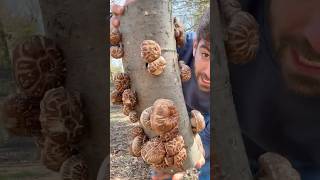

2 Years of Patience Paid Off with Shiitake
45sThe rewarding reveal of mushrooms after a long wait creates an emotional hook that viewers love to see.
▶ Play Clip"Title promises mushrooms and delivers exactly that—a concise, honest guide with no fluff."
This video demonstrates the traditional Japanese method of growing shiitake mushrooms on oak logs, from inoculation to harvest. It covers the materials needed, the step-by-step process, and how to preserve the harvest.
Shiitake mushrooms grow on hardwood like oak, which has a high sapwood ratio that the fungus feeds on.
Drill holes in logs using an angle grinder or power drill.
Use mushroom spawn in plug or sawdust form; plugs are hammered in, sawdust uses a thumb plunger.
Seal holes with food-grade wax to protect from insects/birds and retain moisture.
Stack logs in a shady, rain-exposed area; after a rainstorm, mushrooms appear.
Logs fruit almost monthly until cold, and for years until wood is broken down.
Use fresh mushrooms for dashi stock; slice and dehydrate for storage of 1-2 years.
What type of wood do shiitake mushrooms grow on?
Hardwood like oak, which has a high sapwood ratio.
00:14
What is used to inoculate the logs?
Mushroom spawn, which is wood substrate colonized by shiitake mycelium.
00:26
What two forms does mushroom spawn come in?
Plug form and sawdust form.
00:26
What is used to seal the holes after inoculation?
Food-grade wax.
00:53
Why are the holes sealed?
To protect from insects and birds and seal in moisture.
00:53
Where should the logs be stacked?
A shady place exposed to rain.
00:53
How often do the logs continue to fruit?
Almost every month until colder weather, and for subsequent years.
01:08
How are extra mushrooms preserved?
Slice thin and dehydrate overnight, storing for 1-2 years.
01:20
Inoculation Methods
Explains the two spawn forms and the commercial Japanese method, giving practical options for growers.
00:26Continuous Fruiting
Reveals that logs fruit monthly for years, highlighting the long-term yield of this method.
01:08Preservation via Dehydration
Provides a simple storage solution that extends shelf life to 1-2 years.
01:20[00:00] After two years, my shiitake mushrooms are finally here. In August of 2023, Sylvan and Jordan from Homegrown Hand Gathered came by to teach me traditional Japanese methods of growing shiitake mushrooms. And shiitakes grow on hardwood like oak trees,
[00:14] which have a much higher ratio of sapwood, this outer darker ring, which is what the fungus actually feeds off. And the process started by drilling a bunch of holes in these oak logs, which can be done very quickly with an angle grinder,
[00:26] but a regular power drill works as well. And to inoculate the logs, we're using something called mushroom spawn, which is a wood substrate colonized by the shiitake mycelium, which come in both plug form or sawdust form. The plugs can simply be hammered right into
[00:39] the holes, and for the sawdust, a special thumb plunger is used to fill the holes with the spawn, which is how it's done commercially in Japan for maximum efficiency. Then the holes get sealed with any type of food grade wax to protect the spawn from insects or birds and to seal in all of the
[00:53] moisture. I chose a shady place in my yard to stack the logs, which is still exposed to rain, since fungus of course needs moisture to grow. And after patiently waiting, I went out after a big rainstorm this spring to see my logs had exploded with shiitake mushrooms.
[01:08] I harvested all the mushrooms, but these logs will actually continue to fruit almost every month until it gets colder out and for subsequent years until the mushrooms fully break down the logs and are out of food. I took some of the fresh mushrooms
[01:20] and made a nice shiitake dashi stock, which turned into a delicious noodle soup. And to preserve the rest of the mushrooms, I sliced them up thin and dehydrated them overnight, which will let me store them for about a year or two.




⚡ Saved you 0h 01m reading this? Transcribe any YouTube video for free — no signup needed.