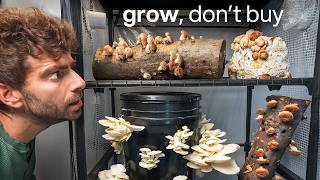

I Grew Shiitake Mushrooms in My Yard
60sThe shocking ease and low cost of growing gourmet mushrooms at home will inspire viewers to try it themselves.
▶ Play Clip"The title promises a personal commitment, and the video delivers a genuine, detailed guide to achieving that goal—no bait-and-switch here."
The video is a comprehensive guide to growing mushrooms at home, covering both outdoor log cultivation and indoor controlled-environment methods. The creator shares their personal journey and practical tips for achieving a self-sufficient supply of gourmet mushrooms.
The creator was inspired by a traditional Japanese method of growing shiitake on logs, which they found easy and cheap.
Outdoor growing is the cheapest option and uses shady areas. Ideal logs are 3-4 feet long and 4-8 inches in diameter. Wood can be sourced from tree-cutting companies or fallen trees.
Two types of spawn: sawdust (quicker but vulnerable to pests) and wood plugs (preferred for durability). Drill holes, insert spawn, and seal with food-grade wax.
A simple lean-to rack can be built from scrap lumber to store logs. This maximizes space and organization.
Mushrooms need moisture and temperate climates. Forcing fruiting by submerging logs in cold water overnight can trigger production in a few days.
A Martha tent with a humidifier and ventilation is essential for indoor growing. It maintains high humidity and allows for year-round production.
Pre-inoculated fruiting blocks are the easiest method, producing mushrooms in 1-2 weeks. Buckets with soaked hay and grain spawn are a cheaper alternative.
Homegrown mushrooms are fresher and higher quality than store-bought, which degrade during transit. The creator now harvests enough for their family's needs.
What are the ideal log dimensions for growing mushrooms?
3 to 4 feet long and 4 to 8 inches in diameter.
02:45
What are the two main types of mushroom spawn used for log inoculation?
Sawdust spawn and wood plug spawn.
03:12
Why is food-grade wax applied over the spawn holes?
To seal the holes, keeping moisture in and protecting from insects and birds.
04:17
How long does it typically take for logs to produce their first mushroom harvest?
8 months to a year, but it can take up to a year and a half.
07:38
What is the 'force fruiting' technique for logs?
Submerge the log in cold water overnight, which tricks it into thinking it's cooler and wetter weather.
08:03
What is needed to grow mushrooms indoors year-round?
A controlled environment, often a plastic-covered frame called a Martha tent, with a humidifier and ventilation.
09:12
How quickly can pre-inoculated fruiting blocks produce mushrooms?
Within a week or two.
12:10
Why are store-bought mushrooms lower quality than homegrown ones?
Because they have been in transit for days or weeks, and mushrooms degrade quickly.
15:01
Force Fruiting Technique
Demonstrates a simple, effective method to trigger mushroom production out of season, significantly increasing yield potential.
08:03Time to First Harvest
Provides a realistic timeline (8 months to a year) for outdoor log growing, setting proper expectations for beginners.
07:38Quality Difference
Explains why homegrown mushrooms are superior to store-bought, highlighting the rapid degradation of commercial mushrooms.
15:01Light Requirements for Mushrooms
Clarifies a common misconception: most mushrooms need light to trigger fruiting, even though they don't photosynthesize.
10:34[00:01] showing you exactly how I set up both an outdoor mushroom growing station and an indoor mushroom growing station that are not only both extremely simple to set up, but the results are damn near shocking with both systems pumping out
[00:15] high quality wild mushrooms to the point where I am completely off-rid from the supermarket commercial mushrooms and living in absolute mushroom abundance. Now, my mushroom growing journey started two years ago when Jordan and Silvin
[00:29] over to my studio to teach me the traditional Japanese method of growing shiake mushrooms on logs. And honestly, I just couldn't believe how one easy it was to do and two, how cheap it was. Wood in a lot of cases is an abundant
[00:45] and free resource. And then on top of that, you're just buying some mushroom spawn to inoculate the logs, which gives you a steady flow of mushrooms to my logs actually fruited for the first time and I got that first harvest that I
[00:58] just became addicted. I mean, these were the freshest shiake mushrooms I've ever had grown in my own yard. And with just a few small logs, it was a pretty cooked a bunch of them fresh and was able to dry a bunch to preserve for the
[01:12] year, which I was using in noodle soups all winter long. So, let's first talk about growing mushrooms outside, which takes longer, but is by far the cheapest option, and it's also a great option for anyone looking to grow food at home
[01:25] because it takes advantage of shady areas outside where you couldn't grow, say, fruits or vegetables, and you do not need much space at all. If you have a fire escape outside an apartment that gets shade, you could successfully grow
[01:39] step is finding the right wood. And different species of mushrooms prefer different species of wood, which can all easily be found on a mushroom chart just you can either start with the mushroom you want to grow and then hunt down the
[01:54] Maybe you already have wood available to you and you get the actual mushroom species that goes with that wood. For me, what I found are the best options are one, you can call up your local tree cutting company and you can ask them for
[02:08] for and maybe they're cutting down one of those trees and they're willing to drop it off for you because it usually costs those companies money to actually dump wood. But when you grow mushrooms outside, you're kind of always on the
[02:20] lookout. you're hunting for those fallen trees, which here on Long Island, there are an abundance of trees, which means a lot of trees are causing issues, need to be chopped down, or they just fall down in a storm. And if you can't identify
[02:33] the type of tree, I use this app called Picture This, and you just take a picture of the tree and it will tell you exactly what it is. Luckily for me, I hit the jackpot because a neighbor of mine had to cut down an oak tree. So, I
[02:45] luckily my neighbor had a more high-powered chainsaw, and I was able to pick out the perfect size logs for mushroom growing, which are around 3 to 4 feet long and 4 to 8 in in diameter. And this range is very manageable to
[02:59] work with the logs. You can move them around easily, but it's big enough that you're going to get years of fruiting before the log fully breaks down and the Now, to actually grow mushrooms on these logs, you need something called mushroom
[03:12] spawn, which is some type of substrate that has the actual mushroom mycelium growing on it that then gets implanted in the wood and spreads and you get a bunch of mushrooms. And for logs, you really have two options. Number one is a
[03:25] sawdust spawn, which works a little bit quicker to actually inoculate the logs, but you need a special plunger like this. Or you could use a wood plug spawn like this that gets hammered into the logs, which is actually what I prefer
[03:38] because I found the sawdust spawn can more easily get eaten by birds or insects. So, I ordered a bunch of shiake mushroom spawn. Plus, I got some chicken of the woods, which I knew was a mushroom species that worked with
[03:51] similar wood types as shiake mushrooms. And to drill the holes for the spawn, you just need a regular old power drill. And if you have a drill bit set, you to go. But I would recommend if you're going to do a lot of these to get one of
[04:04] the specific drill bits that costs like 20 bucks that drills the perfect size make your life a little bit easier. And when you're drilling these holes, it's not a specific science. Some people like a special diamond pattern. I just
[04:17] roughly drill them a few inches apart in lines throughout the logs. I hammer all important to cover them with some type of food grade wax. Most mushroom sites melt down and brush onto the holes which will seal it, keeping it more moist for
[04:32] protect it from insects and birds. And since I did different varieties this time, and now I have logs going from different years. I got some outdoor labels to mark the different species plus the date so I know exactly how long
[04:45] the logs have been in rotation. And this area of my garden gets full shade. I can't really grow much fruits or vegetables. So, I always had the plan of growing a ton of mushrooms there. And when you look at traditional Japanese
[04:58] outdoor mushroom farms, there's a lot of different techniques that they use to enhance my setup, I thought it'd be cool to build one of these storage systems and I just went with a simple lean storage system. So, I took some old 4x4
[05:11] pieces of lumber that I had lying around from an old chicken coupe and then I used a post digger to dig up holes about 2 ft deep. Then I popped in my posts, in with dirt. Then I laid my top beam on, made sure it was nice and level, and
[05:25] drilled it into the post to secure it. And this rack was for all of the taller mushroom logs that I had. And once those were finished, I used the same technique to make a shorter version so I could lay on all of the shorter logs that I had.
[05:37] And my mushroom farm was now complete with dozens of mushroom logs of different varieties, different sizes from different years. But most importantly, this farm has room to expand as I come across more fallen
[05:49] trees in the future. So, growing my own mushrooms at home is all about self-sufficiency and self-reliance, which is the same goal of today's sponsor, Ankor Solex. This right here is the Ankor Sollex F-3800 Plus home power
[06:03] changer. Now, I've had beastly loud and intimidating gas power generators in the past, which is exactly why I love this Ankor Selex so much. What looks like a nice little package packs a punch with a massive 6,000 W output with both 120
[06:18] volt and 240 volt outlets, which means it can power all house appliances from small fans to large refrigerators. But what I'm using this power station for is house. We're coming into hurricane season, which means big storms and very
[06:31] likely power outages with all these trees here on Long Island. So, if the to this Anchor Sollex, and boom, it keeps my entire operation running, which means all my grow stations, so nothing dies. All my batteries, even high-owered
[06:44] appliances like my stove works. But most importantly, I have multiple fridges and freezers that are packed with food that I've worked hard to store for the entire additional batteries for more storage. Plus, you can easily hook up solar
[06:58] some of your own energy. And going forward, I plan to keep expanding out my system for more self-sufficiency. So, if you're interested in the Ankor Solex, more information. Now, it's important to note that every environment is not going
[07:13] outside. If you live somewhere where it's warm year round, not great for growing mushrooms unless you hunt down a specific species that prefers warm weather. And of course, mushrooms love and require a lot of moisture. So, if
[07:26] you live in a dry climate like my brother lives in Colorado, not ideal for growing mushrooms. Most mushroom species prefer that tempered environment where you have multiple seasons. They're going to be dry at times, they're going to be
[07:38] wet at times, and they'll go through those warm and cold cycles. Even in going to cover and insulate the logs and they'll be fine. And it's pretty standard to take around 8 months to a year for that first mushroom harvest. It
[07:51] actually took my logs an entire year and a half from when I first made them. kind day it's like holy an abundance of mushrooms. But of course, since mushrooms are seasonal and they're not fruing right now, I thought it'd be a
[08:03] really cool opportunity to show you a special fruing technique called force log that's already fruited in the past. You submerge it in cold water. This could be outside. I just used a bathtub. And you let it sit overnight, which
[08:17] tricks the logs into thinking it's cooler weather and it's wet weather. And after just a few days, boom, you'll start to see those mushrooms start to emerge out of the wood. And a few days later, I had beautiful shiake mushrooms
[08:30] ready to harvest. Check this out. That is unbelievable. This is the first time I've ever force fruited the shiake mushrooms. And I can't believe how well that technique works. Smells like the earth. Perfect shiake mushrooms.
[08:43] mushroom in the store. I've never seen anything like that. Got to go to Japan or something. Now, outdoor mushroom growing is so fun to do. It's so cheap and you get absolutely delicious mushrooms, but it takes much longer to
[08:58] get mushrooms, and it's seasonal, which is why I was so keen on setting up an could have mushrooms all year round. And what you need to grow mushrooms inside is a controlled environment. Something that in the mushroom world is called a
[09:12] Martha tent. And there's ways to set these tents up in a much more DIY fashion. I got one from Norpore Mushroom, a company that I've been using for mushroom supplies for over like 7 years now. This is their Boom Room 2
[09:24] kit. And this kit starts with assembling a plastic frame with shells. Then it gets wrapped basically in a full plastic coat to keep in that humidity and seedlings in this room in my basement, I thought a mushroom tent would be a
[09:38] indoor grow room. And this kit comes with a humidifier which gets piped into gets plugged into a humidity controller to maintain the relative humidity which you'll need to grow mushrooms successfully. Now this kit also comes
[09:53] with a tube that you attach to the fan to vent the air to the outdoors which is very important unless you're say growing in a garage or somewhere that has a ton of air flow. You want to get that air flowing outdoors and not just building
[10:07] that I'm growing in. It doesn't have a ton of natural ventilation since it's the basement. So, what I did was buy some insulating foam and I cut out a then I popped that in the closest window to the tent. And I sealed that up with
[10:21] ventilate to the outside while still maintaining the temperature inside. And most people assume that mushrooms just don't need any light, which is true for some mushrooms like the popular white button mushroom. These are grown indoors
[10:34] in the dark. But most mushroom varieties actually do require sunlight, just not in the same way say a plant would need it to photosynthesize. Fungi gets all of its energy from breaking down organic matter like wood. But light does signal
[10:47] or trigger to the fungi to actually start producing mushrooms that you see amount of light that the mushroom is getting will affect the size of the mushroom. It might be stretching to get more light. And also the color of the
[11:02] light it gets. So limited light is fine here, but you can also use artificial lights as well. So I'll also be getting some help from this grow rack directly next to my mushroom setup. And that's
[11:16] mushrooms, of course, will grow in a wide variety of temperatures. Since my basement is like a pretty consistent 65° Fahrenheit year round, I'll be able to grow mushrooms year round. Now, the medium to grow mushrooms outside, of
[11:30] course, was logs, which you could do inside in a more controlled environment, a few other options that are going to get you mushrooms much quicker. One of the most popular options, and the easiest options out there are to buy
[11:44] from some type of sawdust that have already been inoculated with the specific mushroom mycelia. And they come in a ton of different mushroom varieties with different degrees of difficulty as some mushrooms are a lot easier to grow
[11:57] and more forgiving. Whereas some varieties just require a little bit more they can be kept in your fridge hibernating until you're ready to use them. But the amazing thing about these mushroom blocks is you can be getting
[12:10] fresh mushrooms within a week or two, which is not bad compared to what took here I have some oyster mushrooms which are starting to pin at this stage which is where those mushrooms just start to emerge. And you really want to check in
[12:24] on the mushrooms every day because they grow very fast and you don't want them get a little woody. They'll start to get a little yellow with some off flavors. You want to snag them at the perfect time and within about two more days they
[12:37] time and within about two more days they were ready to harvest. which were absolutely delicious. I cooked about half of them in this
[12:50] dry-aged steak fat which paired really nicely with the steak plus some chimmy cherry. And then the other half I dehydrated and turned into a powder these gummies for increased brain and immune health. And check out these
[13:02] incredibly stunning chestnut mushrooms, which made a great addition to a few weeks. Now, usually that first harvest is the best, but depending on the variety, you will get multiple harvests after that first one. You can also go
[13:16] garden after that, and they'll continue to fruit over time and then, of course, just break down into beautiful soil. Or to enhance your soil as well. Now, these fruiting blocks are the most plugandplay
[13:29] option. It's super simple, but because a lot of the work is done for you, they're going to be slightly more costly. Another cheaper option which will give you an abundance of mushrooms is growing them in buckets. In this case, I'm using
[13:41] hay which I dumped into a burlap sack. And I'll let that sack soak in water and And then the soaked hay gets drained for a few hours so it's moist but not completely drenched, making it the perfect environment for that mcelium to
[13:55] ways to actually inoculate these buckets. I'm using something called grain spawn which is just grains inoculated with the mcelium which I'll just mix up evenly in that soautay and everything gets packed into the buckets
[14:07] in the side of the buckets for the mushrooms to emerge but these buckets the buckets go in my grow tent to inoculate under humid conditions but this could be done outside as well in the right conditions and after about 2
[14:21] weeks that fungi had completely spread through the entire bucket and you could start to see some tiny little pinning emerging from those holes on the side of the bucket. And then just a few days later, those mushrooms got big and then
[14:33] bigger. And a few days after that, I had an explosion of oyster mushrooms ready to harvest. Now, for me, it seemed like growing mushrooms at home was just too good to be true. Like, it was unattainable. But
[14:47] when you get that first harvest and you taste the quality and the freshness, there's no going back. The only way to really achieve that same type of quality is to get them from like a local provider, someone who does mushrooms at
[15:01] level. But when you get them from the supermarket, they've been in transit for days, potentially weeks, and mushrooms degrade pretty fast. So, the quality is just not the same as getting fresh mushrooms at home. So, it took me some
[15:14] time to build some skills and get into the flow. But mushroom growing is really not that hard. It's more attainable than you might think. And I'm at the point where I am harvesting really enough mushrooms for my family's needs. And I'm
[15:26] feeling pretty confident that I'm kind of done with the store-bought mushrooms. journey. And hopefully this video inspired you to grow your own.



⚡ Saved you 0h 15m reading this? Transcribe any YouTube video for free — no signup needed.