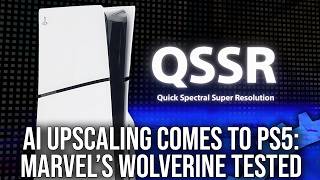

Sony's QSSR: ML Upscaler for PS5!
45sThe video opens with a surprising announcement about new tech, instantly grabbing attention.
▶ Play Clip"Delivers exactly what the title promises — a detailed, technical breakdown of QSSR with real data."
Sony has released QSSR, a machine learning-based upscaler for the standard PS5, adapted from the Pro's PSSR. Tested in Marvel's Wolverine and Ghost of Yotei, it delivers significant image quality improvements over existing upscalers like IGTI and FSR3, with a reasonable performance cost. The video provides a detailed technical breakdown and performance analysis.
Sony released QSSR, a new ML upscaler for the base PS5, surprising the industry. It's a companion to PSSR, adapted for the standard console.
QSSR is a refactoring of PSSR for FP16, which the PS5 supports. The base PS5 has no dedicated ML silicon, so this is a significant engineering feat.
Sony's Daniel Craig describes QSSR as a drop-in replacement for PSSR, potentially requiring only a few days of integration.
In Wolverine, QSSR delivers cleaner foliage, better edge stability, and improved RT reflections compared to IGTI.
QSSR handles RT reflections better than IGTI, with less ghosting and cleaner presentation.
QSSR resolutions are lower than IGTI, but the quality is so much better that it's still a net win.
The frame time cost of QSSR is about 1.5-1.8ms at 1440p output, which is reasonable for an ML upscaler on non-ML hardware.
At 4K, the frame time cost jumps to about 4.4ms, which is significant but still manageable in some scenarios.
QSSR is most useful in 60fps modes targeting 1440p, where it provides a quality boost without significant performance loss.
In Ghost of Yotei, the performance difference is nearly imperceptible, suggesting QSSR's cost is similar to FSR3.
The PS5 Pro has a bigger GPU and Int8 support, allowing for higher internal resolutions and 4K output, making it look pristine.
Sony proved that ML upscaling is possible on the base PS5, despite the lack of dedicated ML hardware.
QSSR is a surprisingly effective ML upscaler for the base PS5, offering a significant quality boost over existing solutions at a reasonable performance cost. Its success will depend on third-party adoption, but the initial results are very promising.
QSSR is a surprise release
Sony released a new ML upscaler for the base PS5 without prior leaks, which is rare in the industry.
00:16QSSR uses FP16
The base PS5 lacks Int8 support, so QSSR is refactored for FP16, a slower but more general data format.
01:49Frame time cost measurement
Measuring frame time cost (1.5-1.8ms) is more accurate than headline FPS differences for evaluating upscaler performance.
18:42QSSR's utility in 60fps modes
QSSR is most useful in 60fps modes targeting 1440p, where it provides a quality boost without significant performance loss.
20:12Sony proved the impossible
Sony managed to implement a performant ML upscaler on hardware not designed for ML acceleration, which was previously thought impossible.
29:12[00:00] It's not often we're genuinely surprised and impressed by an unheralded, completely out of the blue, new technological release. But here we are today with Sony's QSSR, available now, patched into Marvel's Wolverine and Ghost of Yotei.
[00:16] And although we have only two games to look at, the results are very, very promising. So put simply, you can think of QSSR, a quick spectral super resolution, as a companion technology to PS5 Pro's PSFR.
[00:29] our PlayStation Spectral Super Resolution. It's been adapted to use on the standard PlayStation 5. And yes, it is a machine learning-based upscaling algorithm working on a console that, unlike the Pro,
[00:42] doesn't have access to 300 tops of accelerated machine learning performance. In fact, to the best of our knowledge, the standard PS5 has no dedicated ML silicon at all. But I think the results here should speak for themselves.
[00:55] So recently we had access to Wolverine and Yope running on PS5 dev kits at Sony HQ. That's 67 hours of unfettered access, but we're going to be mostly focusing on Wolverine today
[01:07] owing to time constraints, so there's a lot to go through here. Potentially a game changer for PlayStation 5, but joining me to go through everything, Oliver McKenzie. Hello. Yes, Rick.
[01:19] Here with some very exciting new tech that I really didn't expect to see at all on the PlayStation 5. Yeah, absolutely. Interesting stuff. So much to go through here. I guess we should kick off by talking about, you know, what is QSSR? And it's really interesting, right? Because fundamentally, the PlayStation 5 Pro has got dedicated machine learning instructions, int8 support, which the base PlayStation 5 doesn't have.
[01:49] So instead, what QSSR is, is effectively a version, a refactoring of PSSR streamlined for FP16, which PS5 does support with the benefit of rapid-packed math.
[02:04] So we actually had the opportunity to pose some questions to Sony's Daniel Craig, not that one, Principal Engineer, Graphics R&D, FIE.
[02:19] So basically he describes it as a drop-in replacement for titles that already support PSSR. So effectively there's potentially some very good news here because when a developer is introducing PSSR support for their game,
[02:36] and there's a lot of titles that support that now, QSSR is effectively supported just with this drop-in replacement. However, there may need to be a few days of integration,
[02:48] adjusting things like higher quality MIT maps and that sort of thing. So basically, yeah, it's a streamlined version of PSFR. And obviously, there are going to be changes to the quality level.
[03:03] I mean, fundamentally, it's got far less horsepower to work with. And at the same time, Solio is looking to produce an upscaler that has a similar cost to existing upscalers like FSR, for example.
[03:17] We'll talk about performance later. Yeah, but I guess fundamentally there are going to be trade-offs here because there is no machine learning based acceleration on the base station size.
[03:30] But we'll talk about performance later. Anything to add to that, Oliver? Not too much. just to say that the general approach of basically porting over PSR from Int8 to FP16 is surprising,
[03:47] but that does seem like, you know, obviously that's the way that you have to go here. FP16 is a much more general and more precise data format. Int8 and FP8 tend to be very fast data formats to use on graphics hardware that can accelerate those data formats.
[04:02] FP16 is used for machine learning work all the time, but it is a bit of a slower data format that might not lend itself as well, or definitely wouldn't lend itself as well, to a really advanced subscaler like the, you know, underlying neural network that's behind
[04:18] FSR4 and PSSR. But I think as we can see, the results are very shippable and very intriguing, and it's not just like a proof of concept, here's something, we're throwing it out there,
[04:31] you can try it, whatever. This is actually something that seems pretty ready for prime time in terms of the upscaling quality. Absolutely, yeah. And I think it's really important just to put this into context because throughout this console generation,
[04:44] developers have been pushing visual fidelity very, very hard, so to speak. And they also want 60 frames per second, and the impact of that has been very low resolutions. And the upscalers available, FSR being a case in point,
[05:00] the quality isn't particularly fantastic. So if this is effectively a drop in replacement that replaces FSR and other upscalers producing higher quality
[05:13] and if there is a sort of equivalent computational cost to it then the implications for this are just remarkable. It could be a game changer. And the main game that we're going to be looking at today
[05:25] Marvel's Wolverine is a pretty good example of that. so I guess we should just kick off taking a look at Wobbles movie in fact if we go back to my session at Foley the first bit of content
[05:39] I looked at was a cut scene from a particular level, knock knock and I'm just going to go through the things that caught my eye because a lot of digital fantasy comparisons they only kind of make sense if you have the A to B side by side
[05:52] but the thing with QSSR is that you can play it through with QSSR off and you can play it through with QSFR on and it's very, very obvious that there are some profound changes going on here.
[06:04] And obviously we have the benefit of side-by-side comparisons here. So yeah, I mean, another thing, of course, which I highly recommend you check out if you're owned a game is that the menu system has an on-off toggle. So you can actually look at the changes yourself
[06:19] in real time. It's pretty cool. And swapping between them, it just shows how transformative if it is. So the detail level generally seems to be significantly improved and I did wonder
[06:32] about whether there's like some sort of adaptive contrast happening there, a sharpness filter if you like, but you know I'm pretty sure that some of the detail that improvements we're seeing here
[06:44] they are being generated by the model. If you look at this character, Tiger Tiger, there's like very profound subpixel shimmery issues on the QSSR off side and those issues are
[07:01] cleaned up significantly with QSSR on texturing and detail on the embroidery looks a lot better. Yeah so if you've unlocked this level and you're going to try out QSSR head straight there and just have fun with it. But Oliver in
[07:17] In addition to that, before we set off to visit Sony and take a look at QSSR, you put together a series of tests. And we're going to be talking about QSSR on versus QSSR off, which we've been using Insomniac's stock upscaler.
[07:34] And a bit later on, we're going to be talking about the comparisons with PSSR running on the Pro. Because I imagine a lot of users out there are thinking to themselves, why has Sony done this? This is like a unique selling point for PSY2.
[07:48] Why would they bring it to the base system? And I think we've got some good answers for that. But where do you want to begin? Yeah, so I put together some sample shots that are kind of easy to match in Wolverine
[08:00] by basically exploiting the level select feature to get reasonable match shots with a completed save And here with these shots I seeing some very promising image quality characteristics with very clean foliage for instance with nice clean and clear
[08:18] and well-completed edges that don't exhibit a lot of tempo and stability. It doesn't have any of the pixel popping and crawl that we saw with IGTI. IGTI is a pretty decent upscaler,
[08:30] and it's very cheap, as far as I understand it, but not perfect with elements like the firetruck in this shot, where the QSSR presentation is simply much clearer, in particular with the specular lighting along the top of the firetruck that's resolving without flicker
[08:45] with QSSR. The railing and chain link fence in this shot also is another good yardstick for measuring obsecular performance, where it's no longer suffering from the kind of sub-dixel break up that we see with IGTI.
[08:57] Wolverine's hair is also better in this shot with a smoother and less noisy silhouette, less break up in that hair. Another big plus, which is this shot that Rich thought, actually, is the water in this shot,
[09:10] which is resolving quite clearly and cleanly and without ghosting. It does almost look a little bit painterly when you look at it closely, like it's not perfectly sharp, but it is resolving in a remarkably clear manner where you're actually seeing that water detail.
[09:26] IGTI is ghosting like crazy. QSSR seems to handle this really well. Now, archy reflections are also interesting with QSSR because they seem maybe slightly softer, perhaps, but they exhibit less time to frame inconsistency and have less of a bit-tittered appearance.
[09:41] I'm not 100% sure about Wolverine, but I know that in the past, Insomniac has used a checkerboarded solution for their archy reflections, which can cause issues with certain upscalers. Interestingly, it also causes issues with DLSF, at least, or DLSF-wise upscalers.
[09:56] I really don't like it when you're presenting check-reported RT input, basically. But QSSR seems to be handling that really well and seems to be actually delivering a I would say a significantly better presentation of RT reflection information than IGTI, which
[10:13] is interesting because IGTI was presumably designed around it. Here, QSSR, maybe it's a drop-in. I don't know how much work they're doing, but certainly it's presenting more cleanly to the upscaler. Wolverine has a lot of RT Reflections.
[10:26] It's a game that was designed around RT Reflections, quite clearly. Like with the Spider-Man titles, even with Spider-Man 2, Spider-Man 2 does not ship with like a CubeMap SSR fallback or whatever, but they were designing the game with that in mind for the whole production process, basically,
[10:40] and then, you know, six months, nine months, whatever, before launch, so like we're going to scrap this alternate pipeline. So the game is arted up with both systems in mind. Here, Wolverine is basically just an RT Reflections game from the start, made with RT Reflections in mind,
[10:52] but they're super clean on base PS5 or 5GTI. Here they look really clean, really smooth, and just excellent across the board with QSSR. Interesting.
[11:04] Yeah, it's one of these things where I really urge you to check it out because the differences here can be quite, quite profound. Let's talk about PSSR because, yeah, as I mentioned earlier,
[11:18] there is the sort of question as to why Sony has done this, why Sony has added machine learning based upscaling into the base PlayStation 5, but it's one of the selling points of the Pro. But I think there's a couple of things here
[11:31] which we've got to discuss, which is fundamentally that it is a streamlined model that's running on the base PlayStation 5. The quality level isn't going to be quite as good. The other thing is that the resolution side of things,
[11:43] Well, QSSR is basically very challenging to run at 4K, whereas it's like a 3 millisecond or thereabouts cost on the Pro. So, you know, there's going to be resolution advantages on the Pro
[11:55] and there's going to be quality advantages. So the way I'm seeing things, Oliver, is that you've kind of like got three steps with Wolverine. You've got like the base performance mode, all of the shots we've shown so far, by the way, in the performance mode.
[12:08] You've got the base 60fps performance mode. Then you've got the QSSR version, which looks significantly cleaner and has a range of quality improvements. It is transformative. But then you've got the Pro, which has got more advanced upscaling,
[12:22] and it's running from higher base resolutions and a higher output resolution. So we've basically got like three quality tiers here. Yeah, I would say that's generally accurate.
[12:35] And I do think that the comparison with PSSR in particular is really interesting here, because like you said, why would Sony give up this advantage to better support PS5 when PS5 already looks so good, and PSSR is a key selling point of PlayStation 5 Pro consoles, right?
[12:53] and I think it mostly comes down to the accelerations present in these two consoles, the bigger GPU that's present in the Pro, and just the PS5's general lack of capability when it comes to accelerating machine learning,
[13:09] which is why they're dipping down to FP16, for instance, which is going to be a slower data format for this kind of use. So what I'm seeing with PSSR versus QSSR is a lot of similarity.
[13:21] So they like to construct edges in a similar manner. They have a similar resolve on reflections, like the kind of RT differences I noted. You observe those very much in the PSSR as well. The one area where there's a big difference is hair in a few shots,
[13:35] but I think that might be confounded by the higher resolution on PS5 Pro and possibly differences in various settings for the hair that might be going on in the performance mode on Pro as well, where we're seeing a little bit more noise actually in the PS5 Pro rendering of hair,
[13:50] relative to the QSSR rendering of care, which is interesting. But the key limitation of QSSR to me seems to be that it does have a cost, right?
[14:02] It's not free. It's not a free lunch. So, for instance, in world range, I don't think they're going to fork it with QSSR. I think they're going to 1440p, I suspect, which is probably the same resolution as they're going to with IGTI.
[14:15] And ultimately what confounds this particular analysis is the resolutions, which I'll discuss, Now, so I did a few pixel counts, which was kind enough to align some shots and break the game's anti-aliasing by slamming the camera right there, whatever instructions I wrote, it worked.
[14:33] So resolutions on Pro are much higher across the board internally. And interestingly, QSSR resolutions are lower than the base version with IGTI. Not by much, but still noticeably. So QSSR seems noticeably heavier than IGTI, at least in these terms.
[14:50] So, to me, what this shows is that maybe if you were using a lightweight upscaler before, or like a TAA, reasonably cheap TAA, QSSR is going to cost significantly more.
[15:03] But you might get enough of a benefit in image quality that it outweighs the difference. And then if you're going to something like the Pro, obviously the Pro has a much bigger GPU, faster, you know, it has intake support, has much faster acceleration of that intake.
[15:17] So I would expect that Pro is just executing a model that might not be enormously different from a quality perspective because I'm not seeing any large categories of visual phenomena
[15:31] that QSSR is not tackling well relative to PSSR. I think they're both doing a good job, right? I'm not saying there wouldn't be differences, although we don't have a one-to-one comparison here at all, so we can't say with that level of precision.
[15:43] But I think just a much faster acceleration on PSS Pro is what's giving you that tremendous uplift in terms of higher internal resolutions and actually hitting a 4K output. Yeah, absolutely. Higher internal resolution, higher output resolution.
[15:57] I mean, I've spent a lot of time with Wolverine QSSR on and off and then moved to the Pro to do the comparison shots for this. And by comparison, the Pro is just looking like absolutely pristine in a way that neither of the base PlayStation 5 versions are.
[16:12] But the point is that you are still getting that quality bump on the base unit So that kind of justifies the pro to be beyond the other stuff like the improved rate rating and such like But a lot of this discussion has been talking about performance So let talk about performance and basically the computational cost of QSSR on the base PlayStation console
[16:34] Now, the thing is that the examples we've shown to date, I mean, all of us have shown that basically the resolution on QSSR is slightly lower than the Insomniac solution, but it doesn't matter because the quality of the upscaling is such that you're still getting
[16:49] a palpable quality increase. But is there a way to kind of like standardize resolution between QSFR on and off and then basically judge on a like-for-like basis what that performance difference is?
[17:04] And yeah, actually, you can. You can do that. Yeah, so, you know, let's just put this into perspective, first of all. So the upscaler, the IGTI upscaler, as it's called,
[17:18] is basically an iterative thing that's been developed, I guess, over a decade now by Insomniac. I mean, I think we first saw it in Marvel's Spider-Man, when the PS4 played. I think it was actually Ratchet & Clank when they called it Temporal Injection, I believe.
[17:35] Right. I don't know if they have a name for it way back then, But yeah, they did have it in the 2016 version of Ratchet & Clank, I believe, on PS4 Pro. Yeah. So, you know, technology has been iterated on over a decade.
[17:48] Now, QSSR is going to be more expensive, like, by virtue of what it is, a revised version of an algorithm designed for 300 POPs for the console. And, yeah, interesting.
[18:01] Well, we're going to start by showing the knock-knock intro cutscene. I captured that using VLR. and typical resolution here should be 864p on both QSSR on and QSSR off.
[18:14] I believe that is confirmed to be upscaling to 1440p in both cases. So temporal injection versus QSSR, like for like. Now QSSR looks a lot better as we've seen,
[18:26] but you can see here that the frame rate is lower. Now the headline number doesn't look great, right? You're hit with about 8 to 10 frames per second, but the important thing is the frame time cost of QSSR. And by my calculation, it's between 1.5 to 1.8 milliseconds.
[18:42] And I'd say that's reasonable for an ML-based upscaler producing results like this from a low base resolution on hardware that doesn't have any form of ML acceleration.
[18:55] But, yeah, the higher the output resolution and maybe the input resolution too, the bigger the frame time hit will be. So I re-ran that same experiment with this cutscene in fidelity mode,
[19:09] again, unlocked with VRR. Expecting total resolutions of circa 1008p here, upscaling to 2160p, 4K. Again, VRR uncapped.
[19:21] I say uncapped, but it seems to me that with QSSR off, we seem to be capped at just under 60 frames per second. but when we're under that target, that's where things are interesting.
[19:35] Now, again, there's a certain nine frames per second differential when frame rates are much lower, and this is actually giving us a frame time cost of about 4.4 milliseconds on top of whatever insomniac solution costs.
[19:48] And that is significant in a world where 60 FPS gain has 16 milliseconds of total time to generate the whole frame. So I really think that the takeaway here is that QSSR finds utility where the PlayStation 5 really needs it, in 60 frames per second modes, targeting a circa 1440p output from much lower base resolutions.
[20:12] And just to go back to a 60 FPS mode here, where dynamic resolution scaling is being enforced, well, basically now we're getting the best of both worlds. Performance is practically identical.
[20:25] The QSSR on-site will be lower in resolution to maintain frame rate, but the quality of the upscaler is so much better that you're getting a better experience overall. Improved image quality at the same frame rate.
[20:38] So, yeah, QSSR more expensive, but I've also got some gameplay here, like for like but not synchronized, and you'll see that Insomniac's solution can drop frames but you'll drop more frames with QSSR, but
[20:54] you know, CLR just sort of makes all of that pretty far away, but the point is that there is a difference there. Yeah, there's other things we need to talk about here. We're not going to be focusing on Ghost of Yotei too much in this video, we're just too
[21:11] time constrained, but I did do a performance test on that as well. Again, performance mode, uncapped VRR 120Hz. So I wasn't really prepared for the results here.
[21:23] There are differences in the performance level, but they're slight, basically imperceptible for the most part, which is very different from what we saw with Wolverine, right? Right. to the point where, you know, with the IOTA captures here,
[21:37] I have to recheck that QSSR on was actually on, because it looks too good to be true here. There's no real performance here. So the logical conclusion here, assuming everything is on the level, is that FFR3 is a heavier upscale than Insomniac's home-grown solution,
[21:54] and QSSR is basically processing at a similar computational cost to FFR3. Now, assuming that's all on the level, this is seriously good news bearing in mind that this is what we want
[22:07] from QSSR, kind of like a drop in replacement for FSR3 which is kind of undelivered on the image quality front on so many games in 60fps performance modes now this is just one game
[22:19] FSR3 versus QSSR we've got to do more verification here is it the same output resolution for example but I did check in with Sony with the results here asking is this expected
[22:31] behavior and they said it is but really we need to see more qsfr implementations preferably upgrades versus sfr to see if this situation is actually borne out but uh interesting results right oliver
[22:45] basically it's heavier similar to pffr versus sfr on the pro right again similar the the gains seemingly kind of worth it yeah and i think we are seeing that with with wolverine where
[22:59] at the same resolution, it does cost significantly more, but then when you actually see a situation where the developers are trying to normalize for the performance level and they're controlling dynamic resolution, you're still getting a better result with QSSR, right?
[23:12] Like, that to me is the proof in the pudding. Like, you can look at a number where it's like, oh, you know, QSSR is, you know, 8 frames per second lower, 10 frames per second lower in this one shot. Oh, what's happening here? But the reality is that if it's delivering a better result and the developers are actually
[23:28] able to reclaim a meaningful margin of performance by reducing resolution, which should be the case, you know, with a PS5 game. I don't think you've topped out the scaling left in resolution of PS5 games, especially because most games that are released now need to find some margin of resolution
[23:43] scaling down to like a series F target before it really starts to fall off a cliff, right? So they're going to scale well in terms of dynamic resolution behavior, and you're probably going to be able to recover a similar performance level, maybe slightly lower in some circumstances,
[23:56] depending on how they tune it, but probably a similar performance level, but with better image quality, or at least that's been the case in the Wolverine. With Ghost of Yotei, just kind of reflecting on the performance level there, it does suggest that, you know, I mean, in this case,
[24:09] we're not really totally sure what's going on with the dynamic resolution behavior in this title, and if that might actually be kicking in, if it ends on loss, different developers have different approaches with that. A lot of developers will kind of leave it within a tight range,
[24:21] they'll leave it locked, so I'm not quite sure what they're doing in that title, but it does suggest that at least you know similar range in terms of performance outcomes when it comes to those two up which is promising because if you have an upscaler that like you said does cost about as much as FSR3 FSR3 is all over the place you know With Unreal it usually PSR that being used
[24:42] but with third-party, big third-party games, including some, you know, internal Sony games, like Dos Ovietes, they are using FSR, and FSR is a perfectly capable upscaler, but an upscaler that is able to possibly deliver better quality in some key areas would be very
[24:57] much appreciated. I'm sure we can all agree with that. So this is very promising stuff, but kind of like you said, this is pretty limited. We've only really looked at it in detail in one game, then we have another game here in the doc, and as well as a close-up
[25:10] of Yotei that we need to take a bit of a closer look at. I'd love to see this in some big third-party titles. I'd love to see this integrated into games like, you know, I mean, games with really good PSSR implementations already would be interesting targets for it, because I think
[25:24] QSSR is basically a pretty easy replacement once you already have a PSSR implementation in your game. So games like Elmlight 2, games like Avatar, games like Assassin's Creed Shadows, like some of the big third-party heavy hitters that look really beautiful,
[25:39] that you'd really want to see with QSSR, I'd love to see those games with QSSR, and see if they can be improved over the alternate DevOps givers that are available, or the FSRs that are available in those titles, right?
[25:51] That would be really pleasing. but so far this seems like a pretty promising sample at least in terms of performance outcomes and obviously in terms of visual outcomes in a couple of Sony panels.
[26:04] Yeah, I'm really looking forward to seeing retrofits. There should be quite a few titles where if the developers are so inclined QSFR can be retrofitted into their existing games and I'm told by Sony that's a relatively painless procedure there
[26:20] which is good news. but fundamentally it's going to be about the titles going forward and I suppose all eyes are on Grand Theft Auto 6 so we have no idea. That's going to be down to Rockstar whether they want to make any kind of announcement on that
[26:33] but image quality was one of the things that we had issues with in that extended look trailer so I'm going to be very, very interested to see if they do anything there. What do you think of the chances?
[26:45] That's an intriguing prospect, Rich because one element of GTA 6 that seems unusual is I'm not sure they're already using an existing temporal upscaler with their game.
[26:57] It looks to me much more like a TAA, like a 1440p TAA, that's what we counted and that's what it looks like, upscaled with a bicubic upscale, bilinear upscale, range shows upscale, whatever,
[27:10] to 4K, like a naive upscale basically in this case. And it has image quality characteristics that are not reminiscent of any major temporal upscaler. it's maybe a bit more of a lift for Rockstar to actually implement a temporal upscaler in their game at this stage.
[27:27] And it may be the case that they have certain trade-offs in terms of image quality and performance, like perhaps their ray tracing is really tightly tuned to a denoising and TAA pass that they have going on in their engine,
[27:41] that they would not see necessarily an immediate benefit from having a regular temporal upscaler. Or maybe they just don't have time, right, because they're obviously very pushed for time on that project. And I can't imagine shortening a huge engineering challenge your way possibly a month or two before release is really going to relieve them of anything in particular.
[28:01] But perhaps it's a route they could go down, or alternatively, maybe it's something they could pursue post-launch, right, when they have a little bit more leeway in terms of slack on their schedule. But I'd be interested to see it.
[28:14] I mean, if, you know, I'll come out and say that if CTSX ships with a really good temporal up-siver on PS5, that would be a bit of a game-changer for the console. I think it would be pretty extraordinary. But so far, we aren't seeing evidence that they're using, like, an FSR solution or something,
[28:30] for which you'd presume this would be a relatively easy replacement. Right, yeah. There's something else that I really, really enjoyed about this. First of all, when the 8th implementation of XSR4 leaked, we tested it out on sort of
[28:48] console-equivalent hardware, right, and it was okay. Performance was a bit low. But, you know, what I said in that coverage was, well, you know, the PlayStation 5 doesn't
[29:00] support intake, so we're unlikely to see anything like this. However, the Xbox Series consoles do support intake, so it's possibly viable there. And I was, you know, reality has proven me wrong.
[29:12] And I love it. Because basically, you know, this is one of these kind of projects where we just didn't see it coming. We didn't expect it to happen. It didn't leak. And yet here it is. I should say that, you know, obviously with any kind of upscale, the quality of the implementations vary.
[29:29] And I think it's fair to say, Oliver, that the quality boost just sort of generally from Marvel's Wolverine at 60 frames per second versus Yotei, well, Yotei already looks pretty good with its FSR3 implementation.
[29:46] So the kind of gulf of the improvement in quality with Yotei isn't going to be as pronounced as you see here with Wolverine. so yeah it will change on a game by game basis but ultimately you've got to sort of hand it to
[29:59] Sony for doing something which I just didn't think would be possible but they've done it and it works it seems to be relatively performant to the point where it is usable by developers so I can't wait to see more any final thoughts yeah it's commendable and I kind of like you're
[30:18] indicating there, you know, you'd think that a machine learning based upscaler would be a more natural fit for Xbox and it's kind of like full RDNA 2 machine learning implementation, right? But that's not actually the case. It's the case that Sony was just, I'm sure a lot of very hard
[30:34] engineering work has managed to co-develop an upscaler, implement on PS5 Pro, then implement it on PS5, which is pretty extraordinary stuff for a system that, you know, I mean, it has
[30:46] acceleration of, you know, FP16 is a data format that is used at times for machine learning. It's an important machine learning data format, but it's not like one of these hyper-fast, really low-precision data formats that machine learning apps really love, right?
[31:00] It's not an MP8. It's not an FP8. It's not an FP4. It's not one of these data formats. So PS5, as far as we know, was really never designed. Not only was it not designed with an intention to do machine learning acceleration,
[31:14] they seem to have stripped out aspects of the architecture that were important for machine learning architecture or they seem to have stripped out aspects of the architecture that seemed important for machine learning acceleration because they did not want to spend the die area
[31:27] I mean I'm just presuming because those are parts of the RDA2 design right they show up in the Xbox but you know here they've managed to do it and managed to implement a performance machine learning based upscaler and they've managed to achieve good results while doing it
[31:41] so I'm certainly interested to see how this develops and I'm really intrigued, very interested to see how results may appear in certain other big, major third-party heavy-hitter titles
[31:53] that we've analysed over the years, which we have a pretty good understanding of, right, to actually see if those games will be improved by QSSR. Yeah, definitely a promising debut for QSSR there.
[32:05] Can't wait to see more, but I think that's all we've got time for on this one. More QSSR stuff happening soon, as soon as we've got more games and more time fundamentally to look at them. That's all we've got for you for now.
[32:17] So if you enjoyed the content, please do like, subscribe, share, ring bells for notifications, that sort of stuff. Yes, the Digital Foundry Supporter Program, patreon.com slash digitalfoundry. Yeah, join us,
[32:29] support the team, high quality video downloads of everything we do, including this video. And yeah, I guess that's all from us on this for now. Thanks for watching and supporting Digital Foundry.
[32:42] .

![Inside STAR WARS: Galactic Racer: The Tech Behind The Big Arcade Racing Revival [Sponsored]](https://img.youtube.com/vi/EIPgivtETng/mqdefault.jpg)
⚡ Saved you 0h 32m reading this? Transcribe any YouTube video for free — no signup needed.