
AI Summary
In this Macroverse episode, the host analyzes whether the Federal Reserve is making a policy mistake by refusing to raise interest rates despite rising long-term yields and sticky inflation. He argues that the Fed's inaction is causing the bond market to revolt, pushing the 10-year yield higher and creating market uncertainty.
Chapters
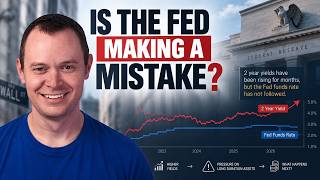
The Fed is not following the two-year yield, which has been rising since February, despite data suggesting rate hikes are needed.
The 10-year yield is now at 4.8%, and the host argues that the long end of the yield curve is rising because the Fed is unwilling to raise rates.
In 2023, the 30-year yield hit over 5% when the Fed funds rate was 5.5%. Today, the Fed funds rate is 3.75%, but the 30-year yield is higher, showing the Fed indirectly controls the long end.
Historically, the Fed funds rate follows the two-year yield. The two-year yield has been rising since February, but the Fed has not raised rates.
Oil is at $92 a barrel, and inflation reports were pricing in lower trends, so inflation is likely to remain sticky.
The unemployment rate has been trending down since late 2025, providing evidence that a rate hike is needed.
The Fed's unwillingness to raise rates, possibly due to political pressure, is causing bond vigilantes to push long-term yields higher.
Treasury Secretary Besant announced a bond buyback program, but yields are higher now than when it was announced, showing the market will test interventions.
The single best thing the Fed could do to lower the long end is to raise rates or resume quantitative tightening, showing they mean business.
As of September 8th, the odds of a rate hike in September are only 60%, which is unusually low just a week before the decision.
With forward guidance removed, the high uncertainty about the rate decision is likely to cause more violent market reactions in both directions.
The host believes the Fed has been making a mistake by not raising rates and should raise by 25 basis points in September.
A 25 basis point hike would bring the Fed funds rate to 4%, close to the two-year yield at 4.3%, but two hikes would be needed to match it.
The host sees Kevin Warsh's hawkish Jackson Hole speech as a sign he might actually raise rates, which the bond market would respect.
Treasury Secretary Besant wants to artificially lower the long end with buybacks, while Warsh wants the long end to do the heavy lifting—these are contradictory.
In 1997, a 25 basis point rate hike caused a 10% stock market drop, but the market then rose for 2.5-3 years. Rate hikes indicate a strong economy.
With the rate decision a week away and odds near 50-50, the host notes this is unusual and attributes it to removed forward guidance and political pressure to cut rates.
The host argues that cutting rates into a strong economy would lead to another inflationary spiral, and raising rates is the appropriate action.
The Fed's refusal to raise rates despite rising yields and inflation is a mistake that will likely lead to higher long-term yields and more market volatility. A rate hike, while painful for some assets, would signal a strong economy and help control inflation.
Mentioned in this Video
💡 Key Takeaways
Fed funds rate vs. long-term yields
Illustrates the disconnect between the Fed's short-term rate and long-term yields, challenging common assumptions.
02:02Bond vigilantes revolting
Explains a key market mechanism where investors push yields higher when they doubt the Fed's inflation fight.
04:48Best Fed action: show commitment
Provides a clear, actionable recommendation for the Fed to lower long-term yields.
06:06Rate hikes can be positive
Offers historical context showing rate hikes can be followed by market gains, countering fear.
11:35Full Transcript
[00:00] Hey everyone and thanks for jumping back into the Macroverse. Today we're going to talk about the Federal Reserve and talk about whether they are making a mistake or not by currently refusing to follow the two-year yield.
[00:15] If you guys like the content, make sure you subscribe to the channel, give the video a thumbs up. Also check out the sale on IntoTheCryptoversePremium at IntoTheCryptoverse.com. And as a reminder to make sure to get your ticket to the first Investing Through the Cycles conference that will be taking place later on this year in November in Miami, Florida.
[00:35] So with that said, you know, I told you guys I was going to be traveling and I am. By the time you're watching this video, I will be in New Zealand. As of the time of this video, Bitcoin is trading around $78,000.
[00:49] I couldn't tell you exactly where it's going to be by the time this video is released to you. Oftentimes, after golden crosses, Bitcoin drops for a little while, right?
[01:01] So, that typically happens. So, we'll see if that is what kind of manifests as well. And there's times in the past where it leads to a higher high after the drop. There's times where it leads to a lower high after the drop.
[01:14] And that will dictate kind of how this midterm year finalizes by the end of the fourth quarter. But what I want to talk about is something that doesn't move typically as quickly, and that is the yield, right?
[01:29] The 10-year yield is now at essentially 4.8%, okay? And we have talked about this forever, that yields would likely head back up. And the issue is that, so why are yields heading up? Why is the long end going up? If you guys remember back in 2024, 2025, there were a lot of people that thought that when the Fed cut rates, that the long end of the yield curve would go down and that mortgage rates would go durably down.
[02:02] That is simply not true. Think about it like this. If you were to overlay interest rates onto the chart, what you'll see is that the Fed funds rate in 2023,
[02:15] when the 10-year yield hit, or sorry, when the 30-year yield hit over 5%, the Fed funds rate was 5.5%. Today, the Fed funds rate is 3.75%,
[02:27] but yet the 30-year yield is higher today than it was back then. Now, I said this back then, right? And I sort of was debating people on Twitter, for whatever reason, about this and trying to show, look, you know, the Fed directly controls the short end, but they indirectly control the long end.
[02:46] If they're not willing to raise rates when inflation becomes an issue, the long end can go up, even if the Fed funds rate is lower than it was back then. And that's what's happening. So why is the long end going up?
[03:01] there's a perfect chart for it, right? Absolutely perfect chart for it. This chart right here. The orangish-yellow line is the two-year yield. The blue line is the Fed Funds rate.
[03:13] Historically, when the two-year yield is going up, the Fed Funds rate follows. When the two-year yield is going down, the Fed Funds rate follows But and even this cycle right You can see the two yield went up and the Fed funds rate follows Not always right away
[03:33] but it does eventually follow. The reason why the long year is likely going up is because the two-year yield has been going higher since February, and the Fed has been unwilling to raise rates.
[03:47] Simply unwilling to raise rates, despite the data saying that they should. And again, I don't know where the price of oil is going to be by the time you see this video, but as of right now, it's $92 a barrel.
[04:02] You can see right here, $92. So, inflation is still going to remain sticky for a while, because the inflation reports that you have were mostly pricing in all these lower trends.
[04:15] So, since then, we've been going back up. So, inflation is likely going to remain a problem, and the labor market, the unemployment rate, has been trending down since late 2025. So there's ample amounts of evidence that we truly need a rate hike.
[04:32] But yet the Fed, perhaps due to political pressure, has been unwilling to do what the market is telling them that they should do. And because of that, the bond vigilantes are revolting.
[04:48] But why shouldn't they? Why should we believe that they're going to get inflation under control when we're going to watch energy prices skyrocket again?
[05:00] And Kevin Warsh talks a big game about getting inflation under control. But what are they actually doing? Because inflation is kind of popping back up in a lot of different places.
[05:13] The labor market is still fine as it stands right now. But yet, because of all this political pressure from the presidential administration, they haven't raised rates. So the long end has no choice but to go up.
[05:28] Has no choice. Yes, Treasury Secretary Besant announced this, you know, bond buyback program. But guess what? Yields are higher now than when they announced that.
[05:40] So they can do everything that they want. But the minute these interventions start happening, the market will then test them. Oh, you'll buy back. You'll do some of the bond buybacks.
[05:52] All right, let's send the yield higher and let's see how much you're willing to do. The market will continue to test them. The reality is the single best thing that the Fed could do to lower the long end of the yield curve
[06:06] is to show that they actually mean business when it comes to fighting inflation. That's what they could do. If they were to raise rates, that would go a long way in terms of, or quantitative tightening again, right?
[06:19] If they were to do something like that, that would go a long way into making the consumer believe they're actually willing to combat inflation. But if they are unwilling to do that and they continue to just operate under this we're going to wait and see approach, well, you can wait and see.
[06:37] The Fed can wait and see. The long and the yield curve is not going to wait and see, right? I mean while the Fed is waiting and seeing since February the long yield curve just keeps going higher which puts pressure on you know on risk assets right It puts pressure on them So this is the conundrum for the market The thing that the Fed needs to do
[07:01] they're unwilling to do. And until they're willing to do it, we should expect the long end to go higher. I don't know what the probabilities are going to be by the time you see this video, again. But as it stands right now,
[07:13] the odds of a rate hike in September are only 60%. I've been doing this for a long, long time now. And we are only, it's September 8th on the day that I'm recording this video. You're probably not going to see this video until like, you know, September 11th or 12th or something for the public channel.
[07:30] I'll release it to the ICC premium people first. But again, as of right now, 60%. We are eight days away.
[07:42] How often have we only been eight days away where the odds of a rate hike versus a pause or a rate cut, whatever, is a coin flip? Usually by this point, there's an 80 to 90 percent observation as to what's going to happen.
[07:56] So what this means is that the stakes are higher because we're getting closer and closer to the event without any resolution. We don't know what's going to happen. When this happens, when we get to higher levels of uncertainty, it leads to more violent market reactions in both directions.
[08:14] So, they took away forward guidance, because that's what Kevin Walsh wants to do. But, uncertainty is not something the markets are typically fond of over a long period of time.
[08:26] They would prefer to either know if there's a rate hike coming, or not. and just get it over with, like provide some type of forecast on that so that we can know. But when we're only about a week away and it's still a coin flip,
[08:41] it means whatever the resolution is will likely lead to a more violent impact on the market than they otherwise would have, which is typical, which is a hallmark of what happens when you have increased uncertainty occurring.
[08:55] So, is the Fed making a mistake? I believe they have been making mistakes by not raising rates. At this point, I do think they should raise rates in September. I don't know if they need to do more than that.
[09:07] You know, one 25 basis point rate hike might be enough. You know, if you want to look at where the two-year yield is, it's currently, again, around 4.8%.
[09:19] Or, sorry, no, it's the 10-year yield. The two-year yield is around 4.3%. A 25 basis point rate hike will get us back up to 4%. Close, but not quite there. Two rate hikes would get us there.
[09:31] so and right now the market thinks we're going to get two but it just doesn't know when that second one's going to happen right now it thinks like it could be you know it could be December it could be January maybe October we don't know yet but I think they gotta at least get one rate hike under
[09:48] the belt first and if they refuse to do so in September I think the bond market is going to continue to revolt until they're willing to do it because the unemployment rate has been trending down for months and months and months while inflation has come back and they're still
[10:02] not raising rates. How can Kevin Warsh sit around and sort of trash-haul the prior Fed chair and the sort of prior committee for not getting inflation back down to target while he is not willing to do what it takes So what I like to see Kevin Warsh do is to come in raise rates show that we going to get inflation under control and I think the bond market would fully
[10:29] respect that. I think Kevin Warsh gave me the first signs that he's actually going to do what he says in his speech at Jackson Hole, okay? So that was the first time I sniffed out that perhaps
[10:42] he does mean business, and I hope that I'm right, right? I hope that I am right with that, and that they don't just let this thing get away from them. That would be a very bad outcome. And, by the way, you have the Treasury Secretary, Besant, and Kevin Warsh at odds.
[10:58] Because if Besant's going to say, we're going to try to bring the long-end of the yield curve down artificially by intervening, while Kevin Warsh is saying, we're going to rely on the long-end to do the heavy lifting for us,
[11:11] they can't both be true. You can't artificially bring down the long end with bond buybacks on one side and then say that the long end is going to do the heavy lifting on the other. Only one of those things can be true.
[11:23] And maybe that's the reason that at Jackson Hole, Kevin Warsh came out, and it was more hawkish than I've ever seen him be. So, let's see if he does the right thing. And in my opinion, the right thing would be to raise rates.
[11:35] Now, listen, you might think a rate hike is scary. And in 1997, they had a rate-cutting cycle before that in the early to mid-90s. In 1997, in March, they had to raise rates by 25 basis points.
[11:48] And the stock market dropped 10%. But then it went up for two and a half to three more years after that. So just because you get a rate hike is not indicative of a weak economy.
[12:00] A rate hike is indicative of a strong economy. it just hurts the longest duration assets the most, right? The assets that did the best in the bull markets of the past,
[12:13] it hurts those the most, which is why it can be painful. But it's something that you can argue at this point is necessary, and the unwillingness for them to do so, the unwillingness for them to act,
[12:26] is only going to send the long end of the yield curve higher. So, again, it's September 8th. eights, the 10 years at 4.8, Bitcoins at 78, 79k, the odds of a rate hike are still near 50-50.
[12:44] As this gets resolved, you're probably going to see the markets respond as well. It's fascinating to me that we're only about a week away, and it's still a coin flip. This is not normal for us. This is not what we typically see, but it does make sense given the fact that
[12:59] they have taken away from over guidance and that there's all this political pressure by the U S presidential administration to cut rates. But I don't, I don't really get that because they talk about it being a strong economy.
[13:11] How does it make sense to say there's a strong economy and that you need to cut rates? You don't cut rates into a strong economy. You raise rates to the strong economy. If you cut rates into a strong economy, it's just going to lead to another inflationary spiral and we don't need that.
[13:23] Right. I mean, I don't know about you guys. I obviously I want my portfolio to go up, but I also don't want my grocery bill to double again over the next five years. So there's trade-offs, right? If you're an engineer, there's trade-offs to everything.
[13:36] You can cut rates if you want, but it's just going to lead to bigger problems down the road. Those are my views. Thank you guys for tuning in. Subscribe, give the video a thumbs up. Again, check out the ICC conference coming up in late November. Get a ticket. Link's in the description below or the pinned comment,
[13:49] and I will see you next time. Bye.