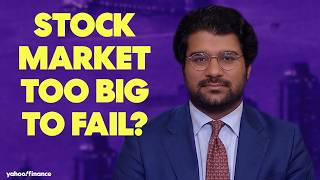

The Fed might buy stock ETFs in the next crisis?
54sA top Bloomberg analyst suggests the Fed could buy ETFs to support stocks, sparking fear of a market backstop.
▶ Play Clip"The title poses a real question that the panel genuinely debates — not clickbait, just a lively market discussion."
The video examines a Bloomberg Intelligence piece arguing that the US stock market has become 'too big to fail,' with so many households invested that the Fed might step in to buy equity ETFs during a crisis. Panelists debate the moral hazard of government backstops, the distorted incentives they create, and whether these concerns apply to unprofitable AI companies. The conversation concludes that risk has become inescapable, hitting even 'safe' assets.
Eric Balchunas wrote that the US market is too big to fail; vast household participation may cap downside risk.
A chart shows households and individuals entering the market in record numbers, which could limit downside.
In a crisis or bear market, the Fed could support markets by purchasing equity ETFs.
In 2008, moral hazard concerns allowed Bear Stearns to fail; now there is no such concern, and the government may take strategic stakes.
Government equity ownership distorts incentives, encourages reckless behavior, and is a reason indicators flash red.
One speaker feels society is post-moral, with government officials engaged in money-making activities and no restraint.
AI/hyperscaler companies are not close to profitable, so Fed backstops subsidize entities that create no actual value, unlike automaker bailouts.
Bradley Tusk says government decisions are about electability; Trump may push the Fed to buy ETFs if it boosts election odds.
Risk used to be opted into; now even safe assets are down 20-30% due to rotation, leaving no safety.
The discussion underscores the tension between supporting markets and enabling risky behavior, with no clear answer on whether the Fed would or should intervene. The prevailing anxiety is that moral hazard has become the norm and risk is now systemic.
Who wrote the Bloomberg Intelligence piece about the US market being too big to fail?
Eric Balchunas
00:02
What could the Fed do to support markets in a crisis, according to the piece?
Buy equity ETFs
00:29
Why was Bear Stearns allowed to fail in 2008?
Moral hazard concerns about incentivizing reckless behavior
00:43
What does the speaker say the Fed buying ETFs would effectively subsidize in the AI space?
Companies that create no actual value and may never be profitable
03:44
According to Bradley Tusk, what is the only way to think about how governments make decisions?
They focus on increasing and maintaining their electability
05:01
How much have 'safe' assets dropped year-to-date, according to the discussion?
Down 20-30%
06:25
Fed buying ETFs is a novel backstop
Introduces a concrete mechanism that could change how market downturns are handled, moving beyond traditional bailouts.
00:29AI companies lack profitability
Contrasts bailouts of automakers with backstopping money-losing AI firms, focusing on real economic value.
03:44Electability drives government decisions
Tusk's framework explains why political leaders might embrace risky Fed interventions despite moral hazard.
05:01No safe assets left
Even traditionally safe assets are falling, illustrating that risk has become systemic and inescapable.
06:25[00:02] colleague Eric Balchunas, former cuz I used to be at Bloomberg at Bloomberg Intelligence ETF analyst, he wrote this piece that I found really interesting where he talked about the US market being too big to fail.
[00:14] point I've touched on in conversations on this show over the past several months, which is that the participation in the equity market is so vast. And this shows that the biggest growth, this is one of the charts from his piece, the
[00:29] households, in individuals who have gotten into the market. And so what I've talked about is that maybe that caps the downside, right? Or limits the downside in stocks. But as he points out, he says if there's another crisis
[00:43] and we get a bear market, maybe the Fed could buy equity ETFs and that's how it could support the market. >> The concept in 2008 there was a moral cared about. The idea that you can incentivize people to be reckless actors
[00:56] backstop. That's why Bear was allowed to fail. There is no conception of a moral hazard and where the US government outright owns equities. Not AIG style Motors style bailout. This is an actual strategic stake that we've taken. So we
[01:11] invested in these companies whether we like it or not. I think it was a great don't think it's very good for the market. I think it distorts incentives can do whatever they want and investors who kind of expect that they'll be
[01:25] structure there. It doesn't create the right incentives and is a big reason why indicators are flashing red. >> Yeah, it's like yep. Keep buying Nvidia, Julie, this kind of reminds me of just a little bit, you know, back in '08, we
[01:40] mentioned '08, when there was like the whispers like, "The Fed is buying call [laughter] And now it's like, "We're going to buy the corporate bond ETFs and according to potentially destroy the market.
[01:53] >> It's like it's okay now to do these >> past that line. >> believe that >> the Fed, especially Kevin Warsh Fed, >> would make a move like this, especially since he's been very vocal in the past
[02:07] >> Yeah. >> So, I don't know if it would actually happen, but does it matter if it would actually happen if the market know, and I don't know how broadly the market expects it's going to happen for
[02:21] >> I mean, it's a very provocative piece. I mean, to think about the fact that this could potentially If we had any big challenges uh to our to our portfolios there was sort of no indication of a Trump put or whatever you want to call
[02:36] >> would the Fed step in? And And the writer is saying potentially maybe happening in other other other countries' central banks, right? They're >> A little family fight as Warsh says. >> Yeah, I mean, to your to your point, I
[02:50] mean, it it feels like we are in a um post-moral society anyways. Certainly from the from the government perspective on down, we've seen all the reports of money-making activities on the part of members of the administration. Um but I
[03:03] thread from what you were saying a little bit, Rohan. Why would it be misaligning incentives? Like why So, let's say um let's say maybe that the hyperscalers say, "We're going to cut spending. It's
[03:17] some spending." And the market falls 20%, and the Fed or there's some other systemic risk, and the Fed says, "Okay, ETFs." Why then? Like what then?
[03:32] >> What would be so bad about it? >> I'll make a I'll make There's an actual Take autos for example. You have actual inputs and those drive the cost of the it looked really fun and really nice. I'm never going to try it, but like you
[03:44] suddenly gone up because the inputs go up. There is no actual profit-making I love Ed Siteron. I think some of his writing is amazing. He is the biggest AI fundamental. These companies don't make money. There
[03:57] Forget about spending the money that they say they're going to spend. They're not even close to profitable. So, the idea on like a pure business fundamental should continue to underwrite something that may never make money, it's at least
[04:11] made, there was going to be utility in those assets at some point. You can't demand for them. So, what you're effectively asking people to do is borrow, finance, unlimited expenditures in this theoretical situation where the
[04:25] the Fed is buying ETFs or or, you know, we are talking about some sort of larger scale government backstop for for for corporations or for hyperscalers, you are asking people to subsidize something that creates no actual value. In the
[04:37] bear scenario, at least when you had a a bailout of insurance, well, world. The bailout of the automakers, that has a real impact on the real companies that actually employ hundreds of thousands of people that make a thing
[04:49] that we sell, that we export, that's tangible or real or stored. These fairly or unfairly, a lot of Americans feel like this is a massive wealth transfer from them, whether it's taking their jobs or taking their money, to
[05:01] very powerful, very wealthy people. And we had Bradley Tusk on our show, this is simple point to be the only way to think about how governments make decisions is it's 2 years or 4 years or 8 years, whatever it is, and every decision they
[05:14] make is about increasing and maintaining their electability. So, whether or not the Bloomberg piece so much is if Trump thinks or any member of his administration thinks that this will increase the odds of their electability,
[05:27] through the Fed or another vehicle, they will do something like this if it means >> I think you may raise it I mean, you almost touched on it was like >> Yeah. >> Uh is it the moral hazard's gone, right?
[05:42] the possibility of an over worse situation if you keep piling into the AI that. Do you think that that's going to stop going to come going to come in? I too, right? Is the fact that we don't know if we're just building a bigger a
[05:56] >> Yes. And then might we can't >> I mean, you mentioned EdTech run. I was I now I'm thinking of the of them as the Eds now in my in my head. Ed Elson, um from the Professor G podcast, writing a piece this morning also talking about
[06:09] invest in an open AI >> Yeah. President Trump says, "Oh, we can share in the profits." Uh which which profits point about risk, it used to be that you you you opted into risk. If you were if
[06:25] venture investor or or in any sort of distressed asset, you wanted to be there more alpha there, there was more upside there. A lot of people weren't. They're stocks, they want to hold assets. Now the risk is everywhere. You can't escape
[06:40] that risk. Even safe assets are down 20%, 30% year-to-date not because of any but because everyone else is rotating out of them. >> There's no safety anymore. Risk is just everywhere.
⚡ Saved you 0h 06m reading this? Transcribe any YouTube video for free — no signup needed.