[00:02]
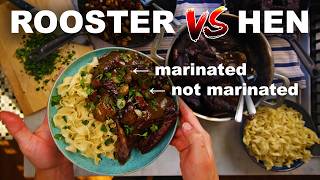
coq au vin, which translates literally to rooster with wine. And in this case, it really is. These are two roosters, uncastrated adult male chickens. You can
[00:15]
obviously just use normal chickens, but for a big holiday feast where you have for a big holiday feast where you have extra time to prepare, mature birds have their advantages, as does this dish in general because you can make a huge
[00:29]
quantity in advance and just hold it warm all day. There's no rushing people to the table at a certain time. So here we are three days before the big feast. I have two big roosters that I bought frozen at the Asian market, which is a
[00:44]
great place to find such things. I'm just going to thaw them in a bucket of water. I also have another one of those big old hens from the farmer in Maine that I talked about last week. That'll be a fun flavor comparison. These will
[00:57]
take many hours to thaw, but it's refrigerator temperatures outside. As long as I keep these out of the sun, I should be safe. Right before bed, I'll get everything cut up and marinating. Carrots, celery, and onions in big
[01:10]
chunks to make them easily removable later. They're just for the sauce. They Here's the first of these roosters, which still have the feet attached. Those will be great for the sauce. I'm not a butcher. I'm not good at this, so
[01:25]
I usually dislocate joints before I cut through them. Among other things, this reveals to me exactly where the joint is. Cut through the skin attaching the leg quarters, dislocate the thighs, cut through. I don't have good technique,
[01:39]
and you don't need to have it either. We're not doing 100 birds a day. You just need to understand what the goal is and move slowly and safely. The goal is to remove the whole leg from the body at the thigh joint by whatever measures you
[01:53]
shall judge necessary and expedient. I could separate the drumstick from the thigh, but I think I'll leave these whole Let's make the pieces look like a Now we separate the breast from the spine by cutting through the ribs.
[02:06]
Knife, scissors, whatever works. The spine will be great for the sauce. straight through the keel bone, which offers a nice little channel that holds the knife steady. Though, because these are old birds, this bone is hard to get
[02:22]
guns. Just keep those fingers clear and you can only go so wrong. Normally I would cut each of these into like two thirds of the way up from the skinny end, but there's not a ton of
[02:35]
meat here compared to a young meat chicken and it's going to shrink a ton in the cooking, so I'm leaving these as is. The inherited wisdom is that you marinate a tough old bird in wine overnight so that the acid helps soften
[02:49]
it. I've always been skeptical of that claim, so let's test it. I'll set some white and dark meat aside to not marinate. Time for wine. Yes, my wine has a hat and scarf. Don't ask questions. I got a couple of cheapish
[03:04]
very traditional, but anything that tastes fine is fine. should be fine for a slightly acidic marinade. An aluminum bowl might leach
[03:16]
some metal ions into the solution, which would taste gross. I guess I'll top this got. I just need to make sure that the actual meaty pieces are submerged and then this can go in the fridge for like 12 hours. Sterilize, sterilize, and I
[03:31]
Oh wait, I meant to put some garlic cloves in there. Anyway, good night and good morning. This next step will take many hours, so I want to get it started right out of bed. We've been marinating 12 hours per tradition. Is it worth it?
[03:46]
watching, won't you? Fish out all the good eating pieces and get them drying so we can sear them. Nice and dry. Here's all the chunkies for the sauce. For this next step, I would normally use a very large deep
[03:59]
roasting tray, but you could also just use multiple oven-safe pans. I've got that stainless number and I've got my 12-in cast iron, both from Made In, sponsor of this video. Check it out. Here's what their new cast iron line
[04:13]
looks like when it's out of the box. These are sand cast in an American foundry and then machined and buffed mirror smooth. Without that step, cast iron pans take years to get really good and stick resistant in my experience.
[04:28]
These are great right out of the box, and you can see I've really been using my other one. It's like a living thing. It grows and changes as you cook with it. These are very luxe pieces, trigger grip handles, heavy in the base where it
[04:42]
matters for heat retention and light on the walls where it doesn't. Work them delts. We'll definitely be using the double pour spouts and the helper handles today. Made In pans are used in Michelin star restaurants and in my
[04:55]
house every day because they're so solid and well engineered. And she's young, but this 10-in is pre-seasoned and ready to go right now. Check out the cast iron collection and Made In's other cookware and use my link in the description to
[05:09]
save on your order. Thank you, Made In. Anyway, three big pans go in the oven and I will jack it all the way up to 500 Fahrenheit, convection fan on, football game on. Here's the test pieces that we didn't marinate and I'll tie some
[05:23]
butcher string around them so we can recognize them later. A little oil just to get them started cooking and season everything really heavily. There's three big chickens here. Toss all that around to coat and I will start laying them
[05:35]
to coat and I will start laying them skin side down into my already hot pans. You could, of course, sear these off in batches on the stovetop, but with this quantity, that would take a long time. And very hot convection ovens are really
[05:47]
great for browning all sides of irregularly shaped pieces. It's important to remember that even a powerful oven only makes so much heat and there's a lot of mass in here already. So that's all I'm putting in
[06:00]
until the pieces are good and brown. While I wait, I'll oil and season the chunks for the sauce, maybe squeeze on some tomato paste and dust on some flour, all will be very good for the sauce. Even though we've crowded these
[06:13]
pans, it's hot enough in here that moisture is evaporating before it collects. Everything is browning exactly as I planned. Though I do have a minute to make myself another latte. Yeah, I just did that.
[06:26]
It's the festive season. Okay, the pieces are brown all around. It will never be easier to get rid of excess fat than right now. Most of it is melted out. We can just pour it off, and that is a good thing to freeze and save.
[06:40]
Chicken shouldn't be sticking very much, but if it is, hey, I've got my right here to help deglaze. Very traditional for coq au vin. Look at that deep amber skin. The wine marinade can go in all these pans, and then I
[06:53]
will get them almost submerged with cartons of broth. When I cook with red wine, I want it to be no more than half of the braising liquid. Otherwise, I As soon as the oven was empty, I threw in the bones and the veg to get some
[07:06]
color on them, but there's no rush on that process, so all this mass can go back in when it 's ready. Though heat stays all the way up because there's only so much heat to go around. Nothing is going to burn anytime soon. I've got
[07:19]
color on the sauce chunks now. I'll distribute them to the pans with the chicken, and there's room for them now because all this stuff shrinks as it cooks. Flavor for all, a chicken in every pot, aromatics for every chicken.
[07:33]
I can pour off this excess fat, and the stuff that I couldn't fit in can stay right here. I'll tent it with foil to limit evaporation since this is so shallow. Throw it back in the oven and fill up the tray with water. Easy sauce
[07:46]
bonus. Though I will have to top off that tray with more water a couple of times or it'll go dry and burn. Likewise, I'll top off the pans with more broth as things evaporate. I want that flavor concentration, so I see no
[07:59]
need to cover the pans, and once everything is bubbling, I'll lower the heat to something middle of the road. Everything just needs to gently simmer for two or three hours until soft. Now I can go take a shower and get dressed.
[08:12]
Remember, these are old roosters and hens. That's why they take hours to get soft. A normal young chicken would be done in half the time at most, but with the extra time, we have extracted so much flavor from all these bones, plus
[08:25]
they've browned. There's room for them in all the pans now that everything has shrunk some more. All that liquid can go into the pans, and I might as well deglaze this. I've got to clean it anyway. Get all that flavor off, and in
[08:37]
the pans it goes. The meat is all super tender after like 3 hours. Lift out the pieces nice and gentle like. If there's good meat on the carcasses, now is an easy time to pick it off. There's the oysters. Nice.
[08:50]
I can consolidate a little now, and it's time to just boil this liquid down. Maybe reduce it by half. Some rosemary and bay leaves maybe. I can consolidate more as I go, and I'm cleaning all these pans as I go. There we are, like halfway
[09:05]
reduced, tastes amazing. Give it all a strain. We could do our final seasoning and thickening on this sauce right now and then eat. Look at all that gelatin we've dissolved. Alternatively, we could chill this liquid down, which is
[09:18]
especially easy to do quickly in a stainless steel bowl and a sink of cool water. Throw the chicken and everything in the fridge, and it'll be even tastier tomorrow. This makes the day of the feast so easy. Good morning again. I can
[09:31]
scrape off whatever fat has settled to the top straight into my pan, and I'll whisk in flour to make a roux for thickening. Let it cook for a few minutes until it smells really good, which it does. And this is probably much
[09:44]
some out, but I like to have it in reserve in case I want the sauce thicker or in case I need to make more sauce. I could whisk in more roux and another carton of stock if I decide I don't have enough sauce. Braising liquid in.
[10:02]
expecting. Melt that down, bring it to a boil to gelatinize the starch. Taste for seasoning and test for thickness. This is thick enough for anyone else, but I like my sauces very thick, unfashionably thick. So, more roux and lots more
[10:18]
seasoning. I generally think sauces should taste a little too strong on they're going to taste just right. Kill the heat, and when the bubbling is mostly stopped, I'm going to melt in a profane amount of butter. Why remove all
[10:32]
the chicken fat just to put in butter? Because butter tastes amazing in sauces, and it gives a silky quality, assuming you do not boil it too hard and break its natural emulsion. Some sauce in this pan. My hen can go in there, and the
[10:47]
roosters over here. I could cover and warm this meat up on low right on the stovetop, but especially around the holidays, it's nice to just stash it away in the oven. Maybe do a moderate temperature until the sauce just starts
[11:00]
to bubble. Do not boil it hard or the butter will separate out. You can baste the pieces with a brush. They're probably still not hot in the center, but it's the morning. I'm just going to take the oven down to warm to like
[11:14]
chafing dish temperatures, and the chicken can sit in there all day. Splash in some water if the sauce evaporates and gets too thick. Whenever we're close noodles. One of these is probably enough.
[11:28]
Now, the last time I made Coq au Vin on the internet, I said if you don't eat bacon, a fun thing to use instead is duck prosciutto. Well, here that is. It's expensive. I had to order it off the internet, but it
[11:42]
is a fun luxury for a holiday feast. The traditional Coq au Vin garnish is big bacon lardons, pearl onions, and mushrooms. This duck is chewier than cut smaller pieces, but I love this texture.
[11:58]
Time to drain the noodles, undercook these a little, melt some butter on them, hold them over warm, and they'll be fine for hours. I just shake them together. Okay, lardons in a cold pan, then turn
[12:11]
on the heat so a bunch of can melt out before they start to brown. Just enough time for me to trim a couple pints of button mushrooms and cut them in half. Remember, they're going to shrink a lot. When I've got lots of hot duck fat and
[12:24]
I'm worried the meat might burn, I can throw in all the mushrooms. These will suck up the excess heat and fat and be very delicious for it. If I stir constantly, nothing should burn, even though my heat is high. This is the very
[12:38]
quick, easy way to do this garnish. Mushrooms have almost shrunk by half, which means they're almost done, so I can throw in a bag of frozen, pre-peeled pearl onions. No need to thaw them first. They'll release liquid to deglaze
[12:51]
the pan, but I might as well throw in the rest of my cognac just for fun. After a few minutes, the onions should be hot and tender, much like myself. Taste and season. I guess the traditional thing is to glaze the onions
[13:04]
separate pan. I don't really see the point of that when it's all getting you can sneak in a little sugar right here. It is very nice. And the remaining liquid in the pan should quickly reduce into a glaze. All done, and this is
[13:19]
better if you make it shortly before eating. Last thing to do is chop up some fresh parsley, or at least it was fresh when I bought it 3 days ago. Now here is some wine-stained chicken. I basted it a few times and now the
[13:32]
exposed tops are like laminated. Let's try the rooster first. A leg quarter and a breast with wing. All the tastes. Six people can have half a chicken each if There's the noodles and finish with some extra sauce from the bottom of the pan.
[13:48]
Thick with three to five Cs, I would say, but you can make yours thinner if you want. Mushroom garnish on top. Finish with the parsley. And again, this is food that can hang around all afternoon with
[14:00]
little to no degradation in quality. So if somebody shows up late, make them a plate. It'll be just as good. Let's try the dark meat first. Again, an advantage of stewing older birds is you can cook them for hours and they do not turn into
[14:14]
mush. This is luscious soft as barbecue, but it is not mushy. Really nice. Let's try the white meat. Again, it's pull-apart soft, but it's still holding Not as good as the dark meat, but still quite nice. Oh wait, this is the
[14:28]
unmarinated breast. Unmarinated breast is on the right. Let's try some of the marinated white meat. You can see a little penetration of the purple color little penetration of the purple color in there. The flavor is no different in
[14:41]
my opinion, and the texture is drier and stringier. That's the thing. Acid tenderization is bad. I don't see the point. Maybe if you didn't have the fuel marinade would help in that context, but in this context, I think the marinade
[14:57]
actually made the white meat worse, and the dark meat is delicious either way. So I will not be marinating my coq au vin ever again. I notice no real flavor difference between the rooster and the baking hen. Both just taste like
[15:11]
particularly flavorful chicken, and for that I am grateful. that I am grateful. Or thankful, I should say.