

Fastest DevOps Transition for Devs
43sGives a clear, rapid roadmap that appeals to developers looking for a career upgrade.
▶ Play Clip"Delivers a clear, actionable roadmap, but the title's '6 months' is an optimistic estimate not fully supported by the transcript's 'few months'."
This video outlines a fast-track roadmap for software developers to transition into DevOps roles. It emphasizes leveraging existing programming skills and provides a sequential learning path covering Linux, cloud, IaC, CI/CD, and Kubernetes.
Developers already possess programming logic and problem-solving, which are the hardest parts of DevOps.
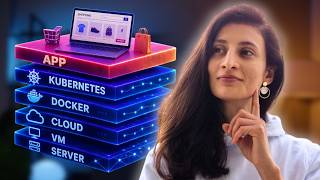
Start with Linux and cloud fundamentals to understand operating systems and cloud providers.
Infrastructure as Code (Terraform) feels familiar because it's coding infrastructure, not applications.
CI/CD pipelines are familiar because they run and build the code developers write.
Kubernetes and Docker are conceptually simple but operationally complex; a month of focus is enough.
Developers understand application architecture and APIs, which sysadmins struggle with.
Monitoring, logging, and incident response are more challenging for developers but essential for a complete skill set.
A complete DevOps skill set makes you 100 times more valuable than a senior software engineer.
What is the hardest part of DevOps that software developers already have?
Programming logic and problem-solving.
00:02
What is the first step in the DevOps transition path?
Linux and cloud fundamentals.
00:14
Which Infrastructure as Code tool is mentioned?
Terraform.
00:30
What runs and builds the code that developers write?
CI/CD pipelines.
00:45
What are the containerization and orchestration tools mentioned?
Kubernetes and Docker.
01:00
What is more challenging for developers than for sysadmins?
Monitoring, logging, and incident response.
01:30
How much more valuable is a DevOps skill set compared to traditional software engineering?
100 times more valuable.
01:45
Developers have a head start
Highlights that programming logic is the hardest part, giving developers an advantage.
00:02IaC feels familiar
Terraform is framed as coding infrastructure, making it easy for developers to pick up.
00:30Kubernetes is operationally complex
Clarifies the conceptual simplicity vs. operational complexity of Kubernetes.
01:00Sysadmins struggle with architecture
Shows the complementary strengths of developers and sysadmins.
01:30Complete skill set is 100x more valuable
Quantifies the career value of a full DevOps skill set.
01:45[00:02] advantage when it comes to DevOps. So, let me show you the fastest transition engineer. So, you already have the hardest part, programming logic and
[00:14] problem-solving. And here's the part that you're missing. First, Linux and cloud fundamentals. You need to understand operating systems in general, cloud providers work. Once you have this, next you're going to dive into
[00:30] infrastructure as code. Infrastructure as code for you will feel very familiar because you're basically coding infrastructure instead of applications. Learning Terraform is just functions and modules, and you will pick this up very
[00:45] fast. After that, you're going to dive into CI/CD pipelines. You understand the concepts of how it works, why it's needed, because it literally runs and builds the code that you write. So, you have daily interaction with it. The next
[01:00] one is Kubernetes and containerization with Docker. Conceptually simple, operationally complex. Just 1 month of focus on how to take your Docker as application and deploy it to Kubernetes and scale it up or down should be enough
[01:16] for you to really understand practically how these technologies work. And your advantage is that you understand application architecture, APIs, scalability concerns, which are things that DevOps engineers from, let's say,
[01:30] sysadmin backgrounds struggle with. Now, there is one part that will be a little bit more challenging for you than, let's say, for systems administrators, which is monitoring, logging, incident response. But if you cover those skills,
[01:45] as well, then you're going to have an all complete, well-rounded skill set that will make you 100 times more valuable than having the traditional software engineering skills, even as a senior software engineer. So, we are
[01:59] realistically looking at just a few months of diving into those tools in the right sequence to completely upgrade your engineering skill set. And I know for a lot of you, even those few months can be difficult because of a full-time
[02:14] job or responsibilities, so you may want to compress this timeline even further, which is understandable because you want to use your time efficiently and upgrade your skills in the fast fastest, least resistant way possible, which is a valid
[02:28] resistant way possible, which is a valid concern, and that's exactly why for a short period of time we are offering free calls where we help you identify your specific gaps and create a sequential learning plan that you can
[02:43] follow. Our spots get booked out pretty fast, so make sure to grab your spot and for the call is going to be in the comments or in the bio, so make sure to
[02:55] check it out there and reserve your spot with us.


⚡ Saved you 0h 02m reading this? Transcribe any YouTube video for free — no signup needed.