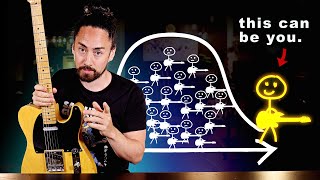

You Suck at Guitar (But Here's How to Change That)
45sDirectly addresses the audience's frustrations with a relatable, blunt opening, promising a solution from an experienced player.
▶ Play Clip"The title promises a method for anyone to become advanced, and the video delivers a structured, mindset-focused approach, though it's more philosophical than technical."
The video presents a 10-step mindset and practice framework for aspiring guitarists to achieve greatness, based on the creator's 23 years of experience. It emphasizes decision-making, goal adaptation, learning from others, broad listening, balanced obsession, efficient practice, and resilience. The core message is that the journey and experiences matter more than an unattainable end goal.
Make a definitive decision that music is essential to your life, not just a wish.
Define what greatness means to you, then break it into smaller, adaptable goals.
Learn from teachers, peers, and musicians you admire—stand on their shoulders.
Listen to what excites you, follow the chain of influences, and find your unique voice.
Let go of the fear of not being 'cool'—every genre offers valuable lessons.
Balance obsession with music by taking care of other life areas to avoid burnout.
Practice should be fun, challenging, and rewarding; adapt if it's not.
Experiment patiently and trust your instinct for what sounds good.
Say yes to opportunities without spreading too thin; maintain direction.
Protect your self-confidence and persist through tough times; giving up is not an option.
Accept that you may never feel 'great'; the journey and experiences matter more.
What is the first step to becoming a great guitarist according to the video?
Make a definitive decision that music is essential to your life, not just a wish.
00:15
How should you define and pursue your goals for musical greatness?
Define what greatness means to you personally, then break it into smaller, adaptable goals.
00:42
What is the third step in the video's path to greatness?
Learn from everyone—teachers, peers, and musicians you admire—by standing on their shoulders.
01:23
What does 'Always Be Listening' entail?
Listen to what excites you, watch it live, learn its history, and follow the chain of influences to discover more music.
02:28
How do you find your own unique voice as a musician?
By mixing diverse influences with your strengths, weaknesses, and life experiences, you create a unique musical voice.
02:56
Why should you let down your guard about music you think might not be cool?
Let go of the fear of not being 'cool'—every genre has something to offer, from pop's songwriting to classical's dynamics.
03:24
What is the catch-22 regarding obsession with music?
An obsession with music can negatively affect relationships and other life areas, putting too much pressure on music and causing burnout.
03:51
What are the characteristics of efficient practice?
Practice should be fun, challenging, rewarding, and show progress. If not, adapt your approach.
04:30
How should you develop your ability to know when something sounds good?
Experiment until something piques your interest, then follow that idea patiently, trusting your instinct.
04:57
What is the balance between saying yes and maintaining direction?
Say yes to opportunities without spreading yourself too thin, but maintain direction to avoid becoming an 'eternal dabbler.'
05:26
How should you handle moments of doubt and failure?
Protect your self-confidence fiercely, especially during tough times, and decide that giving up is not an option.
05:51
What is the final step in accepting greatness?
The goalposts move as you improve; you may never feel 'great,' but the journey and experiences matter more than the end goal.
07:33
The Decision to Be Great
Distinguishes between passive wishing and active commitment, a foundational mindset shift.
00:15Learn from Everyone
Emphasizes the importance of mentors and peers in accelerating growth.
01:23The Catch-22 of Obsession
Highlights the risk of burnout when music dominates life, offering a balanced perspective.
03:51Resilience at the Breaking Point
Personal story of near-quitting illustrates the power of persistence in achieving success.
05:51The Unattainable Goal
References Jimi Hendrix's humility to show that even masters feel inadequate, reframing greatness as a journey.
07:33[00:00] You suck. Nothing you play sounds good enough. All you want is to be a great guitarist, but it's just not happening. It's been 23 years since I picked up this very instrument and I think I finally may have figured out how you become great.
[00:15] Step one, you make this decision, and there's a difference between thinking, wouldn't it be nice to be really good at guitar? And knowing at the root of your being that you're going to take music as far as you possibly can. See, for every great musician that I've ever
[00:27] known, music is an essential part of their life. It's like food for them. You got to make the decision to embrace that thing wholeheartedly. And now that you've set it on your path, you've got to define what greatness means to you. When you have these overarching goals, you
[00:42] start working on the small things that lead into the bigger stuff. And for me, the grand thing always stayed the same, a life of fulfilling musical experiences. But the path to that moved around way more than I was expecting. And for a long time, I felt like I was lost wandering
[00:56] around in a dark forest. I thought I knew where I was going when I walked in, but I quickly got twisted around, I backtracked, went around in circles. But by sticking it out long enough, I eventually got to the other side. Now, tell you, I certainly didn't end up where I thought
[01:10] I would, but that kind of seems to be the case for everyone who gets over here. Stay treated your big goals, adapt the smaller ones, and good things will happen. Step three, learn from everyone, the more musicians that you can be around who you want to sound
[01:23] like the better. This is a picture of me and one of my old teachers, Rick. He is one of the many hugely influential people in my life. From guitar teachers, college professors, producers, band leaders, co-m musicians, I would be nowhere if I wasn't standing on the shoulders of some
[01:38] incredible musicians. Everyone is a different approach to music, but we're all essentially trying to do the same thing here, create things that we like the sound of. And learning how the people that we look up to figure that out is so important.
[01:51] Now, one of the things that I learned when I was in music college was how to take chords that I'd played for years and use them in ways that I'd never thought of. I turned this information into my new mini-course, chord revolution. In it, we look at some great tricks, like
[02:03] tri-tone substitution, diminished resolutions, sub-dominant minor, secondary dominance, and the theory behind these things. So easy to implement this stuff. It sounds great in understanding why it works as crucial information. And if you use the link in the description to pick
[02:16] it up for limited time, you're going to get that course for under 10 bucks. Anyways, let's get back to it. Step 4. Always Be Listening. Something you've heard has inspired you to chase
[02:28] that with all that you've got. That is a powerful thing. Listen to what excites you, watch it play live, learn about the history of it. When I was a kid, I was a huge Guns and Roses fan, couldn't get enough of them, and learning about who they liked led me to. Aerosmith,
[02:43] which then took me to the Rolling Stones, and then the Blues. By discovering who your heroes were, you not only get a more robust understanding of your chosen genre, but you also just find more music to get excited about. But you also got to remember that if all you ever do is try
[02:56] to sound like someone else, you're never going to find your own unique voice, and that's a defining element of greatness. See, when you've got all these diverse influences mixing together with the strengths, your weaknesses, your life experiences, you boil up a musical
[03:09] stew that is unlike anyone else's. On the topic of diverse influences, here's a lesson that took me far too long to learn. You got to let down that thing that prevents you from enjoying music you think might not be cool. There's been a lot of stuff over the years,
[03:24] I didn't want to admit I liked, and what good did that do? It really just deprived me of joy, knowledge, and opportunity. Through pop music, you can learn so much about songwriting and keeping an audience engaged. Classical music teaches you the intricacies of touch
[03:37] and dynamics. Every music has something to offer for everyone, and a great musician will have obtained a wealth of knowledge from countless different sources. Now, a big thing I've seen prevent people who could have been great from getting there was their relationship
[03:51] with music. See, there's a bit of a catch-22 here. The thing that can make you great at music can also be the thing that prevents that. Let me explain. You're probably going to have an obsession with music. This obsession can have a negative effect on your human relationships
[04:04] and other areas of your life, and when that stuff isn't taken care of, it can put too much pressure on music, and then when that happens, it all explodes. I've seen this happen so often. I've dealt with it a times myself, and I've found that if I'm looking after all aspects
[04:16] of my life, this thing over here works so much better. You know how they say practice makes perfect? That's not always true. See, if you're not learning the way that you best learn, that's incredibly inefficient. It's going to be different for everyone, but practice should
[04:30] always be fun, it should be challenging, it should be rewarding, and you should feel like you're progressing. If you're not making that happen, then you got to adapt. Efficient practicing is one of the most important things that a musician can do. I got a lot to
[04:42] say in this topic. I put all of it into a mini-course. If you want to check that out, I'll put a link for that in the description as well. One of your most important skills is your ability to know when something sounds good. So, whenever I'm creating music, I will experiment a ton until something eventually peaks my interest,
[04:57] and I know I just need to follow that. And a big part in making sounds that I like is being patient, not chasing every single idea that I come up with. Waiting until I find one that I know is good, and trusting myself that it actually is good. Now, of course, your standards
[05:13] will change the longer that you do it, but you've always got to trust and develop that base instinct. Step 10, say yes a lot, but not always. I've heard it said that you should say yes to everything because you never know where one door might lead in this world. So, you want
[05:26] to say yes to as much as you possibly can without spreading yourself too thin. There's so much amazing music out there, so much to learn, so many great opportunities. And you want to consume as much as you can and get out there as much as possible, but if you don't have
[05:38] any general direction, you'll end up being an eternal dabbler. You know, taking a step in a thousand directions and ending up pretty much where you started. Now, summer within you lies a fearless sense of self-confidence. I know it does because
[05:51] you wouldn't be trying to become a great guitarist if part of you didn't believe that it was possible. And while you need to keep the same check, you also need to protect it at all costs because there's going to be times where it's really, really tough, and you need
[06:06] to be able to fall back on the idea that you're going to get where you want to go eventually. See, there's tons of people who have what it takes from a base talent level, but you also need to be able to push past the breaking point of most. And I clearly remember this point
[06:19] for me. I graduated college, but I hadn't started doing YouTube yet. All my friends were making strides in their careers, buying houses, getting married, and I had nothing going for me. I'd move back in with my parents. Every project I was involved in was sputtering out, no money,
[06:33] no direction, no girlfriend, just nothing going on. We just got denied for recording grant for a project that I was highly invested in. And I remember sitting in my car and thinking to myself that maybe it was time to think about pursuing something different in life besides
[06:49] music. I sat there for an hour in the dark and I realized that was the point that most people would hang it up, but that wasn't going to be me. I was going to keep pushing no matter what. And the struggle by no means ended there, but this eventually led me to
[07:04] doing YouTube and that quickly became the most successful thing I'd ever been involved in. And I'll be honest, it's still not easy, but every time I think about giving up, I just tell myself, I'm not the person who does that. Giving up is a foreign of a concept as sprouting
[07:21] wheels and becoming a bicycle. And every time I've made that decision, something good has come on the other side of it. And I think the final step in this whole thing is accepting
[07:33] that you'll probably never believe you're great. See, the best guitar players that I've ever met have a way of holding others way above themselves. Like, take a listen to what Jimmy Hendrix has to say when he's asked about being the best guitarist.
[07:46] You're considered one of the best guitar players in the world. How about some of the best in this chair? I remember when I first started playing guitar thinking, if I can just do this one thing, that's all I'll ever need. But when I got there, there was another thing. And when
[08:02] I got there, there was another thing. And there's an unbroken chain of that happening that leads me to where I am today. And the thing you start to realize is that as you move forward, the goal progresses at the same speed. And I've come to terms with this idea that I'm 23 years into
[08:19] this thing. And if I don't think I'm great now, I'm probably never going to. And maybe it's not about becoming a great guitarist, great musician, great YouTuber, great artist or anything like that. It's the whole thing. It's experiences and friends that you find along the way that matter so much
[08:36] more than this unattainable end goal. Ladies and gentlemen, there you have it. Remember, my new course Cord Revolution is available for $9 if you use the link in the description to buy it. Good luck to all you on your quest for greatness. Thank you all for watching. And until next time,
[08:50] look after yourselves, look after each other, look after the planet. I'm Sam Reggitarrist, and I'll see you again soon.
⚡ Saved you 0h 08m reading this? Transcribe any YouTube video for free — no signup needed.
