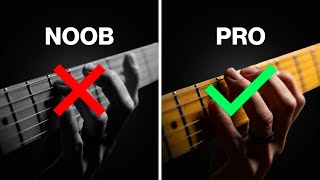

Fix Your Fretting Hand for Better Speed
45sMany beginners struggle with hand positioning, and this clip offers quick fixes that promise immediate improvement in speed and accuracy.
▶ Play Clip"The title promises 12 mistakes for beginner guitarists, and the transcript delivers exactly that—covering 12 distinct, actionable errors with clear fixes."
This video outlines 12 common mistakes beginner guitar players make, covering both technical errors and practice habits that hinder progress and risk injury. The instructor provides clear fixes for each mistake, emphasizing proper hand positioning, effective practice techniques, and the importance of consistency.
Over 20 years, the instructor has identified 12 mistakes beginners make that wreck progress and can cause physical harm.
Place thumb in the middle of the neck vertically, not sideways, to improve reach and comfort.
Keep fingers close to the fretboard to minimize movement, speed up playing, and increase accuracy.
Press with fingertips to avoid string buzz, muting, and lack of precision—essential for clear notes.
Plant palm on the bridge for stability and accuracy when strumming or playing single notes.
Align three dots (middle of finger, thumb, and pick) for a consistent grip; keep ring and pinky fingers out of the way.
Use a relaxed mix of arm and wrist motion to avoid a harsh, choppy sound.
Practice a little every day rather than long sessions a few times a week for faster progress.
Slow down to practice perfectly, building muscle memory without reinforcing mistakes.
Break material into small chunks; practice problem areas separately, then combine them.
Aim to play a passage correctly four times in a row before moving on, avoiding reinforcement of errors.
Practicing with a metronome improves timing; use a free app to develop a steady internal rhythm.
Keep wrist straight or slightly arched to prevent issues like carpal tunnel—this is the most dangerous mistake.
Correcting these 12 mistakes—from hand positioning to practice habits—will accelerate progress and prevent long-term injury. The most critical errors involve wrist health and practicing correctly.
Where should a beginner place their thumb for optimal guitar fretting?
Middle of the neck, vertically (not sideways).
0:33
Why should you keep fingers close to the fretboard?
It minimizes movement, increasing speed and accuracy.
1:06
What is the correct part of the finger to press frets for clear notes?
Use the very tip of the finger.
1:31
How should you anchor your picking hand?
Plant your palm on the bridge.
2:12
What three dots should be aligned for a proper pick grip?
Middle of index finger, middle of thumb, and middle of the pick.
2:51
What is the recommended practice frequency for fastest progress?
Practice a little bit every day.
4:01
When practicing a new piece, how many times should you play it correctly in a row before moving on?
Four times in a row perfectly.
6:33
What device is essential for developing good timing?
A metronome.
7:02
What is the most dangerous mistake for physical health?
Overextending the wrist.
7:30
What condition can result from years of bad wrist technique?
Carpal tunnel syndrome.
7:39
12 Mistakes Overview
Establishes the video's comprehensive scope and its promise to fix beginner errors.
Thumb Position Fix
A simple adjustment that significantly improves reach and comfort.
0:33Consistency Over Intensity
Highlights the principle that daily short practice beats sporadic long sessions.
4:01Most Dangerous Mistake: Wrist Health
Emphasizes injury prevention as a top priority over technical skill.
7:30[00:00] are you frustrated with your lack of
[00:02] progress even though you're putting in
[00:03] countless hours of practice well over
[00:05] the last 20 years I've worked with
[00:07] hundreds of students and they all have
[00:09] one thing in common they're making
[00:11] mistakes that not only wreck their
[00:13] progress but can physically hurt them in
[00:15] the process so today I'm going to show
[00:18] you the 12 most common mistakes
[00:19] beginners make give you an easy fix so
[00:22] you can bust out a beginner mode and
[00:24] advance to Pro status so what's the most
[00:27] dangerous mistake out of all these that
[00:29] can actually cause you physical harm
[00:31] well let's start with the first mistake
[00:33] and I'll go over that at the end in this
[00:35] first section we're going to talk about
[00:37] your fretting hand a lot of beginners
[00:39] will place their thumb too high or angle
[00:42] it sideways which can limit your reach
[00:45] and make scales and cords harder to play
[00:48] So to avoid improper thumb position you
[00:51] want to make sure that you bring your
[00:53] thumb down to about the middle of the
[00:55] neck and keep it vertical and not
[00:58] sideways sometimes I may bring my thumb
[01:00] up but for technical stuff keeping it
[01:02] lower will give you a lot better reach
[01:04] another thing I see is people tend to
[01:06] bring their fingers way too high off the
[01:09] fretboard which just slows you down you
[01:11] want to keep your fingers close to the
[01:13] strings because it minimizes the
[01:15] movement and it'll just allow you to
[01:18] move around a lot easier not keeping
[01:21] your fingers close to the strings can
[01:23] really jack up your speed and accuracy
[01:26] and you just won't be able to move
[01:27] around as efficiently the next one I see
[01:29] see a lot is people tend to press down
[01:31] with this part of the finger but if
[01:33] you're not using the finger tips it can
[01:36] cause you to get string buzz or mute
[01:39] notes and even mute the string below it
[01:42] and it's also just really hard to be
[01:44] precise when you're playing technical
[01:46] stuff so practice slow and watch your
[01:49] hand to make sure you're using the very
[01:51] tip of the finger because it'll help
[01:53] your notes come out a lot more clear
[01:54] keep in mind that sometimes there are
[01:56] exceptions to these it's not like you
[01:58] won't ever use that part your finger in
[02:00] fact you will but especially if you're
[02:02] working on single note Melody and Lead
[02:04] type stuff you want to typically aim for
[02:07] the very tip of your finger all right
[02:09] now let's talk about your picking and
[02:12] strumming hand now you don't necessarily
[02:14] have to do this one but it really helps
[02:16] me be a lot more accurate on which
[02:18] strings I'm hitting so if you're playing
[02:20] chords or you're playing single note
[02:22] lead type stuff and you're not anchoring
[02:25] your hand it's going to be hard to hit
[02:27] the right strings so one simple thing I
[02:29] do is just plant my palm on the bridge
[02:33] and if I have it anchored down like that
[02:35] it's just going to be a lot easier to be
[02:37] more accurate on the strings that you're
[02:39] hitting now before you go yelling at me
[02:41] in the comments about this one I know
[02:43] there's a lot of ways to do certain
[02:45] things and this is one of those this is
[02:47] just the way I do it and I think it's a
[02:49] great way for beginners to start so
[02:51] imagine you have three dots one in the
[02:54] middle of your first finger one in the
[02:57] middle of your thumb and another one in
[02:59] in the middle of the pick now line those
[03:02] three dots up and this is how you should
[03:05] hold your pick I also like to keep these
[03:07] three fingers out of the way like this
[03:09] if you're holding the pick wrong it can
[03:11] make it hard to be precise and I know
[03:13] some people play with the button or even
[03:16] the side of the pick and sometimes I do
[03:18] that too but I just think this is a good
[03:20] way to start for beginners so for this
[03:22] next one if you keep your wrist stiff
[03:25] and only Bend from your elbow when
[03:28] you're strumming this can cause a real
[03:29] really harsh and choppy sound so you
[03:32] really want to use a little bit of your
[03:33] arm and your wrist and stay super
[03:36] relaxed because it'll feel and sound a
[03:39] lot more smooth but if you're only using
[03:41] your arm when strumming it's going to
[03:44] sound super Jagged and robotic all right
[03:47] now let's get into this last section and
[03:49] after that I'll show you the most
[03:50] dangerous mistake out of all these so
[03:53] this is one of my favorite things to
[03:55] talk about because it's extremely
[03:57] important and a lot of people get it
[03:58] wrong practice sometimes people's
[04:01] practice schedules can be really
[04:03] sporadic and inconsistent but you're
[04:06] going to get a lot better results
[04:08] practicing a little bit every day versus
[04:11] practicing for like one or two hours a
[04:13] couple days a week so pick a time a day
[04:16] that works best for you and try to stick
[04:18] to a schedule every day because if
[04:20] you're not practicing consistently
[04:23] you're just not going to progress as
[04:25] fast this next one will help you train
[04:27] muscle memory and you'll be a lot more
[04:29] accurate and consistent in you're
[04:31] playing if you're playing too fast
[04:33] chances are you're probably practicing
[04:35] bad habits so you need to slow down and
[04:38] focus on having every note come out
[04:40] clear and just go slow enough to where
[04:42] you don't even make a mistake at all and
[04:44] then repeat that over and over and the
[04:46] speed will come on its own another thing
[04:48] I see a lot is when someone is learning
[04:50] a new song chord progression scale they
[04:52] try to do the whole thing all at once
[04:55] and what happens is they make the same
[04:57] mistakes over and over again and they're
[04:59] not able to play it correct consistently
[05:02] so for example if they're learning a
[05:04] scale and they keep messing up the same
[05:06] part they go back and start from the
[05:08] beginning again and then they mess up
[05:10] that same part and then repeat but what
[05:12] you're doing is you're actually
[05:14] practicing the part you already know the
[05:16] beginning and then even worse you're
[05:19] practicing the same mistake over and
[05:21] over which is actually training your
[05:23] brain and telling it that that's what
[05:25] your finger should be doing so you need
[05:27] to take that one little part that you
[05:29] keep messing up on work on that by
[05:31] itself and then put it with the rest in
[05:34] context I like to break things up so if
[05:36] I'm learning a chord progression with
[05:38] four chords for instance just repeat the
[05:41] first two chords over and over and then
[05:43] the next two chords and then the next
[05:46] two by themselves and then put them all
[05:48] together or if you're learning a scale
[05:51] maybe just practice the first two or
[05:52] three strings by themselves and then the
[05:54] next two or three strings and then put
[05:57] all those together hopefully you get the
[05:58] idea but if you're you're not taking it
[06:00] in small chunks you're probably
[06:02] practicing the same mistakes over and
[06:04] over which is going to wreck your
[06:06] progress I've touched on this next one a
[06:08] little bit and this one is huge you need
[06:10] to make sure that you play things
[06:12] correctly more times than you play them
[06:15] incorrectly and what I see a lot is
[06:18] someone struggling with something and
[06:20] they play it wrong 10 times and then
[06:23] they finally play it right one time and
[06:25] then they think they got it but no you
[06:27] need to make sure that you play it right
[06:30] more times than you play it wrong so one
[06:33] simple thing I do that's helped me a ton
[06:35] is make sure that I can play it four
[06:37] times in a row perfectly before I move
[06:40] on so if you play it once twice three
[06:43] times and then mess up on the fourth
[06:44] time start over you got to make sure you
[06:47] can get four in a row now this one trick
[06:50] alone has helped me a ton so just make
[06:52] sure you're not practicing your mistake
[06:55] over and over I know a lot of you are
[06:57] going to hate this one but I can't
[06:59] stress how important this is simply put
[07:02] your timing is not going to be good if
[07:04] you're not practicing with the metronome
[07:06] and if you don't know what that is it's
[07:08] just a device that plays a constant
[07:10] click sound to help you with your timing
[07:12] just search for an app and there's a ton
[07:14] of free ones out there but I know a lot
[07:16] of people hate practicing with a
[07:18] metronome but trust me your future self
[07:21] will thank you for this later the more
[07:23] that you practice with a metronome the
[07:26] better your timing is going to be when
[07:27] you're not playing with a metronome now
[07:30] this last one I'd say is the most
[07:31] dangerous mistake out of all these I've
[07:33] had several really good musician friends
[07:36] who have had to completely stop playing
[07:37] all together because of years of
[07:39] practicing with bad technique issues
[07:41] like carpal tunnel and stuff like that
[07:44] you want to make sure you keep your
[07:45] wrist straight and only slightly arched
[07:47] but don't let it come too far out like
[07:49] this because overextending your wrist
[07:52] like that can cause serious issues down
[07:54] the road now one thing I didn't really
[07:56] touch on was finger picking but if you
[07:58] want to avoid the four worst finger
[08:00] picking mistakes click on this video and
[08:03] I'll see you soon peace
⚡ Saved you 0h 08m reading this? Transcribe any YouTube video for free — no signup needed.