
Start Woodworking: Go Back in Time Tips
56sRelatable advice and a clear, actionable tip that resonates with beginners wanting to improve.
▶ Play Clip"Title accurately promises actionable advice for beginners, delivered with a real build."
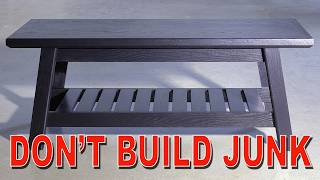
The video offers advice for beginner woodworkers, sharing lessons learned from starting over. The host builds a coffee table using basic tools, emphasizing practical tips on wood selection, jigs, and finishing.
Not all wood is equal; construction lumber (e.g., 2x4) differs from hardwoods like cherry. Beginners should buy wide boards (2x10/2x12) to select better grain and avoid knots.
Affordable hardwoods like red oak, poplar, alder, or soft maple are easier to work with and produce better results than construction lumber.
Focus on making repeatable cuts (e.g., using jigs) rather than perfect accuracy. A circular saw, router, and drill can build almost anything with jigs.
Beginners should use plans to avoid rabbit holes. Getting in the shop and building is more important than designing from scratch.
Sand parts before gluing to avoid difficulty later. Plan the order of operations to save time and frustration.
Avoid pocket holes in visible locations; they are great for hidden areas like undersides. Ignore gatekeepers who criticize their use.
A flat assembly surface is crucial for accurate builds. It should be a priority tool for beginners.
You don't need expensive tools to start. Buy tools as needed for projects. Avoid excuses about lacking a full shop.
Building furniture is typically more expensive than buying, but allows custom, higher-quality pieces.
Cut extra pieces early to have spares when something goes wrong.
Wipe-on finishes (like polyurethane) are forgiving and give great results. Avoid staining light woods to look like dark ones.
Use elongated screw holes to allow seasonal wood movement and prevent cracking.
Projects won't be perfect; people will be impressed by the build, not minor flaws.
Start building with basic tools, use hardwoods, plan ahead, and don't fear mistakes. The journey is more important than perfection.
What is the main difference between construction lumber and hardwood for furniture?
Construction lumber (e.g., 2x4) has knots and unstable grain; hardwood is more stable and looks better.
00:27
Why should beginners buy wide boards like 2x10 or 2x12 from big box stores?
To select vertical grain portions and work around knots, getting better quality wood.
01:11
What is the key to making accurate cuts with basic tools?
Repeatability, not perfection. Use jigs to ensure all parts match.
02:28
What three basic tools can build almost any furniture project?
Circular saw, router, and drill.
02:57
Why should beginners use plans?
To avoid rabbit holes and focus on building rather than designing.
03:53
When should you sand parts of a project?
Before assembly, to avoid difficulty sanding assembled pieces.
05:26
Where should pocket holes be avoided?
In obvious, visible locations.
06:49
What is the most important tool for assembly?
A flat assembly table.
07:42
Is woodworking cheaper than buying furniture?
No, it is typically more expensive due to tools and materials.
12:29
Why should you cut extra pieces early in a project?
To have spares when something goes wrong.
13:12
What type of finish is recommended for beginners?
Wipe-on finishes like polyurethane, Danish oil, or hard wax oil.
14:58
How should you attach a tabletop to allow for wood movement?
Use elongated screw holes (e.g., with a Forstner bit) to allow side-to-side movement.
16:53
Ignore Gatekeepers
Strong advice to ignore traditionalists who criticize using pocket holes, empowering beginners.
07:17Excuses Are the Enemy
Blunt statement that making excuses about lacking tools means you've already lost.
11:48Embrace Imperfection
Reassuring reminder that no one notices small flaws, encouraging beginners to just build.
18:17[00:00] What if you could go back in time and start your woodworking journey over? What would you do differently? I know what I would do, and this isn't some don't buy this tool or that tool video. No, this is the good stuff. And to help better explain myself, I'm going to build an actual beginner project
[00:13] using actual beginner tools so you don't have to look at my goofy face the entire time. I'm going to start by rough cutting parts to build my coffee table base from these boards. And I truly believe that buying wood is one of the most confusing topics out there for beginners
[00:27] and something that I really struggled with when I was starting out. Now, not all wood is wood. Oh, that's not right. Not all wood is equal, meaning a 2x4 that's sold at Home Depot used to frame a wall is much different than this cherry I'm working with.
[00:41] They're both really good at doing their respective jobs, but just okay at doing the others. And beginner John would spend all his time working with a southern yellow pine 2x4 that was filled with knots and flat-sauld grain, wondering why it didn't look like something I saw online or in a magazine.
[00:56] The point of this point isn't to tell you you can't build with construction-grade lumber. You certainly can. However, it's going to look like construction-grade lumber unless you know a couple tricks that I completely whiffed on. If a big box store is your only option, buy the widest possible wood you can,
[01:11] like a 2x10 or a 2x12. That way, you can be selective about what parts you use, like the vertical grain portion down on the side, not the center part of the board, which tends to look really ugly and is quite unstable.
[01:23] Plus, you can work around big knots. bonus points because the box for the lumber is cheap and will afford you the opportunity to mess up at a discount which you will certainly do that was a long drawn-out way of covering my ass for
[01:35] the people who want to suffer with construction grade lumber to tell you if i could go back in time i would build those beginner furniture projects out of hardwood you can get cheap hardwoods like red oak poplar alder soft maple depending on where you live even this cherry is
[01:49] reasonably affordable and not only is it easier to work with and actually dry unlike framing lumber, it doesn't cost you much more and your finished product will look significantly better. We will talk all about standing and finishing later on.
[02:02] I have all the rough parts ready to go for the coffee table base, but because this design has a bit of pizzazz with the angled legs, everything gets a little more complicated, but that's okay.
[02:14] In fact, it's a good thing. Since I'm trying to do this build with bare bones tools, I need to make a jig that will help me make repeatable angled cuts with a circular saw. A.k.a. what a miter saw does, like that one behind me that I'm neglecting to suffer for
[02:28] your enjoyment. If you've watched my videos for any length of time, you've heard me mention this, but accuracy is overrated. Repeatability is how you create a better finished product.
[02:40] When I was starting out, I would have sat here and obsessed with trying to cut all these parts to exactly 10 degrees, but the reality is, it doesn't matter. As long as it's pretty close and all the parts match, you're in the clear. I'll get all the way up on my high horse later in the video when we have a brutally honest conversation about tools,
[02:57] but there are very few things you can't build with a circular saw, a router, and a drill. It just might take you a while. The easiest way to get more out of those basic tools and speed up the process is to build jigs.
[03:09] Yet beginners rarely think about how to incorporate jigs into their build process, and the more experienced woodworkers obsess about it, rightfully so. I know it was the last thing on Noob John's mind, but I wish it was one of the first.
[03:24] The last piece of the puzzle to completing the base is getting the slats from these boards behind me. Now cross cutting 13 identical boards with a circular saw is certainly possible, but it's going to require a decent amount of time and likely some refinement.
[03:37] To speed up the process and make it repeatable, I made this cross cut jig which essentially turns my circular saw into the illegitimate love child of a sliding miter saw, a table saw and a track saw. My next piece of advice would be to ask for help when you need it. The easiest
[03:53] way to get help when you're starting out is plans. Yes, you could sit here trying to model this coffee table based on something you saw online, but I think that leads you down a rabbit hole too early in the journey. Someone has already gone through the trouble of figuring it out. Let them show you.
[04:08] Actually, getting in the shop and making something is far more important at this stage than conducting the entire orchestra. That can come later on. And if you're saying, what about these plans? Can I get some? I want an awesome looking coffee table. Short answer, yes. Long answer, this project is part of
[04:24] a beginner woodworking course I've been working on for over a year with Christian Foreyes and Sean from Sean Boyd made this. The course has over six hours of content, including four step-by-step projects hours of in tool reviews to get you comfortable using them and skill builders that cover important topics like finishing We show you how to build all the projects with basic tools You don even need a table or a miter saw like this coffee table
[04:46] Now, after we finish filming everything and editing it all together, we truly think it's the best beginner woodworking course, period. So we named it that. The course is currently available for presale at 25% off, which is crazy.
[04:59] And if you buy before the presale ends on January 12th, you get access to three live streams where you can ask us questions about all things woodworking. It doesn't matter if you've never used a power tool or have a couple projects under your belt. There's a link down below in the description. If you have any questions,
[05:14] let me know, but I look forward to seeing what you all build. Period. And if you're wondering how good of a job this jig actually does, I would say dead-on balls accurate, probably good enough.
[05:26] Me and the two shop supervisors have all the parts cut to size, which means we can start to assemble this all together. Right? Wrong! Unless you're building something very basic like a cutting board, waiting to sand these parts until they become a coffee table will be an absolute pain.
[05:40] So I'm taking care of that now rather than later, and I know beginners get so wrapped up in the cutting, gluing, and screwing things together aspect of woodworking that they tend to forget about planning ahead. I know that wasn't even a thought for me, but I encourage you to slow down.
[05:55] Think through every step of a build before you actually begin even sanding. Order of operations is such an important aspect to building furniture, and training yourself early on to come up with a plan will help you avoid headaches that create a lot of frustration and wasted
[06:09] time. Now comes the fun part. I need to drill two pocket holes on both ends of the slats, and then I can screw them into my bottom stretcher. General pocket hole tip, keep those suckers away from the edges of boards, especially
[06:23] parts like this that aren't very wide. I marked the center point of the flat and the stretcher, and I'm going to start middle out. And each flat will get glue, but I'm being very careful to keep it in the center so it doesn't squeeze out on the sides.
[06:37] Now I'm not sure it's possible to make a beginner woodworking video without broaching the topic of pocket holes. And I remember how empowered I felt when I first learned about pocket holes. I could easily secure two boards together. It was amazing.
[06:49] What I did a bad job of was knowing when to use them. Specifically, don't use pocket holes in obvious locations. Like this, or that. That looks really bad. I didn't even think about it, honestly.
[07:02] However, on the underside of a coffee table, that will never be seen. A plus application. Let's zoom out a little more. As a beginner, you're likely going to go online and read forums and comments on YouTube videos, and you'll see post after post from supposed experts who have been doing something a certain
[07:17] way for 50 years, and they will tell you what a failure you are for using something like pocket holes. and real craftsmen don't need them, and you should only focus on traditional joinery. I fell victim to that, too, for a bit. If I could go back in time,
[07:30] I would tell beginner John to stay away from those people and ignore them best he can. Gatekeepers are just that, gatekeepers. Find resources you know are credible, not anonymous comment sections, curmudgeons.
[07:42] Time for an off-the-cuff bonus tip because I was having some really painful flashbacks of my early woodworking days when I was assembling this base together. I cannot stress to you how important it is to have a flat surface like this one.
[07:55] Now, it doesn't need to be big and elaborate, but I would make the argument that an assembly table is one of the most important tools in your shop. And yes, I said tools, but for whatever reason, they don't seem to be high on the priority list for beginners in terms of shop builds.
[08:10] But I would move this one right to the top. All right, another bonus tip here. Shop supervisors just make everything more enjoyable. And I know everybody has met Bingo before, but about a year and a half ago, Bingo said that she wanted a friend.
[08:24] And because we have young kids, up there goes Bingo, naturally we named this one Bluey. Puppy boy! I work from home and spend more time with these two little creatures than just about any other being right now.
[08:36] Also, side tangent, I've always had big dogs. These are my first little dogs. I might be officially Team Small Dog. They are fantastic. Anyway, since I spend so much time with these lovely ladies, I'm pretty in tune with how they are doing.
[08:49] Bingo is an absolute cow. Don't tell her I said that. But the blue dog, cheese picky, doesn't even eat treats, just slowly grazes on whatever food is in her bowl all day. So I get an email from Sundays for Dogs asking if I want to try out their food.
[09:03] Bingo halfway obliged. Bluey was indifferent. Shocker to both. And also through the spoiler alert now, I've since signed up to be a customer out of my own pocket. I have never seen the two of them so excited for mealtime. They house it.
[09:15] And what I personally appreciate is the food is made entirely from human ingredients that is air Think like beef jerky Nothing synthetic no preservatives Imagine only eating processed food like a bag of potato chips your entire life
[09:29] That's kibble. It's horrible. That's why the shop supervisors are now eating Sundaes for Dogs. And if you want to get 60% off your first order of Sundaes, check out the link in the description below. And Bluey and Bingo wanted to tell them thank you for sponsoring this video.
[09:42] They greatly appreciate it. While the base dries, it's time to have that brutally honest conversation about tools. Now to make a tabletop, you take thin boards like this one and then glue them together to make one wide piece.
[09:58] As a beginner, one of the first lessons you will learn the hard way is boards don't really come very straight or flat when you buy them. It's a bummer. Even more of a bummer, there is no magic formula that two wavy boards become one straight board when you glue them together.
[10:12] And since I'm only using bare bone tools for this build, my jointer and planer, the two things that are designed to fix the straight and flat issues, were off limits. Which means, when I bought all this wood, I paid extra to have it planed and ripped on all four sides, known as S4S.
[10:29] You can do the same thing. Are these boards perfect, like I just jointed them? Absolutely not. Specialty tools don't exist to make people watching YouTube videos feel like they can't build the same thing. They exist because they serve a purpose.
[10:43] With that being said, there are generally workarounds. But I can't tell you how many hundreds of comments I've seen in my own videos saying, I could build that if I had all those tools. And 95% of what I show on this channel is a cable saw, miter saw, and a router.
[10:57] In my opinion, that's a low barrier to entry. I'm a golfer, and if someone told me they wanted to take up golf, I would tell them, okay, go buy some used clubs. It's no different than woodworking. You need tools to build things, clubs to play golf.
[11:10] I bought new tools starting out and built up a collection. I had planned to demonstrate the exact point I was making by using my old and new plunge router, but surprisingly enough, the old DeWalsh died right as I started filming.
[11:22] Now, I know less than nothing about tools, but I think the brushes are going. Someone help me out in the comment section down below, please. However, I think the point still remains that this was one of my first big boy tool purchases.
[11:34] I paid around $75 eight years ago, and it's more than paid for itself many times over. Since then, I've decided to upgrade, and until today, those two routers did the exact same thing. One was just a fraction of the price of the other.
[11:48] Rest in peace, DeWalt. But if you're going to sit there and make excuses on why you can't start building because your shop doesn't look like what you see online you've already lost, just go find a new hobby. And this doesn't need to be a sprint. It's a marathon.
[12:02] Buy the tools as you need them based on the projects you're working on right now. No need to get everything at once. Otherwise, you end up like me getting tools you really didn't need at the time and thought you would in the future, but never did.
[12:16] Thankfully, I already did the bulk of my sanding, but before I prep for finish, I like to break all the sharp edges and hit the show faces one last time with the sanding sponge working with the direction of the grain.
[12:29] Now picking back up with the woodworking might not be for you. The, I don't have all these tools people, tend to also fall into the mindset that getting into woodworking will save you money. Like, it's cheaper to buy a coffee table than build it.
[12:41] Sorry, folks. You could probably find one-off examples, but over time, as you acquire more tools, buy secondary items like screws, glue, and tape, never mind your own time, you quickly realize that, thanks to modern manufacturing, you can buy a bookcase much cheaper than building
[12:56] on your own. So for anyone just getting started, don't be like beginner John thinking you can make all the furniture in your own home and save thousands of dollars. The benefit of learning this skill is being able to custom make exactly what you want at a higher quality, typically not
[13:12] a cheaper price. One more off-the-cuff double bonus tip for you. Having something go catastrophically wrong during this build so I could make the point about overcoming obstacles would have been great
[13:24] for the video, but I'm not in the business of faking things. But that doesn't mean I wasn't prepared. Behind me are some extra boards, including a long piece to cut slats, an extra leg, and a nice wide one that I could have turned into, whatever. Always have or cut extra pieces to size early on
[13:40] in the project so that you have them available when something inevitably goes wrong, and I promise it will save you a lot of headaches and frustration. All right, time to apply some finish, and believe it or not you about to watch a YouTube video where someone doesn apply a hard wax oil I recently fallen back in love with these wipe polyurethanes Now you can make your own with a 50 blend of mineral spirits and something like Minwax or you can just buy something like this General Finishes Armor Seal
[14:08] which is already thinned down enough, and you can wipe it right on there. Let's keep the golf analogies rolling to help make this next point. Applying finishing woodworking is like putting in golf. There's an old saying, you drive for show, you putt for dough,
[14:21] meaning being able to make a five-foot putt is way more important than smashing the ball like Tiger Woods. Unfortunately, putting is really boring, and most shitty golfers never spend any time practicing.
[14:33] It's the same with finishing. Equally boring, and beginners never even think about it. But you can ruin 20 hours of hard work building a nice coffee table by doing a really bad job rushing the last two hours of finishing.
[14:45] Both on the tactile side with how it feels, and visually with big brush strokes and drips of finish on the edges. Alright, so I think I made my point about finishing being important, but the other big mistake people make is how they apply finish.
[14:58] Beginners, New John included, are enamored with brushing on finishes. Bad idea. When in doubt, find finishes you can wipe on nice and thin like I'm doing with this polyurethane.
[15:10] They are so much more forgiving, and I'll show you the results in a minute, but this application is super easy and gives you flawless results. You can also spray on finishes like Rallocan Lacquer, but that gets expensive, and you need the right space.
[15:23] So focus on wipe-on options starting out, like poly, Danish oils, natural oils, or even hard wax oils, and the results will speak for themselves. I promised earlier we would talk about staining, and here is the massive mistake beginners,
[15:39] again, you've got included, always make. It is very, very difficult to make a pine 2x4 look like walnut. In fact, to be blunt, it'll look like crap. If you want to easily stain your pieces to alter the color, start with a wood close in tone to your desired final look.
[15:54] Great example, same 2x4 bench here, one with a lighter stain and one with a darker. And there's a clear difference in the overall look. So don't try to turn light woods to dark or dark to light.
[16:06] Even better, don't stain your woods at all and buy hardwoods that match the tone you are looking for when finish is applied. Because the stain isn't actually finished, it's just a bad dye job like your 90s frosted tits. As far as this piece, I ended up applying three total coats and I sanded in between each one with 320 grit.
[16:24] Now after the final coat was dry, I buffed the surface with a brown paper bag to remove the dust nibs, but you could also use 4-0 steel wool. Now it's sometimes tough to see on camera, but check out how nice the quality of that finish is.
[16:37] Almost makes it look like you know what you're doing. Time to attach the top to the bottom, or I guess the bottom to the top, with screws. And I'm not going to do a full dissertation on this, but wood moves seasonally across the grain.
[16:53] And if you restrict that movement with fasteners, you run the risk of the top cracking. So, we need the screws to be able to pivot side to side. Thankfully, this doesn't need to be complicated and simply requires drawing for different holes.
[17:06] The first few holes will go into the stretcher, starting with a Forstner bit that is wide enough to allow the pan head room to wiggle side to side. I'm using a 5-8 inch bit. I drilled down somewhere between a quarter to half an inch.
[17:18] Let's call it 3-8. The second hole gets drilled straight through the stretcher, and you want to use a drill bit that's wider than your screw. You can even move it side to side. And this hole enables the screw machine to move with the wood when the top starts doing the electric slide in the summer and fall.
[17:34] Now that I have those two done, I laid my top face down. I'm just going to center this base before drilling my third and final hole. and that is a simple pilot hole to keep the top from cracking when I drive in screws.
[17:46] My final tip or thing that I got wrong is this. Your projects are not going to be perfect. Not when you're starting out, not when you're more experienced, never. Thankfully, unless your friends are walking around with a tape measure and a square
[18:01] and if they already need to find new friends, but no one is ever going to notice the inevitable slight imperfections like this base being a little twisted and the top not being perfectly centered. The best thing you can do above all these other tips is to just get out there and start building.
[18:17] Except that she will make what feels like catastrophic mistakes at the time, even though I promise you they are not. Everyone's just going to be so impressed that she built a badass-looking coffee table, even though you might not actually need one.
[18:29] We'll see ya. She is going to kill me when she finds out that I didn't finish the laundry room and I made this instead. So I go missing. You know where to start looking.
[18:41] Pray for me.
⚡ Saved you 0h 18m reading this? Transcribe any YouTube video for free — no signup needed.