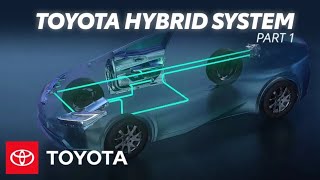

Never Plug In? Toyota Hybrid Battery Truth
37sChallenges the assumption that all electrified vehicles need charging, making it a must-watch for car buyers and EV skeptics.
▶ Play Clip"The title accurately describes the content—a detailed explanation of how the Toyota Hybrid System works."
Toyota's Hybrid System (THS) is a series-parallel powertrain that never needs plugging in, using engine power and regenerative braking to charge its battery. The video explains the startup process, the roles of motor generators, the planetary gear set power split, and how all-wheel drive is achieved with an additional rear motor.
Toyota introduced the hybrid electric powertrain in 1997, proving its viability for passenger vehicles.
The THS is a series-parallel design where wheels can be driven by gas engine, electric motor, or both.
The system never needs to be plugged in; it charges via engine power or regenerative braking.
Start button powers up ECUs via 12V battery; ECUs check battery status, engine temp, ambient temp.
System main relays send high-voltage power safely; they isolate the battery if a fault or collision is detected.
Inverter-converter controls high-voltage flow to/from motor generators and maintains 12V battery charge.
MG1 starts the engine silently and then acts as a generator to charge the hybrid battery.
Planetary gear set acts as power split device, like a CVT, managing output between engine and MG2.
MG2 powers wheels and acts as a generator during braking/coasting to capture energy.
Atkinson cycle cam timing keeps intake valves open longer for efficiency, with power trade-off compensated by MG2.
All-wheel drive achieved by adding a third motor generator directly to the rear axle, with no mechanical connection to front drivetrain.
In what year did Toyota introduce the hybrid electric powertrain?
1997
What is the Toyota Hybrid System (THS) and how does it drive the wheels?
The Toyota Hybrid System (THS) is a series-parallel design where the wheels can be driven by the gas engine, the electric motor, or both.
00:27
Does the Toyota Hybrid EV need to be plugged in to charge?
It never needs to be plugged in; it charges via engine power or regenerative braking.
00:39
What do the ECUs check after the start button is pressed?
The ECUs check the hybrid EV battery status, engine temperature, and ambient temperature.
01:40
What is the function of the system main relays in a Toyota Hybrid EV?
The system main relays send high-voltage battery power to components and ensure safe power switching; they isolate the battery if a fault or collision is detected.
01:53
What does the inverter-converter do?
The inverter-converter controls high-voltage flow to/from motor generators and the high-voltage battery, and maintains the 12-volt battery charge.
02:37
What are the two roles of Motor Generator 1 (MG1)?
MG1 starts the engine silently and then acts as a generator to charge the hybrid battery.
03:07
What component acts as the power split device in the Toyota Hybrid System?
A planetary gear set acts as a power split device, functioning like a continuously variable transmission.
03:35
What are the two roles of Motor Generator 2 (MG2)?
MG2 powers the wheels and acts as a generator during braking or coasting to capture energy.
03:48
What is the Atkinson cycle cam timing and what are its benefits and trade-off?
Atkinson cycle cam timing keeps intake valves open slightly longer, reducing cylinder pressure for better efficiency and lower emissions, but with a trade-off of less power.
04:15
How does Toyota convert a front-wheel drive Hybrid EV into an all-wheel drive vehicle?
By adding a third motor generator directly to the rear axle (Motor Generator Rear), which has no mechanical connection to the front drivetrain.
04:44
Toyota's hybrid debut in 1997
Establishes the historical starting point of Toyota's hybrid technology.
System main relays for safety
Explains a critical safety mechanism that isolates the high-voltage battery in case of fault or collision.
01:53Planetary gear set as power split device
Describes the core mechanical component that enables seamless power blending.
03:35Atkinson cycle for efficiency
Highlights the engineering trade-off between efficiency and power, and how MG2 compensates.
04:15All-wheel drive via rear motor generator
Shows an innovative, simple solution for AWD without a mechanical driveshaft.
04:44[00:00] Toyota helps start the electrification revolution in 1997 when it introduced the hybrid electric powertrain and proved its viability for use in passenger vehicles.
[00:13] Since then, Toyota has expanded its hybrid EV range to include multiple vehicles that have sold millions worldwide. Today, Toyota's latest hybrid EV system, also known as the Toyota Hybrid System, or THS,
[00:27] is an evolution of that original series parallel design, where the wheels can be driven by the gas engine or the electric motor, or both, and it's been further refined to provide better performance and efficiency.
[00:39] Above all, the Hybrid EV THS system never needs to be plugged in since it completely charges the Hybrid EV battery via engine power or regenerative braking, plus its components, including the Hybrid EV battery, have been designed with longevity, durability, and reliability
[00:56] in mind. To really appreciate how the powertrains in these vehicles help reduce carbon emissions, it's important to understand what's happening under the hood, learn how they operate, and take a closer look at the entire process from the moment the start button is pressed.
[01:16] Unlike a traditional gas powered vehicle that cranks a starter motor to get things going, a hybrid EV start button first powers up the system's onboard computers, the electronic control units.
[01:28] Like virtually all automotive systems, these ECUs operate on the 12-volt battery circuit, which also powers vehicle lighting, windows, door locks, and similar features.
[01:40] This explains why you'll find a typical 12-volt automotive battery on every Toyota Hybrid EV. Once online, these ECUs check things like the Hybrid EV battery status, engine temperature, and ambient temperature.
[01:53] They also manage some of the most crucial components in the vehicle, the system main relays. These relays are next in line, and do the heavy lifting of sending Hybrid EV battery power to the components that utilize high voltage, and ensuring the battery power is switched on
[02:08] in a safe manner when the vehicle starts, to avoid spiking any element of the system. For safety, if any fault or collision is detected, these relays are designed to immediately power down, isolating the Hybrid EV battery while shutting off the high voltage cables, which
[02:24] are color-coded in bright orange. Once the ECUs are up and running, the Hybrid EV battery power is sent to the inverter converter.
[02:37] This device controls the high voltage flow to and from the motor generators and the high voltage battery, and maintains the charge on the 12-volt battery any time the vehicle is running. The motor generators, as the name implies, works as both a motor, providing power when needed,
[02:53] or a generator to charge the Hybrid EV battery. Each plays a critical role in how the Hybrid EV system works. Motor generator 1, or MG1, is located directly behind the engine, and when used as a motor,
[03:07] starts the engine on demand any time it's needed. This MG1 is much more powerful than a traditional starter motor. It doesn't require a gear drive and is able to start the engine silently. This is the reason you never hear the typical starter sound on a Toyota Hybrid EV.
[03:23] Once the engine is running, MG1 is used as a generator and charges the Hybrid EV battery. A major key to how the Hybrid EV system works is a planetary gear set that acts as a power split device.
[03:35] This is used like a continuously variable transmission to manage the output between the engine and the motor generator 2. Parallel power output from the engine and MG2 work together, or separately, to power the
[03:48] wheels when accelerating and cruising. MG2 also acts as a generator when the brakes are applied or when coasting to capture the energy from the vehicle's forward momentum and charge the Hybrid EV battery any time the
[04:02] vehicle slows down. This 2-motor Hybrid EV design also takes advantage of Atkinson's cycle cam timing, which essentially means the intake valve stay open slightly longer and create less pressure in the cylinders.
[04:15] This design makes for exceptional efficiency and low tailpipe emissions, but the trade-off is a relative lack of power. That's why it works alongside Motor Generator 2 to produce a combined pool of power, helping
[04:28] provide both exceptional efficiency and good power response, the best of both worlds. So what if you want to make a front-wheel drive Hybrid EV an all-wheel drive vehicle?
[04:44] It's surprisingly simple. Unlike traditional all-wheel drive vehicles that use a mechanical drive shaft to distribute the power from the engine out to all four wheels, Toyota engineers simply add an additional third motor generator directly to the rear right in between the wheels.
[05:00] This explains why it's called Motor Generator Rear. This standalone unit has no mechanical connection to the rest of the drive train. It still helps add extra traction, capability, and power at the rear when it's needed.
[05:14] And like MG2, generates power for the Hybrid EV battery when coasting or breaking. So that's a quick look at the Toyota Hybrid system that's found in so many Toyota vehicles,
[05:26] and it's only one part of Toyota's electrification story. Be sure to check out the other videos in this series to learn more about Toyota's electrified power trains. To explore the full electrified lineup from Toyota, visit toyota.com-slash-electrified.
⚡ Saved you 0h 05m reading this? Transcribe any YouTube video for free — no signup needed.