
Why Homegrown Lettuce Beats Store-Bought
45sStrong opinion and cost comparison hook viewers with a relatable pain point.
▶ Play Clip"Delivers a solid, practical guide to growing lettuce, though the title's promise of 'abundance' is somewhat generic."
This video is a comprehensive guide to growing lettuce at home, covering everything from variety selection and planting methods to harvesting, washing, and storage. The creator shares his personal experience and techniques for growing lettuce in abundance, emphasizing its ease of growth and superior quality compared to store-bought options. He also includes a cost comparison and a favorite salad recipe to showcase the culinary benefits of homegrown lettuce.
Lettuce is easy to grow, can be harvested year-round in many climates, and is ready within weeks. Homegrown lettuce surpasses store-bought in quality, taste, and cost.
Lettuce is one of the easiest crops for beginners. Simply sprinkle seeds on the ground and return in a month for a harvest.
Experiment with different lettuce varieties for diverse flavors, textures, and colors. Consider your growing zone for cold or heat tolerance. The creator ordered 15 varieties this year.
Lettuce prefers cooler weather, building sugars for sweetness. Best grown in spring and fall. In zone 7B, the creator grew lettuce for 9 out of 12 months, with a cold frame extending the season by 3-4 months.
Two main options: direct sowing for cut-and-come-again patches, or starting in trays and transplanting for head lettuce. Use compost or potting mix in trays.
Leaves develop and layer, eventually forming a head. When the center starts balling up, it's ready to harvest, as it will soon bolt and go to seed.
Three methods: clipping outer leaves for continuous harvest, cutting 1.5 inches above the base for regrowth, or snipping the whole head at the base.
Lettuce is dirty; soak leaves in water, agitate, and repeat until water runs clear (1-3 times). Use a salad spinner to dry. Store in a large plastic container with a paper towel for moisture.
The creator eats 3-4 salads a week, using homegrown lettuce as a go-to lunch for energy without feeling heavy.
Includes homegrown lettuce, baby beets, radish, bacon, hard-boiled eggs, blue cheese, pickles, and a dressing of lemon, apple cider vinegar, mustard, honey, and bacon fat.
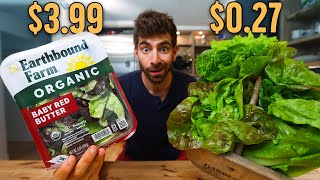
Store-bought organic lettuce costs $3.50-$7 per head. A 4x8 bed can produce $30-$40 worth of lettuce, making it cost-effective after initial setup.
What is the best time of year to grow lettuce outdoors?
Spring and fall, as lettuce prefers cooler weather.
02:18
Name three methods for harvesting lettuce.
Clipping outer leaves, cutting above the base for regrowth, and snipping the whole head.
05:29
How many times should you wash lettuce until the water runs clear?
One to three times, depending on dirtiness.
08:26
What is the cost range for a head of organic lettuce in New York?
$3.50 to $7.
13:51
What does it indicate when the center of a head lettuce starts balling up?
It is ready to harvest, as it will soon bolt and go to seed.
05:13
Lettuce is the ultimate crop
Establishes the core thesis: lettuce is easy, versatile, and superior to store-bought.
Cool-weather preference
Explains the science behind lettuce sweetness and bolting, guiding optimal planting times.
02:18Multiple harvest methods
Provides actionable techniques to maximize yield from a single planting.
05:29Cost-effectiveness of homegrown lettuce
Quantifies the financial benefit, making a strong case for growing your own.
13:23[00:00] See you later. All right, so let's say I only had one garden bed in my entire garden. We'll call it four by eight feet. Most of this garden bed right here would be dedicated to growing lettuce.
[00:16] And the reason for that is lettuce is so easy to grow. You can practically grow it year round. You can harvest it within weeks of planting it. You can harvest it the entire time it's growing. But most importantly, lettuce that is grown at home absolutely sh** on the store-bought stuff in quality, taste, and cost.
[00:35] And today's video will be dedicated to this wonderful crop. I'm going to be explaining why I love growing it so much, as well as how I grow it in abundance, so I'll never have to buy it from the store again.
[00:47] Alright, let's talk growing lettuce, which is by far one of the easiest things to grow as a gardener. If you do not have a green thumb, start with growing lettuce. If you took a pack of seeds and just sprinkled it into the ground,
[00:59] come back a month later, you're going to have something to harvest. Trust me, it is that easy. And the first place you want to start is with varieties, which is one reason why lettuce is so fun to grow.
[01:11] Outside of tomatoes, I would say lettuce is a crop that I experiment with the most different varieties. A lot of the stuff we're getting in the store, the reason they are sticking to those varieties because people are used to them.
[01:23] They grow really well. Maybe they stay fresh and they're easy to ship. But at home, we can just go crazy with it. And from a culinary standpoint, it's so fun to experiment with all of these different varieties
[01:36] that have different flavors and textures and colors. You can really start building some incredible salads when you plant different varieties in your garden. Now, for me, I just kind of pick up a seed catalog and flip through it
[01:48] and just pick out the things that look cool. I have my preferences, like I love butter lettuce. I just like the sweetness and the freshness of it. But one thing to keep in mind is definitely your zone that you're growing in. Some lettuces are more cold tolerant, some lettuces are more seed tolerant,
[02:04] and that will tell you in the seed catalog or on the seed packet. This year I probably ordered 15 different varieties since I had the greenhouse, and they all grew well, and I'll be saving a lot of seed from these varieties. Now another thing to consider, of course, is when to grow lettuce.
[02:18] And in general, lettuce is a cooler crop. It enjoys colder weather. It gives those leaves time to really build up sugars and get sweeter and crunchier. And as it heats up in the middle of the summer,
[02:30] lettuce tends to want to form that flower and bolt and put out more seeds. So in general, the best time to grow lettuce is in those transition seasons, spring and fall, where it's just perfect climate for growing lettuce outside.
[02:44] Of course, if you have some type of greenhouse or indoor growing structure, you can grow it year-round. I'm in zone 7B here. I was able to grow lettuce this year for about 9 out of 12 months. When it got extremely cold in, say, January, February, March,
[02:59] most lettuce varieties are just way too delicate, and if they get an intense frost or freeze, those cell walls start breaking down, and once that happens, they just die. Compared to, say, a more hardy green, like from my last video,
[03:11] if you have spinach, that can take negative temperatures. The entire crop can freeze, it can defrost, and it can just keep growing throughout the entire winter. Now, one thing I will suggest as well is if you have a garden bed to build a cold frame around it,
[03:24] this is going to just maximize your lettuce harvest to a whole nother level. I built this before I had my bigger greenhouse just on one garden bed and it extended my lettuce harvest at least three or four months
[03:37] just from this one cold frame And what I like to do as well is start some of my lettuce inside under a grow light where the temperature is maintained and if I time that right it goes outside when the weather warms up a little bit and it can be planted in the ground. Now speaking of planting your lettuce there's two
[03:53] main options for planting. You can either direct sow or put your seeds right in the ground and let them sprout up which is what I did for say this arugula patch where I really want to pack this tight and create a nice bush of lettuce. Because to harvest this, every few days I just go through
[04:10] and trim out some and it just keeps growing. Whereas for me, I'm growing a lot of head lettuce. In that case, it needs its own space to develop that full head. So I like growing it in trays first and then transplanting it into the ground. So I fill up my trays with a compost or potting
[04:24] mix. I pop in a few lettuce seeds. After they sprout, I'll thin them out if I'm trying to get just a single head of lettuce. And then after a few weeks of development, the lettuce is a little more hardy. It's nice and healthy and it's warm enough to be transplanted outside into my garden
[04:40] beds. Now let's talk about lettuce development, how it's actually growing, which is just fascinating to watch because it happens so quick. Now at first you're going to start seeing a few leaves develop
[04:56] and those leaves will get bigger and bigger and then those leaves will start layering. More and more layers of leaves will start growing. Now the lettuce will continue to get bigger and bigger and grow more and more layers to the point where if it's a head lettuce it starts forming a nice head.
[05:13] It starts balling up in the center and what that's telling you is that your lettuce is ready to harvest because after that it wants to push up those flowers right from the center and go to seed and produce more lettuce. Which brings us to harvesting and there's actually multiple ways to
[05:29] harvest your lettuce which makes it such a cool crop to grow. And the most important thing to know is that you can harvest it the entire time it's growing. You can cut it off right when it's little micro greens and throw that in a salad or keep it going until it's a full head. Now the first
[05:45] harvesting style is going around and just clipping off the outer leaves. This is a great way because you're clipping off those bigger leaves and letting the lettuce just continue to evolve and grow more and more leaves. So very little disturbance here. The downside of this is those outer leaves as you
[06:01] can see here are just a little bit more wilty where that inner lettuce heart is nice and crunchy but for me these leaves make wonderful lettuce wraps because they're nice and big. They can also be rolled up and you just stiffen on them up and throw them in a salad and you're good to go. That's
[06:16] be your best option if you're not growing a lot of lettuce so you can just really maximize your harvest. The second way to harvest is you can take a knife or your pruners and cut about an inch and a half above the base and as long as you leave some of those leaves fully intact right in the
[06:33] center a whole new set of leaves will emerge from that base. You basically can get a brand new lettuce from that spot a few times over throughout the season. And then finally if you're growing a good bit of lettuce as you can see here. You just snip it right at the base and you have a full head
[06:50] of lettuce which in a lot of cases is what you're getting at the market. If it's not a cut lettuce like spring mix or arugula, people are used to getting that nice full head of lettuce when they go to the market. And honestly for me at home, I love it as well. It's a true joy cutting a nice
[07:07] head of lettuce, bringing it inside to make a salad. So we've harvested our lettuce, and lettuce is one of the dirtier crops. It's got all of these layers in here. Look at this.
[07:19] If you come home you bought some lettuce from the farmer market and you see a worm crawling around your kitchen probably came out of the lettuce Like I wouldn be surprised if there was one in here right now No worm but a crazy amount of dirt that just gets stored in those leaves
[07:31] That's why you see lettuce in the store being triple washed. One thing that is mandatory if you're going to make a lot of salads and consume a lot of lettuce is a salad spinner. A lot of people do not have one of these things. I don't know how you're washing your lettuce.
[07:44] This product will make it so much more efficient to the point where I've upgraded this year. I've grown a lot of lettuce. This is an industrial restaurant style salad spinner and I love it. But what you're gonna want to do is click off all of those lettuce leaves and get them soaking in a big bowl of water.
[08:01] Now if you got your lettuce in the market and it was hot out or you picked your lettuce in the middle of the day and it's more wilty, you can just let your lettuce soak in some cold water and it will absorb that water and really perk it up and make it nice and crunchy again.
[08:13] And I take my hands and I ruffle around all of the lettuce in the water, which will knock off a lot of that debris. and just pour off the water. And just like washing some white rice, you're going to do this process until the water runs clear.
[08:26] Usually around one to three times, depending on how dirty your lettuce is. Then you transfer it to the lettuce spinner and give it some spins, which obviously through centrifugal force will eject all of that water off your lettuce
[08:38] to the bottom of your salad spinner and you've got some dry lettuce. Now there's a few options for storage. You can put it in a Ziploc bag or one of these compost bags. Obviously there's no structure to these bags and lettuce is very delicate so it's more susceptible to getting crunched around.
[08:53] My favorite way to do it is to put it in a large plastic container like one of these Cambro containers. And sometimes if there's a little extra moisture, I'll just throw a paper towel in there just to absorb any of that extra moisture to keep it fresher a little longer.
[09:07] Now I'm not spending all this time to grow this lettuce so I can feed my chickens some greens. Although they do love themselves some good lettuce. all of those outer leaves that get peeled off when I field dress them, that are wilted,
[09:19] that are bug damaged, right through the chicken. But all of this good stuff, the reason I am putting in so much time, so much effort is because I consume a lot of salads. I eat about, I would say,
[09:31] three to four salads, sometimes more a week. It is my go-to lunch because you can load up a salad, it can be protein heavy, but it's still light. So it's just pure energy in the middle of the day,
[09:43] so it doesn't weigh me down. And with all these leaves throughout the year, I can create the best salads in the world. And I already created a video about three years ago about how to make salads that don't suck. So if you really want to go deep into salad building,
[09:56] different dressings, different ingredients, check out that video. But I thought in today's video, I wanted to just give you one recipe. If I could only choose one salad for the rest of my life,
[10:08] this is the salad it would be, or at least some form of it. And of course it starts with a little trip to the garden. Now we know lettuce isn't seasoned, but I'm scouting for anything else fresh I can throw in this salad.
[10:20] And I've got some of these beautiful baby beets, so I'll pick a few of those. I also have some radish, that's a go-to salad ingredient. And like I said, one of my favorite things is I can pick a few different varieties of lettuce here
[10:32] to make up my salad to keep it really interesting. And then finally, I'll take one last stop for the chicken coop for a few eggs. The first thing I'm going to do is cook some bacon. I'm using the air fryer for this which is super
[10:46] simple. I'll just throw that in the air fryer for around 10 minutes at 375 degrees Fahrenheit. Then I'll get my greens prepped and washed. Next I'll hard boil my eggs for around 11 to 12 minutes depending on the size. And this bacon is done and perfectly crispy after 10 minutes. And while the
[11:03] eggs are boiling I prep my beef which I going to roast All I need to do is cut off the stem and and cut off the and I get up some tinfoil and I going to remove the bacon from the air fryer but since I have all that rendered fat at the bottom I thought I would use some
[11:15] of that to roast these beef. So I created a little pouch and then I threw that in the air fryer at 350 degrees Fahrenheit for around 25 to 30 minutes. Next I'll chop up all of that crispy bacon into little bits. I'll put that aside. I'll prep and slice my radish.
[11:31] When my eggs are done, I'll place them in some ice water to stop the cooking. Then I'll peel them and slice them up to go in the salad. So here are the baby beef, perfectly roasted after 25 minutes. And the skin will naturally just peel off at this point once they're roasted.
[11:45] But since these beef are super young, the skin is thin and delicate. So you can leave it on and eat it, no problem. I'll slice up all of the beef. I'll put them aside and I'll start working on my dressing. I'm going to squeeze in one lemon, two tablespoons of apple cider vinegar,
[11:59] one tablespoon of fermented mustard, one tablespoon of honey for balance. I figured I would add in that extra beet juice oil from the tin foil pouch. And then for the fat, again, to not waste anything, I'm going back in with the rendered bacon fat to really give this a smoky flavor.
[12:15] And finally, some pepper and salt. And I will pop the lid on and just give this a good shake to emulsify. Now to bring this all together, I stack up all of my lettuce leaves.
[12:27] so I sliced them up or give them a rough chop, really just to make them more bite-sized. And I popped everything in a bowl, and I had some pickles that I thought would be a nice little acidic hit, so I sliced some of them up, got them in the mix, and of course the salad needs some cheese,
[12:42] so I crumbled in some blue cheese, and then back in goes all of those prepped ingredients, and I'll hit it with my dressing, which is a great time to talk about dressing salads. Two things I want to mention that are so important.
[12:55] When you are dealing with beautiful greens that are really flavorful, you do not need to overdress greens. I think a lot of times overdressing greens is to make up for bland greens.
[13:08] You just want a nice delicate coating. And then the second tip is do not mash that dressing in. We're not making a sauerkraut. You got to be nice and gentle when you're folding in that dressing.
[13:23] The final thing I want to talk about is cost comparison. Store bought, home grown. Which is a big reason why I grow a lot of lettuce.
[13:36] This stuff is expensive, especially for high quality organic lettuce. One of these containers, this is about a heads worth of lettuce, say the same as one of these. These things range from probably $3.50, I've seen them all the way up to $7.
[13:51] I do live in New York, so take that into account, which is why I grow a lot of my own food. It's just not really sustainable to eat a lot of lettuce, and I love eating salad. Now, cost comparison is always a tricky subject with gardening, because not everyone has space,
[14:04] not everyone has time to garden. But like I mentioned, one 4x8 garden bed, if that's all you have space for, dedicated to lettuce, you'll be amazed at how much lettuce you can grow. You throw a cold frame on that, and you're growing lettuce nearly all year long.
[14:19] So after you invest in those initial startup costs of materials and compost and fertilizer, the investment starts paying off quick. Over time, I am producing a lot of money's worth of lettuce. All of this right here probably costs somewhere around $30 to $40.
[14:35] And that's like a few salads worth, which is crazy. So get yourself some seeds, try it out, grow some lettuce. It's so easy. And let me know how it goes. Hit me up on Life by Mikey on Instagram. and for more growing videos, check out this video right here.



⚡ Saved you 0h 14m reading this? Transcribe any YouTube video for free — no signup needed.