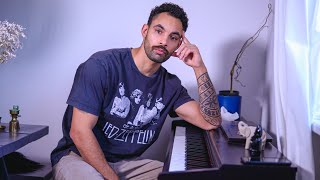

I Learned Piano in 1 Year as an Adult Beginner
60sThe surprising claim of learning piano in one year as an adult with no experience challenges common beliefs and sparks curiosity.
▶ Play Clip"The title is accurate and the content delivers on its promise, though the video could be more concise."
The video documents the creator's journey from having zero musical experience to playing a complex piano piece within one year. It challenges the common belief that learning an instrument as an adult is impractical and presents a practical, piece-focused method.
The creator had no prior experience with any instrument and believed learning piano as an adult was too difficult and time-consuming.
The creator borrowed a keyboard and decided to try, documenting progress through videos that gained significant attention.
The creator distinguishes between learning to play the piano as a whole and learning to play specific pieces, which was their actual approach.
Instead of studying music theory or sight-reading, the creator used Synthesia videos that visually show which keys to press for a piece.
This approach makes the piano less intimidating, allows for fast progress, and is cheap since it doesn't require lessons.
After memorizing a piece, the creator found it easier to learn technical aspects like dynamics and tempo, adding emotion to the music.
The creator notes this is anecdotal and not professional advice, but encourages others to try the approach and let go of doubts.
What was the main tool used to learn piano pieces?
Synthesia videos and similar apps that visually show which keys to press.
02:40
What is the primary benefit of the Synthesia approach?
It makes the piano less intimidating and allows for fast progress by memorizing key sequences.
03:23
What technical aspects become easier to learn after memorizing a piece?
Dynamics (intensity of key presses) and tempo variations.
04:27
What distinction does the author make about learning the piano in one year?
He learned to play specific pieces, not the instrument as a whole.
01:44
Learning Pieces vs. Learning the Instrument
This reframes the goal of learning, making it more achievable for beginners.
01:44Using Synthesia for Visual Learning
This is a concrete, actionable method that bypasses traditional barriers to entry.
02:40Reducing Intimidation Through Fast Progress
Highlights the psychological benefit of early wins in skill acquisition.
03:23Memorization as a Gateway to Technique
Shows that practical learning can naturally lead to theoretical understanding.
04:27[00:01] okay so today I'm going to try to explain how I went from this
[00:22] now I began playing the piano back in the summer of 2019 and prior to that I didn't have any experience at all with any instruments actually like most people do I had always told myself the same story that if you want to learn how
[00:36] probably start when you're a child and even then it's going to be extremely time consuming and difficult and on top of that if you're not musically gifted well you might as well just give up beforehand and that was all up until I
[00:49] got to borrow my sister's old keyboard I simply decided to put all of that aside simply decided to put all of that aside and actually give it a try
[01:02] had kept me from starting before couldn't have been more wrong in any case I decided to document this journey and I ended up uploading a bunch of videos sort of showcasing my progress those videos ended up getting a bunch of
[01:16] views and a bunch of comments from people who wanted to know how I had made some people who didn't even actually believe that the progress that I did make was authentic which I guess I should take as a compliment but so to
[01:29] answer the question how did I go from having zero experience with the piano to playing a relatively complex piece like the fantasy impromptu only one year want to First make an important distinction in that I wouldn't actually
[01:44] say that I learned how to play the piano in one year rather what I would say I did was that I learned how to play specific pieces of music on the piano and then through that process I eventually became more and more familiar
[01:57] with the instrument foreign
[02:09] beginning I didn't actually spend a whole bunch of time learning how to side read notes or studying music theory which definitely is something that most probably recommend that you do instead I simply just found a piece of music that
[02:24] video on YouTube that showed which keys to press in order to play that piece of music I want to see how fast I can learn to play the Turkish March by Mozart
[02:40] of music you can imagine is something called Synthesia and what that means is that it's a video showing you how to play the piece of music that you want to learn through a visual representation so whenever you see that little small tab
[02:53] key you have to press and as a little side note that's actually one thing as an instrument compared to other string instruments like the violin for can actually be quite difficult to place specific notes where with the piano if
[03:09] you want to play a C note you simply just press the c key so using these Synthesia videos and eventually moving on to other apps like the same principle was the main approach that I took to learning the piano and
[03:23] the benefit here I think is that it makes the piano a much less intimidating instrument to get into you have a keyboard you pick a piece of music that you like and then you simply just memorize which order to play the keys in
[03:36] memorize which order to play the keys in in order to play that piece of music learning because you're making Fast progress and it doesn't actually take
[03:48] that long before you're eventually playing your first simple piece of music other than obviously having a keyboard it's super easy and cheap to get into this way since you don't have to pay for expensive piano lessons and the final
[04:02] cool thing about this approach is that it doesn't even have to be at the cost of what some purists might say that you would lose if you were to take this way and learning about all of the technical stuff first because for me and
[04:15] now I'm obviously speaking from personal experience what would happen was that when I had finally memorized a piece of music at first it would sound terrible but at least now I knew how to play it and I had a sense of accomplishment and
[04:27] the more I practice the more comfortable I would get with a piece of music also meaning that it would be easier to then now get into all the technical stuff such as Dynamics meaning with which intensity you press the keys and also
[04:40] being able to play around with tempos or playing a piece of music faster or gotten comfortable with a piece of music you can begin to add actual emotion to the piece [Music]
[04:58] but with all of that said rounding off the video I have to add a final disclaimer in that please remember I am not a professional piano teacher and this sort of practical approach and its efficacy is purely anecdotal and based
[05:12] solely on my own personal experience so if you've been wanting to get into learning a new instrument and more specifically in this case the piano my invitation to you is to let go of all of those doubts and concerns and try out
[05:25] this approach and you might end up surprised by the amount of progress you'll be able to make but with that said thanks for watching I'll see you in said thanks for watching I'll see you in the next one
⚡ Saved you 0h 05m reading this? Transcribe any YouTube video for free — no signup needed.