
Why 'Every Good Boy Does Fine' is SLOW
48sChallenges a widely taught method, sparking debate among musicians and learners.
▶ Play Clip"Title promises fast note reading and delivers a clear, systematic method – the Landmark System – exactly as advertised."
This video teaches a fast method for reading musical notes called the Landmark System, replacing slow mnemonics like 'Every Good Boy Does Fine'. Instead of memorizing all lines and spaces, you memorize a few key reference notes (landmarks) and use the alphabetical pattern to quickly identify surrounding notes.
Each dot on the staff represents a specific piano key; reading music means playing these notes left to right.
Music is written on two staves: treble clef (high notes) and bass clef (low notes). Each staff has 5 lines and 4 spaces.
Mnemonics like 'Every Good Boy Does Fine' are slow because you must recite the whole phrase to find a note, and they don't tell you which octave.
Moving from line to space to line moves up consecutive letters (A-G). This pattern helps figure out notes without memorizing every position.
When notes go above or below the staff, you add short lines (ledger lines) following the same line-space pattern.
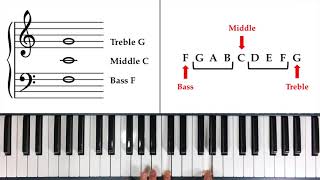
Memorize only a few evenly spaced landmarks: middle C, treble G (second line from bottom), bass F (second line from top). Then expand to treble C, bass C, high G, low F, high C, low C.
Landmarks are visually mirrored between treble and bass clefs (e.g., high C and low C both use two ledger lines). Memorizing 9 landmarks gives access to all common notes.
What are the two clefs used in piano music?
Treble clef (high notes) and bass clef (low notes).
1:14
How many lines and spaces are in a staff?
5 lines and 4 spaces.
1:32
What is the first line of the treble clef?
E.
1:51
What is the first line of the bass clef?
G.
1:57
What is the problem with using mnemonics like 'Every Good Boy Does Fine'?
You have to recite the whole phrase to find a note, which is slow, and it doesn't tell you which octave.
2:37
What pattern do notes follow when moving from line to space to line?
They move up consecutive letters of the musical alphabet (A-G).
3:00
What are ledger lines?
Short lines added above or below the staff to extend the range of notes.
3:48
What is the first landmark in the Landmark System?
Middle C.
4:34
Where is treble G located on the treble clef staff?
The second line from the bottom.
4:54
Where is bass F located on the bass clef staff?
The second line from the top.
5:23
How many notes (letters) are between middle C and treble G?
Three letters: D, E, F.
6:09
What are the nine landmarks in the Landmark System?
Middle C, treble G, bass F, treble C, bass C, high G, low F, high C, low C.
8:30
How many ledger lines are used for high C and low C?
Two ledger lines.
8:10
Flaw of traditional mnemonics
Identifies a key inefficiency in common music teaching methods, motivating the need for a better system.
2:37Introduction of the Landmark System
Core technique of the video – memorizing a few landmarks instead of all lines and spaces.
4:20Symmetry between treble and bass landmarks
Shows the elegant visual symmetry (e.g., treble G and bass F are both second lines from the edge), making memorization easier.
6:09Nine landmarks cover all common notes
Demonstrates the efficiency of the system – only 9 reference points unlock the entire staff.
8:40[00:00] all right in this video i'm going to
[00:01] teach you as quickly as i can how to
[00:03] read notes on a page so first here's a
[00:05] piece of music we have the title at the
[00:07] top the composer in the upper right hand
[00:09] corner and the music below
[00:12] all these dots with stems are notes and
[00:14] correspond to an exact note on the piano
[00:17] for example this note here is g but it's
[00:20] not
[00:21] that g or
[00:23] that g it's specifically
[00:25] this g
[00:27] so every note is an exact note on the
[00:29] piano and reading music is just reading
[00:32] these exact notes and playing them left
[00:34] to right
[00:36] these notes are all lined up together so
[00:38] you play them together
[00:39] [Music]
[00:41] as you move forward it's just like this
[00:44] [Music]
[00:52] okay now that you understand that each
[00:53] of these notes corresponds to an exact
[00:56] note on the piano and playing notes is
[00:58] just playing it left to right
[01:00] now let's get into actually how to read
[01:02] these notes so notice these notes fall
[01:04] into two areas a top area and a bottom
[01:07] area each of these areas is called the
[01:09] staff the foundation upon which notes
[01:11] are drawn now notice both staffs have a
[01:14] different sign the top sign is called
[01:15] treble clef and the bottom sign is
[01:17] called bass clef what kind of notes does
[01:19] a bass player play while he or she plays
[01:22] low notes so the bass clef covers all
[01:24] the low notes on the piano the treble
[01:27] clef
[01:28] covers all the high notes
[01:30] now notice in each staff how many lines
[01:32] are there
[01:33] if you counted correctly you'll see that
[01:35] there are five lines with four spaces in
[01:37] between those lines notice that the
[01:39] notes in the music either fall on a
[01:40] space or on a line there are notes that
[01:43] fall outside of the staff as well these
[01:46] are called ledger lines and we're going
[01:47] to get into that very soon now here we
[01:49] have a clean staff and here the first
[01:51] line in the treble clef is an e
[01:54] however the first line in the bass clef
[01:57] is a g
[01:59] the second space from the top is a c
[02:03] but in the bass clef that same note is
[02:05] an e
[02:05] [Music]
[02:07] the lines and spaces are different in
[02:09] both clefs so reading music becomes a
[02:12] memorization challenge how music
[02:15] teachers have approached this challenge
[02:17] is by giving students mnemonics to
[02:19] memorize like every good boy does fine
[02:22] memorizing that phrase helps you
[02:23] memorize the five lines of treble clef
[02:26] are e g b d f
[02:29] and the spaces are face f a c e the bass
[02:33] clef also has its own mnemonics to help
[02:35] you memorize the lines and spaces there
[02:36] as well
[02:37] the problem with this method is if you
[02:39] want to play the last line
[02:41] of the treble clef you have to think
[02:43] every good boy does fine oh it's an f
[02:47] that's slow and painful because you have
[02:48] to go through the whole acronym to get
[02:50] to that f it also teaches you to
[02:52] memorize that that line is an f but it
[02:54] doesn't teach you which f one thing you
[02:56] can get from looking at this picture is
[02:58] noticing a pattern notice as you go from
[03:01] line to space to line to space you're
[03:03] moving up the alphabet you're moving
[03:04] consecutive letters so the first line
[03:07] there is e right every and then you go
[03:09] to the space which is f you know the f
[03:11] in face then the next line is g then the
[03:14] space is a and you go
[03:16] up to b and the next space is c right
[03:18] then line space line you're at f
[03:21] and that's the pattern of going from
[03:23] line to space you're moving up letters
[03:25] now another important concept is what if
[03:27] we want to keep going higher well we
[03:29] have the final line there at f
[03:31] we know that you have to go line space
[03:33] line space so the next thing has to be a
[03:34] space so we draw the g at the top of the
[03:37] line it doesn't have a line running
[03:39] through it so it's technically space
[03:41] and then we have the g there now what
[03:43] happens now that we've ran out of lines
[03:45] because after a space is a line so what
[03:47] you do is you start drawing your own
[03:48] lines and these are called ledger lines
[03:51] so the next note is going to be an a we
[03:52] know right after g is a and it's going
[03:54] to look like this so now we have our a
[03:56] which is on a line and now we need a
[03:58] space so we draw the line and we draw
[04:00] the note right above it so it's a space
[04:03] and then we need a line again so we draw
[04:05] two ledger lines and we have a c
[04:08] and you can just continue this pattern
[04:10] and that's how ledger lines work so
[04:11] you're just drawing in the lines and it
[04:13] also works as you go below a staff for
[04:16] example in the bass clef like here
[04:18] so with this knowledge now of lines and
[04:20] spaces we can replace every good boy
[04:22] does fine with what i call the landmark
[04:24] system instead of memorizing 18 lines
[04:27] and spaces in a specific order memorize
[04:30] just a few landmarks evenly spaced
[04:32] across the keyboard so our first
[04:34] landmark in the music is middle c
[04:37] right here so middle c is the c in the
[04:39] middle of your piano it's the fourth c
[04:42] from the bottom of an 88 key keyboard
[04:45] and the third c from the bottom on
[04:48] smaller sized keyboards
[04:50] now our next landmark is treble g
[04:54] see it's going to be the second line
[04:57] from the bottom in the treble clef so
[04:59] the second line from the bottom is
[05:00] treble g
[05:02] now see how we can connect the two
[05:03] landmarks you have middle c
[05:05] then after above that you have d right
[05:07] line to space then you have the next
[05:09] line e
[05:11] and then you have space f
[05:13] and then look you're at g
[05:15] c d e f g
[05:18] treble g is the g above middle c
[05:21] now our next landmark is in the bass
[05:22] clef
[05:23] this is going to be bass f right you
[05:25] have an f in the bass so that's going to
[05:27] be
[05:28] here
[05:29] and that is the f below middle c
[05:31] notice what happens when we move up from
[05:33] bass f so we have f on a line then space
[05:36] is g
[05:37] line a space b
[05:39] and then line ledger line right there
[05:42] middle c
[05:44] middle c is the first ledger line above
[05:46] bass clef and the first ledger line
[05:49] below treble clef so a lot of people
[05:51] when talking about landmarks write out
[05:53] three landmarks like this middle c looks
[05:55] the same in base clef and treble clef so
[05:57] it's just right there in the middle
[05:59] notice also that g and f are equally
[06:02] four notes away from middle c so you
[06:04] have middle c here you have treble g
[06:06] here and you have bass f there between c
[06:09] and g you have three letters
[06:11] d e f and between f and c you also have
[06:13] three letters
[06:16] and visually you can see a sort of
[06:17] relationship treble g is the second line
[06:20] from the bottom of treble and bass f is
[06:22] the second line from the top of bass
[06:24] clef now that we've memorized these
[06:26] landmarks figuring out the notes around
[06:27] them is easy if this is g what is this
[06:30] note well it's right above g right so
[06:32] right above g is a
[06:34] and this note here would that be well
[06:36] it's right above middle c
[06:38] so it's d
[06:39] and this note here it's below f so it's
[06:43] e
[06:44] alright so now that we have these three
[06:45] core landmarks let's expand outward to
[06:48] the next landmarks so our next two
[06:51] landmarks are treble c and base c notice
[06:53] again you're expanding equally outward
[06:56] so you have your treble g
[06:58] and your bass f now you go three letters
[07:00] out
[07:02] and you have your two cs so you have
[07:04] your
[07:05] base c
[07:06] and your treble c
[07:08] and notice that they look visually very
[07:10] similar too so
[07:12] again with the treble from the bottom up
[07:15] it's the third
[07:16] space
[07:17] and in the bass clef from the top bottom
[07:20] it's the third space and again we can
[07:23] just figure out notes around it so what
[07:24] is this note well it's above c right so
[07:27] it's a d what is this note it's below c
[07:29] so it's a b
[07:31] and if you wanted to go even lower
[07:33] what's this note well it's just two
[07:35] notes below c so it's an a abc right cpa
[07:38] all right now let's expand out again to
[07:41] our next two landmarks and what we have
[07:43] is high g
[07:45] and low f
[07:46] [Music]
[07:47] and visually they look very similar too
[07:50] high g is touching the top of the clef
[07:53] in treble clef and low f is touching the
[07:56] bottom
[07:57] of the bass clef right it's the space
[07:58] that's touching the outsides
[08:00] and say we look at high g here right
[08:02] above high g is our first ledger line
[08:05] that's an a then we have the space b
[08:08] then we have two ledger lines c
[08:10] and that's our final landmark so we have
[08:13] high c
[08:14] which is two ledger lines out can you
[08:16] guess what low c is gonna look like
[08:19] well it's always gonna be like a mirror
[08:21] right it's always gonna be an inverse so
[08:23] two lines out is high c two lines
[08:26] out is low c so two lines below the bass
[08:29] clef
[08:30] so there we have it we have our nine
[08:32] landmarks in treble clef the landmarks
[08:35] are just c's and g's and in bass clef
[08:37] the landmarks are all c's and f's
[08:40] visually it's easy to remember on the
[08:42] outsides you have
[08:43] high c
[08:44] and low c which are two ledger lines out
[08:47] and then you have
[08:48] high g
[08:49] and low f which are touching the stabs
[08:51] on the outside right just on the space
[08:53] and then within the clefs it's inverse
[08:55] so you have your treble c which is three
[08:58] lines from the bottom of treble and you
[09:00] have your bass c which is three lines
[09:02] from the top of bass
[09:04] and then from there you have your
[09:06] treble g which is two lines from the
[09:07] bottom
[09:08] and you have your bass f which is two
[09:10] lines from the top
[09:12] and then right in the middle you have
[09:13] your middle c which looks very similar
[09:15] in the treble and the bass clef and
[09:17] because now you know the line and space
[09:19] relationships you can figure out the
[09:20] notes around these landmarks very easily
[09:23] and if you memorize these nine landmarks
[09:25] you'll have access to all these notes
[09:28] if you're interested in becoming a fast
[09:30] note reader i've actually already
[09:32] created a note reading boot camp where i
[09:35] go in depth on this method and drill you
[09:37] through exercise after exercise until
[09:39] you can read notes really fast feel free
[09:42] to check that out in the description
[09:43] below alright thanks so much for
[09:45] watching and i hope to see you again in
[09:47] another video
⚡ Saved you 0h 09m reading this? Transcribe any YouTube video for free — no signup needed.