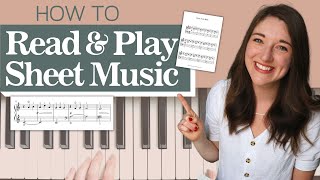

Stop Overwhelming Yourself with Sheet Music
36sDirectly addresses a common beginner mistake, creating relatability and urgency to learn a simpler method.
▶ Play Clip"The title accurately describes the content: a step-by-step beginner's guide to reading sheet music, exactly as promised."
This video provides a step-by-step guide for absolute beginners on how to read piano sheet music. The instructor breaks down sheet music into three main parts: notes, rhythm, and extras, emphasizing the importance of learning each part individually to avoid overwhelm. The tutorial covers the grand staff, treble and bass clefs, note reading, time signatures, and basic note durations.
Sheet music has three main parts: notes, rhythm, and extras. Beginners should learn each part individually to avoid overwhelm.
The grand staff consists of the treble clef (right hand) and bass clef (left hand). Notes are on lines or spaces, each representing a piano key.
Notes moving up on the staff mean higher pitch (move right on piano); moving down means lower pitch (move left).
In the treble clef, the second line from the bottom is G; in the bass clef, the same line is B. This is a common point of confusion.
The time signature (e.g., 4/4) tells how many beats per measure (top number) and which note gets one beat (bottom number). In 4/4, count to four per measure, quarter note gets one beat.
Quarter note = 1 count, half note = 2 counts, whole note = 4 counts. Rhythm applies the same to both clefs.
Common extras include piano (soft), forte (loud), and crescendo (gradually louder). Learn these as they appear in your music.
What are the two main clefs in the grand staff?
The treble clef (right hand) and the bass clef (left hand).
0:49
What is the first note most beginners learn in the treble clef?
Middle C.
1:21
How does the movement of notes on the staff relate to the piano keyboard?
When notes move up on the staff, you play higher pitches (move right on the piano); when they move down, you play lower pitches (move left).
1:33
What note is on the second line from the bottom in the treble clef, and what note is on the same line in the bass clef?
The second line from the bottom in the treble clef is G; in the bass clef, the second line from the bottom is B.
3:47
What do the top and bottom numbers of a time signature indicate?
The top number tells how many beats per measure; the bottom number tells which note gets one beat.
7:19
How do you count in 4/4 time, and which note gets one beat?
In 4/4 time, you count to four in each measure, and the quarter note gets one beat.
7:28
How many counts does a quarter note, half note, and whole note receive in 4/4 time?
A quarter note gets 1 count, a half note gets 2 counts, and a whole note gets 4 counts.
9:13
What do the terms piano, forte, and crescendo mean?
Piano means play softly; forte means play loudly; crescendo means gradually get louder.
11:07
Avoid Overwhelm by Breaking Down Sheet Music
Highlights a common beginner mistake and offers a practical solution to learn effectively.
0:16Grand Staff: Treble and Bass Clefs
Explains the fundamental structure of sheet music for piano.
0:49Notes Move Up/Down = Higher/Lower Pitch
Establishes the core visual-to-physical relationship between the staff and the keyboard.
1:33Bass Clef Notes Differ from Treble Clef
Warns beginners about a common point of confusion between the two clefs.
3:47Focus on Notes First, Then Rhythm
Reinforces the step-by-step learning approach to avoid overwhelm.
7:04[00:00] in this video you're going to learn how
[00:01] to read sheet music as a beginner piano
[00:03] player i'm going to be breaking it down
[00:04] from scratch in a simple easy to
[00:06] understand way let's go so in sheet
[00:07] music there are three main parts that
[00:09] you want to learn individually the first
[00:11] part is the notes second part is the
[00:13] rhythm and the third part are what i
[00:14] like to call the extras now i did want
[00:16] to warn you about something one of the
[00:17] big mistakes that i see beginners make
[00:19] is trying to read and understand all
[00:22] parts of sheet music right from the
[00:24] beginning and then it just gets
[00:25] overwhelming you don't see much progress
[00:27] you'll probably feel frustrated with
[00:28] sheet music and i don't want that for
[00:30] you you can read sheet music you just
[00:32] have to know how to break it into its
[00:33] individual parts so that you can learn
[00:35] it so let's break down these parts
[00:37] individually starting with the notes so
[00:38] here's a sample sheet of music you're
[00:40] going to notice that there are two
[00:42] sections to it so we have the top
[00:43] section there that have five lines and
[00:45] then we have the bottom section which
[00:47] also has five lines now you'll notice
[00:49] with the top section that we have the
[00:51] special sign is called the treble clef
[00:53] and then with the bottom section we have
[00:56] what we call the bass clef all together
[00:58] this is the grand staff and your right
[01:00] hand follows that top portion your right
[01:03] hand's going to be looking at the top
[01:04] portion and your left hand is going to
[01:06] be following the bottom portion notes
[01:09] are written in the grand staff on either
[01:12] a line or in a space like a space in
[01:15] between the lines and each note on the
[01:18] staff represents a key on the piano so
[01:21] for example this note right here is
[01:23] middle c so it's in the treble clef i
[01:25] know i'm going to be using my right hand
[01:27] i would come to my piano and i would
[01:28] play
[01:29] middle c the c that's in the middle of
[01:31] the piano now notes are always moving
[01:33] either up or down on the staff and all
[01:36] that means is when the note starts to
[01:38] move up it's going to get higher so it's
[01:41] going to start to get a higher pitch and
[01:43] you're going to move to the right on
[01:44] your piano when the note goes down
[01:47] you're going to get a lower pitch and
[01:50] you're going to move to the left so
[01:52] anytime you go up you're going to go to
[01:54] the right on the piano anytime you go
[01:56] down on the staff you're going to be
[01:57] going to the left and that's really
[01:59] important because you don't just want to
[02:01] see the notes on the music as just
[02:03] random dots here and there but you want
[02:05] to be able to follow how the notes are
[02:08] moving so that you can get more fluid at
[02:10] reading and playing at the same time
[02:12] we're going to start with just that top
[02:13] section first which is going to tell
[02:15] your right hand exactly what to play
[02:17] okay so let's read and play some notes
[02:19] together so the very first note that
[02:21] you're going to learn is middle c it's
[02:22] the easiest one to pick out it's in the
[02:24] middle of the piano we know that we're
[02:26] going to use our right hand because it's
[02:28] in the treble clef so anytime you see
[02:30] that note you would play middle c so we
[02:32] can see we just moved up one step up to
[02:34] the very next key which is d
[02:36] we can keep going to the next line and
[02:39] play e
[02:40] and then f
[02:42] and then g
[02:44] so notice that when we step like this
[02:46] we're following a pattern we're going
[02:48] line
[02:49] to the next space
[02:51] to the next line
[02:53] to the next space
[02:55] to the next line all right so notes are
[02:58] usually pretty easy to read when they're
[03:00] stepping like this but what happens if
[03:02] they're not stepping let's take a look
[03:04] at this example you can see that we're
[03:05] starting on c
[03:07] and then we're skipping all the way up
[03:10] to
[03:11] g
[03:12] all right and you can see
[03:14] how the distance on the music
[03:17] represents the distance between the keys
[03:20] on the piano alright
[03:22] so that helps us to be able to kind of
[03:25] make sense of how the music
[03:28] is related to the keys on the piano so
[03:30] that's the top section where your right
[03:32] hand is playing now the bottom section
[03:34] is similar in that we still have notes
[03:36] that are either on lines or spaces but
[03:38] the notes change a little bit and this
[03:40] is often where beginners get really
[03:42] confused so stick with me i promise this
[03:45] will make sense okay so notice that for
[03:47] this g in the treble clef we played it
[03:50] on the second line from the bottom now
[03:53] if we were to come to our bottom section
[03:55] our bass clef section with our left hand
[03:57] and draw a note on the second line from
[04:00] the bottom
[04:01] you might think that it would also be a
[04:03] g so it could be this g or this g
[04:06] but it's not and here's why it all comes
[04:10] back to middle c
[04:12] middle c in the bottom section looks
[04:14] like this very similar right so we could
[04:17] play middle c right here
[04:20] and from here we can start moving down
[04:22] right so we're going to start moving
[04:23] down you can see it in your music moving
[04:25] down we're going to move to the left on
[04:28] the piano so this would be b
[04:30] and then we can keep moving down to a
[04:33] and then we can keep moving down to g
[04:36] and then we can keep moving down to
[04:38] f if i were to keep going all the way
[04:42] down i would discover
[04:43] that in the bass clef if i were to play
[04:46] the second line from the bottom it would
[04:48] actually be b
[04:49] so this is something that you want to
[04:51] watch out for because it's not exactly
[04:53] the same in the bass clef it follows the
[04:56] same pattern of line space line space
[05:00] line space
[05:02] but it's going to look a little bit
[05:03] different in the bass clef versus the
[05:05] treble clef another thing to know with
[05:07] reading sheet music is that we're always
[05:09] reading our music left to right just
[05:11] like we would read and we're always
[05:13] playing both sections at the same time
[05:16] so it's not like we're just reading our
[05:17] right hand and then we're reading our
[05:19] left hand separately but when we're
[05:21] playing a song or a piece we're playing
[05:23] them at the same time so we're moving
[05:25] from left to right through our music
[05:28] together so let's do an example of plain
[05:31] notes reading from left to right and
[05:34] reading both clefs both sections
[05:36] simultaneously so if you were to start
[05:39] this from the beginning you'd notice
[05:40] that we just have a c
[05:42] okay so you just play two c's and then
[05:45] notice we're layering on g so this is g
[05:48] right here so then you would play
[05:50] these two together notice we don't have
[05:53] anything in the bass clef so left hand
[05:55] isn't doing anything we just started
[05:56] right hand
[05:58] and then we kept going with the right
[06:00] hand now notice
[06:01] once we get to the next part we have a
[06:04] left left-hand note in there and that
[06:06] left-hand note is just f
[06:08] so that's the f down here now we're
[06:10] going to
[06:11] play them simultaneously because they're
[06:14] right on top of each other there so we
[06:16] would play
[06:21] okay so remember you start reading from
[06:24] left to right so we just read just our
[06:26] right hand
[06:27] and then we added in another note with
[06:29] our right hand
[06:30] [Music]
[06:31] and then we kept layering and we added
[06:33] in
[06:34] left hand like this
[06:38] now when you're first getting started
[06:39] with learning the notes on the staff it
[06:42] can feel overwhelming and confusing to
[06:44] try to remember every single note but
[06:46] don't worry you actually don't need to
[06:48] know every single note you just need to
[06:50] know certain keynotes that will help you
[06:52] read all the other notes so much faster
[06:55] i've got another video on exactly which
[06:56] keynotes to know i'm going to link that
[06:58] down below and i'll post it at the end
[07:00] of this video so you can go and watch
[07:02] that next second part to sheet music is
[07:04] the rhythm and for rhythm there's really
[07:05] only two things that you need to know
[07:07] measures and the time signature the time
[07:09] signature are just the numbers or the
[07:11] fraction at the beginning of your sheet
[07:14] music that's beside the treble clef and
[07:16] the bass clef the time signature tells
[07:17] us how we're going to count the music so
[07:19] that we get the correct rhythm so let's
[07:21] break down these numbers the top number
[07:23] tells us how many counts or beats are
[07:26] inside each measure so for 4 4 which is
[07:29] the most common time signature for
[07:32] beginner piano music the top number is
[07:34] four so we're gonna count to four inside
[07:37] each measure so for example for a song
[07:39] or a piece that's in four four you would
[07:41] count one
[07:42] two three
[07:44] four
[07:45] one
[07:46] two three
[07:48] that would be the beat for the song or
[07:50] the piece now the bottom number tells
[07:52] you what kind of note is gonna get one
[07:54] count so the four stands for one over
[07:57] four which stands for a quarter so in
[08:01] four four the quarter note is gonna get
[08:03] one count inside each measure we would
[08:05] have four quarter notes so just to recap
[08:09] in four four you'll count to four in
[08:12] each measure and the quarter note you're
[08:14] going to hold for one beat or count so
[08:17] basically all you really need to know
[08:18] for beginner sheet music is that in 4 4
[08:21] you're gonna count to four inside each
[08:23] measure if you take nothing else from
[08:25] this rhythm section that's really all
[08:27] you need to know at the beginning now
[08:28] the quarter note is a pretty common type
[08:30] of note but there are lots of different
[08:32] kinds of notes in rhythm i go into a lot
[08:34] more detail in my beginner piano course
[08:36] play but i'm going to go over just a
[08:38] couple basic rhythms you need in order
[08:40] to start playing beginner music we
[08:42] started out with the quarter note which
[08:43] just gets one count so you'll see some
[08:47] notes written up there we've got middle
[08:49] c
[08:50] and g we're using just our right hand
[08:53] and we're just going to count this out
[08:54] how we would play it so we play one
[08:58] two
[08:59] three
[09:00] four and then it changes one
[09:03] two
[09:04] three
[09:06] four notice that the top note changed so
[09:08] that i was playing c and e instead of c
[09:11] and g so that's how we would count the
[09:13] quarter note now if we double the
[09:14] quarter note we get a half note and a
[09:16] half note we're gonna hold for two
[09:18] counts so we're still gonna count the
[09:20] same beat so we're still going to count
[09:22] one
[09:23] two
[09:24] three
[09:25] four just notice that i held it for two
[09:27] counts each one
[09:29] two
[09:30] three
[09:31] four that's the half note now if we
[09:33] double the half note we get a whole note
[09:36] which we're gonna hold for four counts
[09:38] so we're still counting the same way but
[09:40] we're holding out our notes like this
[09:42] one
[09:43] two
[09:44] three
[09:45] four
[09:46] one
[09:47] two
[09:48] three
[09:49] four we've been doing examples with the
[09:51] right hand but this works exactly the
[09:53] same with the left hand when we're
[09:55] counting rhythm there's no difference
[09:57] between the treble clef or the bass clef
[09:59] right hand or left hand so as you can
[10:00] see we're adding in another level of
[10:02] complexity to our music when we add in
[10:05] the rhythm because now you're not just
[10:07] looking at the note but you're also
[10:08] having to look at the note and figure
[10:10] out how long or how short to hold it
[10:13] this is why i'm gonna sound like a
[10:14] broken record i know but when you're
[10:16] first starting to read cheap music you
[10:18] only want to focus on one of these at a
[10:20] time focus on the notes and then the
[10:23] rhythm you could even start with the
[10:24] rhythm and then go to the notes it
[10:26] really doesn't matter but only focus on
[10:28] one at a time and then layer them
[10:30] together and finally you're ready for
[10:32] the third part of sheet music which is
[10:33] what i like to call the extras now there
[10:35] are a lot of extras in music a lot of
[10:38] signs that you're gonna see written into
[10:40] sheet music that i'm not gonna take the
[10:42] time to go into because you really wanna
[10:44] learn all of these inside she music that
[10:46] you're working on otherwise it will just
[10:48] be me throwing up all these musical
[10:50] terms and you probably won't remember
[10:52] them so once you have a good foundation
[10:54] of the notes and the rhythm then you can
[10:56] start to learn more of these inside the
[10:58] music that you're working on i do want
[10:59] to show you just a couple of the most
[11:01] common ones so you can see some examples
[11:03] of how this might show up in your sheet
[11:05] music so if you see this sign it means
[11:07] piano it means that you're going to play
[11:09] your music softly if you see this sign
[11:11] it stands for forte it means that you're
[11:13] going to play your music loudly and then
[11:15] this sign is a crescendo and this one's
[11:17] really fun because it means that you're
[11:19] going to start soft and then you're
[11:21] gradually going to get louder so if
[11:23] you're just getting started reading
[11:25] sheet music and you're like whoa whoa
[11:26] whoa that was a lot here's what i want
[11:28] you to do i don't want you to try and
[11:30] learn all of this all at once trust me
[11:32] it is a recipe for disaster and
[11:34] overwhelm and i don't want that to
[11:36] happen to you instead focus on reading
[11:38] and playing just the notes in your music
[11:40] first i'm going to put a video here for
[11:41] you to go watch next it includes my
[11:43] quick and easy method for how to read
[11:44] and remember the notes in your music
[11:46] i'll see you over there
⚡ Saved you 0h 11m reading this? Transcribe any YouTube video for free — no signup needed.