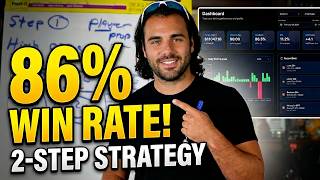

86% Win Rate Secret Revealed
44sThe extreme win rate claim and the promise of a secret strategy immediately hooks viewers skeptical of sports betting advice.
▶ Play Clip"The title accurately reflects the content: the presenter demonstrates a 2-step strategy and shows a tracker with 86% win rate over two months."
The video presents a sports betting strategy claiming an 86% win rate over two months. The core method involves betting on high-odds player props (e.g., -300 to -500) and identifying plays where the true probability exceeds the implied probability, creating a positive expected value edge. The presenter emphasizes treating betting as a long-term investment focused on ROI rather than short-term gains.
Focus on odds like -300, -400, -500, which most bettors avoid because they offer smaller payouts. The sportsbook profits from lower odds (-110) where bettors lose long-term.
Not all high odds are equal. Calculate implied probability from odds and compare to true probability based on player's season rate and matchup environment. Look for a positive gap (e.g., 15% edge).
Casino games like blackjack have a negative house edge (-2%). Similarly, betting -110 lines gives a negative edge (-5%). By betting high odds with a positive edge (e.g., +10%), you flip the house edge in your favor.
Focus on return on investment (ROI) rather than dollar amounts. A 10% ROI on $1,000 is $100, which is comparable to stock market returns. Monthly ROI of 10% compounds significantly.
Shows tracker: February 11.2% ROI, 86.5% win rate (32-5); March 16.4% ROI, 86.4% win rate (19-3). Average odds around -360. Small gains accumulate, and winning streaks offset losses.
The strategy of betting high-odds player props with a positive edge, combined with an investment mindset focused on ROI, can turn sports betting into a profitable long-term endeavor. The presenter claims consistent monthly returns of 10-16% ROI.
What odds range does the strategy focus on?
High odds like -300, -400, -500.
00:52
Why do sportsbooks want bettors to play -110 lines?
Because bettors lose the most on those odds, giving the sportsbook a negative edge for the bettor.
01:34
How do you calculate implied probability from odds?
For negative odds, implied probability = odds / (odds + 100) * 100. For -300, it's 300/400 = 75%.
03:27
What two factors determine true probability for a player prop?
The player's overall season rate of achieving the prop and their performance in similar matchups/environments.
03:55
What is the typical house edge in blackjack?
2% (negative edge for the player).
06:31
What is the typical negative edge for betting -110 lines?
Negative 5%.
07:10
What ROI does the presenter claim to achieve monthly?
10% to 16% ROI monthly.
10:56
What was the win-loss record in February shown?
32 wins and 5 losses (86.5% win rate).
13:45
What is the key mindset shift recommended?
Focus on ROI rather than dollar amounts; treat betting as investing, not gambling.
12:21
High Odds Strategy
Challenges conventional wisdom that high odds are bad, presenting them as the key to consistent wins.
00:52Implied vs True Probability
Explains how to calculate edge by comparing implied probability from odds to true probability based on data.
03:27House Edge Analogy
Uses blackjack to illustrate how negative edge compounds losses, contrasting with positive edge compounding gains.
05:46ROI Mindset
Emphasizes that small ROI percentages compound over time, similar to stock market investing.
09:38Proof of Concept
Provides real tracker data showing consistent monthly ROI and high win rates, validating the strategy.
13:17[00:01] last 2 months, and in this video, I'm going to show you the exact strategy in let's get into it. Now, if you click this video right off the bat, you're probably not believing that I've hit 86% of the plays that I have made over the
[00:14] last 2 months. But, I'm going to prove to you and show you exactly how it's actually possible and where this is a secret within the sports betting industry that nobody believes works. Most people are out there guessing on
[00:27] their five, 10-leg parlays or betting their minus 110 lines hoping that they they're not realizing that they're losing long-term while I'm winning long-term. And I'm winning on teams and player props that you would never even
[00:40] and get to Step one is going to be something that everybody hates in the Everybody in the sports betting industry despises this. But, it's high odds,
[00:52] okay? Your first step is going to be to identify higher odds. And majority of these are going to be with player props. Now, when I say higher odds, yes, I mean Now, when I say higher odds, yes, I mean odds like this: minus 300, minus 400,
[01:06] minus 500. That's what I'm talking about when I say high odds. Now, you guys have been groomed for decades upon decades in sports betting to never play odds that are in this type of bracket, okay? The odds that you like to look at are what?
[01:21] odds that you like to look at are what? Minus 110, minus 120, maybe minus 130, okay? You've been groomed to choose these over this. Now, the reason why is actually pretty simple. Because why? You get more of a payout when you're playing
[01:34] these instead of these. But, the one key factor that you're actually missing is that the sports books want you to play these type of numbers here because that's where they make the most money out of you. Why? Because you lose the
[01:48] most betting these type of numbers. Sports books don't want you betting if you know what you're doing, you can actually turn a profit long-term and take money from them rather than always donating to them. But, the one mistake
[02:02] that everybody gets when they're looking at this is not every high odd is created equal. So, just because a line is minus 300, 400, or 500, does not mean that's guaranteed to win. What you actually
[02:15] higher odd plays and you have to decipher which ones have the actual highest probability of actually hitting. And when you take those type of plays and you put yourself in a scenario that gives you the best opportunity to win,
[02:30] that's where you create your edge long-term. Now, this creates an edge long-term, where this creates a negative edge long-term, where you slowly lose all of your money rather than slowly gain all of your money. And make sure
[02:45] going to show you exactly and prove to you how this actually works with actual plays that I put in my Now, let's get to Step two. Step two is going to be finding those plays, right? We have to find the plays that fit that bracket
[02:59] that I just mentioned, where like I said, not every single odd that is a high odd is created equal. There are some within that give you a greater probability of hitting than others. Well, it's our job to find those. But,
[03:13] how do we find them? Now, this is going to differ between each sport and each player prop, but it all comes back to the same exact concept. And the same concept means implied probability versus true probability. Now, for example,
[03:27] going to do is we're going to talk about Kevin Durant. This is a favorite player prop that nobody likes to play because he's probably went out and said, "Don't So, we're going to use him as an example, all right? Let's say Durant,
[03:40] let's just say his points. Let's say for him to score at least 20 plus points, let's say his implied probability is 70% for him to achieve that. Now, let's go and look at his true probability, but how do we find his true probability? So,
[03:55] there's two steps to finding that true probability within this prop right here. Where you would have to look at what his overall rate is on the entire season of how many times he was able to surpass this. Then, after you do that, you're
[04:08] Then, you write that percentage down. The next step is going to be how does he playing in that game that you're looking at him, which means similar defenses, which means the similar environment that he's in, okay? Because most of the time,
[04:24] and this happens most of the time, where the environment that they're in, they for is let's say Kevin Durant was guard that position pretty good, okay? And they give up a decent amount of
[04:37] points to that position. So, what you're looking for is that matchup and then the true probability that lies within that is the overall percentage combined with the environmental percentage. Like, in that environment against that team, how
[04:52] does he perform against similar situations? You take those two percentages and it's easy, you get the average of those. So, let's say for example, his true probability, and this is the true probability, like I just
[05:04] say, is 85%. Now, if you find that, guess is 85%. Now, if you find that, guess what? We just created a gap of 15%. We have an edge of 15% in this matchup. Now, remember when I said all plays that
[05:20] are higher odds are not created equal? Because this circumstance right here might not be the same for another player with the same exact odds as here. It might be the complete opposite. The true probability for another player could be
[05:33] 55% to get 20 plus. But, the implied probability is 70%, which would give you probability is 70%, which would give you a negative edge of 15%. Now, a negative edge long-term is going to slowly drain your bankroll. And I'm going to show you
[05:46] an example, a real-life example, using casino games to show you exactly how this works long-term and why so many people that go to a casino always lose long-term compared to a sports better that actually has an edge that plays the
[06:02] call it the new way of sports betting because everybody, and I mean everybody in the entire industry for decades has been doing it completely wrong. And I know this because all of anybody's track record that's out there has nothing
[06:18] compared to what my track record has been since I started sports betting and show an example of here, we're going to pull up casino game, all right? And we're going to use the closest one possible to actually giving you an edge
[06:31] in the casino. So, we're going to use blackjack as an example. So, the house edge on blackjack is 2% most of the time, okay? Could be more. We're using time, okay? Could be more. We're using 2% as the example. 2% meaning that's
[06:44] negative 2%. So, what does that transition mean? The longer you sit at a table and you play blackjack, your minus 2% edge compounds. So, you slowly If you
[06:56] stay there for 10 hours, you are slowly going to drain your bankroll completely out till you have nothing left. That's why casinos like to keep the people at the tables because they know the longer you sit at that
[07:10] table, the longer this comes into play and you slowly start losing your money. Now, the same concept happens with sports better that play minus 110 lines, okay? Most of the time, their edge is negative 5%. So, meaning when you're
[07:26] playing these type of plays, yes, you feel like it's 50/50, it's really not. Your edge is negative and you're slowly draining your bankroll. The longer you sit there and the more plays that you play at a negative
[07:40] percent, what are you doing? You're draining your bankroll. Now, for the new you and showing you, what we're doing here is we're taking this. See this negative edge that we have? And we're transforming that negative edge into a
[07:56] positive edge, okay? So, let's go ahead and put new sports betting here, all right? Let's say average odds, let's just put a minus 300 there, okay? How you're creating that edge is just like I showed you
[08:09] previously, where that play had a plus 15% edge, okay? If you stuck to plays 15% edge, okay? If you stuck to plays that were within 5 to 15% edge consistently over time, guess what? You've created yourself,
[08:24] let's just say on average, a 10% edge that's going to compound over time. So, the longer you sit at this table right here, guess what happens? Your bankroll
[08:38] starts to go from here and it starts to go up, the complete opposite of what happens playing a casino game, where the longer you stay at that table, your money goes down. Doing it this way with sports betting, you're slowly going up.
[08:54] You start to make that climb and you climb up steadily, okay? Now, the people that win in blackjack are what? Somebody that sits down at the table, plays maybe five hands, wins their money, and walks away because they
[09:07] That's the people that make that money. But, when you're trying to look for a longer-term investment, you can't here. This is not a long-term investment. A amounts of money and they gain over time, which I'm going to show you guys
[09:22] another example of how this correlates people are against it in the sports betting industry. Now, these three the complete way that you look at sports betting forever, okay? And they are R
[09:38] O I, okay? That stands for return on investment. These three letters right here will change the way that you look at sports betting forever. Now, if you invest in the stock market, you invest
[09:50] in stocks or any of that stuff, you know that long-term in the stock market, your that long-term in the stock market, your ROI, okay? Long-term, that's been proven is at least 10% a year, okay? So, what does that mean? Going back to our other
[10:02] example, you have a plus 10% edge in the stock market over the course of a year, year-to-year. Okay? So, that what it happens, you put your money in there, it happens, you put your money in there, it slowly compounds at 10% each year. Now,
[10:17] make when they're trying to take this key concept and adapt it to sports betting is the money, okay? The money factor. Because that Let's break down the different types of bankrolls with an ROI
[10:30] of 10%. Let's start out with the most common one in sports betting, which is common one in sports betting, which is $1,000. 10% on $1,000 is 100 bucks, okay? So, if somebody took $1,000 and invested in the stock market, within a
[10:42] year, they would have made $100. What does that do? Absolutely nothing, right? that right there is the mindset that needs to be broken. Because you think this is nothing, but that's actually 10% ROI on your money, which is
[10:56] great. Getting 10%, like I said, is on par with what the stock market could literally produce. Now, the crazy thing with this is I actually reach this type of number in sports betting monthly. I'm able to reach 10% ROI monthly. So, just
[11:11] think about how that compounds monthly when you're able to do this the correct bankrolls here. Let's go to 10,000, is going to equal $1,000. So, over the course of the year, you make $1,000. Still, most people's mindsets are going
[11:24] waited a whole entire year to make $1,000. That's absolutely nothing. But again, that mindset has to be broken. Because this right here, thinking that this is nothing, is a broke mindset. It's broke mindset. Because what most
[11:40] people would rather do in this situation is they would rather, with a $1,000 bankroll, take a $100. They would take that, go put it on an ill-advised bet that's 50/50, and then lose. And then they would lose their money. They would
[11:52] completely lose it, rather than using it as an investment and actually making they'll just lose. And then, like I said, slowly throughout the whole entire most won't even last the entire year. I'm going to say within a month or two,
[12:08] they'll drain their accounts, and they'll have no money left to invest whatsoever. Why? Because they didn't understand these three letters, return on investment. So, the key takeaway from what I'm speaking about right now is not
[12:21] amount of money doesn't matter. The ROI is what actually matters, the return on your investment. The smaller amount of money that you investment is going to be. The bigger amount of money you have, the bigger
[12:35] But, the key point is getting through the mindset of understanding how that actually works, and how you can actually make money long-term, as long as you understand how ROI works, and adapt that into your sports betting. Now, I teach
[12:50] people exactly how to do this and how to actually profit month in and month out every single month. If you want to be a part of that crew, and you actually want long-term, and flip the house edge in your favor, make sure you click the link
[13:03] sit and prove to you exactly how this works. So, let's go ahead and jump in the laptop so I can show you guys my official tracker where I track every single bet day in and day out, so you can see exactly how this actually works
[13:17] long-term. So, the first thing I want to focus on here is, like I said, the ROI. look, this is from February 1st to February 28th, 11.2% ROI. Shows you right there what I just told you. Okay? I reached that 10%
[13:32] plateau that literally the stock market produces in a year, I reached that in that month. And how did I do that? Look at the average odds. These are odds that people will run away from. They will not play. They decide, "Oh, it's not I'm not
[13:45] going to be able to make money doing that long-term." But, look what happens when you hit over 80 6%. I can say over 86% cuz it's 86.5. I went 32 and five, okay? And when you roll through that list, let's go ahead
[14:00] that list. Okay? Let's go to February and show you exactly how this works. Let's start from February 1st here. Where I actually lost the first play that I put in here, okay? So, I was down $1,000 first day in
[14:14] February. But, what happens? I go 1 2 3 4 5 in a row here, and I accumulate way more than what I lost. But, then what happens what I lost. But, then what happens again? I take a loss at even more money.
[14:26] again? I take a loss at even more money. But, what happens after that? 1 2 3 4 But, what happens after that? 1 2 3 4 5 6 7 8 9 10 11 12 13 14 15 16 plays in a row that I win. And look at the profit margin on these. You're not getting too
[14:40] not happening. You're getting small gains, but look at the small gains, they add up over time and recoup any losses that end up happening. And that's where on the streaks. May Yeah, you're going
[14:54] to go, okay? You will take losses and you will incur occur losses. But, long-term, your little money starts adding up, and it starts adding up quicker and quicker the more streaks that you create. Now, that's February.
[15:07] Now, let's go ahead and go back, and let's take a look at March. So, so far let's take a look at March. So, so far into March, ROI 16.4% win-loss, 86.4%, 19 and three, average odds minus 366. So, what happens there? The same exact
[15:22] February. Same exact thing here. Let's start March 1st. You start getting your small gains and you get and you add them up, get a couple losses along the road, together, and those completely add up and surpass any losses. And guess what?
[15:37] You end up being profitable, and you be you switch the edge. The house edge comes in your favor, rather than you being the person that continuously donates, you become the person that consumes and actually makes money rather
[15:53] strategy that I'm teaching you right here, right now, this is the strategy that literally everybody thinks doesn't work. But, I just proved to you right here how that actually works long-term. There's no doubting the system that I
[16:07] show you. It works, as long as you stay consistent, and you understand the concept of investing, rather than gambling. Because what I showed you right there is not gambling. That's investing, because we know what our
[16:20] percentage is that we're going to win. We're not just hoping something happens, because hope doesn't create money. Knowing what's going to happen is what creates money. High probability is what creates money. Every other sports better
[16:33] that you look at that gives plays, that gives picks, they're just guessing. They have no probability, they have no edge. Because they can't prove it to you long-term. What I just showed you is the new way to bet on sports, and to
[16:46] actually make a living, and to actually turn a profit doing it. There is no remains is what are you going to do? Are you going to keep guessing? Are you going to keep hoping that you make money? Are you going to learn a strategy
[16:59] that actually works, and actually turns a profit long-term? I'm Frank LaManna Sports. I'll see you guys in the next video. Till then, I'm out.


⚡ Saved you 0h 17m reading this? Transcribe any YouTube video for free — no signup needed.