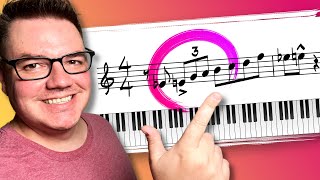

Why Your Jazz Solos Sound Boring
45sRelatable struggle for musicians who feel their solos lack creativity despite studying theory.
▶ Play Clip"The title 'How Jazz Works: Creating Solo Phrases' is largely accurate as the video focuses on creating solo phrases, though it covers broader concepts than just phrasing."
This video explains the creator's biggest struggle learning jazz: creating interesting solo lines. He realized that knowing jazz theory is not the same as using it while soloing; true mastery comes from practice and allowing the music to flow naturally.
Learning to create interesting solo lines was intimidating; listening to recordings of favorite artists made his own solos seem boring.
The creator believed the reason solos were boring was due to a lack of jazz theory knowledge, leading him to study extensively but with no immediate impact on his soloing.
Observing musicians like Oscar Peterson, he realized they are in a flow state, not actively thinking about theory. He learned that theory is practiced upfront and then let go during performance.
Learned from fellow creator Amy Nolte to sing solos, which made it impossible to think about theory simultaneously, leading to the insight that theory is not used during soloing, but prepared beforehand.
Constructing musical sentences (questions or statements) with clear beginnings and endings, practicing starting and ending on various beats to develop rhythmic control.
Introduced key melodic concepts: linear scales with aim to land on chord tones (especially 3rd, 7th, 9th), chromatic motion for target approach, scales in thirds, triads, and seventh chord arpeggios.
Covered advanced techniques: leading tone into arpeggios (chromatic half-step below), pivoting (Barry Harris' changing octave mid-arpeggio), enclosures (surrounding a target note with neighbor tones), and combining scales with enclosures.
Incorporating extensions and alterations (e.g., sharp 9, flat 13) for dominant chords to add color, using arpeggios from upper intervals (e.g., starting on the 3rd of C major to include the 9th).
The challenge is not knowing the concepts but combining them with a rhythmic structure to hit target chord tones. He encourages not waiting until perfect—practice these concepts directly in tunes for immediate application.
The key to jazz soloing is practicing techniques like rhythmic phrasing, scales, arpeggios, and enclosures until they become automatic, allowing the musician to enter a flow state and create interesting lines without conscious thought.
What is the most important element for creating interesting jazz solo lines?
Rhythm. Rhythm is more important than notes; you can get away with wrong notes if you play them confidently with good rhythm.
5:26
Name two types of musical sentences mentioned.
A question or a statement.
3:38
When practicing scales, which intervals are the most interesting to land on?
The third, seventh, and ninth of the chord.
6:33
What is an enclosure?
Leading into a target note with the note above from the scale and a note below by a half-step.
8:48
What is pivoting as taught by Barry Harris?
Taking a seventh chord arpeggio and changing the octave halfway through.
8:25
Give two examples of colorful notes or extensions on a dominant chord.
Sharp 9 and flat 13.
9:59
Theory vs. Practice
The creator distinguishes between knowing jazz theory and using it during soloing, which is a key insight for many musicians.
2:14Musical Sentences
Framing jazz lines as 'sentences' (questions/statements) provides a clear, creative approach to phrasing.
3:38Rhythm Over Notes
Stating that rhythm is more important than notes—even wrong notes can work with good rhythm—is a liberating tip for improvisers.
5:26Enclosures Explained
The detailed explanation of enclosures offers a powerful tool for adding tension and resolution to solos.
8:48Art of Combination
The creator presents the true difficulty: combining rhythm, melody, and harmonic targets to create coherent music, which is the core challenge of improvisation.
10:22[00:00] in this video i'm going to tell you
[00:01] about my biggest struggle learning how
[00:03] to play jazz and that's creating solo
[00:05] lines
[00:14] learning how to create interesting solo
[00:15] lines was so intimidating for me i would
[00:18] listen to recordings of my favorite
[00:19] artists and the lines they played were
[00:21] just so hip but when i listen back to my
[00:23] own solos they're so boring i thought
[00:26] that the reason i sounded boring was
[00:27] because i just didn't know enough jazz
[00:29] theory i thought i needed to spend more
[00:31] time studying and so i read every book
[00:33] that i could find i studied
[00:34] transcriptions i filled my brain full of
[00:36] chords voicings scales modes extensions
[00:39] alterations everything else now that was
[00:41] time well spent it absolutely made me a
[00:43] better musician but
[00:45] it didn't really have an immediate
[00:46] impact on my soloing while i was
[00:48] listening to my favorite recordings you
[00:50] know like oscar peterson i had this
[00:52] terrible misconception about what he was
[00:54] thinking about while he was soloing but
[00:56] i thought one of the reasons that his
[00:58] solos were so much more interesting than
[00:59] mine was because he had more music
[01:01] theories stuffed in his head and where
[01:03] he had more experience recalling that
[01:05] music theory and composing a solo with
[01:06] it on the fly now as i've gotten to be a
[01:09] better player i've realized that this
[01:10] isn't entirely true
[01:12] what's actually happening is that
[01:14] oscar's putting himself in kind of a
[01:15] flow state while he's performing i don't
[01:18] think oscar's thinking much about music
[01:19] theory at all actually he's already done
[01:21] that and i don't think he's worried too
[01:23] much about his technique either he spent
[01:25] a ton of time in the wood jet
[01:27] but i think he's at a point where he can
[01:28] just take a breath
[01:29] let it out and just play the solo that
[01:32] comes to him in his head
[01:33] this guy ben patterson has a great album
[01:36] in the style of oscar peterson
[01:38] watch him play does he look tense does
[01:40] it look like he's computing his solo in
[01:42] his head
[01:43] no way he's totally chill the music is
[01:46] just flowing out of him
[01:48] one of my fellow youtube jazz creators
[01:50] amy nolte she taught me that i should
[01:51] sing my solos
[01:56] [Music]
[01:58] when i started doing that i realized
[02:00] that i cannot think about theory and
[02:01] sing at the same time it's just
[02:03] impossible for me and to think that i
[02:05] thought i could do all that and play the
[02:06] piano too i mean come on there's just no
[02:08] way
[02:09] so i realized that while you need to
[02:11] know jazz theory in order to solo well
[02:14] you don't use jazz theory while you solo
[02:16] this epiphany changed everything for me
[02:19] and i realized it was the reason that i
[02:20] wasn't soloing well even though i could
[02:23] use music theory to describe basically
[02:25] any solo you put in front of me i could
[02:27] not spontaneously create a solo that
[02:29] sounded anything like it
[02:30] i'm not the brightest guy in the room
[02:32] and so when i had this epiphany it took
[02:33] me a little while to figure out what i
[02:35] needed to change
[02:36] i want to show you what i did to get
[02:37] over it that way someone smart like you
[02:39] can get over this much faster than i did
[02:42] so here's the heart of the problem if
[02:44] you want to play a hip solo you have to
[02:46] consider rhythm
[02:47] notes articulation phrasing and more and
[02:50] you have to have solid ear training to
[02:52] get what's in your head out and into
[02:53] your hands and you got to do that
[02:55] fluently over a set of changes while
[02:57] you're trying to keep up with two other
[02:58] people in your trio this is all kind of
[03:00] like driving a car if you go back to
[03:02] when you were 15 years old and you were
[03:03] learning how to drive for the first time
[03:05] you might remember you spent time
[03:06] learning how to accelerate how to brake
[03:08] smoothly you were learning how to corner
[03:10] gently but after a while all this became
[03:12] automatic
[03:13] you could really just focus on your
[03:15] destination or the song you're listening
[03:16] to on the radio you did all the thinking
[03:18] and practicing up front it was not part
[03:20] of you and you didn't really have to be
[03:21] conscious of all the individual
[03:23] mechanics to drive this is the same way
[03:25] we need to spend time practicing we are
[03:27] going to intensely focus on the
[03:28] mechanics of our practice and then we're
[03:30] going to let them go when we perform so
[03:32] we're going to go through this by
[03:33] constructing musical sentences and let's
[03:35] just do a few of them together
[03:38] so a musical sentence could be a
[03:39] question
[03:41] [Music]
[03:43] or it could be a statement
[03:48] we just want to be careful we don't want
[03:49] run on sentences
[03:57] [Music]
[04:00] we want clear beginnings and clear
[04:02] endings
[04:04] [Music]
[04:08] we need to practice making these
[04:09] rhythmic sentences starting from
[04:11] anywhere in the measure if we wanted to
[04:12] start on the end of one
[04:14] and two and three and four and one
[04:17] or maybe we want to start on b3
[04:20] one
[04:21] three and four and one and
[04:24] or maybe on the end of two
[04:26] one and three and four and one two three
[04:30] four and
[04:32] so in the same way we want to be
[04:33] intentional about where our lines end so
[04:35] if we want to end our line on the end of
[04:36] one
[04:37] one and two three and four and one and
[04:42] or maybe we want to end it on three
[04:45] one and two and three and four and one
[04:47] and two and three
[04:49] you should go through a bunch of
[04:50] variations of this where you pick a
[04:51] specific starting point and you pick a
[04:53] specific ending point in the next
[04:54] measure and you connect the two
[04:56] you can do this using simple eighth note
[04:57] lines like we just did one and two and
[04:59] three and four and one
[05:02] you could do this using syncopated
[05:04] quarter notes
[05:05] and and and and one
[05:08] you could put eighth note triplets in
[05:09] there
[05:10] and triple it three four and
[05:13] if you really want to impart a swing
[05:14] field then you need to make sure your
[05:16] lines end off the beat i spent a ton of
[05:18] time transcribing other solos and this
[05:20] is one of the things you notice right
[05:21] away is that the great musicians they
[05:23] end off the beat way more than they do
[05:25] on the beat
[05:26] i started with rhythm with a reason
[05:28] because rhythm is just way more
[05:29] important than notes you would be
[05:30] surprised how many wrong notes you can
[05:32] get away with if you play them
[05:33] confidently and with cool rhythm
[05:36] but let's talk about the notes i'm
[05:38] getting ready to throw a bunch of
[05:39] melodic concepts at you that you can use
[05:41] to solo i'm going to do this super fast
[05:43] not because these are easy or
[05:44] unimportant actually quite the contrary
[05:47] i just want to give you plenty of things
[05:48] that you can take to practice if you
[05:50] want me to go deeper on any of these
[05:51] concepts let me know down in the
[05:52] comments most of the video ideas for
[05:54] this channel come directly from that
[05:56] little community we have going in the
[05:57] comments and i would really love it if
[05:59] you would chime in all right let's get
[06:00] down to it everything i'm about to show
[06:02] you is going to be in the key of c but
[06:04] you know this by now you've got to
[06:05] practice these things in every key
[06:07] you've got to do all major and all minor
[06:08] keys sorry i'm not letting you off the
[06:10] hook this time in order to internalize
[06:12] these so well that you can play them
[06:14] when you're not thinking about them
[06:15] you've got to learn how to do it in all
[06:16] 12 keys
[06:17] first thing we're going to do is play
[06:19] linear scales you can go up
[06:22] you can come down
[06:24] you can start on different notes
[06:26] you can make a short line
[06:28] you can make a long line
[06:31] when you do this i want you to focus on
[06:33] aiming your line to end on a chord tone
[06:36] you might be aiming on the one of the
[06:37] five but really the third the seventh
[06:39] and the ninth are the most interesting
[06:41] places to land
[06:44] okay the next one is chromatic motion so
[06:46] we can go up chromatically
[06:48] we can come down grammatically chromatic
[06:50] motion is especially useful when you're
[06:51] aiming for a specific note so if we're
[06:53] aiming for the third of c you can
[06:55] approach it with a chromatic motion from
[06:56] the bottom
[06:58] or you can aim at it from the
[07:00] top so the next thing we're going to do
[07:02] is play our scale in thirds we can do it
[07:04] up
[07:07] or we can do it down
[07:12] then we do the same thing with triads up
[07:14] and down
[07:27] and then we're gonna do it again with
[07:28] seventh chords
[07:44] once you've got those arpeggio things
[07:46] down you're going to lead into them with
[07:47] a chromatic leading tone like this
[07:56] just use a half step below the arpeggio
[07:59] and if we're going to come down we're
[08:00] going to do the same thing we're going
[08:01] to start with the leading tone below the
[08:03] top note and then come down
[08:13] and do the same thing with with triads
[08:18] and with seventh chords
[08:19] [Music]
[08:25] the next thing we're going to do is what
[08:26] barry harris calls pivoting and that's
[08:28] where we take one of these seventh chord
[08:29] arpeggios but we're going to change the
[08:31] octave halfway through so we might take
[08:33] the seventh chord with the leading tone
[08:35] but then drop the last few notes to the
[08:36] octave below
[08:41] this is useful for all musicians but
[08:43] it's especially useful for horn players
[08:45] who are trying to stay within their
[08:46] playable range the next thing we're
[08:48] going to do are enclosures and that just
[08:50] means we're going to pick a note we want
[08:51] to land on and we're going to lead into
[08:52] it with the note above from the scale
[08:55] and a note below by a half step so if
[08:57] we're aiming for c
[09:00] and then go up the
[09:01] [Music]
[09:06] scale the next thing we're going to do
[09:08] is combine scales with these enclosures
[09:10] so we're going to play a linear line up
[09:12] and we're going to aim for a specific
[09:13] note but instead of playing that note
[09:15] right away we're going to surround it
[09:16] with that enclosure
[09:21] make sure you do this up and down
[09:26] so now just like we did with scales
[09:27] we're going to do this with arpeggios
[09:28] we're going to do an arpeggio up and
[09:30] we're going to end on an enclosure
[09:34] and do it down
[09:38] the last of these melodic concepts i
[09:40] want to show you is just bringing in
[09:41] colorful notes and so that just means
[09:43] we're going to add extensions and
[09:44] alterations to our chord and we're going
[09:45] to include those in our lines or our
[09:47] arpeggios so for playing c major we
[09:50] might want to play the seventh chord
[09:51] that starts on the three on the e
[09:53] because that arpeggio will include d
[09:55] which is the ninth of the chord that's
[09:56] one of our colorful notes
[09:58] [Music]
[09:59] over playing a dominant seventh chord we
[10:01] might want to give it an altered sound
[10:02] by bringing in a sharp 9 and a flat 13.
[10:05] [Music]
[10:12] now that is a lot to practice and when
[10:14] you think about major and minor and all
[10:16] 12 different keys boy it's a lot and
[10:19] you're going to discover when you do
[10:20] this that that's not even the hard part
[10:23] that hard part happens when you use
[10:24] these concepts to make musical ideas
[10:27] so here's what i mean let's invent a
[10:29] rhythmic sentence
[10:33] and we got to call our shot and pick the
[10:35] note we want to end our sentence on so
[10:36] i'm going to pick the third of c
[10:38] but here's the hard part how are you
[10:40] going to choose the notes to fill out
[10:41] the rhythm in a way that gets you to
[10:43] land on that third at exactly the right
[10:45] time
[10:46] [Music]
[10:49] so this is your breakthrough moment and
[10:51] this is hard once you get here and you
[10:52] end up in the pit of despair unable to
[10:54] do this confidently but you decide to
[10:56] plow through and keep moving anyway once
[10:59] you get to that point your brain has
[11:01] learned how to think about solos in a
[11:03] different way you are just going to
[11:04] think arpeggio up and close your landing
[11:06] on the third of the next chord pick your
[11:08] target and trust your training to figure
[11:09] out how to get you there this stuff is
[11:11] so much fun don't get yourself in a
[11:13] hurry i know we all want to sound like
[11:14] oscar peterson right now but this this
[11:17] is the fun part this is where you become
[11:19] a professional soloist this is where you
[11:21] discover your own sound have fun this is
[11:23] the journey please don't feel like you
[11:25] have to wait until you can do all these
[11:27] exercises before you try to put them in
[11:28] a solo this stuff is a lifetime of work
[11:31] so you've got to take these ideas as you
[11:33] practice them and put them into tunes
[11:34] right away there's a whole world for you
[11:36] to explore here how do you move from one
[11:38] chord to the next chord smoothly can you
[11:40] make a single line that covers two or
[11:41] more chords can you invent some kind of
[11:44] a line and then use variations of that
[11:45] line to make an entire solo out of it
[11:47] and spend time practicing by listening
[11:50] sing along with recorded solos what are
[11:52] these techniques are they using where do
[11:53] they start and they end their phrases
[11:55] how do they articulate their phrases are
[11:57] there musical sentences statements or
[11:58] are they questions are you excited yet
[12:01] i know i am in fact i'm gonna get back
[12:04] to practicing these myself and while i
[12:05] do that you're gonna check out this next
[12:07] video on spicy dominant chords that
[12:08] every pianist needs to know and i will
[12:10] see you next week bye
⚡ Saved you 0h 12m reading this? Transcribe any YouTube video for free — no signup needed.