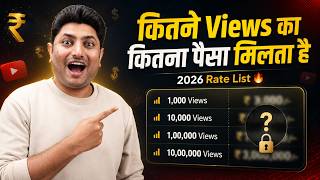

Why 1M Views Earned ₹8,000 vs ₹85,000
44sThe stark contrast in earnings for the same view count sparks curiosity and highlights the importance of niche selection.
▶ Play Clip"Delivers on the promise of a rate list, but includes repetitive explanations and a lengthy intro."
This video explains how much YouTube pays creators per view in 2026, focusing on the Indian market. It breaks down the difference between CPM and RPM, explains how earnings vary by category and audience location, and compares long-form videos with Shorts. The creator provides specific RPM ranges for various niches and emphasizes that category and viewer location are the biggest factors in earnings.
Two creators with 1 million views earned vastly different amounts: ₹8,000 vs ₹85,000, highlighting that views alone don't determine income.
You don't get paid for views directly; you get paid for ads shown. CPM is cost per mile (advertiser pays YouTube), RPM is revenue per mile (creator earns). RPM is what matters to creators.
Earnings vary based on video category, video length (more ads on videos >8 minutes), and viewer location (not creator location).
For Indian audience, finance videos can earn ₹100-₹500 RPM (sometimes ₹85-₹500). For US/UK audience, RPM can be ₹1500-₹4500.
Tech videos: Indian audience ₹60-₹300 RPM, US/UK audience ₹700-₹2500 RPM.
Education and how-to videos: Indian audience ₹100-₹250 RPM, US/UK audience ₹600-₹2200 RPM.
Gaming videos: Indian audience ₹20-₹95 RPM, outside audience ₹200-₹800 RPM.
Health/fitness: Indian audience ₹50-₹200 RPM. Entertainment/vlogs: Indian audience ₹15-₹90 RPM.
Music has the least earnings due to many claims; income often goes to music owners.
Entertainment: ₹35,000-₹80,900 per million views. Finance: ₹1 lakh-₹5 lakh per million views.
Shorts don't have ads on the video itself; ads appear between shorts. Revenue share is reversed: YouTube takes 55%, creator gets 45%.
Shorts earn ₹250-₹1250 per million views, but creators can earn more by tagging products.
Australia, USA, UK pay more than India. Audience location is key.
YouTube earnings depend heavily on niche and audience location, not just views. Choosing a high-paying category like finance and targeting audiences in countries like the US or UK can significantly increase RPM. Shorts pay less but offer product tagging opportunities.
What does RPM stand for and what does it mean?
Revenue per mile; the amount a creator earns per 1000 views.
02:03
What is the difference between CPM and RPM?
CPM is cost per mile (what advertiser pays YouTube), RPM is revenue per mile (what creator earns after YouTube's cut).
01:47
What is the RPM range for finance videos with an Indian audience?
₹100 to ₹500 per 1000 views.
04:01
What is the RPM range for finance videos with a US/UK audience?
₹1500 to ₹4500 per 1000 views.
04:32
What is the RPM range for gaming videos with an Indian audience?
₹20 to ₹80 (or max ₹95) per 1000 views.
06:13
What is the revenue share for long-form videos?
Creator gets 55%, YouTube gets 45%.
08:49
What is the revenue share for Shorts?
Creator gets 45%, YouTube gets 55%.
09:04
How much can you earn per million views on Shorts?
₹250 to ₹1250.
09:56
Which countries pay the highest RPM?
Australia, USA, UK.
10:24
What is the earning range for entertainment videos per million views?
₹35,000 to ₹80,900.
07:49
Views don't equal money
Clarifies a common misconception that creators are paid per view, emphasizing ads are the revenue source.
01:32Finance is top-paying category
Shows the highest RPM range, guiding niche selection for creators.
03:46Revenue share difference for Shorts
Highlights the reversed revenue split, a key factor for creators considering Shorts.
08:49Audience location matters more than language
Emphasizes that targeting viewers in high-CPM countries boosts earnings regardless of video language.
10:24[00:03] Got 1 million views and earned only ₹8,000. Another creator also made another video. It also got 1 million views and earned ₹85,000. Were you
[00:17] shocked? I am not talking about short format and long format separately here. Here I am talking about long videos made in the same format. This is the truth about YouTube. You will not know on which type of video
[00:31] you will earn ₹8,000 even on 1 million views and on which type of video you will earn ₹85,000 on 1 million views. But if you have full knowledge then you can create such content in which your earning increases. In this video, I will
[00:47] explain to you in full detail how creators in India get less and how much money they get. What do you get for long videos and what do you get for short videos. How much money is earned on how many views, that too category wise. You will know everything about YouTube earning
[01:02] in this video. So if you want to earn money from YouTube , want to come on YouTube, want to start, then this video is very useful for you so that you can select your niche correctly. If
[01:17] you are a new creator, like the video now. Please subscribe to this channel also whatever content I upload on this channel is very helpful for new creators. Look, first let me make one thing clear to you that on YouTube it is said how much
[01:32] money is received for how many views. But the truth is that you do But the truth is that you do n't get paid for views on YouTube. The money for views is actually received on the basis of views but money is not received on getting views rather
[01:47] money is received on the advertisement that comes on it but when we count, we do it according to the views and its formula is CPM and RPM CPM which is actually called cost per mile, it means that
[02:03] means that how much money will the advertiser give to YouTube on how many ads are played, YouTube will also keep its cut from that and then the formula for the money that the creator will get is RPM revenue per mile. Now it's RPM. Its meaning is
[02:17] mile. Now it's RPM. Its meaning is revenue per mile, that is, if there are 1000 views or 1000 playbacks on the video, then how much money was given to the creator? Overall, only RPM matters to the creator. If RPM increases, the
[02:32] creator will earn more on the same number of views. If the RPM is down, there will be less earning on the same views. I have explained the formula to you completely. Apart from this, the earnings from your video cannot be fixed. She varies
[02:48] on some factors. For example, firstly, your video is categorized very well. We will tell you in this video how much money is there in which category. But it also matters what the length of your video is. If you are making a 5-minute video, only
[03:01] one or two ads will run on it. But you can place multiple ads on videos longer than 8 minutes and if multiple ads are played, your earnings will be higher. It is a simple thing and location also plays a factor. Location does not factor into where you are
[03:17] uploading the video. It matters to him where the video is being watched. It where the video is being watched. It viewed? It is possible that people may watch the video in Hindi also in UK and US.
[03:31] Indians also live there so they must be watching it in Hindi too, so whatever is watched there will earn more. RPM is cheap in India, earnings will be less here. So your video language doesn't matter. Where the video is viewed makes a huge difference to earnings.
[03:46] Now let's talk about the first strong category. And right now I am talking about long videos. We will also talk about shorts later. The strongest category in terms of long videos is also talk about shorts later. The strongest category in terms of long videos is
[04:01] money is talked about and the best earnings are made in this category. Now we will talk about the Indian audience. If your video is watched by Indian audience then your is watched by Indian audience then your RPM can be ₹100 to ₹500.
[04:16] RPM means the money received in exchange for 1000 views. So in exchange for 1000 views you can get ₹100 to ₹500. Sometimes it is also 85 to 500. Depends on your video length. At the same time, if its
[04:32] audience is in the US or UK, an expensive country, then its RPM can country, then its RPM can go from ₹1500 to ₹45000. That go from ₹1500 to ₹45000. That means you can get ₹1500 to ₹4500 for 1000 views.
[04:45] So the location of the audience makes a lot of difference. Now let's talk about lot of difference. Now let's talk about if we talk about India, you can get ₹60 to ₹300 maximum for 1000 views. You can
[05:02] either get ₹60 or anything in between up to ₹300. It you made the video about. What is your keyword and what is its length? If we talk about the US or UK audience, then in the same category you can get RPM ranging from ₹700 to ₹2500. That
[05:18] means you can earn between ₹700 to ₹2500 for 1000 views. The next category is education or how-to style. See there is the Education category and the How To Style category. Both are very big categories. This video
[05:34] is also an educational video. Education can be anything. I am teaching you. I am making you study 10th class. How to means how to dress anything in how to ? How to do makeup? Beauty is all about how- to. Cooking that involves how to.
[05:48] So how to and education is such a big category that it has many different types of channels. If we talk about earnings in these, then the
[06:01] earnings are different for both the Indian audience and the US UK audience. to ₹200 or maximum ₹250 per 1000 views. If we
[06:13] talk about the US UK audience, then you can earn from ₹600 to ₹2000 or ₹2200 in this category. Now let's talk about the gaming category and the earnings in this category are a little less as of today. For Indian audience, you can earn from ₹20 to ₹80
[06:30] or maximum ₹95 per 1000 views. If we talk about outside audience, you can earn from ₹200 to ₹600 or maximum ₹800. maximum ₹800.
[06:46] If we look at the earnings in the Health and Fitness category in India, you can get ₹50 to ₹200 per 1000 views. Now let's talk about entertainment and vlogs. So your earnings are a little less for the Indian audience. You can earn from ₹15 to ₹80 or maximum ₹90. It
[07:01] depends on the length of your blog. Now let's talk about the music category. There is the least earning in this. Because there are a lot of claims. If we talk about earning here, then for 1000 views,
[07:18] Because there are many claims in this. So whatever income is generated goes to the music owner. So overall, there is a huge difference in earnings in these categories of entertainment and finance. If any of your videos gets 1 million views and is entertainment,
[07:33] then you will earn Rs 40 to 80 lakh. If there is a video on finance investment, then your earnings can range from ₹15 lakh to ₹5 lakh. So, the category matters a lot as to how much you are going to earn. Let us now talk about
[07:49] how much income is earned in the case of YouTube subscribers. Now look, one thing must have become clear to you that category makes a lot of difference. Even if you get 1 million views in the entertainment category, if you get 1 million views in the entertainment category, your earnings will be only Rs 35,000
[08:02] to Rs 80,900. If you talk about finance or investment category, then you can earn from ₹1 lakh to ₹5 lakh on 1 million views. That means your earnings depend most on the category. Let's now talk about YouTube.
[08:18] Because in case of long videos, ads like pre-roll, mid-roll, post-roll come. But here if we talk about shorts, ads do not play on shorts but ads keep coming in between in the short field. Ads are not applied to any shorts. I
[08:34] watched two or three shorts and then the ad came. Then look, the ad came again. This is how ads come. So basically there is a different way of earning in this. Let me tell you that. The first difference is that
[08:49] whatever money the advertiser pays to YouTube for a long video, 55% of it goes to the creator and 45% is YouTube's cut. But in case of shorts, because we also use music etc. The opposite happens in that. That means, whatever
[09:04] money the advertiser pays for the ads that run in between the short feed, YouTube's cut is 55% YouTube's cut is 55% and our cut is only 45%. But now the ad here does not apply to shorts. It happens in between.
[09:17] So a pool is built on it. That means, I will explain to you the meaning of pool in simple language. For example, I will explain to you the meaning of pool in simple language. For example,
[09:30] they got so many views. Totally this many ads were aired. YouTube earned so much from them. Now in that he will see how many shots of which creator were played in this much earning and how many views those shots got. how many shots of which creator were played in this much earning and how many views those shots got.
[09:44] Calculations are made and you get the money which is very less. So in the case of shorts, the category does not matter that much. Mostly, if we look at the money,
[09:56] Mostly, if we look at the money, you can get from ₹250 to maximum ₹1250 on completing 1 million views. But there is a big twist here. If you is a big twist here. If you
[10:10] then you can tag the product and earn any amount from it. Because nowadays short creators are earning a lot of money by tagging products. If you think that more money is earned in the US than in India. This
[10:24] is true in the audience. But it is not true that the US audience earns the most. So if we look at three or four broad countries, first is Australia, second is USA, third is UK, then India and many more
[10:40] countries. But mostly I have told you the ratio of the country. So now I have in which category and at which location your video will be seen. So how much money can you make
[10:52] and this is just AdSense income. Rest YouTube is a platform. You can earn here in many different ways. By
[11:04] can invent new ways and increase your earnings as per your intelligence. Still, if you have any doubt then in the next video with a new topic. Till then, Jai Hind.




⚡ Saved you 0h 11m reading this? Transcribe any YouTube video for free — no signup needed.