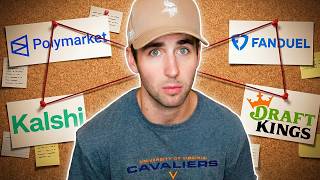
Prediction Markets vs Sportsbooks: The Key Difference
42sClearly explains the fundamental difference between betting against the house and peer-to-peer trading, which is a common point of confusion and interest.
▶ Play Clip OddsJam: Sports Betting Strategy & Education
"Title promises an explanation of how the platforms work, and the video delivers that with practical strategies, though it's padded with some repetition."
This video explores how to make money on prediction markets like Polymarket and Kalshi, contrasting them with traditional sportsbooks. It highlights their regulatory status, peer-to-peer trading model, and the wide range of markets available beyond sports, then details strategies like positive EV betting and arbitrage.
Prediction markets like Polymarket and Kalshi are similar to sportsbooks but differ in key ways. They are regulated by the CFTC and available in nearly every state, unlike FanDuel and DraftKings.
Kalshi and Polymarket are regulated by the CFTC as financial exchanges, making them legal in more states than traditional sportsbooks.
Prediction markets allow trading on a wide range of topics including sports, politics (e.g., US presidential election), entertainment (Oscars), and financial data (inflation).
Unlike sportsbooks where you bet against the house, prediction markets are peer-to-peer. The platform connects traders and earns through small fees, not by taking opposing positions.
Compare odds across sportsbooks and prediction markets to find value. For example, a Thunder game over at +180 on Kalshi vs +154 on FanDuel. Always line shop to get the best price.
Prediction markets charge small fees on trades, unlike sportsbooks which build the vig into odds. Fees vary by market and platform, so be mindful of them.
Arbitrage involves placing equal and opposite bets on different platforms to guarantee a risk-free profit. Example: an OddsJam user made $80 by betting over on Kalshi and under on a sportsbook.
Arbitrage offers daily compounding and platforms like Kalshi and Polymarket never limit bettors. Funds are returned immediately after the event ends.
Using multiple sportsbooks and prediction markets increases line shopping and arbitrage opportunities. More books mean more chances for risk-free profit.
Sports are the most liquid markets, but niche markets (e.g., Oscars, inflation) can offer edges if you have expertise or unique data. However, these markets are often illiquid with wide spreads.
Prediction markets like Kalshi and Polymarket offer unique opportunities for profit through positive EV betting and arbitrage, but success requires careful line shopping and awareness of fees. While niche markets can provide edges, they come with liquidity risks.
What regulatory body oversees Kalshi and Polymarket?
The CFTC (Commodity Futures Trading Commission).
00:29
How do prediction markets differ from sportsbooks in terms of who you bet against?
In prediction markets, you trade against other people (peer-to-peer), not against the house.
02:08
What is positive EV betting?
Comparing odds across sportsbooks and prediction markets to find value where the odds are better than the true probability.
03:01
What is arbitrage betting?
Placing equal and opposite bets on different platforms to guarantee a risk-free profit.
05:04
What is a key advantage of prediction markets over sportsbooks regarding bet limits?
Prediction markets never limit your bet sizes; you can bet as much as liquidity allows.
02:37
What fees do prediction markets charge?
They charge small fees on trades, which vary by market and platform.
04:51
What is an example of a niche market on prediction markets?
Trading on who will win the Oscars or what inflation will be.
07:33
Why are niche markets on prediction markets often illiquid?
Because there are fewer traders and less volume, leading to wide spreads.
08:41
Peer-to-Peer Trading
Explains the fundamental difference from sportsbooks, which is crucial for understanding how to profit.
02:08Positive EV Betting
Provides a concrete strategy for finding value by comparing odds across platforms.
03:01Arbitrage Betting
Highlights a risk-free profit method unique to prediction markets due to their peer-to-peer nature.
05:04Niche Market Edge
Shows how expertise in non-sports areas can be monetized, but warns of liquidity risks.
07:33[00:02] video we are going to be discussing how to make money on prediction markets. So prediction markets are somewhat similar to sports books but in other ways they're very different and the two platforms that have absolutely taken off
[00:16] platforms that have absolutely taken off are Polymarket and Kalshi. So a few differences to kind of go through before we discuss strategies that you can use to make money on Kalshi and Polymarket are what's nice about these platforms is
[00:29] they're available in nearly every state. So Kalshi and Polymarket unlike sports books, they're actually regulated by the CFTC like a financial exchange. So long
[00:42] story short, Kalshi and Polymarket are in way more states than FanDuel and DraftKings. The second thing that's really cool about prediction markets is it's not just sports. We all use FanDuel, DraftKings, PrizePicks to bet
[00:57] on things like you know LeBron James points. What's interesting about prediction markets is you can play sports but you can also trade on a bunch of other things like who's going to win the US presidential election or any
[01:11] other countries election. You can also trade on things like who's going to win the Oscars, what is inflation going to be. So long story short with prediction markets, you have the opportunity to trade and express opinions in the market
[01:25] on a wide range of topics from politics to entertainment to financial data to how many searches are there going to be on Google. Basically anything you can think of, it's probably on Kalshi and Polymarket. So why this is interesting
[01:41] is maybe you're not good at sports betting but you have an edge and you're an expert, let's say in entertainment and in that case you can trade on the Oscars. But what we're going to do is I'm going to explain different
[01:55] strategies you can use to make money on Kalshi and Polymarket. And then we're also going to explain some of the cons of these platforms. Right? Just because there's a new platform available where you can gamble, where you can trade,
[02:08] doesn't necessarily mean you're going to make money. So, the first way that prediction markets kind of differ from sports books are sports books, you're betting against the house. Whereas with prediction markets, you're trading
[02:21] against other people. So, for example, if I place a $10,000 bet on DraftKings on the Super Bowl and my bet loses, then DraftKings made $10,000. Right? You're at odds with the platform you're betting on. Whereas Kalshi and Polymarket on the
[02:37] other hand, all they're doing is connecting traders. Right? They don't care if you're up a million dollars or down a million dollars, it's completely peer-to-peer. You're trading against other people. So, if you bet on the
[02:49] Seahawks and the Seahawks win, Kalshi doesn't care. You're never going to get your bet sizes limited or cut down, anything like that. The way that these platforms make money prediction prediction markets is just through
[03:01] little fees. So, the first way that you can make money on prediction markets that I recommend is called positive EV betting. So, even though prediction markets are a little different from traditional sports books, you can still
[03:14] compare odds between sports books and prediction markets and try to find value. So, for example, here's a play from Odds Jam um where you can get the over in the Thunder game at plus 180 odds. You can see on Kalshi plus 180 is
[03:29] really an outlier. You're getting great value relative to all the other sports books such as FanDuel, a $40 billion company, massive company, you know, they're experts in setting lines. They're only offering plus 154. So,
[03:43] ground zero, the thing you need to remember when you're using these prediction markets is you always want to be finding value. Even though prediction markets are different from sportsbooks, you want to be comparing Kalshi's odds
[03:56] to Polymarket's odds, as well as sportsbooks, and making sure that you are always getting the best possible price. This is called line shopping in sports betting, and it's also critical in prediction markets because sometimes
[04:09] FanDuel will have a better price than Kalshi. Other times, Polymarket may have a better price than any regulated sportsbook. So, you really want to make sure, as step one to being a profitable sports better, is you're always getting
[04:22] the best possible price. The only thing you want to be conscious of when you're using these prediction markets is their fees, right? Traditional sportsbooks like DraftKings and FanDuel, they add in the vig, the house edge, right? They're
[04:37] adding in a spread around fair value, and that's how they make money. But, if you place an $100 bet on FanDuel at plus 100 odds, and you win, you're profiting 100. There's no fees after that. Whereas on these prediction markets, they
[04:51] basically say, "Trade as much as you want." And then they just take a small fee, and depending on the market, depending on the platform, these fees will vary slightly. Sometimes they're really high, sometimes they're not, but
[05:04] conscious of. So, the second strategy that is amazing with prediction markets is called arbitrage betting. So, arbitrage is when two books, sportsbooks, prediction markets, betting exchanges have such different prices
[05:19] that you can play equal and opposite outcomes and guarantee a risk-free profit. So, you trade, you know, you buy one place, you sell another place, and you make a risk-free return. It's kind of like if you could buy a stock at $10
[05:32] on Fidelity and go sell it immediately on E*TRADE at $11 just to guarantee a $1 profit. You have no risk. So, because prediction markets are peer-to-peer, you'll never get limited. You can basically bet however much money you
[05:47] want. It just depends on how much liquidity is available and sometimes there's a ton of liquidity. So, long story short, you can sometimes, if you're looking really closely with the OddsJam arbitrage tool, you can find
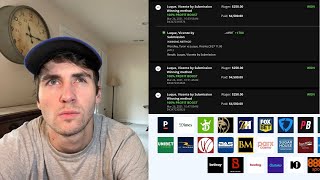
[06:00] massive arbitrage bets. So, here's an example of one OddsJam user who bet the over for a hockey game on Kalshi, he bet the under on a sports book and he made a
[06:12] risk-free profit of about $80. And what's really nice about arbitrage is the second the game ends, you get your money back, right? So, you're not tying up money for a long period of time. He placed, you know, the the over on
[06:25] Kalshi, then the under on the sports book, second the game ends, he's $80 richer. He gets his $80 risk-free return. So, what's nice about arbitrage is you get daily compounding and these platforms like Kalshi and Polymarket
[06:39] will never limit you. They actually love arbitrage betters. But again, the only to take into account the fees. So, when you're arbitrage betting with Kalshi or Polymarket, this is a great strategy is sometimes you'll see arbitrage or
[06:54] crossed markets between two prediction markets like Kalshi and Polymarket, sometimes you can find arbs between [music] them. Other times you may find an arb between Kalshi and a sports book, right? So, ideally, even if you start
[07:07] using these prediction markets, you're still using as many sports books as possible that are legal in your state like FanDuel, DraftKings, Fliff, Free Bet. More books because all these platforms set their own prices, their
[07:19] own odds. More books means more places to shop for lines and that means more arbitrage opportunities, which means more risk-free money for you. So, positive EV betting as well as arbitrage betting are
[07:33] the two best strategies for Kalshi and Polymarket, especially for sports. In sports, even though Kalshi and Polymarket have elections, inflation, all these crazy things you can trade on. Sports is still overwhelmingly the most
[07:47] active liquid markets on the platform. But another cool thing is you can try to create your own model to trade on some of these more niche markets like who's going to win the Oscars or who's going to win the Emmys or what is inflation
[08:00] something and you think you have an edge, especially in these more niche, more illiquid markets where there's not as big of market makers, sometimes you can actually find edges and make money, right? There's actually a famous story
[08:15] of a guy who, you know, did his own research studies and made like $60 betting on Trump to win the US presidential election. And he wasn't doing that, you know, looking at software, he was doing his own research.
[08:28] So because Kalshi and Polymarket have so many more markets than traditional sportsbooks is if there's something you're an expert in or you can get a unique data set and actually get an edge against other people, you can make
[08:41] money. But one thing you got to remember is because this is peer-to-peer, these more niche markets are illiquid, right? not a lot of volume available. There's not a lot of other people trading on
[08:54] these, you know, markets. So there's That means for you, there's not a lot of other people you can trade against or the markets are just wide, right? Like someone will say, "Hey, 30% to 50%." It's just a wide market compared to
[09:08] sports where these markets are super tight and liquid. So regardless, this prediction markets like Kalshi and Polymarket. These platforms are very similar, right? The strategies you can use to make money, arbitrage plus EV,
[09:23] very similar to sportsbooks like DraftKings and FanDuel. But again, if you have an edge in modeling, you can also find some value in these more niche also find some value in these more niche markets.


⚡ Saved you 0h 09m reading this? Transcribe any YouTube video for free — no signup needed.