
AI Summary
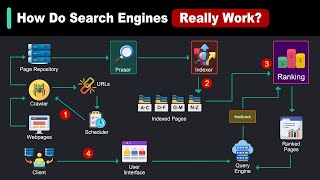
This video provides a comprehensive overview of how search engines work, from web crawling and indexing to ranking and serving results. It explains the technical processes and algorithms that enable users to find information quickly and accurately.
Chapters
Search engines use advanced crawlers that start with seed URLs and follow hyperlinks to discover new content. They prioritize pages based on factors like external link count, update frequency, and perceived authority.
Search engines can only crawl a fraction of the internet daily, so they allocate crawl budget based on site architecture, sitemaps, and internal linking quality to prioritize important and frequently updated content.
Crawlers use URL normalization and content fingerprinting to avoid redundant crawling. For JavaScript-heavy sites, they use a two-phase approach: first crawling static HTML, then rendering JavaScript to capture full content.
The crawling system decides which pages to forward for indexing and which to place in a separate area for further evaluation, filtering out potential spam or low-quality content before it enters the main index.
Indexing involves analyzing and categorizing content into a structured database for quick retrieval. Unique identifiers are assigned to each piece of content, and the process breaks down page content into individual words and phrases.
The inverted index is a core data structure that maps which words appear in which documents, enabling rapid retrieval. Compression techniques, sometimes optimized by machine learning, keep the index manageable at scale.
Ranking uses sophisticated algorithms and machine learning models trained on massive datasets. They consider content relevance, quality, authority, user intent, and user interaction signals like click-through rates and time on page.
Links are viewed as votes of confidence, but natural and authoritative links are preferred over artificial link-building. Freshness is considered for current events, while evergreen topics can rank well with older high-quality content.
Search engines parse queries to determine user intent (navigational, informational, transactional), correct spelling errors, and expand queries with related terms. The index is distributed across multiple data centers to handle billions of searches daily.
Search engines combine machine learning, distributed systems, and information retrieval techniques to organize and provide access to the world's information, enabling users to find almost anything online with just a few keystrokes.
Mentioned in this Video
Study Flashcards (8)
What is the primary purpose of web crawling?
easy
Click to reveal answer
What is the primary purpose of web crawling?
To discover and gather data about web pages by following hyperlinks from seed URLs.
What factors do crawlers consider when prioritizing which pages to scan?
medium
Click to reveal answer
What factors do crawlers consider when prioritizing which pages to scan?
External link count, update frequency, and perceived authority.
00:41
How do crawlers handle JavaScript-heavy websites?
medium
Click to reveal answer
How do crawlers handle JavaScript-heavy websites?
They use a two-phase approach: first crawling static HTML, then rendering JavaScript to capture full page content.
01:40
What is the inverted index?
medium
Click to reveal answer
What is the inverted index?
A data structure that maps which words appear in which documents, enabling rapid retrieval of documents containing specific terms.
03:37
What techniques do search engines use to keep the index manageable?
hard
Click to reveal answer
What techniques do search engines use to keep the index manageable?
Compression techniques, sometimes optimized by machine learning algorithms.
04:06
What is 'learning to rank'?
hard
Click to reveal answer
What is 'learning to rank'?
A machine learning technique used to directly improve ranking quality by capturing complex patterns from training data.
05:19
How do user interactions influence ranking?
medium
Click to reveal answer
How do user interactions influence ranking?
Click-through rates and time spent on a page are considered positive signals of a page's value.
06:00
What are the three types of user intent mentioned?
easy
Click to reveal answer
What are the three types of user intent mentioned?
Navigational, informational, and transactional.
07:45
💡 Key Takeaways
Crawling as Foundation
Establishes the core concept that crawling is the bedrock of search engine functionality.
Inverted Index Explained
Clearly explains the key data structure that powers fast search retrieval.
03:37Machine Learning in Ranking
Highlights the modern reliance on ML for ranking, a critical insight for SEO professionals.
05:19Query Intent Deciphering
Emphasizes the challenge of understanding user intent from short queries, a fundamental aspect of search quality.
07:30Full Transcript
[00:00] We'll follow the journey from web pages to search results, Web crawling forms the bedrock of search engine functionality.
[00:13] Search engines deploy advanced crawlers that combine breadth-first These crawlers begin with seed URLs and follow hyperlinks to discover new content.
[00:28] As they scan the web, crawlers gather vital data about each page - titles, keywords, and links. Crawlers must intelligently prioritize which pages to scan based on factors
[00:41] like external link count, update frequency, and perceived authority. Search engines use sophisticated algorithms to decide the crawling order, balancing new content discovery with a thorough exploration of existing sites.
[00:57] while less frequently updated pages might only see a crawler once a month. search engines can only crawl a fraction of the internet daily.
[01:11] They carefully allocate their crawl budget based on site architecture, sitemaps, and internal linking quality. This ensures priority for the most important and frequently updated content. Crawlers also tackle the challenge of identifying and handling duplicate content.
[01:27] They use URL normalization and content fingerprinting to avoid redundant crawling, Modern websites often rely heavily on JavaScript for dynamic content generation.
[01:40] To address this, crawlers use a two-phase approach: first crawling static HTML, then rendering JavaScript to capture the full page content. highlighting the importance of efficient web development for better search engine visibility.
[01:57] As crawlers navigate the web, they extract and categorize outgoing links, distinguishing between internal and external links. particularly in analyzing page relationships and determining relative importance.
[02:13] The crawling system doesn't just collect data; it makes important decisions about content handling. Some pages may be immediately forwarded for indexing, while others might be placed in a separate area for further evaluation. This helps
[02:27] filter out potential spam or low-quality content before it enters the main index. This involves analyzing and categorizing the content and creating a structured
[02:40] database for quick and efficient retrieval when a search query is made. The indexing system assigns unique identifiers to each piece of content, ensuring effective tracking and management even for similar information across multiple URLs.
[02:55] The process starts by breaking down page content into individual words and phrases. This is straightforward for languages like English but becomes more complex for languages without clear word boundaries, such as Chinese or Japanese.
[03:09] The search engine then processes these words to understand their basic forms and meanings, recognizing that "running," "runs," and "ran" all relate to the concept of "run." Context analysis is next. Search engines examine the surrounding
[03:24] text to determine whether "jaguar" refers to the animal or the car brand. for providing relevant search results and accurate answers to user queries.
[03:37] , with the inverted index at its core. This powerful data structure enables rapid retrieval of documents containing specific terms, essentially mapping which words appear in which documents.
[03:51] This allows the search engine to quickly find relevant pages when a user enters a query. Dealing with billions of web pages presents significant challenges in index size. Search engines employ various compression techniques to keep the index manageable.
[04:06] Some even use machine learning algorithms to dynamically optimize compression based on data characteristics, ensuring efficient storage and retrieval of vast amounts of information. Indexing goes beyond word analysis. Search engines store and evaluate
[04:21] important page information like titles, descriptions, and publication dates. considering factors like depth, originality, and user intent matching.
[04:33] The system also maps page connections through links, helping determine each page's importance. databases to reflect web content changes. They track new, modified, and removed pages,
[04:48] ensuring search results remain current and relevant in the ever-changing internet landscape. Once content is indexed, search engines face the complex task of ranking - determining which pages are most relevant and valuable for each search query. This process involves sophisticated
[05:04] algorithms that consider many factors to provide the most useful results to users. Modern ranking systems rely heavily on advanced machine learning models. These models are trained on massive datasets of search queries and human-rated results,
[05:19] They use techniques like "learning to rank" to directly improve ranking quality, capturing complex patterns that would be difficult to program manually.
[05:31] Ranking algorithms examine various webpage aspects. They consider content relevance to the search query, looking at factors like topic coverage and keyword presence. But relevance alone isn't enough. Search engines also evaluate content quality and authority,
[05:47] content depth, and how well it satisfies user intent. Search engines analyze how users interact with search results,
[06:00] considering factors like click-through rates and time spent on a page. result is seen as a positive signal of that page's value. mobile-friendliness, and overall user experience factor into rankings.
[06:18] well compared to a slow, difficult-to-navigate one. Search engines examine the number and quality of links pointing to a page,
[06:31] viewing these as votes of confidence from other sites. However, the focus is on natural, authoritative links rather than artificial link-building. Freshness and timeliness of content are considered. For queries about
[06:44] current events or rapidly changing topics, more recent content might be prioritized. However, for evergreen topics, older but high-quality content can still rank well. Personalization is another factor in modern search ranking. Search engines may tailor
[06:59] results based on a user's location, search history, and other personal factors. balanced against the need to provide diverse perspectives. It's important to note that ranking factors are constantly evolving.
[07:14] quality and adapt to changes in web content and user behavior. This dynamic nature of search ranking means that maintaining high search visibility requires ongoing effort and adaptation to best practices.
[07:30] When a user enters a search query, the engine faces the complex task of deciphering the user's intent. This is particularly challenging given that most queries are just a few words long. The process begins with query parsing and analysis, where the engine breaks
[07:45] down the query to determine whether the user is seeking a specific website, Search engines use sophisticated techniques to enhance query understanding. They correct
[07:58] spelling errors, expand queries with related terms, and use advanced analysis methods to handle rare or ambiguous searches. informational, or transactional, helping the engine tailor its results accordingly.
[08:15] Serving these results at a massive scale - billions of searches daily - is a monumental task. Search engines rely on complex infrastructure to manage this load efficiently. The search index itself is too vast for a single machine,
[08:29] so it's distributed across numerous servers, with redundancy for reliability. These serving clusters span multiple data centers globally. Keeping this distributed system up-to-date is an ongoing challenge,
[08:42] with new content often indexed separately before being integrated into the main index. Modern search engines combine cutting-edge machine learning, distributed systems, and information retrieval techniques to organize and provide access to the world's information.
[08:57] It's this combination that lets us find almost anything online with just a few keystrokes. It covers topics and trends in large-scale system design.
[09:10] Subscribe at blog.bytebytego.com