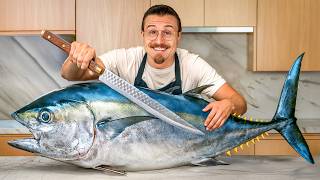

$20,000 Bluefin Tuna Catch
45sThe extreme value of the fish and the unique experience of catching it at a tuna ranch immediately grab attention.
▶ Play Clip"The title accurately describes the video's content: a step-by-step guide to carving a whole tuna."
This video follows the host as he catches and carves a $20,000 bluefin tuna at Bluefina, one of the largest tuna ranches in Mexico. With guidance from tuna experts Blake and Matt of Riviera Seafood Club, he breaks down the entire fish, from removing the head to slicing the prized otoro. The journey highlights the skill, precision, and care involved in preparing this luxury ingredient.
The host visits Bluefina, a large tuna ranch in Mexico, to catch and carve a $20,000 bluefin tuna. The ranch raises thousands of bluefin in the open ocean.
The host and pros select a fish from a pen filled with 300 lb tuna. The host describes being surrounded by 6-foot-long bluefin tuna.
The host's guides are Blake and Matt from Riviera Seafood Club and Prime Time Seafood, whose family has carved more bluefin than anyone in America.
The host makes his first cut, removing the head along a clean line. The head meat is used, as the loins extend almost to the nose.
The host cuts off the collar, which is the most expensive part of the fish due to its high quality and limited quantity.
The host uses an 8.79-inch breaker knife and a skin knife to remove the dorsal fin and puncture the back loin.
The host successfully cuts the back loin, which contains akami (lean meat) and chutoro (medium fatty meat). He is amazed by the quality from the ranch.
Bluefin tuna start wild but are penned and fattened on organic sardines for a year. Ranching helped the bluefin population recover from near collapse 15 years ago.
The host cuts the massive belly loin, home of the otoro. This is one of the most challenging cuts.
The host scrapes meat from the frame with a spoon, describing it as sweet, fresh, and rich in umami. The fish was caught yesterday and eaten today.
The host separates the top loin from the belly loin, noting the fish is 6 feet tall (with tail).
The host cuts into the otoro, the fattiest part. He describes the cross-section showing akami, chutoro, and otoro.
Matt removes the bloodline and cuts chutoro. The host explains these cuts can be used for sushi, sashimi, nigiri, tartare, or ceviche.
The host tastes akami, chutoro, and otoro. Akami is meaty and umami-rich; chutoro is balanced with richness; otoro melts in the mouth, described as beyond A5 Wagyu.
The host thanks Bluefina and Riviera Seafood Club, encouraging viewers to try otoro and subscribe.
Carving a whole bluefin tuna is a meticulous process that requires skill and respect for the fish. The journey from catching to tasting the otoro reveals why this bite is considered one of the most luxurious in the world.
What is the most expensive part of the tuna?
The collar.
02:39
What are the three types of tuna meat mentioned?
Akami (lean), chutoro (medium fatty), and otoro (fattiest).
08:52
How long are bluefin tuna fattened at Bluefina?
For an entire year.
05:09
What tool is used to scrape meat from the frame?
A spoon.
06:14
What is the approximate weight of the tuna carved in the video?
300 lb.
00:45
What is the name of the ranch where the tuna was caught?
Bluefina.
00:14
What type of knife is used to remove the dorsal fin?
A skin knife.
03:37
How does the host describe the taste of otoro?
It melts in the mouth, is tender and fatty, beyond A5 Wagyu.
10:35
Tuna Harvesting Adventure
Sets up the unique experience of catching and carving a $20,000 bluefin tuna.
Collar: Most Expensive Part
Reveals that the collar, not the belly, is the priciest cut due to its rarity and quality.
02:39Ranching Helps Conservation
Explains that tuna ranching contributed to the recovery of bluefin populations.
05:09Cross-Section of Tuna Cuts
Visually demonstrates the three main cuts: akami, chutoro, and otoro.
08:52Otoro Tasting Experience
Describes the otoro as melting in the mouth, highlighting its luxurious texture.
10:35[00:00] This is a $20,000 bluefin tuna, and we're about to carve it down to one of the most expensive bites of fish on Earth. But first, we're going to actually catch it ourselves. There's only a few places in the world you can do this. So, we went to one of the largest tuna ranches on Earth,
[00:14] Bluefina, located in Mexico. This place raises thousands of blueofin in the open ocean, and we're about to get our own. First, we need these pros to pick a fish.
[00:28] Awesome, man. First, these pros and uh me are going to pick our fish. I don't have my glasses, so I can't see. This is a perfect situation. How do I get through this hole? You know, I've never asked myself that question before. I've always known. Feels good. Is there a different way to get
[00:45] in? All right. I love being surrounded by 300 lb fish. What is that? Those are like jellyfish. Are you for real? Oh, [ __ ] Christ. So there I was, surrounded by hundreds of 6 foot long bluefin tuna
[01:00] swing around like torpedoes. Now I just had to pick one. With our fish selected, time to harvest. We all know what happens next. Just know that it's done at the highest level of care. So now we have our fish. Finally, we can break it down. My guides today are America's tuna kings Blake and Mattto of
[01:16] Riviera Seafood Club and Prime Time Seafood. Their family has carved more blue fin than anyone in America. And today, for the first time ever, I'm going to help cut this entire tuna down all the way down to the most legendary bite on Earth, the O Toro. But before we get to that perfect bite,
[01:32] we've got to get to work. Let's get into it. Something went in my mouth when you clapped just now. Step one, removing the head. I'm going to set you up a nice clean line here, and you're just going to go right through the head. Okay. So, I just cut along the dotted line, and wow,
[01:49] just it came right off. Do you guys ever use the the head meat? Oh, absolutely. Yeah. So, we got four different loins that actually connect almost to about the nose. It's crazy how long these loins go to. Later in the video, we'll show you guys the four loins that all come from right here. Okay,
[02:05] my first cut is complete. Now, we really get into it. And a big fish means big knives, right? I'm actually going to use this first cut. We're going to take off this beautiful collar right here. Nice
[02:18] and sharp knife. Let's go right underneath it. All right, we're cutting through here. second fin and the collar. Follow that line. One, two. Here's our first cut right here. Crazy easy.
[02:39] This is the collar cut. So, this is the comma. And because of how little and how high quality it is, it's actually the most expensive part of the fish. All right, my first solo cut. No guidelines. And with this being the most expensive piece, we have to be precise here. No waste. So, I've
[02:54] done it before now that I'm doing this, which is super great. We're going more angle now. Down.
[03:07] That's it. Okay. Halfway there. And my knife got a little stuck. I mean, let me see if I got you. There you go. Daddy had to help me a little bit. Hey. Hey. Okay. All right. I think that's better than mine, honestly. I don't know,
[03:22] dude. We got it. I'm sweating a little bit. Now we step it up. The big cuts and with knives that I definitely didn't expect. This is an 8.79 in breaker knife. And then this is our skin knife right here. So, we're going to use this to take off our beautiful dorsal fin
[03:37] right here. We're going to use this knife right here to puncture the back loin and the skin here all the way up to here. Yeah, I can see why you don't use a sword for this.
[03:56] the bone but not cut through it. Just take your time, guys. Take your time.
[04:10] Back to my skin knife. Create our first skin cut to take off our back loin. So, I'm only using this knife to puncture the skin and to follow the midline.
[04:24] This is the crucial moment. My first huge cut. Like a pro. There you go. There you go. You want to hear that sound of the separation
[04:41] slide. Oh my god. Oh, there it is. This right here is our back loin and this has akami and chro cuts in it. The akami is the bright red lean meat. Chro is the pink medium fatty meat.
[04:53] And I'm in search for the most luscious, the most fatty, the most buttery bite in dude. That was pretty badass. I'm kind of blown away this came from a ranch. I mean, it's a beautiful fish. These tuna actually start completely in the wild. But once penned,
[05:09] they live like millionaires, fattening on the best organic sardines for an entire year. Only bluefina does this, so every single tuna can reach peak flavor and fattiness, making the best otoro. What's crazy is that the blueofin population nearly collapsed 15 years ago. But ranching is
[05:24] a big reason that they're safe to eat again. But now we have to cut the massive belly loin, home of the otto. It's one of the most challenging, but also satisfying cuts. Listen carefully.
[05:45] Go. [Music] And this is the otto right here. So, we successfully cut this massive fish in half,
[05:57] but now we have to finish cutting before we break the otto down into edible pieces. Until then, there is one secret cut that very few will ever get to taste. At least not like this. from the frame of the fish. Scraped off simply with a spoon. How is it? Sweet,
[06:14] fresh, clean. That rich umami. I mean, this is about as fresh as it gets, buddy. It was out of the water yesterday and in my mouth today. We're going to take the frame off of the second half of the fish and then we're going to get the last two back loin and belly.
[06:50] Going to give it my uh my best shot here. Here we go. Wow. This is so satisfying.
[07:07] You got her? Yep. Jesus Christ. I don't want to I don't want to whack the meat again. Just don't whack me. Woo! Dude, this thing is almost as tall as I am. Actually, it is if it had the tail attached to it. It really would. This is a 6ft fish. 5'11 though,
[07:22] right? No, no, no. 6' one with shoes. So, we're close to being finished. But now we have a big test for me. Separating the top loin from the belly loin.
[07:36] Let's get it going. Oh, I didn't even have to do anything. That was pretty satisfying. Not bad. Only one more cut. If I can get through this,
[07:50] we can finally start breaking down the belly and get our otor. The next cut we're going to do, we're going to remove this bone/tendon. You can do the exact same thing you did last time.
[08:03] You guys are trusting me quite a bit here. Okay, so we're good. What'll happen typically in a sushi bar when they receive this tuna is that this fish will be cut typically to hand lengths. So hand length. So like right here.
[08:18] This is the moment of truth. We're cutting into the otto. And I'm feeling kind of hot right now. I'll be honest. After that first cut, this one felt sensual, if you will.
[08:37] I felt more confident on that one. This is a moment I've always dreamed of. This incredible cross-section that shows all three parts of the tuna in one. The lean, which is the deeply red akami, the medium fatty pink churro,
[08:52] and the fattiest, butteriest melt in-you mouth otoro. The holy grail. We got a lot of tuna the real fun begins. So, first I'm going to start by taking out the bloodline. You can
[09:05] see that Matt's doing long smooth strokes. He's not sawing through the bloodline. Now, Matt moves on to the medium fatty churro. You can use both cuts for sushi, sashimi, nigiri, tatar,
[09:17] or even ceviche. But, we know what we're really here for, the otoro. So, this is the otoro cut. So, this is our otoro, but specifically, it's like the center cut of the center
[09:29] cut. It's just like glistening, dude. Now that these are all broken down, we're handing the baton to Blake and Matt's sister Claire, who will expertly break these down into the most perfect, freshest sashimi pieces we'll ever eat. We're going to eat these from akami choro
[09:43] to oo toro. Starting with aami. Let's all grab a slice. Little soy. Cheers. Tartar flemen. Dude, it's got the acidity. It's got the real aromatics to it. Akami is my least favorite cut, but this
[09:56] is some of the best akami I think I've ever had. It's not quite creamy. You're leaning into that sort of like meaty umami. onto Chro. Wow. World of difference. So balanced cuz you get the umami, but you also get it a little bit of that richness to help cool it off a little. It's my favorite.
[10:11] I also feel like the soy lends itself better to this. Literally emulsifying in your mouth. Okay, it's time. The best piece in the house, the O Toro. Cheers. This journey has been insane.
[10:23] From literally swimming with blueofin tuna in Mexico to carving a 300 lb fish, it finally culminates to this one moment. I mean, this is like beyond A5 Wagu fish. It's more than
[10:35] that. Something about it so special. It melts in your mouth. It's so tender. It's so fatty. you go to a sushi restaurant. You wonder why it's so goddamn good. And now hopefully you understand
[10:48] a little bit more about that. It's just so special when you eat it. It's the only way you can quench that thirst is with a piece of otoro. Huge thank you to Bufina and Riviera Seafood Club. These guys are beasts. If you want to learn more about them, go to the description. Please click and check them
[11:03] out. Go get yourself some Oro or whichever one you want. You know, maybe you need to get a little flight. These guys will ship it straight to your house. You can experience this yourself. Maybe it. How about that? So, come back and watch this twice. Love you so much. Subscribe. Bye.




⚡ Saved you 0h 11m reading this? Transcribe any YouTube video for free — no signup needed.