

Can You Really Grow a $100 Forex Account?
44sChallenges the common belief that small accounts can't grow, sparking curiosity and debate among traders.
▶ Play Clip"Title promises illegal speed, but video delivers realistic, cautious advice for growing small accounts."
This video discusses strategies for growing small forex accounts (starting with $100-$200) despite high risk. The speaker emphasizes the need for a high-probability strategy (70-80% win rate), emotional control, proper risk management, and taking advantage of economic events. The ultimate goal is to multiply capital slowly, with caution against blowing the account.
Despite the difficulty, growing small accounts like $100 or $200 is possible with the right strategy, though it is riskier than trading larger capital.
For small accounts, a strategy must have at least 70-80% win rate because you cannot afford multiple losses without emotional impact.
Risking 10% per trade on $200 leads to a 30% drawdown after three losses, which changes mindset from profit-seeking to recovery mode.
Start with trades offering 1:1 or 1:2 risk-reward ratios to gradually grow capital while minimizing loss impact.
After winning trades, treat profits as a buffer for future losses to maintain a detached, systematic mindset.
Use meditation, books, or podcasts to develop patience and emotional control, as off-chart habits directly affect trading performance.
After 3-4 consecutive losses, reduce risk and take a few days off instead of increasing risk to recover losses, which often leads to blowing the account.
Events like CPI, NFP, GDP, and retail sales add volatility that can accelerate trades to profit targets, especially if they align with your analysis.
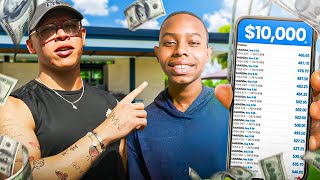
For those who find small account growth too stressful, funded accounts (e.g., $10 for a $10,000 challenge) offer a less risky path to earn returns.
Growing small forex accounts is a slow, challenging process that requires a high-probability strategy, strict emotional control, and disciplined risk management. If the pressure is too high, funded accounts provide a viable alternative to building capital without risking personal funds.
What win rate is recommended for small forex accounts?
At least 70-80%.
02:02
What should you do after three or four consecutive losses?
Reduce risk and take a few days off.
05:54
Name three economic events that add volatility to forex markets.
CPI, NFP, and GDP.
08:49
Why is it important to view profits as a buffer for future losses?
To maintain a systematic mindset and avoid emotional trading after wins.
03:37
What risk-reward ratios are suggested for small accounts?
1:1 or 1:2.
02:55
How much can a funded account test cost, and what capital can it provide?
Around $10 for a $10,000 account challenge.
10:22
High Win Rate Is Non-Negotiable
Emphasizes that small accounts cannot survive many losses, so a win rate above 70% is critical to avoid emotional blowups.
00:56Emotional Work Outside Charts
Challenges the common belief that trading skill is only technical; psychology is built off-chart through habits like meditation.
05:03Reduce Risk After Losses, Not Increase
Contrasts the typical revenge trading urge with a disciplined counterintuitive move that protects capital.
05:54Economic Events as Accelerators
Leveraging news volatility can help small accounts reach profit targets quickly without altering the strategy.
08:08Funded Accounts as a Pressure Relief
Offers a practical alternative for traders who struggle with the emotional burden of growing tiny capital.
10:22[00:01] you can grow small accounts. Some people think it's impossible, others small accounts, but I'm going to tell you if this can really be done in the long term and how I would do it so that you too can replicate that strategy.
[00:14] have much capital to trade with and it's difficult for you to get that capital. That's why you've gotten the idea in your mind to use 100, 200, 300 and constantly increase it over time. Before watching this video, you should know that it's
[00:29] very difficult for someone with little capital to earn a lot of money, but there are amount of capital, multiply it, and grow it little by little. Obviously, these strategies are much riskier than a normal strategy with a capital
[00:42] of $10,000, $20,000 or $30,000. But if you only have $100 or $200 and want to grow it, it's possible. You just have to do it the right way. So have a strategy with a high probability percentage. If you have
[00:56] a small account, you can't afford to take 3, 5, or 10 losses because, possibly by risking the correct percentage to grow the account, many times we lose count more because of emotions than because of actual
[01:11] mistakes. Let me explain. If you have an account of $200 and you start taking a risk of 10% for each trade, that is , $20, if you take three losses three losses occur, you will see that your account
[01:23] is down 30%. Once that happens, you start to see the account from have the same mindset you had when you started trading. Now your mindset is focused on recovering what you lost and when you're going to continue
[01:35] losing, your mindset isn't the same. So, you need to have a strategy that has a high probability percentage, because little as possible. And often the losses we take are not
[01:49] part of the probability, but are emotional losses that when we are trading and in the operation, we start to make decisions that cause us to lose more. Your strategy needs to have a success rate of at
[02:02] least 70 to 80%. And I know I 'm asking a lot of you with this, but if you want to focus on growing small accounts and taking big risks, you can't afford to you need to have the strategic and mental aspects well defined. You have to
[02:15] starts sabotaging your strategic side, your strategy will have a lower lose more, and you'll end up blowing your account. A very rookie mistake that many people make is that when they take these three losses, they want to risk
[02:29] more with the goal of recovering these three losses, and their mentality is, if I already lost 30%, the next trade will be 20 or 30% to recover what I lost and earn a little more. Then they end up losing and the account
[02:42] starts to get completely lost. You realize that you only have 40% now you start trading recklessly, not following the strategy, but following your emotional instability, which brings us to the second point, you have to
[02:55] The higher the probability percentage of your strategy, the more You can start by taking one-to-one or one-to-two trades, meaning you'll try to try to earn double what you're risking. At first this is going to be
[03:10] a little difficult because if you take a trade with a 10% risk, let's assume an account of $200 and you are risking $20, if you win a trade and earn those $20, you can't see it as you are already winning. You have to
[03:23] see it as a new opportunity that you now have to lose, because if will not lose your capital. So, every time you win, if you win 1, 2, 3, or four trades, all of that is an opportunity to keep losing, because since
[03:37] your mindset is different if you start losing the profit as you understand the risk-reward ratio, unlike a normal account where you can face several losses and then win again, here you can't
[03:51] operations have to be with a risk- reward ratio that is both feasible and quick. One by right, to grow your capital, you can look for one-to-one trades, look easy and follow the strategy that work well with one by one,
[04:07] but there are other trades that develop better and give you a one-to-two or one-to-three. perfect risk-benefit ratio, and if you're going to risk a lot, try to lose as little as possible. The third thing would be to increase your win rate, but by controlling your emotions. The
[04:20] find that strategy and start testing it and realize that the probability of you winning with that strategy is not the strategy or the earlier, your mind won't work the same way when you have losses involved
[04:35] your capital shrinking more and more, your mind doesn't work the same way. You don't start analyzing the same way; your mind is blocked by those losses. That's why you ca lower your probability percentage.
[04:49] dedicate time outside of trading to trying to understand your emotions. Why are you Why are you afraid of losing? You have to learn to regulate all these emotions that negatively influence your trading emotions that negatively influence your trading
[05:03] become the person who is able to regulate their emotions. You need to of being patient. And this is not achieved by backtesting, it is not achieved in the graph, it is achieved outside the graph. So the decisions you
[05:17] make outside the chart will directly influence your result inside the chart. Your goal now is to work enough off the chart so that when you get to the chart you are prepared, relaxed, and completely calm
[05:29] to trade. You can use meditation techniques, you can read books that teach you how to be more patient, listen to podcasts, search for information, but the main thing is to analyze and determine what your main mistakes are.
[05:41] Some people are naturally very anxious and come to trading that way. Others because they have those bad habits in their daily lives, and they major consequences and prevents them from
[05:54] Number four would be that if you start losing a lot of the growth of that , four or five trades in a row and your account is greatly reduced, you have to reduce the risk and not increase it. Most people
[06:07] increase risk with the goal of recovering those losing trades and wanting to recover what he lost. What I lost can't be lost, so I have to get it back. And from now on they start increasing
[06:20] a trade will come along and save them. They begin to see the opportunities that were lost, future opportunities and with an increased risk; they are literally blind to reality. Their mind is only thinking about when they're going to win again,
[06:34] not about when I'm going to find a good trade with a good probability. So can do is reduce the risk and take a few days off. You don't want to burn through the account. I know it's hard for you to get those $100 or $200 and you don't
[06:47] where you're going to come with $100 and multiply it by 100,000. Some people have achieved these kinds of challenges, but these challenges are not easy, so If you have three or four losses in a row, take three days off and
[07:01] then when you return, reduce your risk. Because if you keep losing and if your mind is blinded by the negative emotions that come with losing, you're going to keep account very quickly. My first account was $3,000 and I lost it in about 3 days
[07:15] because I didn't know how to manage that $3,000. I was trade, and every loss that came made me lose more because I wasn't feeling well. Being a complete novice and not understanding how to grow small accounts, I
[07:28] ended up losing that capital in three days. Then, a few days later, I put in another account of 3,000 and ended up losing it in about five or six days. And what happened with the first account. I said, "This time will be different, this time I'm going
[07:41] control my emotions." But the truth is I never changed, I only said I was going to change internally, we will always reflect the same actions that will give us the same results. So if you have several losses in a row, don't
[07:55] increase the risk. On the contrary, it reduces the risk of re-entering your better. And when you regain that confidence, return to your normal risk tolerance. Give yourself a few days off to let your mind rest from the pressure of trading, and
[08:08] point, I will tell you that you have to take advantage of economic events. During the month, specifically regarding the dollar, we have between eight and ten economic events. Each of volatility to the price, allowing the price to rise sharply or fall sharply. And
[08:22] these economic events, if you can take advantage of them, often go hand in hand with your analysis. If you're managing small amounts of capital, you might be using that broker and that broker is placing your order in the real market,
[08:35] even if you're trading a news item, it won't trigger your stop-loss order. That's why you can to your advantage. If an economic event is about to happen and you have a gave you the direction, you can take advantage of that movement that might
[08:49] give you a one-to-three trade in 2 minutes. But this is not the case with all economic events. You can use economic events such as CPI, retail sales, NFP, GDP, and Unemployment Claims. These are important economic events that
[09:02] generally move the price very quickly 80 or 90% of the time, and often go in the direction of the strategy we are using. About two weeks ago I took a trade and in the middle of that trade some news came out.
[09:14] trade, helping me reach the take profit target faster. It even went beyond the take profit, but I left with 4% of the account. What I did on that economic event and my real account so that the economic event would push my trade towards
[09:28] profit. But what dictated that operation was not the news itself, it was that at that moment I should sell. What I did helped the trade reach the take profit faster. So take advantage of
[09:41] volatility. to find these entries that will help you multiply your account. And finally, remember that growing small accounts isn't so easy. You need a strategy, you need a steely mindset,
[09:53] because you're not going to multiply from 100 to 10,000 or 100,000 in a short time, time for the snowball to start growing. If you don't want to depend on this pressure of constantly growing accounts, I recommend doing what I did when I
[10:07] was resort to funding accounts. These funding accounts have become very popular in 2024 and 2025 and are basically tests on a capital that you can invest in the market and with that capital earn more
[10:22] money. The capital generally ranges between 5,000 and 600,000 and it is much easier for you to invest $10, which can cost you a $ 10,000 account, than to grow an account from $140 to $10,000. If you invest $10, pass the test, and you can have a
[10:38] funded account of $10,000. With this $10,000 account, if you earn 5%, you would already be earning $500 without having to risk much, without having to resort to strategies. You can use this funded account or you can grow your
[10:51] $140 account and keep multiplying it, but you have to know that the path will not be easy, it will be complicated, that your emotions will work against you and that you have a high Growing a small account is possible
[11:03] first thing you'll need is a strategy, a good mind, and to use these tips I've given you in this video. I have boosted accounts from $200, $800, from $500 to $1,000. The other day I did a challenge where I took an account from $1,000
[11:18] to $3,000. And this is not easy because you have to win a lot, you can't lose too much, you can't allow the probability of your trading flowing in work against you, as I have repeated to you many times. So if you want to grow
[11:32] tips. But if you don't want to go through that headache or if you don't want to challenge yourself, I recommend going for funded capital. Whether you decide to grow a small account or go for funded capital, both options are
[11:44] mind is that growing a small account is n't going to be easy, because otherwise everyone would start trading with $50 or $100 and become a millionaire. And it's practically impossible to start making millions of dollars with a capital of 100, 200 or $
[11:57] step, it's going to be a slow process, the same time it can decrease a lot, you can burn through the account, you can lose capital, but believe me, I've seen many people who have succeeded. You
[12:09] use the right strategies. If you enjoyed this video, I invite you to leave a comment and tell me if you would be able to manage an account from $200 to $1,000. You can also do it as a challenge to test your skills
[12:21] and to reduce your loss percentage. In other words, if you want to these kinds of challenges, as they force you not to lose too much. And if you want to small accounts, let me know in the comments. If you'd like me to be
[12:35] trading into your biggest source of income in 2025, below this video you'll find a form where you can apply, and a member of my team will contact you if you apply. And with nothing more to say, see you in the next video.
[12:48] Apply these tips. Bye, bye and kisses. M.

⚡ Saved you 0h 12m reading this? Transcribe any YouTube video for free — no signup needed.