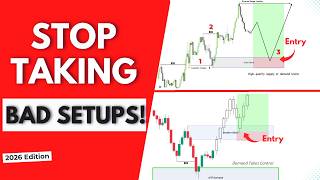

Stop Chasing Every Trade
43sDirectly addresses common trader frustration with a clear solution, hooking viewers seeking to improve win rate.
▶ Play Clip"Title accurately promises a method to filter A+ setups; video delivers exactly that with clear hacks and entry techniques."
This video presents five essential hacks for filtering out risky trades and focusing only on high-probability setups using Smart Money Concepts. The presenter emphasizes that market success comes from better filters, not more trades, and provides a step-by-step checklist to identify A+ setups.
A high-quality setup must originate from a strong supply or demand zone on a higher time frame (1H or 4H). This determines who is in control and the allowed trading direction.
Look for a liquidity sweep (buy-side or sell-side) that causes a break of structure, creating a point of interest at its origin. These zones represent smart money footprints.
Focus on order blocks or points of interest formed with imbalance and inefficiency. Unfilled gaps act as magnets, making zones more reliable.
Points of interest at market extremes have higher priority. In a bullish profile, focus on discount areas; in a bearish profile, focus on premium areas.
A higher time frame liquidity level ahead of price serves as the take profit target. This determines whether to open a position or stay out.
Aggressive (limit order within zone), Conservative (wait for rejection on lower TF), and Ultra Conservative (multiple TF confirmations). Each has pros and cons.
The key to profitable trading is not finding more setups but filtering out weak ones using these five hacks. Proper entry execution is equally critical, and traders should choose an entry approach that matches their risk tolerance.
What is the first hack for filtering high-quality setups?
Price must originate from a higher time frame supply or demand zone (1H or 4H).
00:53
What does a liquidity sweep create according to hack 2?
A point of interest at its origin after a break of structure.
03:07
Why are zones with imbalance and inefficiency more reliable?
Because unfilled gaps act as magnets, making price more likely to respect them.
04:02
In a bullish market profile, where should you look for points of interest?
In the discount area (lower part of the range).
04:28
What is the purpose of a higher time frame liquidity level in front of price?
It serves as the take profit target and helps determine whether to open a position.
05:08
What are the three entry approaches in Smart Money Concepts?
Aggressive, Conservative, and Ultra Conservative.
06:28
How is an aggressive entry placed?
As a limit order at the lowest point of the supply zone (for shorts) or highest point of demand zone (for longs).
06:55
What is the key principle for time frame selection in conservative entry?
The analysis time frame should be at least twice as large as the entry time frame.
08:43
Market Rewards Better Filters
Core philosophy: success comes from filtering setups, not taking more trades.
00:15Identifying Who's in Control
Explains how to determine if supply or demand is dominant using unmitigated zones.
02:15Liquidity Sweep as Smart Money Footprint
Describes how manipulation of retail positions creates high-probability zones.
03:35Execution is the Critical Challenge
Emphasizes that even perfect analysis fails without proper entry execution.
05:49[00:02] episode of smart risk. If you apply smart money concepts on your charts, you every day. But most of those trades end in losses, not because your analysis is bad, but
[00:15] setups without realizing it. The truth is, the market doesn't reward more trades. It rewards better filters. That's exactly why in today's video, I'm going to show you five powerful hacks that I personally use to filter out
[00:29] risky setups and focus only on A+ trades. By the end of this video, you'll stop chasing every setup and start trading only the ones that actually matter. Let's get into it.
[00:53] The very first key step in smart money concepts to becoming profitable is identifying a high-quality trading setup, one that carries a higher probability while filtering out risky trades. I use five important hacks as my
[01:06] personal checklist, and I don't enter any trade without them. These help me clearly identify whether a setup is truly high-quality or not. Price must originate from a higher time frame supply or demand area.
[01:20] First and foremost, for a high-quality trading setup, price needs to originate from a strong supply or demand zone on a higher time frame, such as the 1-hour or 4-hour charts. This is important because it helps you understand who is in
[01:32] control, buyers or sellers, and it defines which direction you are actually allowed to trade. For example, if we're looking to buy the market, the price should originate from an unmitigated demand area on the 1-hour
[01:45] or 4-hour time frame. On the other hand, if we want to sell, supply area. Identifying which side is in control is crucial because if you don't know whether buyers or sellers are dominating
[01:59] you'll end up trading against the real direction. Before we go any further, let's quickly recap. How do we identify who's really To understand whether demand or supply is in control, we need to check the most
[02:15] For example, if the market is in a downtrend and price originates from a fresh unmitigated supply zone, then supply is And we should be looking for selling opportunities, not buys.
[02:28] Supply remains in control until price reaches a fresh demand zone and reacts At that point, demand takes control and we should stop looking for sell setups, even if what looks like a perfect entry appears. So, identifying who's in
[02:41] control always depends on how price reacts to unmitigated supply and demand zones. Always remember that higher time frame fresh zones have priority over the time frame you're currently analyzing. This means that if price taps into a
[02:54] fresh unmitigated higher time frame zone from the opposite side, control can shift from demand to supply or from supply to demand. hack. Hack number two, look for a point of
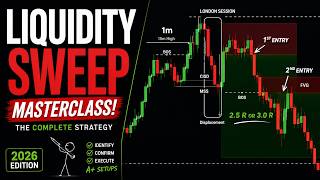
[03:07] interest created by a liquidity sweep. In the second hack, the first thing we want to see is a liquidity sweep, either buy side or sell side, that causes a eventually leads to a break of structure.
[03:21] point of interest at its origin, creating a very strong probability for the price to react to reverse when it returns to that area, giving us an you're asking why, because these zones represent the
[03:35] footprints of smart money in the market. We believe price performs a manipulation by taking out retail traders' positions, and these areas are where large volumes are traded and positioned just before a strong move in the opposite direction.
[03:48] high-quality supply or demand levels that we should always keep our eyes on. Now, let's add even more confluence. The third hack is looking for inefficiency. To add more confluence to our setup, we need to focus on order
[04:02] blocks or points of interest that are formed with imbalance and inefficiency. disequilibrium between buyers and sellers indicates that large volumes were traded, showing potential smart money involvement.
[04:15] The existence of an unfilled gap below or above a point of interest acts like a magnet, making that zone more reliable and more sensitive. Because of this, price is more likely to respect these areas when it returns to them. Now,
[04:28] let's continue with the fourth hack. Area of premium or discount. Points of interest located at market extremes always carry higher priority than those forming in the middle of a range. In a bullish market profile, you should
[04:41] focus only on supply or demand zones that form within the discount area, the lower part of the range. In a bearish market profile, look for points of interest in the premium zone, the upper part of the range,
[04:54] to find high probability short setups. This helps us filter out weaker, riskier zones and focus only on the areas that offer the best possible risk to reward Now, the next important hack is the presence of a higher time frame
[05:08] liquidity level in front of the price. Finally, we need a higher time frame liquidity level ahead of the price to serve as our take profit target. the trade. This is important because even if we
[05:22] identify a high quality setup, a successful trade also depends on having take profit level. This understanding helps us decide where where to set our profit targets, and how
[05:36] reward ratio. It's the final and one of the most important steps that determines whether we actually open a position or stay out even when other high-quality conditions appear.
[05:49] When all these rules and criteria align, we have a high probability trading But, here's the catch. The biggest challenge traders face isn't just finding the perfect setup. It's knowing exactly how to execute it and where to
[06:02] place the entry. And this is the most critical and tricky part of trading. Because even if you identify a flawless setup and correctly predict where the price is headed, a poorly timed entry or a misplaced execution can still turn a
[06:15] winning idea into a losing trade. So, now let's dive into smart money concept entry methods step by step and learn how to use them correctly to identify the best entry points in the market.
[06:28] In smart money concepts, we have three main entry approaches. Aggressive, which carries more risk. Conservative, which gives you entries with additional Ultra conservative, which gives you even more confirmation
[06:42] across multiple time frames. Each model has its own pros and cons, so you need to choose the one that matches your trading style and your risk tolerance. Now, let's break them down step by step.
[06:55] Starting with the aggressive approach. Opening a position using this entry model is similar to placing a limit order within a higher time frame demand or supply zone. Imagine we have a perfect sell setup,
[07:07] just like the example on the chart, confirmed by all the rules and criteria of a high probability trading setup. For placing a short position using this your entry should be set at the lowest point of the supply zone.
[07:19] To manage risk effectively, place your stop loss a few pips above the highest When it comes to take profit, you can target the nearest external liquidity on the same time frame, since we expect the price to move in that direction.
[07:34] you can aim for a higher time frame major liquidity level to achieve a major liquidity level to achieve a better reward-to-risk ratio. Also, if you want to use a more refined and slightly conservative entry, you can
[07:47] place your order at the midpoint of the point of interest. This option usually gives you a better risk to reward ratio by tightening your stop loss nearly in half, while also potentially doubling your R to R.
[08:01] Aggressive entries come with certain advantages. You're less likely to miss trading opportunities, and you don't need to constantly monitor the charts. need to constantly monitor the charts. However, there are also drawbacks.
[08:13] you're entering the market without waiting for a confirmed reversal, reacts when it reaches the area of interest. Now, let's move into the interest. Now, let's move into the conservative entry model in more detail.
[08:27] different time frames, a higher time frame for market analysis, and a lower execution. Personally, I prefer using the 15-minute time frame for market analysis, and then switching to the 1-minute time frame for
[08:43] However, you can choose other combinations like the 1-hour with the 5-minute, or the 4-hour with the 15-minute, depending on your trading style. The key principle is that your analysis
[08:57] time frame should be at least twice as large as your entry time frame. To apply the conservative entry, we wait for the price to tap into the point of interest and show a clear rejection. Once that happens, the next step is to
[09:10] switch to the lower time frame, closely monitor price action, and patiently wait to form. After confirming the market structure shift on the entry time frame, we place our entry at the lowest point of the
[09:24] newly formed order block, in this case, a lower time frame supply move, with the stop loss placed a few pips above the highest point of that zone. For the take profit, we target the
[09:37] frame. One of the main advantages of this entry model is that it confirms a reaction at the point of interest by using a lower time frame price action, which often results in a better reward to risk ratio
[09:52] thanks to tighter stop losses. However, there are also some drawbacks. If price flips the identified point of interest and continues moving upward, hit. There's also the possibility of a
[10:05] continuation flip pattern forming on the higher time frame or price needing to sweep more buy side liquidity, which can trap you in the market. Another downside is that refining your entry too much increases the chance of
[10:18] missing valid trades. Now, let's dive into the third entry setup, the ultra conservative entry. Imagine we have a perfect sell setup on a higher time frame, like the 4-hour chart, confirmed by all the rules of a
[10:32] high probability setup. The next step is to wait for the price to return to the higher time frame supply, then move to a lower time frame, such as the 1-hour chart, monitor price action, and wait for the price to form a
[10:45] change of character. After confirming the market structure shift on the 1-hour time frame, we begin the ultra conservative entry process. First, identify the supply zone created by the bearish change of character wave,
[11:00] then zoom into the 15-minute time frame and wait for the price to tap that 1-hour supply zone and form another change of character. Next, mark the order block created on the 15-minute chart.
[11:12] After that, drop to the 1-minute time frame and wait for the price to enter the 15-minute supply zone, reject, and create one more change of character. Once confirmed, identify the new order
[11:25] block and place a sell limit at the lowest point of the zone with the stop loss a few pips above it. To take profit, you can target either a higher time frame unmitigated demand zone, or the current swing low.
[11:42] frames, and a better reward to risk ratio thanks to refined entries. patience. And waiting for too many confirmations can sometimes lead to missed trades. That's it, traders. Thanks for watching.
[11:57] I hope you found this video valuable. If you did, hit subscribe and turn on notifications so you never miss an update. Drop a comment below with your next. Your support means the world to us. See you in the next video.
⚡ Saved you 0h 12m reading this? Transcribe any YouTube video for free — no signup needed.