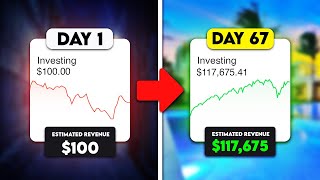

Turn $100 into Millions: The Blueprint
44sThe promise of turning a tiny $100 into millions is an irresistible hook for aspiring traders, making it highly shareable and clickable.
▶ Play Clip"The title promises a blueprint for growth, and the video delivers a solid, if somewhat generic, framework. It's not revolutionary, but it's not misleading either."
This video presents a blueprint for growing a small trading account, starting with as little as $100, into a substantial portfolio. The creator emphasizes risk management, the power of compounding, and the importance of finding and testing a statistical edge, concluding with the value of journaling trades for continuous improvement.
The creator stresses that risk management is the most important tactic for beginners, stating that without it, even a successful strategy will fail. Poor risk management is equated to gambling.
Successful traders often follow the 2% rule, risking only 2% of their trading balance per trade. This limits potential losses and allows for a longer trading lifespan.
A simulation with a 60% win rate and 500 trades shows that risking 20% per trade can lead to a 90.4% max drawdown, while risking 50% results in a 100% drawdown. In contrast, risking 2% limits the max drawdown to 15%.
Compounding is compared to a snowball rolling down a hill, where each small win adds to the base for future wins. A 1% weekly gain compounds to roughly a 67% annual gain, turning $1,000 into about $1,670.
The next step is to find a trading strategy with a statistical edge, whether from YouTube, books, or other sources. The key is to backtest the strategy yourself to verify its profitability.
The final step is to journal all trades, recording entries, exits, and outcomes. This helps identify patterns and insights, similar to how a fighter reviews tapes to improve. Tools like Trader View can assist with this.
The video concludes that growing a small account is not about hitting a home run but about consistent base hits, protecting capital, and continuously improving one's edge. Applying these rules will lead to account growth over time.
What is the 2% rule in trading?
Only risk 2% of your trading balance per trade.
01:50
What is the max drawdown when risking 20% per trade in the simulation?
90.4%
02:33
What is the max drawdown when risking 2% per trade in the simulation?
15%
03:17
What is the annual gain from a 1% weekly gain with compounding?
Roughly 67%
04:52
What is the final step in the blueprint for growing a small account?
Journaling all trades to identify patterns and improve.
07:06
The 2% Rule
This is a core, statistically-backed principle that directly addresses the risk of ruin, a key concept for traders.
01:50High Risk Leads to Catastrophic Drawdowns
The simulation clearly demonstrates how even a profitable strategy can be ruined by excessive risk, a crucial insight for beginners.
02:33Compounding is the Engine of Growth
The snowball analogy effectively explains how small, consistent gains can lead to exponential growth over time.
04:14Backtesting is Essential
The emphasis on verifying a strategy's edge through personal backtesting is a practical, actionable step that many beginners skip.
05:51Journaling for Continuous Improvement
The comparison to a fighter reviewing tapes highlights the value of self-analysis in refining a trading edge.
07:06[00:02] account and you want to grow this balance as quickly as humanly possible. So, you can have millions of dollars and sail your private yacht to pick up a fancy pizza in Italy. Now, I get it. Not everybody has hundreds of thousands of
[00:16] dollars to start out with. You may only have, dare I say it, $100. That's exactly why in this video, I'm going to show you my blueprint to grow a portfolio with only $100 in it and perform mathematically proven tactics to
[00:31] grow this balance to a thriving, successful portfolio with millions of dollars inside. To start us off, we're going to start with one of the most important tactics that helped me the most when I was a beginner trader, and
[00:44] that topic is risk management. Now, I know risk management is probably one of the most boring topics to talk about. boring. But I'm telling you right now, it doesn't matter how successful your trading strategy is. If you don't have
[00:57] good risk management, you will not grow your account. If your risk management is bad, honestly, you're better off going to the casino and putting all your money on red because you're basically gambling at that point.
[01:11] trading account as a lifeboat. Every dollar is a passenger you need to protect. and too many passengers and too many routes, your lifeboat, well, it's very likely it's going to sink. If you truly want to grow your account, you
[01:25] have to aim for longevity and consistent profits. The reason why trading with high risk is a problem is because of a little thing called consecutive losses. I don't care how good you think your trading strategy is, every trading
[01:37] strategy will have consecutive losses. If you have five or seven losses in a row and you're risking 20% per trade, your lipbo, well, let's just say your lipo is going to be at the bottom of the ocean very quickly. This is exactly why
[01:50] some of the most successful traders out there follow what's called the 2% rule. The 2% rule is simple. Only risk 2% of your trading balance per trade. Let me simulator. We're going to start with $100. Have a win probability of 60%.
[02:06] Have two wins for every losses. 500 trades and finally we'll risk 20% per trade. Now, this this is absolutely wild. Even though we have a successful trading strategy with a win rate of 60%, meaning we're winning more than we're
[02:20] losing, even though our current strategy is successful, our risk has the potential to absolutely ruin this strategy. For example, the key statistic we want to focus on is the max draw down. So, look at this. If we risk 20%
[02:33] of our capital on each trade, our biggest max draw down is 90.4%. Meaning there's a probable chance that if we continuously use this exact same setup, we would potentially end up losing close to 90% of our money we
[02:48] initially invested. Gone. Setup inflames. That money gone. Even though we have a successful strategy, could you handle a 90% loss? Probably not. And that's just 20% risk. Let's see what 50% looks like. Yeah, 100% draw down and the
[03:03] looks like. Yeah, 100% draw down and the average is 99%. That's no bueno. But take this exact same scenario and add 2% risk per trade. The biggest amount we could potentially lose is 15%. That's definitely better. Now, I get it. If you
[03:17] balance within a day, you're not going to get there while trading with 2% on a $100 portfolio. Hell, even 10%. You have to risk more to get higher returns like that. Now, I completely realize not everybody has the same risk tolerance.
[03:31] Some of you might be some crazy lunatics that have insanely high risk tolerances. Some of you might like to gamble. Some of you want to make millions of dollars with only a hundred bucks. So, I know what you're thinking. 2% is absolute
[03:43] garbage to me. Which I get that. But if you truly want to grow your account not only efficiently, but consistently, it has been statistically proven that using the 2% rule is the best way to do that. If you're using just 2%, you can handle
[03:57] a lot more consecutive losses compared to if you're using 20 or even 50%. So, if you like math, profits, and a lot of [ __ ] money, use the 2% rule. But just doesn't necessarily mean we're making that money.
[04:14] That brings me to my next step, the power of compounding. Now, in order to make money, we have to understand a key concept called compounding. Imagine you're rolling a small snowball at the top of a hill. At first, it's tiny, just
[04:26] like your $100 account balance. Boom, roasted. But as you keep rolling, that snowball picks up more snow with each turn. By the time it's halfway down the hill, it's [ __ ] massive. Each rotation adds more than the last because
[04:40] previous turns. That's compounding, baby. Every small win matters. It becomes part of the base for all future wins. Let's put this into perspective. Say you're making just a measly 1% gain
[04:52] on your account each and every week. Now, I know 1% it's a low number and probably isn't a lot of money for you, but over a year, thanks to compounding, that's roughly a 67% total gain. That means $1,000 could become about $1,670
[05:09] by the end of the year. And that's just with a measly 1% every week. If you got that number to 2% each week, your account would double within under a year. Yeah, you starting to see what I mean. Once your little snowball gets
[05:22] later down the hill, that could potentially be millions of dollars every year. It's not about hitting a home run. It's about hitting consistent base hits. riskmanagement tactic that you guys complained about? This is where it pays
[05:35] off. By avoiding big losses, you keep that snowball intact to roll another day and another day and another day. Protect your capital so it can compound. Guard life. Your main priority is to make sure that compounding engine continues to
[05:51] operate. One giant loss can stop our snowball completely. Don't let that happen. So, we got our risk management. We now know about compounding. Now's the fun part. Finding your edge. Now, there's a lot of ways to do this.
[06:03] YouTube videos, books, or your uncle Larry. Hey, I'm Larry. It's kind of up to you. I personally like the YouTube option just because, you know, I'm a visual guy, so I like to watch videos. Plus, that Larry guy is kind of weird.
[06:15] But I post strategy videos all the time and all of them have a statistical edge. So you can simply look through those to find a strategy or you can find another YouTuber strategy. Kind of rude, but moving on. It doesn't really matter how
[06:28] you find your edge. What matters is you actually test the edge yourself. Find a strategy, go to your charting platform, and actually back test that strategy. What's the win rate? How many wins? How many losses? How did it do? Is it
[06:41] actually profitable? These are all questions you yourself should know. And if you don't know, well, you got to test it. Now, I get it. Back testing, it's basically work. Nobody wants to sit down and put in the work to test a strategy.
[06:53] But remember that whole snowball thing? If you don't have a statistical proven edge, yeah, that snowball thing, it doesn't work. So, this is definitely the balance. If you want the millions of dollars, put in the work and start
[07:06] testing. So, now you should have a statistical edge or basically a back to do the final step in the blueprint, and that is to journal. Now, I'm not talking about dear diary, today I made my first trade type of journal. I'm
[07:20] identify the history of your trades, entries, exits, was it profitable? Did it fail? If so, why? All of these questions should be answered for each your time doing this? Take Conor
[07:34] you don't know, is a UFC fighter. One noticed his opponent moves his right hand slightly before throwing it. So he went to the gym, started practicing that exact same scenario where he slightly
[07:47] moves his hand and he counters. Then the big fight comes and within 9 seconds this happened. Conor relax and smiling. Oh Jesus. My point being if Connor never
[07:59] never known to do what he did. Same goes with trading. You can look back at your trades and say, "Oh, whenever I trade out of boredom at 2 p.m., I lose." Or, "My best trades happen when I follow trends instead of trying to pick
[08:12] bottoms. Those insights are priceless, and just like Connor, you only get them by reviewing the tapes. You don't need anything fancy. A simple spreadsheet or notebook works. I personally use a site called Trader View. It's basically a
[08:25] broker statement and Trader View gives a lot of useful metrics like each trade, if it was a win or loss, and overall how profitable you are. No, this is not an pretty cool. I'll leave a link to them in the description. So, this all makes
[08:40] me feel very sentimental. Making money in stocks really isn't about getting definitely get to that, but in the beginning, it's really about honing in on your edge, consistently improving set edge, and keeping that snowball rolling.
[08:53] And on top of all of that, keeping track of your progress. This mission isn't for the weak. There will be losses. There will be days where you question if you're even cut out for this. There will be nights where your balance is red and
[09:05] all you have left is the trust within your statistical edge. But I can promise you one thing. If you actually apply all of these rules to your trading, you will of these rules to your trading, you will grow your small account balance.
⚡ Saved you 0h 09m reading this? Transcribe any YouTube video for free — no signup needed.

![BEST MACD Trading Strategy [86% Win Rate]](https://img.youtube.com/vi/rf_EQvubKlk/mqdefault.jpg)