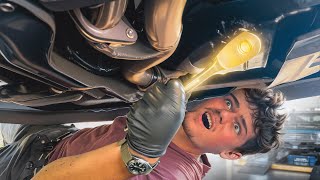

Save $900 by fixing your own car
43sHigh money-saving appeal that immediately grabs attention of DIY enthusiasts and budget-conscious viewers.
▶ Play Clip
[00:00] Do you want to learn how to fix cars but you're overwhelmed and don't know where to start? The good news because in this video I'm going to go over some general knowledge on how to fix cars, what tools are needed, and how to find cheap parts. The skill of fixing your own cars is valuable
[00:14] because you save a substantial amount of money instead of paying someone else to do it. As a general estimate, if a shop quoted you $1,000 to think something, you could do it yourself with $100 in parts and a half a day of work. Working on a car might seem intimidating at first,
[00:29] but don't let that stop you. Even as a beginner, you can handle most repairs with a bit of knowledge and the right guidance. I have been working on cars since I was 14 years old. I started off doing oil changes on my newly bought Mustang because I didn't want to pay a shop to do it. I,
[00:43] Lucky Seven, wasn't old enough to drive yet. So I started off with learning how to do my own car maintenance, things like replacing fluids and preventative maintenance, such as putting in a new starter and installing spark plugs. This was the best way to learn and how I recommend you start, with no previous
[00:58] experience, you could replace your alternator, but you're not ready for something like a transmission swap. Once you've done a few repairs, you'll gain confidence to move on to harder tasks. With enough time, you can repair anything, but there's certain things that aren't usually worth
[01:11] doing because of the expensive tools they require, or the skills they take, such as replacing tires. Mechanics use expensive tools and they only charge like $30 per tire, or painting as it takes special equipment and a lot of knowledge and skill to get a good result. First, you need to understand how
[01:27] to fix cosmetic and mechanical issues. When tackling mechanical issues, begin by focusing on the issues you notice. Is the check engine light on? Well, if it's on, you must figure out what it means. Begin by plugging in an OBD2 scanner under the steering wheel. This will provide you with an engine code.
[01:42] If you don't have a scanner, consider buying one or visiting your local auto part store, where they will scan your car for you and give you the code, such as P0301, cylinder one, misfire detected. For more information, search up the code with your vehicle's make and model. Click on a few links
[01:57] and read about the specific code. You can usually narrow down the code to a few different parts, which replacing one of them would fix the problem. Normally, there's a clear first thing to try to fix your issue. If it isn't fixed by doing that, you go down the list and replace each part that's
[02:11] potentially the issue until it's fixed. There are three ways to avoid replacing the wrong part and having to try something different. Starting off with just reading online threads, there are great place to look for help with fixing car problems. Search up your issue or code and write threads or
[02:26] read it at the end. This will guide you on what needs to be done. Another option is to pay a shop or mobile mechanic to diagnose the issue and tell you what to replace. Instead of guessing and hoping that replacing a part will fix your problem, properly diagnosing the issue is crucial. For example,
[02:40] if there's a misfire, you should test the components like the park plugs, ignition coils, and wiring before replacing anything. With a proper diagnosis, you will usually end up with what needs to be replaced. To diagnose correctly, remember the five key systems. Fuel, air, spark, compression, and electrical.
[02:57] If your car isn't starting, begin by checking for power. Next, verify that it gets gas and listen for the fuel pump. Then check for air, spark, and compression. If any of these are missing, inspect the related component to make sure it's working properly. Hey, do you know this dance?
[03:13] It's still like the video dance. You still haven't liked it? Alright, thank you. So what if the car doesn't have an engine light on, but you notice something unusual like a noise or its poor driving performance? Start by identifying the source of the issue.
[03:27] Typically, noises come from the engine bay or around the wheels. If the sound is coming from the engine bay, it's likely a mechanical issue. Pay attention to the type of noise and pinpoint its exact location. If the noise is coming from around the wheels, it's usually related to brakes or suspension.
[03:41] You could jack up the car, move the wheels, and inspect the area while listening for unusual sounds. A squeaking noise usually comes from the brakes, a belt, or a worn out part. Taking noises can have various causes. They might be as simple as replacing your oil or as
[03:55] serious as having to replace your engine. Grinding noises often indicate issues with brakes, transmission, or bearings. While a hissing sound usually signals the leak. Certain car models typically have common issues. So if you can't pinpoint the root cause of your
[04:09] problem, by researching it specific to your car model, fluid leaks are quite common. Start by cleaning the area and tracking where the leak is coming from. If you can't identify the source, you can often use colored dyes to locate a leak in a system. Normally, leaks require replacing a
[04:22] gasket, seal, hose, or lines. Here's a list of common components that cause issues. Park plugs, the initial coils, fuel pumps, joints, bearings, brakes, hoses, gaskets, belts, alternators, starter, suspension, and batteries. Once you've identified the cause
[04:35] of your issue, it's time to fix it. You can learn to do this through detailed write-ups or YouTube videos. Cosmetic issues are generally easier to address than mechanical ones. Let's say there's an interior piece broken, or there's a dent in your fender. You could just
[04:47] replace it with a new one, which is almost always easy and straightforward. Now, here's a list of common cosmetic flaws. These color trim rips, seats, things faded, that lights damage paint, carbrush, cracked windshield, and missing or worn out parts. You now know how to fix any worn out
[04:59] problems on your car, but you need the right tools to do the repairs. Many people hesitate at this point, thinking they need to spend thousands of dollars on tools. But that's just not the case. To start, you only need a basic mechanics tool set, a torque wrench, and either ramps or jacks. If you
[05:14] discover you need a specific tool that you don't already have, and it's not too expensive, buy it if you plan to use it often. However, avoid over investing in tools you don't really need. For expensive or specialized tools, you can usually borrow them from a local auto parts store. So you have the right
[05:28] tools, but where do you find parts? And how do you get them at a good price? When it comes to sourcing parts, you have two options, OEM parts and aftermarket parts. OEM parts are the parts that were installed on the car when it was new. They're reliable and generally the best, but they tend to be more
[05:42] expensive. For critical components like starters, spark plugs, ignition coils, and electronics, OEM parts are usually the best option. Aftermarket parts are produced by third parties. While they are often more affordable, they may not end up lasting as long. They're generally acceptable for components like
[05:58] batteries, brake pads, hoses, and fluids. By considering each repair, you can make a decision about which parts you want to use, balancing the cost and the quality. In many cases, a refurbished OEM
[06:10] part is better than a new aftermarket part. Now let's talk about how to find affordable parts. It's a pretty simple process, but requires some searching around. You can either look up the OEM part number and choose the least expensive option, or search for the part name of your car's model
[06:23] and pick an aftermarket option, like the most cost-effective choice with good reviews. It's important to check reviews when buying aftermarket parts, as they will help you determine whether the part is reliable, or if it's worth spending a little extra on an OEM part. There's many sites that sell
[06:37] car parts, but you'll find about five of them offer the best options. Some popular sites with good options include carparts.com, Amazon, eBay, LKQ, and Rock Auto. Most parts come with a warranty and can
[06:50] be returned, so make sure to return the part if it doesn't fix the issue. Always check the total price after shipping and fees. Sometimes a part that's more expensive, but as free shipping, it's cheaper than a lower priced part with shipping costs. Another way to find cheap parts is
[07:04] to get them used from junk yards or using platforms like Facebook Marketplace to search for part-outs. Keep in mind that some parts can be repaired rather than replaced. Consider the time and effort required for a part repair, versus the cost of a new part. Here's a fuel pump I repaired with $5
[07:19] worth of parts, and an hour of work saving $300 by not buying a new one. Auto part stores usually charge more than online, but if you need parts quickly, it's usually worth paying a little bit extra to get it that day. You're now ready to start fixing problems with the tools you need and knowing
[07:33] how to find affordable parts, but you should learn the secrets of saving money on a car. So click this video to discover how, as always, I'm wishing you a lucky day.
⚡ Saved you 0h 07m reading this? Transcribe any YouTube video for free — no signup needed.