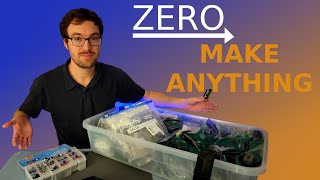

Starter Kits Are Not Toys
45sChallenges the common perception of starter kits, sparking curiosity and a desire to learn real engineering.
▶ Play Clip"The title promises a mindset shift to think like an engineer, and the video delivers exactly that with a clear ladder and practical advice."
This video explains the mindset shift needed to turn a $20 starter kit into a real engineering experience. The host, James, argues that following tutorials without understanding the underlying principles is just copying, not learning. He presents a five-rung engineering ladder to guide beginners from following tutorials to building custom systems.
Most people treat starter kits as toys, following tutorials without truly learning how to build systems. They copy recipes instead of understanding electronics.
Think of components as inputs (buttons, sensors) and outputs (LEDs, screens) that need to be chained together. This transforms the kit into a laboratory.
A five-rung ladder: tutorials (blinky stage), integration (combining components), modules (using pre-built modules), components (using raw parts from catalogs), and debugging (fixing issues independently).
Modules are convenient but expensive. For example, an infrared transmitter module costs $1-2 but the raw parts cost only 5-10 cents. Using raw components from catalogs like Mouser or Digikey is more cost-effective and customizable.
At the highest level, you expect things to break and know how to fix them. You stop copying and start building and solving problems independently.
To become a true engineer, you must shift from following tutorials to building systems, integrating components, and learning to debug. The engineering ladder provides a path from beginner to independent builder.
What is the main problem with following starter kit tutorials?
You are copying recipes, not learning electronics. You don't understand why things work.
00:31
What are the two main categories of components in a system?
Inputs (buttons, sensors) and outputs (LEDs, screens).
01:10
What is the first rung of the engineering ladder?
Tutorials (blinky stage) - following instructions to get results.
02:23
Why are modules more expensive than raw components?
Modules cost more because they include packaging and connectors; raw parts are cheaper per piece.
03:20
What is the 'superpower' at the top of the engineering ladder?
Debugging - expecting things to break and knowing how to fix them.
05:19
Kit as a Laboratory
The host reframes the starter kit as a 'freaking laboratory', empowering the viewer to experiment.
01:54Electron Jazz
The analogy of combining components to create 'electron jazz' is a memorable and creative way to describe integration.
03:20You're Dangerous
The host declares that reaching the top of the ladder makes you 'dangerous' because you can build anything independently.
05:50[00:00] Most people treat starter kits like toys, then they don't know how to start their first real project because they never learned how to build systems. In this video, I'm going to show you the mindset shift that you need to turn a $20 starter kit into a real engineering experience.
[00:17] This is how the pros do it, and if you start now, so can you. Hello and welcome to Fluxbench. My name's James and I'm a nerd and I hope you're a nerd too. Okay, so here's the problem. You get your kit, you follow the tutorial,
[00:31] you plug in your light and wire it up exactly like they tell you to, you run the code that they give you, and it blinks. Wonderful. And then you go on to the next lesson and another part. But what did you actually learn by doing that?
[00:43] Like, if I took away those instructions, do you think you could honestly use that part in something else? You're not learning electronics. You're following recipes, and that's copying. And it's fine to get started,
[00:55] but you're not going to get far past blinking lights doing that. What matters is connecting all these ideas together. Why does the LED actually work? What else could the LED respond to? What else could you swap in instead of using an LED?
[01:10] Here's how I look at it. Those lessons are giving you one tool at a time where you have things like buttons and sensors and those are just inputs. And then you have your microcontroller in the middle and then you have LEDs and screens and stuff like that that are outputs. And what you need to do is
[01:28] chain the inputs to the outputs somehow. You need to build a system that links them all together. And that where the real engineering is If you begin thinking like this then that starter kit of yours it no longer a toy It a freaking laboratory Do whatever the heck you want with it It your R laboratory You have all the tools all the sensors the buttons whatever you need to make what you want
[01:54] It should be in there. So now we get to the fun cheesy part of it's not what you know, it's how you think about it. It's the real difference between a beginner and a builder. A beginner looks at a starter kit as a bunch of individual demos that are separate.
[02:09] And a builder looks at them as a bunch of individual tools that they're going to go and link together in a system, and they're just learning one at a time. And so you've got to have that mindset shift of, it's not demos, it's systems.
[02:23] I want to show you the engineering ladder of mine. It's got five rungs on it, and in the beginning, you start out with tutorials, and in the end, you're able to build whatever the heck you want. This is the blinky stage where you follow tutorials, you plug in sensors, you just get results.
[02:37] but it's not the destination. Think of this as just learning individual words of a vocabulary. The magic really begins once you start to integrate these separate things. Once you start to combine
[02:50] a button with an LED or some sort of sensor with like a speaker, all of a sudden you're taking these individual tools and combining them into a system. It's like if you took these individual vocabulary
[03:05] words started putting them together and they're starting to make like a fluid sentence. Now, you're really starting to speak like a real engineer. Music isn't just one note, it's a arrangement of many. And it's the same thing with electronics, and when you start to combine
[03:20] and integrate them this is where that real electron jazz begins I love modules they a great way to get started in electronics You can just go and buy a kit of them for real cheap and they just work But the problem is once you need a lot of them
[03:34] This here is a infrared transmitter. It's probably a dollar or two dollars a piece, but the problem is it's probably five or ten cents a piece for the actual parts. And then this thing here is a
[03:48] photoelectric light measuring module, but all these parts here are probably one penny a piece. They're just resistors, to be honest. And this bag of buttons, if you buy a button module, oh my
[04:00] goodness, well, you might need it, but it's just like a penny or two per button. So all these are great, but those $5 modules are probably just like 75 cents in parts. If you use enough of them,
[04:15] it's kind of like trying to water a tree with bottled water. You can definitely do it. It's just a really expensive way to go about doing it. Flip your board, read the chip, look up the part, own your circuit. So the real playground isn't in your 37-in-1 sensor kit or your modules.
[04:33] It's in the catalog. Check this out. A whole box or bag full of different microcontrollers. So you can take your esp32 and i can basically swap out any size of memory i want so i can get a three
[04:47] dollar micro microcontroller or a five dollar microcontroller depending on how much money i want to put into it i can add all sorts of sensors i can customize it however i want and that's what you get when you start working with the catalog compared to modules start browsing
[05:03] distributors like Mauser Digikey LCSC and you don just search you really try to discover You sometimes find the part that just does exactly what you need and other times you find a part so cool you end up changing your whole project around it
[05:19] The real superpower is debugging, fixing, and just not panicking while you do it. Because by now, you don't expect things to work on the first try, and when something else breaks, you're used to it,
[05:34] and you just start hunting it down because you're ready for it and you know where to look. At this point, you're not copying anymore. You're building. You're solving. And if you actually manage to get here, you're dangerous.
[05:50] Most people don't get past level one. But the thing is, if you're feeling the itch to do something real, then this is your ladder. Climb it. I'm serious. By the time you get to the top, you will be dangerous
[06:03] because you're not going to need anyone else's help. Whatever the thing is that you want to do, you're going to know how to do it. You got to learn, integrate, replace, explore, and most of all, you got to persevere.
[06:17] If you don't know where to begin, then my previous video talks about how to actually get electronics, what to buy, where, how much, just get a starter kit, any of them will do. And in the next video,
[06:29] we're going to start doing something crazy. I'm going to start a series where we're actually going to take some of these first few lessons of any of these starter kits, and we're going to go all the way from idea all the way to income making a real product.
[06:42] This is something that you guys can do as well, so follow along. It's going to get crazy. But for now, whatever it is, go out there, make something awesome. You got this.
⚡ Saved you 0h 06m reading this? Transcribe any YouTube video for free — no signup needed.