
I Got Banned from Sportsbooks for This
46sThe hook of getting banned from multiple sportsbooks is intriguing and taps into the audience's curiosity about forbidden strategies.
▶ Play Clip"Delivers a solid, math-based strategy with a clear three-step process, though the tool promotion and repetitive examples add some padding."
This video presents a three-step mathematical strategy for identifying profitable bets on Kalshi, a betting exchange, by converting prices to American odds, comparing them to sharp books, and de-vigging to find true edges. The creator emphasizes that Kalshi's exchange model allows profitable bettors to operate without restrictions, unlike traditional sportsbooks.
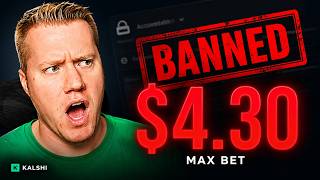
The creator claims to have been banned or limited on multiple sportsbooks (Hard Rock, PrizePicks, Dabble) due to consistent profitability, setting up the need for an alternative platform.
Kalshi is an exchange that profits from the spread between buyers and sellers, not on bet outcomes, so it has no incentive to limit profitable users.
Most users see Kalshi prices in cents (e.g., 58 cents) and don't understand the implied probability, leading to poor decisions.
For favorites (above 50 cents): (cent price / (1 - cent price)) * 100 with a negative sign. For underdogs (below 50 cents): ((1 - cent price) / cent price) * 100 with a plus sign. Example: 58 cents = -138, 16 cents = +525.
Compare converted odds to sharp books like Pinnacle, Circa, and No Vig (not DraftKings or FanDuel) to identify meaningful price differences.
Strip the built-in margin (vig) from sharp book lines to find the true no-vig implied probability, then compare to Kalshi's implied price to confirm a real edge.
Consistently finding gaps where Kalshi prices outcomes below sharp market value leads to compounding profits over a large sample, not winning every bet.
The Game Line Optimizer at upside.tools automates all three steps: converts Kalshi prices, pulls sharp book lines, de-vigs, and flags +EV plays (e.g., Rockies run line at 14 cents = +574, with a 15.5% market chance vs 14.84% implied).
Kalshi cannot limit profitable bettors because it's an exchange; the edge is another user's position, and Kalshi collects fees regardless.
The strategy involves converting Kalshi's cent prices to American odds, comparing to sharp books, and de-vigging to find true edges. Using an automated tool like the Game Line Optimizer simplifies the process, and Kalshi's exchange model allows for unlimited profitable betting.
What is the formula to convert a Kalshi cent price above 50 cents to American odds?
(cent price / (1 - cent price)) * 100, with a negative sign.
02:30
What is the American odds equivalent of a 16-cent Kalshi line?
+525
03:14
Which books are considered sharp and used for comparison?
Pinnacle, Circa, and No Vig.
04:26
What is de-vigging?
Removing the built-in margin (vig) from sharp book lines to find the true no-vig implied probability.
05:52
Why can Kalshi not limit profitable bettors?
Because Kalshi is an exchange that profits from the spread between buyers and sellers, not on bet outcomes.
00:18
What is the implied probability of a +574 American odds line?
14.84%
09:31
Kalshi's exchange model
Explains why Kalshi allows profitable bettors to continue, unlike traditional sportsbooks.
00:18Conversion formula
Provides a concrete, actionable formula for translating cents to American odds.
02:15De-vigging importance
Highlights a critical step often overlooked that ensures the edge is real, not a math artifact.
05:21Math over prediction
Clarifies that professional betting is about finding market disagreements, not predicting outcomes better.
06:49[00:02] that it has gotten me banned or severely limited across multiple sports books. We're talking $4.30 maximum on Hard Rock, $5 a slip on PrizePicks, completely banned on the DFS app called Dabble. This strategy is a
[00:18] three-step process for identifying consistent profitable bets on Kalshi. And what makes this work with so much upside is that Kalshi is an exchange, not a sports book. They make money on the spread between buyers and sellers,
[00:34] not on whether you win or lose. So, they have zero incentive to limit you, zero incentive to ban you, and zero ability to kick you off for being profitable. The same exact process that got me removed from every platform I just
[00:50] mentioned runs completely unrestricted on Kalshi. There are three steps. The third one is a step almost nobody knows how to do. And it's the one that gets the math to actually work. I'll get to it. But you need steps one and two first
[01:06] or the third one won't click. If you've been on Kalshi and feel like you're just guessing, this is the fix. This is the exact process. Let's dive into it. So, here's the problem most people have when they open up Kalshi. They see a game
[01:20] line bet listed at 58 cents and they don't know what that actually means. And sports book where you're used to reading everything in American odds. That same person just kind of eyeballs it and
[01:33] decides it feels right. That's the first thing that has to change. Kalshi prices games in what's called cents. A team at 58 cents to win means if you bet a 58 cents to win means if you bet a dollar, you get back $1.58. But sharps
[01:47] like myself don't think in cents. Sportsbooks don't post lines in cents. The entire sharp betting world runs on American odds and implied probability. So, if you're on Kambi looking at cents
[02:01] and trying to compare to what the sharp market thinks, you're essentially comparing two different languages and you don't have a translator. Step one is the translator. You convert Kambi's cent price to American odds. Here is exactly
[02:15] how to do it. Take the cent price and ask yourself, is this above 50 cents or ask yourself, is this above 50 cents or below 50 cents? Above 50 means you're looking at a favorite. Below 50 means you're looking at an underdog. The
[02:30] formula is slightly different for each. For a favorite, anything above 50 cents, you take the cent price divided by one minus the cent price, then multiply by minus the cent price, then multiply by 100 and add a negative sign. So, a team
[02:45] 100 and add a negative sign. So, a team at 58 cents, .58 divided by .42 = 1.38. Multiply by 100, add a negative sign, and that's minus 138. That should look a
[02:58] lot more familiar. That is the American odds equivalent of 58 cents on Kambi. For an underdog, anything below 50 cents, you flip it. You take one minus the cent price, divide by the cent price, then multiply by 100 and add a
[03:14] price, then multiply by 100 and add a plus sign. So, a team at 16 cents on plus sign. So, a team at 16 cents on Kambi, one minus .16 is .84. Divide .84 by .1 6, that's 5.25. Multiply by 100, that's plus 525. A
[03:31] Multiply by 100, that's plus 525. A 16-cent Kambi line is plus 525 in American odds. That's the full conversion. It takes you about 10 seconds once you've done it a few times. And the reason it matters is now you're
[03:45] speaking the same language as every other sharp book in the world. Without this step, every comparison you try to make going forward is meaningless. And you're going to need to compare. Most people skip this entirely because they
[03:59] don't know how to do it. They stay in cents, they stay confused, and they have no way of knowing if Calshi is giving them a good price or terrible one. This conversion is the foundation everything else builds on it. And that's where step
[04:12] two comes in. Step two is taking that converted American odds number and comparing it to what the sharp books have the same game price that. And I want to be specific here. Not DraftKings, not FanDuel. Those books
[04:26] shade their lines toward recreational bettors, not sharp ones necessarily. The books I'm most concerned about when taking a look at game lines are Pinnacle, Circa, and other exchanges like No Vig. Those are the books where
[04:39] real sharp money flows. When Pinnacle, Circa, and No Vig agree on a line, that is the closest true thing to a true market price for a sporting event that
[04:51] exists anywhere. So, you take Calshi's converted American odds and you go check what Pinnacle, Circa, and No Vig have at the exact same game. If Calshi's number is meaningfully different than what the sharp books are showing, that gap is a
[05:06] signal. You're potentially getting a better price on Calshi than what the sharp market is offering. But, that comparison alone is still not enough to confirm a real edge because there's certainly one more layer, and this is
[05:21] the step that nobody takes. The problem with comparing raw lines at Pinnacle, Circa, and No Vig is they all build in the margin to every single number they post. It's called the Vig. The lines on both sides of a game don't add up to a
[05:36] true 100% probability split. There's juice baked into both sides. So, if you compare Calshi's converted price directly to a Vig'd sharp book line, your read on the true gap is slightly off. And in this game, slightly off
[05:52] compounds against you over time. So, step three is stripping that vig out of Pinnacle, Circa, and No Vig before making the final comparison. And this step is called de-vigging. You take the lines on both sides of the same game
[06:07] from the sharp books, remove the built-in margin, and find the true no vig implied probability. That is also called a fair price. What the sharp market actually thinks this outcome is worth before anyone takes their cut.
[06:23] Now, you compare that fair probability directly to Calshi's implied price. Any gap that you find after that step is a real edge, not a math artifact from the
[06:35] real edge, not a math artifact from the juice. The actual mathematical edge. And here is the part most people never fully grasp. You certainly will not win every bet doing this. Sharps understand that probability does not work that way. What
[06:49] you will do is get the math right on every single bet you place. If you are consistently finding spots where Calshi is pricing an outcome several percentage points below what Pinnacle, Circa, and No Vig say it's actually worth, over a
[07:04] large sample that gap compounds in your favor. And that is the entire model. That is how professional sports bettors make money. Not by predicting outcomes better than the market. By finding spots where different markets disagree on the
[07:20] same outcome and betting into these gaps at volume. And it is exactly why I got limited to $4.30 on Hard Rock and completely banned on Dabble and limited on multiple other DFS apps. When you are consistently getting
[07:35] the math right on platforms built for recreational players, they know this. And their only move because they're a corporation is to cut you off. See, Kalshi can't do that. It is a betting exchange. You are not betting against
[07:49] the house. You are betting against other users in an open market. Kalshi makes their money on spread between buyers and sellers regardless of who wins. They have no reason to limit you and no mechanism to punish you for being
[08:03] profitable. The same three-step process that got my accounts restricted everywhere else, I run it on Kalshi with no ceiling. Now, here is what I want to show you because this is where everything I just explained becomes real
[08:17] in about 30 seconds. This is the Game Line Optimizer at upside.tools. And I'm going to walk you through why this tool is useful and all three steps happening automatically on a live game right now. Let's take this example with the
[08:32] Rockies tonight. We're looking at a Rockies run line at minus two and a half. Step one, the conversion. On Kalshi, this line is priced at 14 cents. Most people see that and have no idea what that means. The optimizer converts
[08:48] it automatically. That 14-cent Kalshi price translates to a plus 574 in American odds. Now, it's a number that we can actually compare to the rest of the market. Step two, the book comparison. Right next to the Kalshi
[09:02] price, the optimizer pulls in live lines from every single sports book in the market automatically. In this example, we're comparing three different sports books. One, No Vig. Two, Profit X. And the last one's going to be Fanatics.
[09:16] Because No Vig and Profit X are exchanges, they are considered sharper. exact same game line, we're looking at No Vig with plus 456, Profit X with plus No Vig with plus 456, Profit X with plus 495, and Fanatics with plus 500. After
[09:31] de-vigging automatically their lines, the optimizer is flagging this as having a 15.5% chance to hit according to the market. But, the implied probability for the Kelce odds of plus 574 = 14.84%.
[09:48] That means they're pricing this exact same game line as less favorable than what the market actually says it is and giving us a more favorable price tag. The best part is the optimizer calculates this within seconds. No
[10:01] guessing, you just simply look at the plus EV column and if it's green, that simply means it's profitable. And here's another one. Same process, different game, just to show you how fast this works in practice. The Chicago White Sox
[10:16] versus the Detroit Tigers, over 12 and 1/2 total runs. Kelce has the over priced at plus 373. The optimizer converts it, pulls all the sharp book American odds, and then strips the vig from both sides, calculates the true
[10:31] fair probability, and the gap comes out to plus 2.3%. According to the market, this has a 21.6% chance to hit. However, on Kelce, we have a more favorable on Kelce, we have a more favorable price. That's it. That's the play. That
[10:46] price automatically converted, automatically de-vigged, gap calculated, probability displayed. You don't need to touch a calculator, you don't need to have four tabs open. The optimizer does every single step and shows you exactly
[10:59] which plays have a profitable edge right now. All sorted by the top plays live on one screen. And that's what I'm looking at for every single bet. And this is the exact process that got me banned or limited on every single sports book that
[11:15] I play at. And just to bring this full circle, when you are consistently finding gaps like these and betting them on a sports book, the sports book loses money on you. So, they have no choice because they're a corporation and their
[11:28] job is to make money but to limit you. That is a sports book telling you that your process is working. However, on Kalshi, Kalshi has no equivalent move. It is an exchange. Your edge is someone else's position in the market. Kalshi's
[11:44] fine either way. They collect their fee. And that structural difference is why this strategy has a longer runway here than anywhere else I have ever used it on. If you want to sign up for the optimizer at upside.tools, the link is
[11:58] first time signing up, you get access to a 5-day free trial. So, you can pull up the real game, see the sharp Novig probability sitting right next to it live, and find gaps like these before they close. Step one, step two, step
[12:13] three, all done for you automatically for free for 5 days. If you have any questions on any part of the process, drop them in the comments. I personally read every single one. And if you want more Kalshi strategy, subscribe. There's
[12:27] a lot more coming. I'll go ahead and link another Kalshi strategy video here link another Kalshi strategy video here next.
⚡ Saved you 0h 12m reading this? Transcribe any YouTube video for free — no signup needed.