
Sourdough: The 5,000-Year-Old Trend
45sChallenges modern food trends by revealing sourdough's ancient origins, sparking curiosity and debate.
▶ Play Clip"The video delivers exactly what the title promises: a comprehensive masterclass on making sourdough bread from starter to finish."
This video is a comprehensive masterclass on making sourdough bread from scratch. It covers creating a sourdough starter from flour and water, maintaining it, and using it to bake two loaves of bread. The instructor emphasizes the simplicity of the process and provides tips for home bakers.
Sourdough is trendy since 2000 BC and is the oldest form of American bread. The future of bread is about going back to the past with naturally fermented sourdough.
The starter is a simple mix of 50g flour and 50ml water. Let it sit out covered at ambient temperature for 12 hours.
Wild yeast is everywhere in the air. The starter picks up bacteria that ferments and lives off the protein in the flour. It takes about 7-10 days to become active.
Once you make a starter, as long as you don't use it all, you'll never run out. You only have to do this one time in your life.
After 12 hours, add another 50g flour and 50ml water. Repeat daily. By day 4, bubbles appear showing active fermentation.
A sweet vinegary smell is normal. If liquid appears on top (hooch), just stir it back in.
Starter might not be ready by day 6 or 7; give it an extra day if needed. Environment affects speed.
The instructor has kept a starter for 9 years. To maintain, after using some, feed equal weight flour and water. For home bakers who bake weekly, keep starter in the fridge and feed it once a week.
If you don't want to make your own starter, local bakeries may give you some. Check realbreadirelands.org for real bread bakeries in Ireland.
Ingredients: 800g strong flour, 460ml water, 10g salt, 320g sourdough starter. Mix together and knead.
Knead for 8-10 minutes using the heel of your hand. Avoid adding too much flour. Use a dough scraper if available. The windowpane test indicates readiness.
Let dough proof for about 3 hours (slower than yeast bread). After proofing, knock back the dough by shaping it into a ball.
Divide dough into two portions. Shape each into a round using a proving basket or a bowl lined with a floured tea towel. Let proof for another 3-3.5 hours, or refrigerate overnight.
Preheat oven to at least 230°C. Score the bread with a razor blade to control rise. Create steam by adding hot water to a preheated tray.
A Pyrex dish with a lid creates a self-steaming environment, perfect for home ovens without steam injection.
Bake at high temperature (230°C minimum) for a good crust. Steam helps the bread rise and creates a crispy crust.
Making sourdough bread is a rewarding process that connects us to ancient baking traditions. With a simple starter and patience, anyone can produce beautiful, flavorful loaves at home.
What is the ratio of flour to water for feeding a sourdough starter?
Equal weight: same weight of flour and water (e.g., 50g flour to 50ml water).
00:53
How long does it take to make a sourdough starter from scratch?
About 7 to 10 days.
01:21
What is the windowpane test in bread making?
Stretching a piece of dough thin enough to see light through without tearing, indicating enough gluten development.
07:24
How can you store a sourdough starter if you only bake once a week?
Keep it in the fridge. Take it out the night before, feed it, and let it come to room temperature.
03:48
What is the purpose of scoring the bread before baking?
To control how the bread expands and give the dough a place to rise, preventing random cracks.
14:47
Why is steam important during the first 8-10 minutes of baking sourdough?
It keeps the crust from forming too early, allowing the dough to continue rising and creating a better crust.
13:41
What temperature should the oven be set to for baking sourdough bread?
At least 230°C (450°F).
15:01
Sourdough's Ancient Heritage
Highlights that sourdough is not a trendy novelty but dates back to 2000 BC, grounding the technique in tradition.
00:13One-Time Starter Investment
Emphasizes that making a starter is a once-in-a-lifetime effort; it can be maintained indefinitely.
01:35Windowpane Test
A practical technique to determine dough readiness without relying on exact kneading time.
07:24Home Steaming with Pyrex Dish
Provides a clever, accessible alternative to professional steam injection for home bakers.
13:53High Temperature Baking
Emphasizes the necessity of high heat for proper crust development, countering common low-temperature habits.
15:01[00:00] So what we're going to do now is we're going to show you how to make some sourdough bread. Sourdough is not quite fashionable, it's quite trendy, it's on a lot of restaurant menus.
[00:13] Sourdough is trendy since about 2000 BC. The oldest form of American bread. So why we all think that we have a big tradition with soda bread, or your granny might have made it, this is what her granny used to make it. This is what we're all trying to get back to.
[00:27] So the big revolution, the big future of food, the future of bread is about going back, about going back to the past. And this is what we're trying to get back to. Beautiful, beautiful sourdough, naturally fermented, we've got a seeded sourdough, we've got a
[00:39] rye, we've got a malt out, as I say we need a hundred different types. What we need in order to force a mix in sourdough bread is to make our sourdough starter, our sourdough culture. The process is very, very simple. It's simply just a mix of flour and water.
[00:53] So we need about 50 grams of flour and to that we're adding 50 ml of water. We stir it together and that is simply there. So now what we're going to do is you need that cup to sit out in your kitchen,
[01:07] just gently covered, ambient temperature overnight for about 12 hours. So at the moment we're surrounded by wild yeast. It's a good strain of bacteria, it exists everywhere, you breathe it in every day and then basically over a process of using simply just flour and just water
[01:21] it eventually picks up that bacteria in the air and that bacteria starts to ferment, it starts to live off the protein in the flour. It starts to rise and collapse. Realistically it takes about 7 or 10 days to make it. But for a lot of people I know, I say I'm not making it over, but it'll take 7 or 10 days to make it.
[01:35] But the idea is once you get up and go in once, that's virtually about it. As long as you don't use it all, you'll never run out. So realistically you only have to do this one time in your life. So we mix it together, flour and water.
[01:47] And then 12 hours later it looks a little bit like this. So at this stage we will be due to mix this another 50 grams of fire and another 50 ml of water. Stir it together and that's it.
[01:59] Again we let it stir overnight. Day 3 we repeat the process. And then on day 4 you can already see it's starting to come lovely and bubbly. You can see all these little bubbles. They're coming lovely and active.
[02:11] And this is the final life starting to form. exactly what we're looking for. Satin to ferment. It's all the good things in life. Wine, beer, cheese, bread, all based on the same principle.
[02:25] So you will find a satin on it and a kind of sweet kind of vinegary smell, but don't worry, that's exactly what we're looking for. And if you find a little bit of liquid satin coming from it, don't worry about that either, just pour the drink back in. So we're going to give this another day and I'm going to feed it again, one more time.
[02:40] And when my timer is ready, I'm possibly on about day seven, but don't worry if you find that maybe I'm quite day six or day seven, it's not exactly day yet, don't be afraid
[02:52] to give it an extra day because it will differ depending on the environment in which it's kept in. So if I need an extra day, just give it an extra day. Now we've got our lovely pasta sourdough. It's got that lovely vinegary smell.
[03:04] You can see it's been rising up the glass. but it started about here earlier on and now it's climbed up here so it'll continue to rise and then it will drop back down. So at this stage it's basically ready to go.
[03:19] Well, if I'm completely honest, this is day two, this is day four and this is year nine. I've had this for nine years. As long as I don't use it all, I'll never run out. So all I'll simply do, for example, after we make our bed today, I'll have 200 grams left over.
[03:36] simply stir in 200 flour, 200 water and tomorrow it's ready to go again. Because I keep mine at room temperature I have to feed mine every day. But for the home baker who might only bake maybe once a week or on weekends a bit more
[03:48] time it can become quite an expensive pet to keep. It keeps eating this thing every day. So what you can simply do is just keep yours in the fridge. Because it based on bacteria cold won kill it it just slow it down So for example you going to bake it on a Saturday morning take it out of the fridge on a Friday just leave it sit in the kitchen to take the chill off it That evening whatever weight you have
[04:07] for example 200 grams, stir in 200 flours, 200 water, leave it sit in the kitchen, next morning it'll be lovely and bubbly, lovely and active, ready to make your bread. Take what you need to make your bread, whatever's left over, back in the fridge,
[04:20] and that's it. So it's a little once a week cycle. And you'll find it kind of gets better when it eats, the flavor starts to develop. So even if you're not baking, you still have to feed it, because technically it is alive. So if you're building up too much, just bend some of the weights.
[04:34] Keep back enough to keep it going. And the easiest way to work off is whatever weight you have here, same weight of flour, same weight of water. Could not be simpler. Now, in order to make our sourdough bread, we've got our sourdough starter.
[04:49] As I say, it takes about a week. Get it going today, you'll be ready by now. Next weekend, ready to go, perfect, and make your bread. If not, you can always check out your local baker. Most real bread bakeries will happily give you some starter.
[05:03] You can check out realbreadirelands.org. It's got all the real bread bakeries across Ireland. And most of them, like myself, are quite happy to give you a little bit of starter. You can't get your own going. So with this one, we're going to make enough for two loaves.
[05:15] The great thing about this is that you can bake two loaves. You can pop one in the freezer and you have one to dry fresh in the den so the sourdough can be back to the right from the freezer. So we've got 800 grams of strong flour. So into this we're going to add 460 mils or 460 grams of water.
[05:33] We're taking about 10 grams of salt. Salt is an essential ingredient. Salt acts as a natural flavor enhancer. We've got our flour, we've got our water, we've got our salt and finally we just need
[05:46] a little bit of our sourdough starter. So we're using 320 grams. Just make sure you don't use it all. If you want any other recipe, just add your yeast straight in. In this case, our sourdough starter.
[05:59] Once your ingredients are all in, just start bringing everything together. Once the dough roughly comes together, just dump it straight out of the table.
[06:12] The gluten forms once you add a liquid, but the moment you do it, it's quite weak. You want to build up the strength of our dough by what we call kneading. The idea of kneading is you simply stretch and work the dough.
[06:26] So you will find that your dough is a little bit wet, a little bit sticky. Generally, everyone's reaction at home is to immediately reach for some flour and keep adding in there. If you keep adding flour, the dough will quite happily soak it up.
[06:38] And then the more it soaks it up, the heavier the dough becomes, the tighter your bread will be. So when it comes to kneading, you will get a lot of rest in suggesting the best techniques, how best to knead. To be honest, the one piece of advice I give most people is think about somebody you don't like and just go for it.
[06:55] So I just tend to use the heel of my hand, a little short stretch, and just use my fingers, kind of pinning the dough between here and here, and just huff it back. And if you can pick yourself up a little dough scraper, it's absolutely great. Almost like an extension of your hand.
[07:09] Bring it all back together then, and keep working away. So most recipes will suggest how long is your need for. Most of them say 8 to 10 minutes. Most of them are live. But the thing is, it's very difficult for a rescue to be exact.
[07:24] Everybody's a little bit different. Some people are stronger than others. Some days you're just tired. They don't always tell you when it's ready. There's a thing called the windowpane effect. You see it's getting elastic. It's getting there. They're all going to stretch and work it out.
[07:37] It's just rendering, it's tearing. And that's just to don't tell me it's not ready. It just needs a little bit more work. So just keep on going. But if you do have a mixer at home, feel free to use it. The dough hook is going to do exactly the same thing that your hands are doing.
[07:52] You can feel the dough starting to change. You can even see already how beautiful and silky how lovely and smooth the dough has become Like you saw earlier when we tested it initially it just kept gripping and kept tearing We took a little bit of oil in your hands it would stop the dope from sticking to you
[08:09] Right from down to the stretches of the dough, working it out. You can see the shadow, the membrane behind it, that's exactly what we're looking for. Earlier, that just ripped and teared more. Now, it's holding, it's elastic, it's got the strength we need, that's exactly what we're looking for.
[08:25] So bring your dough back together, back into one piece, into your bowls and now we're going to let it proof. With sourdough however, as it's a more natural dough everything tends to happen much much slower. So where most yeasted recipes proof for about an hour, this one we're going to be looking at about three hours.
[08:41] So you need to give it plenty of time. So we're going to let this proof for three hours, when you come back to it, you're going to be looking at something like this. What we're going to do now is we're simply knocking our dough back.
[08:54] Because as much as we say the longer you prove it the better, you can over prove your bet. Simply take out your ball and try and make it into a round ball. And again, don't over think it. By making it into a ball you will simply knock all the air out of it.
[09:10] So you're kind of back to where you would have been about three hours ago. So now, what we need to do with this face is we need to shape our dough. So with the quantity of dough that we made, it gives us the perfect portion to make two lovely sized loaves.
[09:23] When we're shaping our breads, we use the proving baskets. Because we're going to be proving for another three hours, it would just slowly start to prove out and go very very flat. By using the basket, it gives the dough support. I encourage it to take on that shape,
[09:38] so instead of proving out, it proves up. But if you don't have a basket, you could use absolutely anything. Tin, a tray, a box, a bowl, it's simply just something that's going to support and help your dough out. I'm sure all of us have. Pirate fish at home. If you don't have it, your mum has,
[09:58] your gran has. Always keep it around everywhere. You just take a little bit of flour and dust it all over. Just coat it with a little coat of flour and stop the dough from sticking. So the best thing to do is if you take a clean tea towel, you could use your mixing bowl,
[10:10] you could use whatever you like. Pop your tea towel in. Again, some good, generous coating of flour just to make sure that the dough won't stick. So all we've got to do now is to shape our dough. No matter what we're shaping, we always want to start from a round base. Again,
[10:27] try not to use too much flour. Just a very gentle coating if you find your dough is a little bit soft or a little bit sticky. Simply flip your dough over, take all the little edges and push them out of the centre. We go to the next one and then overlap the last.
[10:41] Round, round you go, and you'll see the knack you start to curve round. So flip your dough over, place your hands out, and simply drag them forward. As you find that the dough has lifted up, turn about 45 degrees and go again.
[10:56] And we will keep repeating each time, the surface of the dough is getting to that neck of the tie. A little roll around, and then we have a perfect little loaf ready to go. Pop it into a basket, put it right on.
[11:11] We're going to turn it on our extension with our two towels, just there to fix. We'll go to our third.
[11:23] And with the two towels, we simply tuck it straight in. So we just tucked our dough in, and we're going to let it proof again. It needs to proof about another three to three and a half hours.
[11:36] But the great thing about this dough is, at this stage, you can go and put it straight in the fridge and it can sit there all night long. No problem whatsoever. Because you just found out it's moving lovely and slowly.
[11:48] Of course, when you use the bread, you tend to over-proof the fridge. Sourdough really lends itself to improve it overnight. You can leave it there all night, first thing tomorrow morning. Come back take your dough out turn it straight out turn the door open and bake it away Our sour level is improving we had our second prove now we have some shaping We got one in our lovely pruning basket and our second one in our little pyrex dish So at this stage they ready to bake
[12:15] So you do have a nice little bounce to it, try and touch it and there's no fear of it collapsing. If you were trying to touch it and you thought the whole thing was going to drop, you've over pruned it. The idea is you should know for next time, catch it a little bit sooner. The idea is you catch it on the right. Have your baking tray ready.
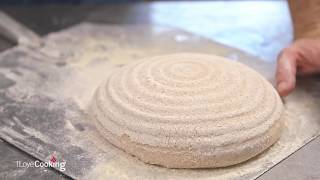
[12:31] if you're using a proving basket or if you're lucky to have one at home, is simply like a sand castle, just turn your dough straight out. So you can see all that beautiful pattern which the dough picks up from the basket. That's what kind of gives this dough a lot of its traditional markings.
[12:46] So then we've also got our lovely little pirate fish, and it's a great way to kind of improvise at home. So it's been tucked in for the last couple of hours. So we're going to gently waking them up. And all you do, very simply, just in case it's going to stick, we just
[13:03] put a little bit of flour on our dough. So we take our lid, you pop your lid on, and literally just flip it upside down. So taking it off. Nice and gently remove the flour tea
[13:27] towel. Most professional ovens are fitted with steam. The idea being for the first 8 to 10 minutes of your bake your dough is still rising. So by having steam in the oven it allows the dough to open up and kind of stops the crust from forming.
[13:41] Because often what can happen is if you don't use steam, the crust forms, the dough hasn't finished rising and sometimes it can break through the surface. I guess it's been bullied out of size because it looks like it's not any weakness to the dough, but sometimes it just won't be able to rise at all.
[13:53] So by having steam in the oven, it protects the dough and allows it to continue to open up. That's also what helps to create your lovely little crust. This is why the pirate dish is so great, it's so brilliant, because no matter how crappy your oven is, you don't even have to steam it.
[14:06] because once we pop the lid on, it will almost self steam, it creates its own little chamber and it will steam the bread and does a perfect job for us. Before we do that though, we're going to score our bread. It kind of dates back to when we had all the nice central ovens, each village would have one,
[14:20] everybody would have to maintain it, and the only way to tear the bread apart is to have your max, it's called a baking signature, before we score our bread we use a razor blade. It takes a moment to use it, it's not a bed knife, so you don't start doing that. Be nice and confident, use a really sharp knife at home if you can.
[14:34] Then you're in full control. And don't be afraid to cut into your dough.
[14:47] Just make sure you cut all the way through. So by scoring it well, as well as aesthetics, it also helps you control how the dough rises and gives the dough somewhere to go. So when it comes to baking your bread, don't be afraid to turn the temperature of your oven up.
[15:01] tendency to cook absolutely everything at 180, thanks to universal setting on the oven, but with bread we need those good high temperatures to really crank it up. So you look at a minimum 230 degrees. So you need that high temperature to create that lovely lovely colour. A great
[15:16] way in which we can create steam at home is by as we pop our bread in, pop in a little pile of fish. Once you pre-heat the oven, just turn it right up, put in a roasting tray
[15:29] to preheat it and all I'm doing is taking some hot water which is going to release that lovely blast of steam into our oven which is going to help your bread rise
[15:59] Thank you.
⚡ Saved you 0h 16m reading this? Transcribe any YouTube video for free — no signup needed.