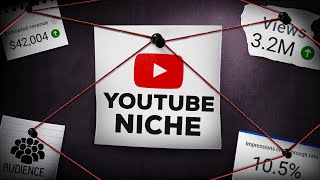

17-Year-Old Makes $15K/Month with One Video
45sThe incredible financial claim at a young age immediately grabs attention and promises a lucrative strategy.
▶ Play Clip"The title promises a niche-picking strategy, which is delivered, but the heavy sponsor segment and generic advice dilute the value."
This video presents a three-step process for selecting a profitable YouTube niche, emphasizing the importance of aligning personal passion with audience demand. It also introduces the concepts of 'idea ceiling' and 'view ceiling' as critical factors for channel growth, illustrated with examples like Dr. Mike's pivot to reaction content.
The creator claims to make over $15,000 a month at 17 years old, attributing success to a niche strategy, and promises to share a three-step process.
Creators should list potential content topics and evaluate which ones they are passionate about, as building a successful channel takes years (e.g., Mr. Beast took over 10 years to reach 1M subs).
YouTube content falls into two roles: entertainer (e.g., Mr. Beast, Logan Paul) and educator (e.g., Graham Stephan). Entertainers need a unique selling point; educators need social proof.
The line between educator and entertainer is blurry; creators like Vsauce mix both. The video promotes Riverside for high-quality headshot content, claiming a 65% reduction in editing time and 230% increase in quality.
Content ceilings are limits to growth. The 'idea ceiling' is the number of video ideas a niche can generate (e.g., US election coverage vs. general pop culture). The 'view ceiling' is the potential audience size.
Dr. Mike initially targeted medical students with low view counts, then pivoted to reacting to medical shows, leveraging social proof, and his most popular video grew to over 40 million views.
The idea ceiling is more critical than the view ceiling because you can succeed in a smaller niche if you can consistently create fresh content, whereas viewers get bored of repeated ideas.
The key to choosing a YouTube niche is to combine personal passion with a role (entertainer or educator) and select a sub-niche with a high idea ceiling and view ceiling, prioritizing the idea ceiling for long-term sustainability.
What are the two main content roles on YouTube?
Entertainer and educator.
01:19
What is 'social proof' in the context of educator creators?
Evidence that shows you know what you're talking about, like years of experience or a high income.
01:59
Define 'idea ceiling'.
The limit on the number of video ideas a niche can generate.
04:10
Define 'view ceiling'.
The maximum potential views a video can get based on the number of people who will watch it.
04:38
Which ceiling is more important for channel success?
The idea ceiling.
05:44
What change did Dr. Mike make to increase his view ceiling?
He pivoted from targeting medical students to creating reaction content to popular medical shows.
04:52
Passion is a prerequisite
Highlights that long-term success requires genuine interest, as it takes years to grow a channel.
00:15Two content roles
Provides a clear framework for understanding different creator strategies and what they require.
01:19Content ceilings concept
Introduces a useful analytical tool for evaluating niche potential beyond just topic popularity.
03:57Idea ceiling priority
Offers a counterintuitive insight that sustainable content creation matters more than audience size.
05:44[00:02] was able to do it with only one video, and I now make over 15 grand a month off of my channel at 17 years old. But it everything to do with my niche strategy. So, I'm going to show you the three-step
[00:15] process that I used to pick a good niche and how one creator grew to over 10 million subs with a simple change that you can use as well. And for those who give away my editing presets for free that helped me blow up with my very
[00:28] first video. Starting with step one, find your drive. For most creators, their drive is to either create content, make money, or a bit of both. But the it is going to take a ton of time, energy, and focus to create a successful
[00:42] channel. In fact, it took creators like Mr. Beast and Marcus Brownley over 10 years just to reach a million subs. So, I want you to create a list of things that you might want to create content about on YouTube. Then go through that
[00:54] doesn't drive you. Remember, some of the years making content before they started making money. So, you need to find a topic that you are equally passionate about creating content on. Then, I want
[01:06] audience on YouTube as passionate as you about this type of content. For example, saving money, then you'll want to pick something like personal finance that has an existing fan base of people who also love the topic. Then, once you've
[01:19] narrowed down a list of content that drives you as a creator, you'll need to YouTube, there are two main content roles. The first role is the entertain viewers through things like humor and drama. Examples of creators
[01:33] Beast, Logan Paul, and PewDiePie. To make it as an entertainer, you need some people in and keeps them coming back for ideas. For PewDiePie, it was his unique and unusual personality. It doesn't
[01:47] matter what your unique selling point is, but it needs to be unique and attention-grabbing. The second role is the educator, the purpose of which is to educate the viewer on a topic such as finance, nutrition, or even growing on
[01:59] YouTube. Examples of creators with this role are Graham Stefen, Film Booth, and myself. To succeed in this role, you'll need what's called social proof, which show that you know what you're talking about. For Graeme, it was his years of
[02:12] agent and multi-million dollar net experience growing and monetizing YouTube channels and the fact that I'm earning over six figures a year on YouTube at just 17 years old. And
[02:24] editing presets that helped me get to the point that I'm at today for free at natewealth.com/e or with link in the description. So, go with everything said though, the line between the role of educators and
[02:37] entertainers on YouTube is quite great. Just because you're an educator doesn't mean you can't also be an entertainer and vice versa. In fact, there are some creators like Vsauce that are a mix of both. Which is why no matter what you
[02:49] software that I've been using recently called Riverside. You see, one of the keys to standing out as an educator or entertainer is through leveraging a only be leveraged for the most part when you show your face and use your own
[03:02] But the last thing you want is lowquality headshot content. And that's where Riverside comes in. Riverside is great because it records your headshot and then uploads your content to the cloud where specific AI improves the
[03:16] narration quality for you and adds attention-grabbing captions. And if that clips feature, which takes your content and turns it into viral worthy short form clips to post on other social media platforms. And by using this software,
[03:29] you can expect a 65% reduction in editing time along with a 230% increase in quality. Achieving such results would typically cost around $5,000 otherwise. these benefits too by clicking Riverside's link in my description and
[03:44] using coupon code Nate at checkout to get 15% off. So don't lose quality on your headshot content and save time with Riverside. And then once you've picked your driving niche role and established a highquality editing system with
[03:57] Riverside, you can pick a subniche that capitalizes on the two content ceilings. And trust me when I say that you can't miss this section, as it covers the two make when selecting a niche. Content ceilings are the limits a type of
[04:10] content has for growing your channel. The first is the idea ceiling, which you can make in a certain niche before say that you were to make a channel that only focuses on covering the US
[04:23] presidential election, which happens every four years. When the election is when the election cycle isn't on, you'll have nothing to talk about, meaning you compare that to a channel which focuses on general US pop culture, like Philip
[04:38] content to make videos about. The second one to determine is the view ceiling, views you can potentially get on a video based on the number of people that will actually watch it on YouTube. For example, Dr. Mike is a famous YouTuber
[04:52] he struggled in the beginning to get a was quite low. At first, he was making content that targeted medical students on topics like how not to get sick and the seven health benefits of green tea.
[05:05] niche as an educator that had a much higher idea ceiling. This idea was to create reaction content to popular medical shows. And by leveraging his social proof, he was able to provide commentary on popular medical shows and
[05:19] happened in the shows was accurate or not. And unlike his earlier videos, which struggled to get a lot of views, his most popular video, named Real grown to over 40 million views, meaning it had an amazing view ceiling. So,
[05:32] after you pick a niche that drives you and your role as a content creator, make sure to pick a subniche that has a great idea ceiling and view ceiling. But even with both of these ceilings being really important to your channel success, the
[05:44] than the view ceiling. as it's still possible to succeed in a smaller niche channel. As long as you're able to keep consistently creating new content that which isn't the same the other way around, because there's only so many
[05:59] ways to repackage and remake the same video idea before viewers get bored and And if you're interested in learning how some niches have the potential to make creators millions of dollars just off of ad revenue, then check this video out
[06:12] next where I explore those niches and show you how to find




⚡ Saved you 0h 06m reading this? Transcribe any YouTube video for free — no signup needed.