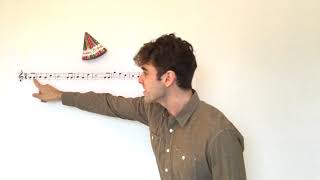

Reading Music Is Like a Graph
46sThis analogy makes music theory feel intuitive and shareable to beginners.
▶ Play Clip"The title accurately promises a beginner-friendly guide to reading music, and the transcript delivers exactly that with clear explanations and examples."
This video teaches beginners how to read sheet music, focusing on the core concepts of pitch and rhythm. The instructor explains that music is read left to right like a graph, with higher notes meaning higher pitches. The lesson covers note durations (whole, half, quarter, eighth notes) and how to identify notes on the treble clef using acronyms like 'Every Good Boy Deserves Fudge' and 'FACE'.
Music is read left to right, with higher notes indicating higher pitches and lower notes indicating lower pitches. It can be thought of as a graph with time on the x-axis and pitch on the y-axis.
Even without knowing exact notes, you can get information from the contour (shape) of the melody. The instructor demonstrates by humming the contour of 'Happy Birthday'.
Note durations: whole note (empty circle, no tail) is the longest; half note (empty circle with tail) is half as long; quarter note (solid black dot with tail) is a quarter; eighth notes (solid black dot with curved tail) are twice as fast as quarter notes.
Pitches are named with letters A through G. The treble clef indicates where A is placed on the staff. Lines and spaces have specific note names, remembered with acronyms: 'Every Good Boy Deserves Fudge' for lines (E-G-B-D-F) and 'FACE' for spaces (F-A-C-E).
Reading music allows you to play instructions written by someone not present, enables group performance without extensive rehearsal, and lets you play music you've never heard before.
In what direction do you read music?
Left to right.
00:12
What does a squiggly line in music mean?
A rest.
01:12
What is the name of an empty circle note with no tail?
A whole note.
02:32
What is a solid black dot with a tail called?
A quarter note.
02:44
What note takes half the time of a whole note?
A half note.
02:32
How many eighth notes can you sing in the time it takes to sing one whole note?
Eight.
02:44
What are the seven letters used to name notes in music?
A, B, C, D, E, F, G.
03:58
What is the curly cue at the beginning of the staff called?
The treble clef.
04:13
What acronym helps remember the lines of the treble clef?
Every Good Boy Deserves Fudge.
05:08
What acronym helps remember the spaces of the treble clef?
FACE.
05:08
Music as a Graph
Provides a simple, intuitive framework for understanding pitch and time.
00:12Reading Contour
Teaches a practical skill to get the gist of a melody without knowing exact notes.
01:12Note Duration Hierarchy
Clearly explains the relationship between whole, half, quarter, and eighth notes.
02:32Acronyms for Note Names
Offers memorable mnemonics (Every Good Boy Deserves Fudge, FACE) for quick note identification.
05:08Value of Reading Music
Explains the broader benefits: playing music from distant sources and collaborating without rehearsal.
05:44[00:00] Hey, what's up? My name is Scott. I'm a cellist and a singer. And in the next few minutes, I'm going to teach you how to read music. Now, if you've ever seen a piece of music, you probably thought, what in God's name are these chicken scratches?
[00:12] But I promise you, it's easy. So, here we go. These little black dots are the notes. And you read the notes like a book from left to right. And the higher the note is, the higher you sing. And the lower the note is, the lower you sing.
[00:26] If you're mathematically inclined, you can think of this like a graph with time on the x-axis and pitch on the y-axis. And each note is a coordinate on the graph. If that didn't make any sense to you, don't worry about it. The most important thing to remember is that you read left to right and the higher the note is, the higher you sing.
[00:44] So, let's read this. Let's start it up. Bum, bum, bum, bum, bum, bum, bum, bum, bum, bum, bum, bum, bum, bum, bum, and then back down.
[00:58] Bum, bum, bum, bum, bum, bum, bum, bum, bum, bum, bum, back to where we started. Same line. And this little squiggly thing is a rest, which just means nothing happens here.
[01:12] So, even with just this basic knowledge, we can get a lot of information just based on the contour of what we see. So, ignore this for now. And let's just start on the first note and read the contour. Bum, bum, bum, bum, bum, bum, bum, bigger jump, bum, bum, bum, back to where we started.
[01:29] Bum, bum, bum, bum, bum, bum, bum, bigger jump, bum, bum, bum, bum, and back to where we started. it!
[02:05] Bum, bum, bum, bum, bum, bum, bum, bum, bum, bum, bum, bum, bum, bum, bum, bum. Something's a little wrong with the rhythm. Okay, we're making each note the same length.
[02:17] When we know that in the real song, some of the notes are longer than others. So let's look at these little black dots. They're not all the same, are they? So let's go and find out what they mean. The most basic kind of note is a whole note, which is an empty circle with no tail,
[02:32] like this. A half note takes half the time of a whole note. You can tell it by its tail. A quarter note is a solid black dot with a tail, and you guessed it, it takes a quarter of the time of a whole note.
[02:44] Finally, these are eighth notes, a solid black dot with a curved tail. You can sing eight eighth notes in the same time it takes to sing one whole note. Back to happy birthday. This eighth note takes half as long as this quarter note,
[02:59] which takes half as long, again, as this half note. Now, you don't really need to remember all those names. If you can just kind of intuitively see that these notes look faster than these notes,
[03:14] and that this note looks slow. So if we keep that in mind, we go fast, fast, normal, and slow. Fast, fast, normal, and slow.
[03:28] Fast, fast, normal, and normal. Fast, fast, normal, and slow. Ta-da. Now, we've talked a lot about how to read the music from left to right, which gives us the rhythm.
[03:44] But we haven't talked a lot about how to read the music up and down, other than to say a higher note means you sing higher. Have you ever heard someone say she sang a high C, or that's a low A? Well, in music, we say how high or low we sing with letters of the alphabet,
[03:58] A is the lowest, and then B, C, D, E, F, G. And in the music alphabet, we stop at G. But what if you want to keep singing higher, you just go back to A?
[04:13] And so on. This little curly cue is called the treble clef. And it just tells you where on this thing, you're going to put A. And in treble clef, the A goes here in this space. So going up from A, this line is B.
[04:28] This space is C, D, E, F, and we can keep going. G, A, and so on. And then below A, this line is G, F, E, and we can keep going down, D, and C, and so on.
[04:49] Say I'll give you this note and ask, what is it? Well, we can count up from A, which we know is going to be in the second space, or we can use one of my favorite acronyms. For the lines, every good boy deserves fudge.
[05:08] And for the spaces, face. So this note is an E. Well, here we are at the end, back to our friend Happy Birthday.
[05:20] Not only can we one make a good guess by reading the contour, two, get the exact rhythm with our note names, but three, we now know that the first note is A.
[05:32] Remember that acronym? It's a G. And it's the last note is, remember that acronym? F, A, C, E. It's a C. So there you go.
[05:44] Reading music is a cool skill because it lets you play from instructions that were written by somebody who's not there, like somebody in another state, or another country, or even someone dead. It lets everyone in a group play from the same instructions without a lot of instruction beforehand,
[05:59] and it lets you play something that you've never heard before, or, if you're lucky, that no one has ever heard before. If you're into this stuff and you want to learn more, check out time signatures, key signatures,
[06:11] accidentals, half steps versus whole steps, and dynamics. Thanks for watching, and happy reading.
⚡ Saved you 0h 06m reading this? Transcribe any YouTube video for free — no signup needed.