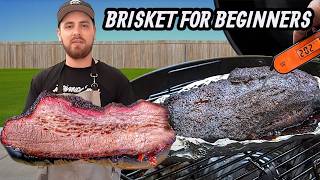

How to Smoke Brisket for Beginners
45sThe opening directly addresses a common desire to learn brisket smoking, hooking beginners with a clear promise.
▶ Play Clip"Title accurately reflects content: a beginner-friendly guide to smoking brisket on a charcoal BBQ."
This video provides a comprehensive, step-by-step guide to smoking a full brisket on a charcoal barbecue using the snake method. The presenter covers trimming, seasoning, setting up the barbecue, managing temperature, wrapping, and resting the brisket to achieve a tender, juicy result.
The video demonstrates how to smoke a full brisket (6.5 kg) on a charcoal barbecue.
Trim the large pocket of fat from the underside and remove hard fat, leaving thin layers to render.
Trim the top flap for uniform shape; leave even fat coverage on the leaner flat side.
Save trimmings with 80% lean meat and 20% fat for burger patties; hard fat can be rendered into beef tallow.
Use a 50/50 mix of kosher salt and cracked black pepper as a base, optionally add steak shooter and garlic granules. Apply a light coat of mustard to bind the rub.
Use the snake method: stack briquettes in a domino fashion around the charcoal grate, leaving a gap for starter briquettes.
Use about 12 briquettes in a chimney starter until red hot and ashed over, then add to the start of the snake.
Use a combination of pecan and cherry wood. Place wood chunks on the coals. Use a grill probe to monitor temperature.
The snake method does not produce dirty smoke if the barbecue is preheated for 5-10 minutes, allowing unlit briquettes to catch cleanly.
Place a foil tray under the brisket, position the thicker point end closer to the snake, and ensure the brisket is never directly over the burning coals.
Target 275°F (135°C) at grill level. Keep top vent wide open and adjust bottom vent to stabilize. Stabilize slightly below target temperature.
After a couple of hours, rotate the cooking grate to keep the brisket away from the burning snake. Spritz with water for moisture and bark formation.
At around 4 hours, check internal temperature (target 160°F/71°C) and bark set (should not come off on fingers).
Wrap the brisket in two layers of foil, pour drippings over it, and position the point end closer to the fire to even out cooking.
Continue smoking until internal temperature reaches around 200°F (93°C) and probe tender. Be patient through stalls.
After about 10.5 hours, the brisket probes like butter. Let it steam off for 5 minutes to stop cooking.
Rest in an esky for 4-5 hours, in an oven at 70°C (160°F) for up to 24 hours, or at room temperature for 1 hour.
Slice the flat against the grain. For the point, slice perpendicular to the flat slices to get fatty point slices. Dice remaining point for cubes.
The brisket is tender, juicy, with amazing bark. Boating method is recommended for best results.
Smoking a brisket on a charcoal barbecue requires patience and attention to detail, but the snake method and boating technique yield excellent results. With proper trimming, seasoning, temperature control, and resting, you can achieve a tender, flavorful brisket.
What is the recommended internal temperature for wrapping or boating a brisket?
Around 160°F (71°C).
09:10
What is the target internal temperature for checking probe tenderness?
Around 200°F (93°C).
10:28
What is the snake method in charcoal barbecuing?
Stacking unlit briquettes in a domino pattern around the charcoal grate, with a gap for starter briquettes, to create a long, slow-burning fire.
03:08
How can you avoid dirty smoke when using the snake method?
Preheat the barbecue for 5-10 minutes with the lid closed and vents open, so unlit briquettes catch cleanly from the red-hot starters.
05:02
What is the recommended fat-to-lean ratio for brisket trimmings to make burger patties?
Around 80% lean meat and 20% fat.
01:24
What is the purpose of boating a brisket?
To preserve the bark and help even out cooking by wrapping the brisket in foil with drippings.
09:35
How long can you hold a brisket in the oven at 70°C (160°F)?
Up to 24 hours.
14:05
What should you do if your barbecue temperature gets too high and you've closed the bottom vent?
Pour a little water into the drip tray below the brisket to absorb heat and stabilize temperature.
07:35
Use Trimmings for Burgers and Tallow
Practical tip to reduce waste and create additional products from brisket trimmings.
01:22Snake Method Does Not Produce Dirty Smoke
Debunks a common myth about the snake method, explaining proper preheating ensures clean combustion.
05:02Using Water to Control Temperature Spikes
A clever hack to quickly bring down runaway temperatures without opening the lid.
07:35Boating Preserves Bark Better Than Wrapping
Highlights a preferred method for maintaining bark quality while still protecting the meat.
09:35Resting Options for Brisket
Provides flexible resting strategies depending on serving time, including long holds in oven.
13:47[00:00] do you want to learn how to smoke
[00:01] brisket then stick around because in
[00:02] this video i'm going to show you how to
[00:04] smoke brisket in a charcoal barbecue all
[00:06] right so we're going to be working with
[00:07] a full brisket today now this one weighs
[00:09] about six and a half kilos and we're
[00:11] going to get started by trimming it up
[00:12] all right so we'll start by flipping it
[00:14] over and we'll trim the underside first
[00:16] you've always got a big pocket of fat
[00:18] here so we'll work on taking that out
[00:20] [Music]
[00:22] all right so that's about as much as
[00:24] i'll take off there for now so we'll
[00:25] spin it around and now we want to work
[00:27] on taking some of this hard fat off the
[00:29] bottom
[00:33] you don't have to get all of it the thin
[00:34] layers will render down
[00:36] and because this end of the flat is very
[00:38] thin i'm just going to square it off
[00:40] through here
[00:44] all right now i'm pretty happy with how
[00:46] that underside's looking so we'll flip
[00:47] it over and get started on the top
[00:49] so you want to make your brisket a nice
[00:51] uniform shape so i'm just going to trim
[00:53] this top flap off
[00:56] the more evenly you trim your brisket
[00:58] the more even it's going to cook
[01:01] now i'm working on the point end here
[01:02] now there's so much intramuscular fat in
[01:04] there you can afford to trim a lot of
[01:06] this top fat off but on the flat side
[01:08] here it's a little bit leaner so you
[01:10] definitely want to try and leave a nice
[01:11] even fat coverage on there and you
[01:13] really want to try and trim your brisket
[01:15] in a way that no juices will pull up
[01:16] anywhere on it i know it's going to be
[01:18] hard to avoid sometimes but if you can
[01:20] definitely try and trim it that way and
[01:22] your brisket trimmings don't throw them
[01:24] away if you've got anything around 80
[01:26] lean meat and 20 fat keep it as it makes
[01:29] for the best burger patties if you've
[01:30] got a mincer and any hard fat i like to
[01:33] keep i'll put that in a pot later on
[01:34] render it down and make some beef tallow
[01:37] now this side of the brisket is a lot
[01:38] thinner than the other so i'm just going
[01:40] to run my knife down this side and just
[01:42] square it off a little bit
[01:44] [Music]
[01:47] all right now i'm happy with both sides
[01:48] of this brisket it's nice and uniform so
[01:51] let's season it up all right so
[01:52] seasoning your brisket now if you've got
[01:54] a favorite beef rub go ahead and use
[01:55] that or salt and pepper always does the
[01:57] trick some of the best briskets i've
[01:59] tasted is just a 50 50 mix of kosher
[02:02] salt and cracked black pepper which is
[02:04] the base for what we're going to be
[02:05] using today but we've topped it up with
[02:07] some steak shooter and garlic goals so
[02:09] that's what i've prepared here in this
[02:10] little shaker so we'll get it mixed up
[02:12] and season this brisket
[02:14] all right so we'll flip our brisket over
[02:16] and season the bottom side first
[02:19] i'll give it a light coat and mustard
[02:20] just to help bind our rubs
[02:23] and then you want to sprinkle from a
[02:24] height so you get a nice even coverage
[02:27] and give the bottom side of our brisket
[02:28] a nice generous coat
[02:32] don't forget the ends as well
[02:36] then we can flip it over and do the top
[02:43] all right so now our brisket is trimmed
[02:45] and seasoned we can get started on
[02:46] setting up our barbecue all right so
[02:48] we're going to be using the oklahoma
[02:49] joe's blackjack kettle so we'll get
[02:51] started by opening it up and taking our
[02:52] cooking grate out then you want to open
[02:54] up some briquettes now you can either
[02:56] rip the bag open or usually one side you
[02:59] can just untie
[03:00] the string a few times
[03:04] and then you should be able to just pull
[03:05] it
[03:06] and open it up like so and we're going
[03:08] to be using the snake method today so
[03:10] with your briquettes you want to just
[03:12] stack them up like so in a domino
[03:14] fashion
[03:22] all right so the bottom layer of our
[03:23] snake is done now if you were using
[03:25] larger briquettes you just run a single
[03:27] stack through the middle for our second
[03:29] layer but because these brick hats are a
[03:30] little bit smaller we're going to keep a
[03:32] double stack on top
[03:38] all right so our snake is pretty much
[03:39] done as you can see we've built it most
[03:41] of the way around our charcoal grate but
[03:43] we've just left a gap here and that's
[03:45] where our startup briquettes are going
[03:46] to go so in a charcoal chimney you want
[03:48] to get about 12 briquettes
[03:52] then we'll get a couple of fire lighters
[03:54] going
[03:56] we'll get our brick hats on top and
[03:57] we'll wait until they are nice red hot
[03:59] ashed over and ready to go so while your
[04:01] briquettes are coming along use that
[04:03] time to get some other things ready you
[04:04] need for this cook so we've got a foil
[04:06] tray ready we've got some smoking wood
[04:08] ready i'm going to be using a
[04:09] combination of pecan and cherry but if
[04:11] you've got another favorite smoking wood
[04:12] for beef go ahead and use that and we've
[04:14] also got our grill probe ready now this
[04:16] barbecue has a temperature gauge on the
[04:18] lid but as usual heat rises and you do
[04:21] normally get a slightly higher reading
[04:23] at lid level as opposed to grill level
[04:25] so that's all we need to do now until
[04:26] these briquettes are ready so we'll come
[04:28] back when they are ready all right so
[04:29] our brick hats are pretty much ready so
[04:31] i'm going to get this smoking wood on so
[04:32] we'll lay down a piece of our pecan
[04:35] piece of our cherry another piece of
[04:37] pecan and we'll save our other piece of
[04:39] cherry to put on at the start of our
[04:41] snake where our startup briquettes are
[04:42] going to go and that's what you want to
[04:43] see with your startup briquettes you
[04:45] want to see them nice ashed over and red
[04:47] hot so we'll dump those in at the start
[04:48] of our snake
[04:50] and then you just want to stack them up
[04:51] nicely at the start
[04:55] now you want to make sure they are all
[04:56] over the unlit stuff and then we can
[04:58] shut our lid and then we'll make sure
[04:59] our top and bottom vents are wide open
[05:02] so i get questions all the time about
[05:03] the snake method and if it produces
[05:05] dirty smoke throughout the cook due to
[05:07] all the unlit ricketts that you use for
[05:09] the snake now the answer to that
[05:10] question is no not when you set it up
[05:12] right because we're giving our barbecue
[05:14] five to ten minutes to preheat that's
[05:16] going to pre-heat our briquettes to a
[05:17] hot enough temperature that they will
[05:19] catch light from our red hot ones
[05:21] without producing dirty smoke it's the
[05:23] same concept as the minion method where
[05:24] you're using a bunch of unlit briquettes
[05:26] to fuel a really long slow burning fire
[05:29] for a long smoke like this as long as
[05:31] you use red hot briquettes to start your
[05:33] snake and you pre-heat your bbq
[05:35] everything around it will be preheated
[05:37] enough to catch light cleanly without
[05:39] producing dirty smoke so i hope that
[05:41] answers that question but if you do have
[05:43] any more questions don't hesitate to ask
[05:44] them in the comments below but for now
[05:46] we'll be back once this barbecue's had
[05:47] five to ten minutes to preheat right so
[05:49] as you can see nice clean burning smoke
[05:52] our bbq is nice and preheated so we'll
[05:54] open it up and as you can see our unlit
[05:56] brickets are already starting to catch
[05:57] light from our startup briquettes so
[05:59] we'll get our foil tray in we'll get our
[06:00] piece of cherry on at the start we'll
[06:02] get our cooking grate on we'll get our
[06:03] brisket on and you want to make sure
[06:05] that your brisket is never over the
[06:06] burning part of the snake so later in
[06:08] this cook once our snake starts burning
[06:10] around here we're just going to rotate
[06:12] our brisket around away from it and i've
[06:13] also positioned the thicker part of our
[06:15] brisket which is the point end closer to
[06:17] the snake which is just going to help it
[06:19] cook a little bit more evenly and then
[06:20] we can hook up our grill probe i'm just
[06:22] going to clip it in up the back here and
[06:23] then we can close our lid
[06:25] and let this brisket start smoking away
[06:27] all right now our brisket's on we're
[06:28] just going to get our barbecue to a nice
[06:30] smoking temperature for this cook i'm
[06:32] going to look to stabilize our barbecue
[06:33] off at around that 275 fahrenheit or 135
[06:36] celsius range and in this video we're
[06:38] going to be running through everything
[06:39] step by step so the next thing you'll
[06:41] see is how i like to stabilize my
[06:43] temperatures off so i'm going to leave
[06:44] our top and bottom vents wide open until
[06:47] we get back up to around the 225
[06:49] fahrenheit or 110 celsius at grill level
[06:52] so we'll come back once we've hit that
[06:53] stage
[06:56] so it's been about 15 minutes since we
[06:58] shut that bottom vent down to almost
[07:00] closed it's sitting just a crack open at
[07:02] the moment and again our top vent is
[07:04] sitting wide open now i've been keeping
[07:06] an eye on our temperature at grill level
[07:07] and it's been sitting really stable for
[07:09] the last five minutes so now's the time
[07:11] you want to make any further adjustments
[07:12] if you need to increase temperature open
[07:14] that bottom vent up slightly if you need
[07:16] to decrease it then shut it down a
[07:18] little bit now i will always try to
[07:20] stabilize off a little bit lower than
[07:21] where i want to be at as it's much
[07:23] easier to increase temperature than to
[07:25] decrease your temperature it can be
[07:27] quite challenging bringing your
[07:28] temperatures back down if they have
[07:29] gotten away from you and for whatever
[07:31] reason if your temperatures have gotten
[07:32] away from you and you've closed that
[07:34] bottom vent down to pretty much shut
[07:35] don't be afraid to pour a little bit of
[07:37] water in that drip tray below your
[07:38] brisket that's going to absorb a lot of
[07:40] heat and really help to stabilize your
[07:42] temperatures off so for the first couple
[07:44] of hours of this cook this is where you
[07:45] really want to just keep an eye on your
[07:46] temperatures and find that sweet spot
[07:48] with your vent set up and that's going
[07:49] to really vary depending on what type of
[07:51] barbecue you're using how hot it is
[07:53] outside how windy it is what type of
[07:55] briquettes you're using and much more
[07:57] it's all about finding and understanding
[07:59] what works for you making any
[08:01] adjustments needed and building off that
[08:03] so we're going to continue to let our
[08:04] brisket smoke away and we'll keep
[08:06] checking in throughout this cook all
[08:07] right so it's been a couple of hours
[08:08] since we last checked in so we're gonna
[08:10] have a look at our brisket and as you
[08:11] can see where our snake's burning it's
[08:13] getting close to being underneath that
[08:14] brisket so we're just gonna rotate our
[08:16] cooking grate around
[08:18] and now that's given us some good
[08:19] distance between the burning part of the
[08:21] steak and our brisket and while we're
[08:23] here i'm just gonna spritz our brisket
[08:24] with some water
[08:26] that's just really going to help with
[08:27] some moisture retention and bark
[08:29] formation
[08:30] and you don't want to leave your lid
[08:31] open for too long so we'll close it back
[08:33] up and let it keep smoking away all
[08:34] right so our brisket's looking great
[08:36] that barks coming along nice and our
[08:38] temperatures have been holding
[08:39] beautifully so all we're going to do now
[08:41] is let this brisket go for about another
[08:42] hour that's going to take us to around
[08:44] the four hour mark into this cook so the
[08:46] next time we check our brisket we're
[08:47] going to be checking the internal
[08:48] temperature and we'll potentially wrap
[08:50] it or boat it as well so we'll be back
[08:52] once we've hit that stage all right so
[08:54] we've just ticked over the four hour
[08:55] mark into this cook so let's have a good
[08:57] look at this brisket right so our
[08:58] temperature's still holding nicely so
[09:00] just be mindful whenever you've got your
[09:01] lid open you are letting lots of oxygen
[09:03] in so you might see a spike in
[09:05] temperature when you do close your lid
[09:06] again but for now let's have a look at
[09:08] these internals
[09:10] so the two things i like to look for
[09:12] before i wrap or buy a brisket is being
[09:15] at an internal temperature of around 160
[09:17] fahrenheit or 71 degrees celsius
[09:21] we're a bit further behind in the point
[09:22] so when we boat this i'm going to
[09:24] position the point a bit closer to the
[09:26] fire so it catches up
[09:28] i'm happy with the bark you should be
[09:30] able to touch around and it shouldn't be
[09:32] coming off on your finger that's when
[09:34] you know your bark set and we're going
[09:35] to boat this one which is going to
[09:36] really help preserve that bark too so
[09:39] we'll get some alpha already and then
[09:40] we'll boat it up
[09:42] all right so get two layers of good
[09:43] quality foil ready carefully get this
[09:45] brisket out
[09:48] and while we're playing around with the
[09:49] brisket we'll close our lid again and
[09:51] now we just want to fold the foil up
[09:52] around the brisket
[09:58] and then i'm quickly going to get our
[09:59] foil tray out
[10:02] and i'm going to use those beautiful
[10:03] drippings to go back into our brisket so
[10:05] we'll pour them over
[10:08] get our tray back in
[10:11] get our cooking grate back on and then
[10:13] our brisket and like i said that point
[10:14] end is now closer towards where that
[10:16] fire is burning so that internal
[10:18] temperature is going to catch up to the
[10:20] flat side right so now our brisket's
[10:22] back in we just need to let that smoke
[10:23] away until we're ready to check for
[10:25] probe tenderness and i'm going to start
[10:27] doing that once we reach an internal
[10:28] temperature in both ends of around that
[10:30] 200 fahrenheit or 93 degrees celsius
[10:33] mark now it can be challenging to get
[10:35] both ends of your brisket to the same
[10:37] internal temperature that's why it's
[10:38] always important to rotate whatever end
[10:40] is behind closer towards the fire where
[10:42] it's going to be a little bit hotter now
[10:44] to get to that internal temperature
[10:45] where we're going to start checking for
[10:46] probe tenderness might take us two hours
[10:48] to get there it might take four it might
[10:50] even take six i don't like putting a
[10:52] time on these things that's why it's
[10:54] always better to get your brisket on
[10:55] earlier than what you think that way if
[10:57] it is done a little bit earlier you can
[10:59] always rest it up until you're ready to
[11:00] serve it we're just going to be patient
[11:02] if our brisket stalls we're just going
[11:04] to ride through it we're not going to
[11:05] panic we're not going to increase
[11:06] temperatures we're just going to simply
[11:08] let it go until it pushes through it so
[11:10] be patient with your brisket we'll keep
[11:12] checking back in throughout this cook so
[11:14] we'll come back soon all right so it's
[11:15] been about three hours since we last
[11:17] checked in so that means we're about
[11:18] seven hours total into this cook now our
[11:21] bbq has been holding beautifully around
[11:23] that temperature we want it to be at so
[11:24] let's have a look at this brisket all
[11:26] right so i haven't had to do too much
[11:28] all i've been doing is rotating the
[11:30] brisket away from the hottest part of
[11:32] the snake
[11:33] i've faced the point in towards the fire
[11:36] so it can catch up a little bit
[11:38] about 180 internal in there
[11:41] in our flat we're about 185 so as you
[11:45] can see the two ends are starting to
[11:46] cook nice and even we've still got about
[11:48] two hours left on our snake i reckon so
[11:50] let's keep this lid closed and let this
[11:52] brisket keep going so in them three
[11:54] hours that passed since we boasted our
[11:56] brisket we did hit a stool for about an
[11:58] hour of that time we got stuck at about
[12:00] that 165 fahrenheit internal mark but
[12:03] like i mentioned earlier we were just
[12:04] patient and it eventually pushed through
[12:06] it so that brisket is looking absolutely
[12:08] fantastic i'm really happy with it all
[12:10] i'm going to do now is keep checking
[12:12] every 45 minutes to an hour i'll have a
[12:14] probe around i'll check my internals and
[12:16] if you wanted to put a probe in each end
[12:18] of the brisket by all means go ahead and
[12:20] do that but i'm happy with how that's
[12:21] coming along so we'll check back in soon
[12:23] all right it's been two hours since we
[12:25] last checked in so we're about nine
[12:26] hours in total into this cook
[12:29] i reckon this brisket will be pretty
[12:31] close to being ready so let's have
[12:32] another probe around a temperature check
[12:36] 196 in the thickest part of the point
[12:40] 199 start a probe quite nice do it a
[12:44] little bit to go
[12:45] 198
[12:47] it's quite soft there
[12:51] very soft there
[12:52] 201 we're almost at the end of our snake
[12:55] it's burning hottest a bit back here so
[12:57] i reckon it's got another hour's burn
[12:59] time i don't reckon our brisket will be
[13:01] far off maybe another half an hour to 45
[13:03] minutes so we'll check back in then all
[13:05] right it's been an hour and a half since
[13:06] we last checked in i did check it after
[13:08] about 45 minutes and it wasn't quite
[13:11] there
[13:12] but this is feeling
[13:15] nice and soft now
[13:18] up around the 203 sort of range
[13:23] it's just probing like butter and as you
[13:26] can see our snakes pretty much at the
[13:28] end so that's a pretty good 10 and a
[13:30] half hour burn time so i've just put
[13:31] some high heat gloves on and we are
[13:33] carefully
[13:35] going to lift this brisket out
[13:39] all right so when you get your brisket
[13:40] out i always like to just let it steam
[13:42] off for five minutes just to stop that
[13:43] cooking process so you don't overcook it
[13:45] and when it comes to resting you've got
[13:47] a few options based on when you want to
[13:48] serve your brisket if it's ready four or
[13:50] five hours in advance it's always a good
[13:52] idea to rest in an esky they hold the
[13:54] heat really well and they'll keep the
[13:56] brisket hot at a really good eating
[13:57] temperature until you're ready to serve
[13:59] it or you can hold a brisket in the oven
[14:01] at about that 70 degrees celsius or 160
[14:04] ish fahrenheit and i've done that for
[14:05] about 24 hours until i've been ready to
[14:07] serve it the next day but today i'm just
[14:09] going to let it rest at room temperature
[14:11] for an hour because i want to serve it
[14:12] in an hour and then i'll slice and serve
[14:14] it so we'll come back when we're ready
[14:15] to do that all right i'm just about
[14:17] ready to slice this brisket but i don't
[14:18] want to waste those juices in the foil
[14:20] so i'm going to put it in this container
[14:22] and then we'll get into slicing this
[14:23] brisket so i'll make a little lip in the
[14:26] foil
[14:27] i'll carefully pick it up
[14:33] put the lid on we can save that for a
[14:34] future cook or i'll slice it straight
[14:37] down the middle
[14:57] all right so that's the end piece of our
[14:58] flat as you can see
[15:00] juicy all the way through
[15:03] still pulls apart with these
[15:05] that is a great brisket all right so
[15:07] slicing the flat is pretty
[15:08] straightforward but as you get into the
[15:10] point
[15:11] we've got the flat muscle more on this
[15:12] side
[15:13] so what i like to do
[15:16] is on this side we've got that big point
[15:18] muscle
[15:19] is we can start taking
[15:21] slices
[15:23] off this way
[15:26] and that's where you start getting them
[15:28] beautiful
[15:29] fatty point slices from
[15:32] which are my personal favorite
[15:35] and once you've only got that little bit
[15:36] of point muscle left
[15:38] i like to just trim it off like so
[15:41] dice those pieces up
[15:44] and then turn it back to the way you
[15:45] were slicing the flat
[15:49] and continue slicing like so you get
[15:51] these beautiful little slices of flat
[15:53] but either these little cubes of point
[15:55] or the point and slices would have to be
[15:56] my favorite so let's have a taste all
[15:58] right time for a taste i'm gonna go for
[16:00] one of these little point cubes
[16:02] oh man that is incredible try a bit of
[16:05] this beautiful little flat
[16:07] so tender so juicy
[16:10] that is up there with one of the best
[16:12] briskets i've had such amazing bark
[16:15] incredible taste texture so juicy
[16:18] everything you want in a brisket and i
[16:19] can't recommend boating your brisket
[16:21] enough i absolutely love that method it
[16:23] would have to be my favorite out of
[16:25] wrapping in foil wrapping in butcher's
[16:27] paper or anything else i've had the best
[16:29] results every time i do it and as you
[16:31] can see this brisket turned out amazing
[16:34] well if you enjoyed the video everyone
[16:36] and you learned something from it be
[16:37] sure to subscribe to our channel so you
[16:38] don't miss any of our future videos but
[16:40] for now that's the end of this video so
[16:42] thanks for watching and we'll see you
[16:43] next time
⚡ Saved you 0h 16m reading this? Transcribe any YouTube video for free — no signup needed.