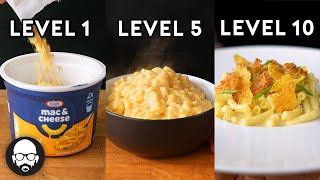

Microwave Mac & Cheese FAIL
40sRelatable and funny critique of a beloved but flawed convenience food, sparking nostalgia and debate.
▶ Play Clip"Title accurately describes the content: 10 distinct levels from microwave to Michelin, each demonstrated in detail."
In this video, Babish explores 10 levels of mac and cheese, starting from the simplest microwave version to a gourmet Michelin-star-level creation. He demonstrates various techniques, ingredients, and hacks to elevate this classic comfort food, providing insights into cheese sauces, pasta making, and flavor balancing.
The easiest iteration, Craft Mac and Cheese in a cup. Add water, microwave, stir in cheese sauce. Result is gluey with unevenly cooked noodles.
Classic blue box mac and cheese. Boil pasta, drain, add butter, milk, and cheese sauce. Tastes good but has artificial flavor.
Elevate boxed mac by infusing butter with paprika, garlic, and mustard, then baking with crushed corn flakes. Result is significantly better.
Use evaporated milk and pre-shredded cheese coated in starch (corn, tapioca, or potato) to create a smooth, gooey sauce without a roux. Avoid cheese coated with cellulose (wood pulp).
From America's Test Kitchen: cook pasta in milk and water, then add American and cheddar cheese. Smooth and creamy but less flavorful due to American cheese.
Breaded and deep fried mac and cheese bites served with ranch. A Texas state fair food, more of a thing to do with mac and cheese than a preparation.
Classic French technique: make a roux, add milk gradually to make béchamel, then melt in a blend of cheeses. Results in a classic, flavorful sauce with a slightly less smooth texture.
Use sodium citrate to create an ultra-smooth, foolproof cheese sauce with any cheese. Blend milk, sodium citrate, and cheese in a blender. Texture is ethereal but may lack traditional mouthfeel.
Use expensive ingredients: $60/lb cheese, $12 pasta, lobster, truffle. The strong cheese sauce overpowers the delicate flavors, showing diminishing returns on cost.
Invent a new pasta hybrid (macboki) using semolina, rice flour, tapioca starch, and a tangzhong method for chewy, resilient noodles. Serve with a seven-cheese mornay sauce, parmesan broth, and crispy breadcrumbs.
Babish demonstrates that mac and cheese can range from a simple microwave meal to a gourmet dish. The key takeaway is that technique and ingredient quality matter, but throwing money at a dish doesn't guarantee the best result; balance and creativity are essential.
What is the main problem with microwave mac and cheese?
It results in gluey texture with overcooked and undercooked noodles due to starches added to help emulsify without milk.
01:47
What ingredient in pre-shredded cheese should be avoided for a smooth sauce?
Cellulose (wood pulp), which does not bind proteins and causes a gritty, clumpy sauce.
05:48
What starches are good for coating cheese to make a smooth sauce?
Cornstarch, tapioca starch, and potato starch.
06:00
How does evaporated milk help in making a cheese sauce?
It has higher protein content than normal milk, which helps the sauce emulsify and become smooth.
05:05
What is the role of sodium citrate in cheese sauce?
It acts as an emulsifier, similar to the stabilizers in American cheese, allowing non-processed cheeses to melt smoothly.
17:29
What is the main flavor drawback of the one-pot mac and cheese (level 5)?
It is blander because it uses half American cheese, which has little flavor, and relies on mustard for cheesy taste.
10:51
What technique is used to make the homemade pasta (macboki) chewy?
A tangzhong method: pre-hydrating and pre-gelatinizing rice flour with boiling water before adding to the dough.
25:56
What is the key difference between level 4 and level 5 cheese sauces?
Level 4 uses evaporated milk and starch-coated cheese for a smooth, flavorful sauce; level 5 uses a milk-water cooking method with American and cheddar, resulting in a smoother but blander sauce.
10:38
Why does the expensive mac and cheese (level 9) fail to impress?
The strong, sharp cheese sauce overpowers the delicate flavors of lobster and truffle, showing diminishing returns on cost.
24:12
Evaporated Milk Hack
Reveals a simple, foolproof method for a smooth cheese sauce using evaporated milk and starch-coated cheese, challenging traditional roux-based techniques.
04:50Sodium Citrate Science
Explains how sodium citrate enables any cheese to melt smoothly, democratizing cheese sauce making.
17:29Inventing Macboki Pasta
Demonstrates creative problem-solving by hybridizing Italian pasta and Korean tteokbokki to create a resilient noodle that holds up to heavy sauce.
24:41Diminishing Returns of Luxury
Shows that expensive ingredients can overpower a dish, emphasizing balance over cost.
24:12[00:05] essential of food products. It ranges from impossibly simple to impossibly complex. Where on that spectrum do you want to land? I'll show you the way. All you have to do is hold both my hands, give
[00:19] have to do is hold both my hands, give me some, and we'll make some pasta with cheese on it. [Music]
[00:44] Babish. Today we're taking a look at 10 levels of mac and cheese. Starting with the very easiest. It's even right there in the name. Uh, wow. They rebranded it. It's not easy mac anymore. Now it's just called craft mac and cheese in a cup
[00:59] easiest iteration of mac that I can imagine. pouch. Step two, add water to the fill line in cup. Stir. Step three, microwave
[01:17] on high 3 and 1/2 minutes. Step four, stir in cheese sauce. And that's the long and short of it. Doesn't say to eat it, but I trust that that's step five.
[01:32] from the box stuff. Why is this so awful? It's so gluey. I put in exactly for this right amount of time. I'll add some water to thin it out. Just give it the benefit of the doubt. So, Easy Mac, well, Craft Mac and Cheese Microwave
[01:47] Edition. Let's see if it's gross. It's um not terribly good. We have uh some really overcooked noodles, some very undercooked noodles. Then the sauce turned out really gloopy and gelatinous because of the starches that they add to
[02:02] the bowl to help the sauce emulsify without milk. It scratches the Mac itch if you're a child or a college student. It's also a form of child, what I would It's also a form of child, what I would call borderline acceptable. But then
[02:15] there's level two, boxed mac. Not so easy. Still very easy. boxed mac. Not so easy. Still very easy. Requires cooking utensils and a stove. [Music] Step one, boil water in medium saucepan.
[02:29] Stir in macaroni. Cook 7 to 8 minutes or until tender. Drain. Do not rinse. Return to pan. Add margarine or butter. Milk and cheese sauce. Blue box. As essential a mac and cheese as there is, but let's see if it's worth all that
[02:44] extra effort. It remains as good to this day as it ever was. So yeah, it's lost a lot of that artificial flavor that I really love. Never mind. They changed the recipe and it sucks now. It's too light
[03:00] in color. It should be electric orange and it should taste like chemicals masquerading as cheese. Now it just tastes like
[03:14] reasons, but also Blue Box. Can't hate Blue Box. I dare you. Level three, Blue Box dressed up for the first date it's gone on in years. So, it's pulling out
[03:26] gone on in years. So, it's pulling out the pattern tie, the suspenders, the dress watch, and it's showing off its tattoos by rolling up the French cuffs. It's trying way too hard, but it's still delicious if you just give it a try. So,
[03:39] to elevate our blue box, first we're going to make twice as much. That's an upgrade already. >> Oops. I've ever done. That was >> But instead of adding our butter and
[03:55] heat them up in a separate little saucepan and we're going to infuse them with spices. Paprika, dried garlic, and ground mustard. Get that nice and melty. Get the pasta cooked. Bring it all together. and then pour it into a
[04:07] not stopping there. We're going to butter up some crushed corn flakes and sprinkle those over top. Then we're going to bake it at 375 Fahrenheit for about 2530 minutes. All right, level three, dressed up craft. Craft's all
[04:22] three, dressed up craft. Craft's all dressed up for dinner. all we did was add spices and corn flakes. Pretty fantastic result. This is
[04:34] flakes. Pretty fantastic result. This is way better. and very easy upgrade to craft mac and cheese is to treat it like real mac and cheese, which it is. You know what I mean? Level four. And now we're delving into food hacks. Mixing
[04:50] three very simple ingredients together. Will they become something greater than the sum of their parts? I'll let the other me find out. We're going to make a simple cheese sauce out of evaporated milk. This is milk that has much higher
[05:05] protein content than normal milk, which helps something happen. And we're going to use shredded cheese coated in cornstarch. Now, you can do this yourself. Shred some cheese, coat it with cornstarch. But to make it super
[05:18] duper easy, we're going to use pre-shredded cheese, something I normally never advise using because it is coated in starch for the very reason that we seek it out today. Now, you need to read the back of the
[05:33] bag because I found, oddly enough, that there's an inverse relationship to price and quality. I have here three examples from across the price and quality organic valley. This is $2 more expensive than these guys, and you're
[05:48] getting 2 ounces less. That and it is coated not with starch, but cellulose. Cellulose is wood pulp. I'm not joking. It's wood pulp. Cellulose does not bind
[06:00] proteins together and it will give you a gritty, clumpy sauce. So, what you want to look for are plant-based starches. Tapioca starch, potato starch, cornstarch. Craft mac and cheese, which is oddly the middle of the pack for
[06:14] price, uses only corn starch, which is great. Cabbitt, which was shockingly cheaper and one of my favorite cheese brands because they're all lactosefree, uses potato starch and tapioca starch, both also great candidates. So, all we
[06:29] have to do then is heat up some evaporated milk. Gently stirring the cheese and rake in the money. So, I'm going to pour 12 oz of evaporated milk into a saucepan. I'm going to heat it gently over medium medium low heat. Add
[06:43] gently over medium medium low heat. Add my shredded starchcoated cheese. 12 oz worth. And we're going to gently whisk the cheese in with the evaporated milk while heating over low heat until melted and smooth. Oh my god, it's working. I
[06:58] but what we have done is changed the game forever. I'm so blown away. Pour in going to add a little bit of pasta cooking water, starting with 1/4 cup,
[07:10] and adjusting as necessary. Oh, mommy. Wow, dude. me. Perfect. I don't Wow, dude. me. Perfect. I don't believe it. Level four. And holy. Right. Just kind of made this one up on the spot here. And it appears to have
[07:26] worked, I would say, to a ridiculously well extent. Good extent. I would say it's worked very well. Look at how freaking gooey it is. It's so perfectly freaking gooey it is. It's so perfectly smooth and gooey. Just those two things.
[07:48] It's what keeps it up at night. Sweating, tossing, turning. It's like, why can't I be like this? Oh my god, that was the easiest cheese sauce I've ever made. And it is perfectly smooth and creamy and gooey. I think we've just
[08:03] changed the entire world. I think wars will no longer have to be fought that might have been fought otherwise. I think that next up, cure for cancer. I'm allowed to say that cuz my mom died of cancer.
[08:19] from America's Test Kitchen. This is a one pot macaroni and cheese that really works. And it does that by using the stabilizers in American
[08:32] using the stabilizers in American cheese. I'm going to shred this guy. And we're also going to grate 4 oz of sharp cheddar. This is going to be our source of flavor. Uh, and it's going to integrate
[08:45] seamlessly into the cheese sauce by virtue of the shredded yellow American. nervous. >> That's fine, Brad. This is my craft. My craft cheese. We'll be right back. >> Does the size of a sauté pan matter?
[09:00] Yeah, different recipes require differentiz pans, and this one offers great utility in the 12 in range. So, yeah. No, the size of this sauté pen matters. Absolutely. >> Can a small pan still work in some
[09:14] applications though? >> Yeah. Um, a small pan can work in some line of questioning and why you're giggling while you're asking me. It's a
[09:26] giggling while you're asking me. It's a little offputting. top where other things are going to happen. In a medium saucepan, I'm combining 1 and 1/2 cups of whole milk with 1 cup of whole water. Cover and
[09:39] bring it to a rolling simmer. Then we're going to add 8 ounces of elbow macaroni. And we're going to cook this until it's cooked and most of the milk water to want to stir this pasta more frequently than others because cooking
[09:52] it in the milk causes it to stick to itself like a young man discovering his, you know. Then we're going to kill the heat and add our American and cheddar little bit. I've got a/4 teaspoon of cayenne pepper and about a/ teaspoon of
[10:08] ingredients for any mac and cheese that needs a big hit of flavor. Now that our cheese sauce is nice and gooey, we're going to add a melty factor by stirring mixing until just combined throughout the pasta, covering and allowing to
[10:22] melt. If you want to be really, really fancy, hit it with a little bit of freshly ground black pepper. And there you have it. Level five, the first truly from scratch mac and cheese. Really beautiful, creamy, smooth sauce.
[10:38] That's a good sign. Somehow it's smoother than the evaporated milk sauce. At least the extra effort rewards you with something because I was going to just forever abandon this method for the for the uh evaporated milk one, but it's
[10:51] for the uh evaporated milk one, but it's just so smooth and creamy. sauce is not nearly as flavorful because it's half American cheese, which does
[11:03] not have much flavor to it. So, it's always going to be a little blander than the evaporated milk sauce, and it relies on mustard to bring more cheesy flavor, but really, it just kind of tastes like mustard. So, it's a wonderful, fantastic
[11:18] option for quick and easy homemade mac and cheese. But, if I had to pick one, I'd go evaporated milk. I'd go level four over level five. And that is weird, right? Look, we already did baked
[11:33] mac and cheese. Wouldn't you rather see me take that mac and cheese bread and me take that mac and cheese bread and deep fry it,
[11:46] skewer it into a tall, erect tower served in a shallow pool of ranch. That's what I thought. I didn't hear your answer, but I assumed it. And that's what real men do. And there you have it. Level six mac and cheese.
[12:00] extra cheese. Breaded, deep fried, and served in a shallow pool of ranch.
[12:15] ranch. Weird. It works. So, obviously, this is both easy and heart healthy, but it did spark a debate here in the office. Is this a preparation of mac and cheese, or is this something to do with mac and cheese? And um I'm here to
[12:29] settle it. Uh this is a a thing to do with mac and cheese. And while this of course is Texas state fair food, it I mean like Texas state fair food is delicious. It's it's it's horrible and it's delicious. Almost forgot in the
[12:43] traditional preparation. Of course, it is slathered with cats up. There we go. Now it's a feast fit for a kingsized scooter. Level seven, the mouret level, where we're actually making a sauce using rue and
[12:59] actually making a sauce using rue and mouret and uh bashamel and milk and um French other French words. There's there's a lot of whisking. There's
[13:11] there's a lot of whisking. There's carefulness being exercised carefulness being exercised and it's really great. So, let's talk cheese. I'm going with 12 oz of different cheeses. Some
[13:25] bringing meltiness and richness, others bringing tang, sharpness. We have different ages, different colors, different countries of origin. And it all comes together in the grand melting pot of mac and cheese melting pot. I
[13:37] is an excellent melter. It's going to help prevent the sauce from getting gritty. What makes sauce gritty is more aged cheeses. I have here some kha which is how you're actually supposed to pronounce gura but I know that I'm never
[13:51] going to get away with that the same way I would quas you know just be like and going to be like the did he just say to me in my Christian house in front of my Christian daughter and then for tons of flavor but high potential of grittiness
[14:06] so we're not using much of it parmesan or reana all these need to be fresh grated and the parmesan in particular cuz I want it to melt quickly I'm going to grate finally ly. Look at that beautiful mix and spread of cheese. Bear
[14:20] now coating the strands of cheese, you could absolutely coat this in cornstarch, tapioca starch, potato starch, and simply melt it in evaporated way easier and I think a better texture
[14:34] than the one we're about to make. We'll be right back after I consider what I'm doing here. So, in a medium highwalled sauté pan, I'm melting 2 tablespoons of butter, adding an equal part of flour, whisking
[14:47] to combine into a paste, which we're then going to cook for 1 to 3 minutes, just until the raw flour smell dissipates. Now, we've got two cups, that's 1 tbsp, butter and flour per cup of whole milk, which maddeningly, we're
[15:01] going to stir in one little splash at a time. And when we do, things are going to clump up in rather a frightening and unsavory way. But worry not, because I all at once, it'll clump like this and not and it'll just be this inside of
[15:16] your sauce. But if we make sure that each splash of milk is fully incorporated into the clumps, eventually it's going to smooth out. Now, at a certain point, you're just going to have a very thick bashamel. And that's the
[15:28] milk at a time. It's pretty much where we're at now. And there you have it, a beautifully smooth bashamel. Now, we're a very gentle simmer. Then, once we've cooked it for about 3 minutes, we're
[15:42] going to kill the heat, stir in our cheeses, and let the residual heat melt the cheese into a smooth mouret sauce. What is moure? Well, metaphorically, it's an awakening from sleep into dream.
[16:02] >> Right. Well, that's got to be the best ma I've ever made. Oo, the original mac and cheese. Much trickier, but lots more opportunities to build flavor with opportunities to build flavor with different kinds of cheeses.
[16:19] of can't beat it. Like those other sauces were creamier and smoother because they were made from processed cheese or they were made with starch, which makes things taste processed. Tastes like a or has the the mouth feel
[16:33] of a packet cheese, you know. And this just feels like a classic mac and cheese sauce. Yes, it's not as smooth, but it's flawed in just the right ways to make it flawless. Being able to build a bashimal and a mouret sauce are really great
[16:47] skills to have in your tool skill set box pocket and definitely worth doing the next time you're trying to impress your boss or something. >> What do you say to people who say molecular gastronomy? What is that? To
[17:02] those of you who don't know what molecular gastronomy is, it's the molecular gastronomy is, it's the practice of spending lots of money to practice of spending lots of money to create balls and foams that I would say
[17:16] detract from eating experiences more than they add to them. >> Why do people do that? >> Nobody knows. And that's why you pay so darn much for it. But we're doing something different. We're only doing
[17:29] something that is technically molecular gastronomy. We're using sodium citrate. Technically, >> I have noing idea. So sodium citrate is an athome equivalent to the stabilizer that they use in American cheese. It's
[17:44] basically how uh and why American cheese is such a great melter. So now we can do the same with not so great melting cheeses. That's what we're going to do. First, we got to grate our cheese. Do not use
[17:57] pre-shredded cheese for this joint or I'll kill you. Just kidding. And then I'm just going to heat up one cup of milk. Meanwhile, over here, we're going to ready our blender. Into the blender, I'm going to measure
[18:11] Into the blender, I'm going to measure about 12 oz of cheese. And I'm going to add about a/ teaspoon dijon mustard. And for a big old bite of flavor, some finely grated Pecarino Romano cheese. And let's also throw a little bit of
[18:24] cayenne pepper in there just to show that we care. And as soon as our milk is boiling, we're going to build our sauce. Uh, milk's boiling. So, I'm going to add directly to the milk. We're going to give that a little tiny whisking just to
[18:39] make sure the sodium citrate's dissolved. Then, the blender awaits it. dissolved. Then, the blender awaits it. Start on relatively low speed.
[19:03] yielded an incredibly gooey cheese sauce. Okay, Kavatapi with an absolutely foolproof so foolproof it couldn't even didn't make a foolproof it couldn't even didn't make a fool of me cheese sauce.
[19:23] level creamy. It's etheral. It's bizarre. It's honestly not my favorite. I I doing this made me realize that I think I like moure sauce the most. But think I like moure sauce the most. But your ability to use any cheese and just
[19:37] bang it hard fast and just do it instantly in a blender, it's it's it's it's pretty incredible. It's pretty wild and it's absolutely worth picking up a a bag of sodium citrate and keeping it under your bed next to the Playboy
[19:51] magazines just in case just in case you need some cheese sauce. we're going to see what happens when we add a special secret ingredient. Lots
[20:04] add a special secret ingredient. Lots and lots of money.
[20:21] when we put a whole lot of money where our mouth is. And where our mouth is is on this mac and cheese. So, we're going to put some money into it. Do you see >> No. >> It's rare that you put your money where
[20:33] your mouth is in the context of food. And frankly, that was extremely clever. And I came up with it on the fly. And I think we should just all >> Yeah. If we all recognize that recognition.
[20:52] we use only the most expensive ingredients. So for the cheese, not only expensive cheese at Italy, which is saying something. This one was $60.99 a saying something. This one was $60.99 a pound. This one was $36.99 a pound. And
[21:05] then we got the four most expensive cheeses from my local grocery shop. Each of which was 27.99 a pound. So by putting a pound's worth of cheese in this cheese sauce, we're looking at, you know, about a 30 $35 cheese sauce
[21:19] basically depending on how much we use of each. And that's just the cheese sauce. I'm just getting started. Babish Nation. Next up, the pasta. And I love busiate. This guy was 12 bucks for this bag. And
[21:32] long curls. These guys are probably going to unfurl into these long curls, which are annoying to eat, which usually expensive pasta bullseye. We have Senica milk clocking in at some dollars and
[21:45] milk we could find. Just trust us. I have one summer burgundy truffle clocking in at $40 for this little guy. We have a lovely lobster tail whose
[21:57] price cannot be calculated. It's It's priceless. And then we have this little whack of butter. This little guy, this little piece of Italian butter was like little piece of Italian butter was like $12. Will these make a difference? These
[22:09] questions and more answered right now. Now, the lobster tail I'm going to cut butter poach it before adding it to the mac and cheese. >> How do you respond to those who say adding lobster is cheating?
[22:21] >> Has anybody ever said that? >> I mean, this person I just made up for the sake of this question did. Well, I would say to that person, cheating in >> Mac and cheese. >> It's a good answer.
[22:36] What? >> That's a great answer on your part. >> I'm going to grate up this cheese. Now, to build the cheese sauce, instead of using plain old butter, I'm using this expensive butter that was used to poach
[22:50] lobster. So, that you can I do I have to explain myself? That's a brilliant idea. I'm going to do tablespoon and a half of this butter. Add one tablespoon of flour. Uh this is very very little amounts of rue, but I'm going to be
[23:03] using both sodium citrate and rue to ensure stabilization, but also a nice classic mac and cheese texture. Now, I'm going to stream in our very expensive milk, one little splash at a time, whisking until fully incorporated before
[23:16] adding the next. Remember how we talked about this? You always forget. All right, here it is. Now I've added the lobster, the cheese sauce to sort of heat back through cuz it cooled off. And once this pasta is done, we're in the
[23:31] money because this was expensive. There you have it. Very expensive mac and cheese. I'm going to garnish with some finely minced chives because this is looking pretty pale. Some freshly cracked black
[23:45] pepper. And of course, it's just not expensive unless it's completely drowned expensive unless it's completely drowned in freshly shaved black truffle. Okay, there it is. The most expensive mac and cheese ever conceived. It cost about $60
[24:00] to make it. Imagine what they would charge you in a restaurant. Let's see if charge you in a restaurant. Let's see if it's worth making.
[24:12] it is drowning out the truffle and the lobster. Can't really taste them. This lobster. Can't really taste them. This is such a powerful, sharp, funky sauce. That's fantastic, but it overpowered everything else in the orchestra. It
[24:27] just goes to show you can't throw money at problems. You can, but there are diminishing returns. So, throwing money at the problem didn't solve it. Can we make technique the star of the show? on to level 10.
[24:41] One that I'm not actually entirely sure what it is yet because at the time of this recording, I haven't filmed it. Whatever it is, level 10 better be really, really good. It's level 10. So, for this round, I want to try making
[24:57] pasta. Now, normally homemade pasta plus mac and cheese equals no. No. Homemade pasta tends to collapse under the weight of any significant sauce. So, a thick gloopy cheese sauce is for sure just going to take any macaroni we make and
[25:11] sandwich them, pancake them into nothingness. So, I want to try and invent a new kind of pasta. Is that is that such a big deal? What I'm going to do is I'm going to try to make a hybrid between traditional
[25:26] to make a hybrid between traditional Italian pasta dough and tukbi. Uh, I love tukboki and cheese. The, you know, microwave one, the the easy quick ready snack version. It's one of my favorite expressions of mac and cheese. So, can I
[25:41] make macaroni that has some of the same chewy bouncy characteristics of tukboki? chewy bouncy characteristics of tukboki? So to make our macaroni tukboki or macbo So to make our macaroni tukboki or macbo macboki,
[25:56] a couple techi techniques into traditional pasta making. So first I'm traditional pasta making. So first I'm going to effectively make a tangzong out of rice flour. Basically I'm going to pre-hydrate and pre- gelatinize a little
[26:09] bit of rice flour to add some resilience and extra chew to the final product. So, I've got 30 g of rice flour here over which I'm going to pour 90 g of boiling water. Mix to combine. This should form a thick gloopy paste. And then we're
[26:25] going to let it cool completely before trying to work it into the dough. So, now for the primary pasta dough. I've got 300 g of semolina flour combined got 300 g of semolina flour combined with 90 g of white rice flour, 60 g of
[26:38] tapioca starch, and 5 g of kosher salt. Give that a tidy little whisking to make sure that everything is homogeneous. Now I'm going to add this cooled rice flour paste. And I'm actually going to press it through a fine mesh sie to make sure
[26:52] that I don't have any lumps. Then I've got 10 g of neutral oil. This is just vegetable oil. And two eggs plus one egg yolk. 120 g of egg all told. Beat that up. Add it to the bowl. Then I'm going to affix my dough hook. And I'm just
[27:06] minutes until everything is evenly mixed. Then I'm going to let it rest for the starches and flowers are hydrated so I have an accurate picture of what kind of consistency I'm working with here. It's looking pretty dry and crumbly. I'm
[27:19] just going to incorporate things by hand. I have a feeling that once that consistency. What I'm going to do is I'm plastic wrap. Let them sit at room temperature for about 20 minutes until
[27:33] everything is fully hydrated. All right, so it's been about 20 minutes and I think this is good to go. Like it's fully hydrated. It feels nice and firm, but not sticky, but not crumbly either. Let's give it a try. All right, so I
[27:46] have the small macaroni attachment set up here. So what you want to do here is grab little hunks of dough and form them into balls, which we're going to feed through the extruder, hopefully creating perfect MacBookie on our very first try.
[28:00] That's how life works, right? [Music] Okay, those are macaroni. Last time I checked, we're making macaroni. I know I shouldn't be so surprised, but
[28:14] one of my ideas works, but whatever. I'm not that smart. Holy cats and dogs. It's macaroni. Holy macaroni is what what I meant to say. And there we have it, folks. Some maci. So, I'm very curious to see
[28:30] how this turns out. I'm not going to commit to it until I've tried some. So, going to start with 2 minutes. See where soon as they float, they're done. But, I'm going to go ahead and not do that
[28:44] cuz they're already floating. Okay, that's 2 minutes. I'm going to drain, toss it with a little bit of butter and pasta water. See what we end up with. Okay, that's looking creamy and right. I want to see what kind of strength we're
[28:57] dealing with here. Really nice. It's not collapsing at all underweight. That's great. Uh oh. It's not al dente. And that al dente is kind of like a soft exterior and a chewy almost firm interior. This
[29:14] is just firm throughout. It's delicious. So, I set out to invent a new kind of pasta and I did it on my first try. This is a very first in my life ever
[29:26] occurrence kind of thing. I know pride is a sin, but I think we have our level 10 mac and cheese mac. Now we just got to figure out the cheese. So to start things off, I'm going to make some parmesan broth.
[29:42] Combining two cups of chicken stock with an equal part of water. Then I'm adding an equal part of water. Then I'm adding some usual stock suspects. We have a big bundle of thyme, couple bay leaves, shallots, a couple cloves of garlic, but
[29:55] then rather unusually, we are adding parmesan cheese rind, as many as we can muster. That's going to simmer for probably about an hour. And I'm going to use this as the cooking liquid for my pasta. And I'm going to insert a little
[30:11] bit of it into the sauce itself. So, obviously, one of the things that steps up mac and cheese is crunch. And I want to bring crunch in two ways. is in the form of cheese, in the form of bread. So, I want to do some homemade
[30:24] breadrumbs, but not any homemade breadrumbs. What I want to do is tear breadrumbs. What I want to do is tear some big sort of like webbby breadcrumbs from a good baguette. So, I'm going to hack off that much. Cut it in half.
[30:37] Okay, look at that. That's exactly what I'm looking for. I want to get this like big kind of webbby structure. This is what I imagine being on top of the mac and cheese. just these big kind of honeycombed bits of fried bread. So,
[30:52] tear these out. Then, I'm going to generously coat them in olive oil. And then, I'm going to convection bake them to try and get them nice and evenly golden brown all over. Don't worry, this is not going to waste.
[31:11] with convection. I'm going to toast it for probably 10 15 minutes, tossing every few minutes to make sure it's very, very even. Now, on to the cheese sauce. And I kind of want to use a dizzying array of cheeses. I just do
[31:26] because I have a fantastic balance of flavors here. We have kind of a sweet fudgy vibe with, you know, just a plain Jane Gouda. We have some sharpness and some funk coming from some provolone. We have some extreme cheddar sharpness
[31:40] coming from this carold Dubliner. We have some nuttiness and some cave-aged funk coming from some griier. We have some sharpness and parmesan-like characteristics in a much milder form with manchego. And then we have a great
[31:57] melter in the form of fontina. Really, it's seven cheeses with the parmesan cheese crisps. And that feels like overkill. And it is overkill, but I want do. All right, let's see how this blend of
[32:10] All right, let's see how this blend of cheeses tastes as one cohesive unit. flavor, but not too assertive. Like that plus milk plus pasta, it's going to be
[32:24] because I don't have any other cheese left. Just in the nick of time, our breadcrumbs are out of the oven. They're looking fairy tale, just the way that I looking fairy tale, just the way that I wanted them to. They're big, fluffy,
[32:37] wanted them to. They're big, fluffy, crispy, fantastic. So now onto the seventh cheese. While my oven is preheated, I'm going to make a couple of Parmesan freos or cheese crisps. So I'm going to grate
[32:50] this very finely into a nice little pile. I want it to melt fast. I want the fat to separate. I want the cheese to break effectively and then for it to fry in its own fat, all in short order. Otherwise, it will just dry out. This
[33:03] guy's going to head it into our 400° Fahrenheit oven for we'll see how many minutes until they are cheese freakos. To make our cheese sauce, I'm going to do a pretty simple mouret, but I'm going to bolster it. A little bit of sodium
[33:16] should make it smoother, and make it more stable. But I want the natural sort more stable. But I want the natural sort of familiar mouth feel of moure. Sorry, freakos. Nicely golden brown. Okay, 5 yard line.
[33:32] Let's do this. Oh, I'm nervous. Okay, over on the stove top, I have my parmesan broth in which I'm going to cook our pasta. I have 1 tbsp each butter and allpurpose flour for the base of my r. I have 1 cup of whole milk to
[33:48] which I'm going to add 1/4 teaspoon of sodium citrate for extra stability. And I'm going to gently heat. Milk's nice and warm. Just has to be warm for the sodium citrate to dissolve. pour it back into this measuring cup and start
[34:05] back into this measuring cup and start to stream it in. fortified with sodium citrate. So as soon as we've simmerred for about 1 to 2
[34:18] minutes, I'm going to kill the heat, add the cheese. I have 227 gram or 8 oz of our cheese blend and just use the residual heat in the bashimal and in the residual heat in the bashimal and in the pan to melt the cheese into what should
[34:33] be a pretty perfect cheese sauce. All right, here is our maci ready to be plunged into the boiling water. Give my mac a taste. See if it's done cooking. mac a taste. See if it's done cooking. It's only been about 90 seconds. Yep,
[34:47] it's ready to go. Scoop it out. Add it to the sauce. I'm not going to drain it too much cuz I want some of that lovely cooking, simmering stock. Here we go, folks. It's time to make our Michelin Mac. Oh man, look at that. It'sing
[35:04] picture perfect. Are you kidding me? Wow. Oh, there you go, you freakos. Then Wow. Oh, there you go, you freakos. Then we've got our giant flaky breadrumbs. we've got our giant flaky breadrumbs. And then our ridiculous chives. And of
[35:18] course, let's throw some super coarse FGP right on top. And there you have it, folks. Level 10 mac and cheese covered with shards of cheese and bread, herbs, and in a proprietary broth of seven cheeses with homemade maci noodles and
[35:34] cheeses with homemade maci noodles and parmesan broth. Let's see how it is. flavors are just wow. the parmesan. You can taste the Parmesan cheese cris crisp
[35:48] so distinctly and it's adding such great texture along with these huge flaky breadcrumbs and the texture of the mac. It cannot be overstated how unique and perfect it is. It's fresh homemade pasta with a cheese sauce on it that's not
[36:03] folding under the under the pressure. It's a first for me. That's it. That is level 10 time mac and cheese. It is mac and cheese to a tea. It ticks every box for what makes mac and cheese. But it is playful. It is profoundly flavored. It's
[36:20] It's the best mac and cheese I've ever had in my life. And I made it. That doesn't make any sense. Thank you very much for joining me on these 10 levels of mac and cheese. Please let me know in the comments below what do you want to
[36:35] see me explore 10 levels of. What's next? What should I do? I'm all ears. This is the new series on the Babish channel. I'm having so much fun making can't wait to show you what we're working on. Thank you so much for
[36:49] watching. Thank you for sticking with me for almost 10 years now. And keep for almost 10 years now. And keep cooking. I will if you will. >> When I'm sad, I often make a blue box mac and cheese and eat it straight from
[37:01] the pot standing over the sink. >> Why? >> It's because it's comforting. It's something that says, "I want to do what I want to do right now." There's nothing wrong with that. It's human nature. Are
[37:17] >> Do you want an honest response? >> Yeah. Why? Why would I ask that question and want a dishonest response? Why wouldn't you be a human? It was a really a rhetorical question. >> Yeah. Yeah. Why wouldn't I be a human?


⚡ Saved you 0h 37m reading this? Transcribe any YouTube video for free — no signup needed.