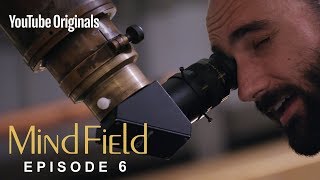

Are We Alone? The Alien Paradox
41sTaps into the universal curiosity about extraterrestrial life and the Fermi Paradox, sparking debate.
▶ Play Clip"The title promises a guide on talking to aliens, and the video delivers with science, experiments, and a practical demo."
The video explores the scientific and philosophical questions surrounding communication with extraterrestrial intelligence. It covers the history of SETI, the Arecibo message, and the work of METI (Messaging Extraterrestrial Intelligence), while also featuring an experiment where experts attempt to decode a randomized version of the Arecibo message. The video concludes with a personal story of sending a message to space via SpaceSpeak.com.
Humanity has been listening for messages from outer space, but so far no signals have been detected, raising the question of whether we are alone in the universe.
The host expresses a desire to design a message to extraterrestrials, acknowledging the honor but also the potential waste of time if no one is out there to receive it.
Stephen Hawking warned against making contact with aliens, comparing it to the meeting of two civilizations where the less advanced one gets crushed.
Douglas Vakoch, president of METI, advocates sending messages to space despite concerns. He argues that humanity has already been announcing its presence through radio and television since the early 20th century.
The Fermi Paradox asks 'where is everyone?' given the high probability of alien life. The host notes that only a tiny fraction of stars have been searched.
The most famous message sent to space was the Arecibo message in 1974, containing 1,679 binary digits. It included numbers, DNA structure, and human figures.
A group of experts attempted to decode a randomized version of the Arecibo message. They quickly identified the semi-prime nature (23x73 grid) but struggled to find meaning due to randomization.
Jacob Haqq-Misra built SpaceSpeak.com to democratize active SETI, allowing anyone to send text or image messages into space. The host sends a photo of his grandmother.
The video emphasizes that the search for extraterrestrial intelligence is not just about finding aliens but also about understanding ourselves. It highlights the importance of continuing to explore and communicate, even if the risks are debated.
What is the Fermi Paradox?
The contradiction between the high probability of extraterrestrial life and the lack of evidence for it.
04:49
What was the Arecibo message?
A 1,679-bit binary message sent in 1974 to a star cluster 25,000 light years away, containing numbers, DNA structure, and human figures.
08:29
Why is 1,679 a special number for the Arecibo message?
It is the product of two prime numbers (23 and 73), allowing the binary data to be arranged into a 23x73 grid to form an image.
14:51
What is METI?
Messaging Extraterrestrial Intelligence, an organization that advocates sending intentional signals to space.
02:36
What did Stephen Hawking warn about contacting aliens?
He warned that when two civilizations meet, the less advanced one gets crushed, so making contact could be dangerous.
02:11
What is SpaceSpeak.com?
A website that allows anyone to send text or image messages into space, democratizing active SETI.
21:14
How many stars have been searched for alien signals?
A few tens of thousands of stars, out of 400 billion in our galaxy alone.
05:16
Hawking's Warning
A prominent scientist's caution against contacting aliens, framing the debate.
02:11Vastness of the Search
Highlights how little we have searched, countering the Fermi Paradox.
05:16Arecibo Message Details
Explains the structure and content of the most famous interstellar message.
08:29Prime Number Grid
Key insight into how binary messages can be decoded into images.
14:51Democratizing SETI
Shows how anyone can now send messages to space, changing the landscape.
21:14[00:05] We have been listening for messages from outer space and so far...
[00:17] Why? Are we truly alone in the universe? and just doing a lot of listening?
[00:31] Maybe we need to send more messages out there. whose language and culture and biology and mind And what do you say?
[00:46] And given all of the unknowns about what they might be, ♪♪
[01:14] I've wanted to design a message A sort of hello from Earth to whatever extraterrestrials I mean, come on, to be the author of the first thing
[01:28] would be a fantastic honor. an opportunity to send a message to space But it might be a waste of time.
[01:43] What if there isn't anything or anyone out there to receive it? of intelligent alien life despite the high probability that such life exists,
[01:56] that attempt to explain it. that whenever two civilizations meet, Which is why in 2015,
[02:11] warning against making any contact at all. [Stephen Hawking]
[02:36] send no messages to space. He is the president of METI, an organization that, despite all of these concerns,
[02:50] extraterrestrial intelligence. I should talk to him first. Why isn't he afraid?
[03:04] home to the largest public refractor telescope -[Douglas] So here we are. -[Michael] Wow. This was one of the prime telescopes of a century ago.
[03:19] [Michael] Jeez! I've seen so many observatories Believe it or not, I've never been this close to one. and yet it's balanced too exquisitely.
[03:34] [Douglas laughs] I'm telling you, I had no idea I would have this feeling, Can I handle what I would see?
[03:48] You just take a look. -Because of the fog. -Because of the fog. [Michael] Just the fog coming in is pretty darn cool.
[04:03] but we've only been actively listening for life out there In 1960, astronomer Frank Drake began the search He scanned for interstellar radio waves,
[04:19] but did not detect any recognizable signals. Soon after, SETI, or Search for Extraterrestrial Intelligence, for other life in the universe.
[04:33] we've also launched physical messages both Voyager spacecraft in 1977. that told a story of who we are as Earthlings,
[04:49] Today, Doug and his team at METI are on a mission to send new messages to the stars. Thank you for taking some time to have a conversation with me.
[05:03] where is everyone? You know, we've been looking And so that leads some people to say we must be alone.
[05:16] I mean, we've looked at a few tens of thousands of stars, and there are 400 billion stars in our galaxy alone.
[05:28] So I think we just need to keep on looking. I mean, we are still discovering species on our own planet today.
[05:40] and instead of just listening for signals, we send powerful, intentional signals to other stars What do you say to people who go, "Hold on,
[05:53] "It's just not worth the risk. I would say it is too late. We have been announcing our presence to the universe
[06:08] since the beginning of radio and television. to travel between the stars So maybe the aliens have been observing us,
[06:21] So our goal isn't to let them know that we want to make contact. and comfortable about sending a message out
[06:36] There are some group of scientists who have said But that's an example of someone very prominent because maybe the aliens will come to Earth.
[06:51] to commemorate his life, his family, Anyone and everyone can transmit to extraterrestrials. for people involved in SETI to say we shouldn't transmit,
[07:07] because the day they succeed, everyone will be transmitting. Okay, so how do we craft a message for E.T.? I would want to know something about that civilization.
[07:21] what is it that we have in common What do you think the aliens would know that we know? So that's the natural starting place.
[07:35] But how can you communicate the idea of numbers? Like this.
[07:47] -Hey, look, we're communicating. -Okay, okay, great, great. to count up to a million. Right.
[08:00] The goal, for me, is to learn about other civilizations But I think even if they're not, do we want to tell about ourselves,
[08:16] forces us to look at ourselves anew. And I think that can only be good.
[08:29] that humans have ever sent for extraterrestrials to some day receive was written in 1974 They sent the message to a star cluster 25,000 light years away.
[08:44] It contained 1,679 binary digits the famous Arecibo message.
[08:57] Up here in the white are numbers. I feel like it's fair to say But what about some of these other parts?
[09:11] that that is supposed to be Could an alien figure out what all these symbols mean? what they all mean?
[09:25] to guess what all this means, I want to give some humans a message, I didn't put in there, or conflicting interpretations,
[09:40] well it could spell trouble for our ability to say much more than simple mathematical truths to whatever might be out there. I recruited Dr. Steve Vance.
[09:55] for JPL's Astrobiology group, meaning it's his job to think about the possibility that if the Arecibo message is received,
[10:10] will see all kinds of meanings in it. of how they experience their world. we would think of the ones we've sent out,
[10:23] And maybe the message contains none of those things. that they will find meaning where there isn't any.
[10:35] -Yeah. Let's do it. -Let's do it. would influence their approach to a message from space,
[10:49] of critical thinkers and problem solvers I'm a sophomore engineer, and I have a PhD in physics. I'm a graphic artist and app coder.
[11:02] This set of experts would be told and would be asked to decode it and computer software.
[11:16] although similar to the original Arecibo message, Would our group of experts notice or apply their own meanings to this indecipherable message?
[11:30] It was time to find out. using a radio telescope from outer space. What we want to know is what it says.
[11:46] A copy of the message as received is on that laptop. This is an audio output of that message. and the tools that you have in front of you,
[11:59] please figure out what this message is saying. -Okay. -Good luck. -Okay, you ready to listen? -Let's hear it.
[12:12] [pings] that our jumbled image is meaningless, to decipher it visually.
[12:26] who received the real Arecibo message. that it's binary. [man] Is there a difference in time between any of these?
[12:43] There's going to be a repeating pattern in there, probably. Yeah, it doesn't seem to go any higher or lower than that.
[12:56] We should probably start transcribing it They're noticing two tones, binary message. because we already come to this
[13:11] So we're already seeing into it what we expect to see. Okay, so, we have a way to encode binary into letters. -and it wouldn't be the same language anyway. -Right.
[13:28] Like, there's, you know, universal language and all that. just so we make sure we don't miss anything. and let's start writing it down.
[13:41] Now they are creating a visual representation The key is to see how many tones there are.
[13:54] [woman] Do we need to play it in half time [Michael] The message is 17 minutes long, with 1,679 individual tones.
[14:08] I decided to help them speed up the process. This thumb drive contains a transcription of the message, -But now you're just kind of jumped ahead in time. - Fast forward, yeah.
[14:23] -All right, we will continue. -All right, I'll leave you guys to it. Does it look like an even distribution No, there's way more zeros than ones.
[14:36] So, what is the total number of--? [man] 1,679. Is that divisible by anything in particular? It's going to be hard to test that without writing a script.
[14:51] [Michael] Just like the Arecibo message, 1,679 total tones. The number 1,679 can only be divided into two prime numbers:
[15:06] When you arrange the ones and zeros the jumbled image will begin to emerge. If the group can discover this feature of 1,679,
[15:19] of the message into an image. Hey, it's-- hey, yo, this is important, guys. Okay.
[15:31] because 23 and 73 are prime numbers. So that is very relevant. Wow. Look at the big brain on that dude.
[15:45] to try and straight up, like, make a 23-by-73 grid, and maybe there's some kind of image being sent there.
[15:57] [man] I'm strongly with the graph idea. -and then we can graph it in Excel and see. -Yeah, that's good. Yeah.
[16:11] -all of the cells that have a one in them. -That's great. of mathematics and physics and music. is proving to be the best skill.
[16:25] the team figured out how to break down Will they try to find meaning in the message, Oh, I'm done! Guys, I'm done!
[16:39] [man] That looks sadly random. That almost looks like it's going to resolve into something. -Those aren't letters, are they? -They could be.
[16:52] Except for little nine over here. -[woman] Baby nine. -[man] That's an "I", right? Do we agree, like, this probably looks like nothing?
[17:06] -Productive. -Okay. even though there wasn't one that made sense. Within a matter of minutes,
[17:20] So it was time to let them in on the ruse. All right, so, this is Steve Vance. Have you learned anything about the message?
[17:34] It seems very random still. Let me show you guys something new.
[17:46] -I see how you're doing this. -Oh, we were almost there! kind of in these blocks. that we don't actually have mapped correctly here.
[17:59] This is the famous Arecibo message. Now, what you have been working on but randomized.
[18:14] [all laugh] In a way, you guys were quite successful. recognized the semi-prime nature of this message very quickly,
[18:29] to see things there that weren't. I think the real reason that we weren't interpreting We're looking for something like this.
[18:45] If I'd seen any symmetry in these patterns, the best kind of message to send, You know, a marker to where we are
[19:01] but then it's like, do we really want to tell them where we are? -I don't know. -What do you guys think? Should we be sending messages to outer space?
[19:13] Every single time any civilization and one is technologically advanced, one guy gets crushed. What if we're at the same place,
[19:26] What if we can just exchange the recipe for fusion? and really nothing to lose in that situation.
[19:41] to send our knowledge to share with other civilizations. Let's just think of this as a way which, by the way, we tell better than the universe does.
[19:56] [all] Thanks. Thank you. to find meaning where there is none would more quickly emerge.
[20:12] What I also didn't expect was just how educational I mean, I saw some human flaws and biases at work, but more generally, I saw the human mind at work,
[20:27] I mean, the Voyager Golden Record really isn't just a neat thing for extraterrestrials. It's a neat archive by, of and for us.
[20:45] about whether or not we should be sending messages But here's the thing. requires technology that not all of us have.
[20:59] can say hello to extraterrestrials if they want. for all of Earth? to talk to a man who is changing that.
[21:14] He is democratizing active SETI, because the service he has built to outer space. with a doctorate in elementary particle physics,
[21:27] and he's the one who's going to help me send my message. and helping other people do it. Well, I have built a website, called SpaceSpeak.com.
[21:41] or a image message out into space. My view is, as many people that can reach out to aliens What are you using to transmit these messages?
[21:57] And once a photon is broadcast into space, it persists. A million years from now, maybe the earth is gone,
[22:09] but your message is still out there, for some future generation to see what we were about.
[22:21] -Awesome. -Great. -And... -This is it. This is a transmitter box here.
[22:35] I've been thinking about this a lot, about what to send, how to write the message, I don't think this is something to take as fact.
[22:51] I don't have any fear that this is dangerous. constructing what I believe I was going to not send a two-dimensional image
[23:05] but a three-dimensional image made of voxels. And then after talking to you and really thinking about the point of communicating with outer space,
[23:20] I...I just think to decide what to say and how to say it. is an exercise in learning how we communicate at all.
[23:32] to who we are. I'm so sorry to hear that. and I'll get to see all of my family.
[23:46] And the way she, you know, made me who I am, that will, in a way, like echo like ripples in a pond, right? But this is a message made of light
[24:02] that will be around forever... So I have the last photograph I'd like to send that picture out.
[24:16] -Let's do it. -Okay. using one of those, like, grabber tools, you know, [laughs]
[24:31] she could pinch. of who we were. as far as I know,
[24:43] that I think I want to remember, So... Yeah. Go ahead and hit "send."
[24:57] -It's already 229,435 miles away from Earth. -Yes. -Now she has. -She has now, absolutely.
[25:09] Your grandmother will touch the universe. Yeah. You are very welcome, sir. It was a pleasure.
[25:22] thanks for watching.
[25:35] ♪♪



⚡ Saved you 0h 26m reading this? Transcribe any YouTube video for free — no signup needed.