
AI Summary
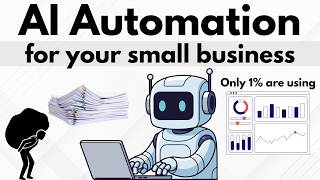
This video provides a beginner-friendly guide on using AI automation to streamline small business operations. It emphasizes that automation frees up time for strategic tasks, not replace the entrepreneur, and offers a step-by-step approach to implementing simple automations.
Chapters
AI can handle repetitive tasks like answering FAQs, organizing leads, scheduling, tracking inventory, and sending payment reminders, allowing you to focus on high-value decisions.
Most automation tools are affordable and don't require technical skills. The key is clarity on which tasks to automate.
Start by listing daily or weekly repetitive tasks. Common ones include responding to FAQs, sending follow-ups, onboarding, generating reports, and tracking payments.
Choose one area to automate first, such as setting up an AI chatbot for customer service or automating email sequences for leads.
An AI chatbot on your website can answer common questions 24/7, significantly reducing customer service workload.
Automate professional follow-ups for new leads to ensure timely communication without manual effort.
Integrate invoicing software with automated reminders to reduce late payments without awkward conversations.
Connect CRM, email, payment, and marketing tools for a seamless automated workflow that increases efficiency.
Regularly review automated workflows and measure time saved, revenue improved, and errors reduced. Saving 5 hours a week equals 250 hours a year.
AI automation is a powerful tool for small businesses to gain consistency, build trust, and scale efficiently. Start small, automate intentionally, and you'll create an unfair advantage.
Mentioned in this Video
Tutorial Checklist
Study Flashcards (6)
What is the first step to start AI automation in a small business?
easy
Click to reveal answer
What is the first step to start AI automation in a small business?
List your most time-consuming repetitive tasks.
01:02
How many hours can a small business save per week by automating 5 hours of tasks?
easy
Click to reveal answer
How many hours can a small business save per week by automating 5 hours of tasks?
Over 250 hours per year.
03:20
Name three repetitive tasks that can be automated for a small business.
medium
Click to reveal answer
Name three repetitive tasks that can be automated for a small business.
Responding to FAQs, sending follow-up emails, onboarding new customers.
01:02
What is the recommended approach to start automating multiple areas?
medium
Click to reveal answer
What is the recommended approach to start automating multiple areas?
Start with one area only, then scale.
01:16
What systems should be integrated for efficient automation?
hard
Click to reveal answer
What systems should be integrated for efficient automation?
CRM, email system, payment system, and marketing tools.
02:18
Why is consistency important in automation?
hard
Click to reveal answer
Why is consistency important in automation?
Consistency builds trust, and trust builds revenue.
02:46
💡 Key Takeaways
AI as a Liberator
Reframes automation as a tool for freedom, not replacement, which is a key mindset shift for entrepreneurs.
00:18The Power of Repetitive Tasks
Identifying repetitive tasks is the critical first step; it turns chaos into actionable opportunities.
01:02Automation Builds Trust
Links automation directly to revenue growth through consistency and trust, a compelling business case.
02:46Quantifying Leverage
Concrete math (5 hours/week = 250 hours/year) makes the value of automation tangible.
03:20Unfair Advantage
Positions early automation adopters as gaining a competitive edge, motivating action.
03:35Full Transcript
[00:02] are probably doing everything yourself. You answer emails, send invoices, follow up with leads, post on social media, manage customer service, and still try to grow revenue. That constant pressure drains your time and your energy.
[00:18] AI automation is not about replacing you. It is about freeing you. Imagine your business handling repetitive tasks automatically while you focus on automatically while you focus on strategy, sales, and profit. AI can
[00:32] respond to common customer questions, organize leads, schedule appointments, track inventory, and even send payment reminders without you lifting a finger. The goal is simple. Remove low-value tasks so you can spend time on
[00:47] high-value decisions. Many owners think automation is expensive or complicated, but most tools today are affordable and beginner-friendly. You do not need to be technical. You need clarity. Start by identifying tasks
[01:02] you repeat every day or every week. Those repetitive tasks are your biggest opportunity. When you automate small things first, you create breathing room. And breathing room gives you power to grow.
[01:16] The smartest way to begin with AI automation is step by step. First, list your most time-consuming tasks. For many small businesses, that includes responding to FAQs, sending follow-up emails, onboarding new customers,
[01:32] generating reports, and tracking payments. Next, choose one area only. For example, you can set up an AI chatbot on your website that answers common questions 24 hours a day. That alone can reduce customer service
[01:48] workloads significantly. Then, automate email sequences for new leads so every inquiry gets a professional follow-up instantly. Connect your invoicing software with automated reminders, so late payments decrease without awkward
[02:02] conversations. Use AI tools to summarize financial reports, so you understand your numbers faster. The key is integration. Your >> [music] >> When your CRM, email system, payment
[02:18] system, and marketing tools are connected, your business becomes more efficient automatically. Automation does not remove control. It increases >> You design the system once, and it works for you every single day.
[02:34] Automation changes how you experience entrepreneurship. Instead of feeling overwhelmed, you begin to feel organized. Instead of reacting to problems all day, you start planning growth.
[02:46] AI automation gives you consistency. Leads are followed up on time. Customers receive clear communication. Data is tracked properly. That consistency builds trust, and trust builds revenue. But remember, automation is a tool, not
[03:04] >> [music] >> You still need clear goals, strong offers, and financial discipline. Use AI to support your systems, not to replace Review your automated workflows regularly. Measure time saved, revenue
[03:20] improved, and errors reduced. Even saving 5 hours a week equals over 250 hours a year. That is real leverage. Small business owners who adopt automation early create an unfair advantage. They move faster, operate
[03:35] leaner, and make smarter decisions. If you start simple, stay consistent, and automate intentionally, your business will not just run. It will business will not just run. It will scale with structure and confidence.