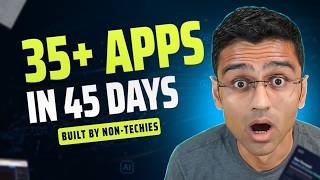

We Built 35 AI Tools in 45 Days
50sConcrete examples of non-engineers replacing SaaS products with custom AI tools make the future of work feel immediate and impressive.
▶ Play Clip"A genuinely detailed and measured account of an AI transformation, with tangible numbers and real challenges—delivers on its promise."
The video documents CodeBasics' transformation into an AI-first company over 45 days, where the team used vibe coding to build 35+ tools, replace SaaS subscriptions, and deploy 12+ tools into production. It covers the initial fear and excitement, the sprint process, challenges faced, and five key takeaways for any team undertaking a similar transformation.
In 45 days, the team vibe coded 35+ applications, tools, and automation workflows, replacing several SaaS products and cancelling subscriptions.
The team produced in 45 days what would normally take a year, leading to the equation: 1 day in the AI era equals 8 days in the old way.
Dhaval sent an email titled 'Change your life in the next 45 days', stating that everyone now has to become a builder and that 'this ship will sail with or without you'.
Realizing AI could handle 50% of the work, they chose not to scale down but to equip everyone with skills and make everyone a builder.
Dhaval built an internal learning tool (LMS) in a week that would have taken 3 months and cost $20,000, proving the power of AI.
Team members built a SQL game, interview prep tool, Chrome highlighter for codebasics website, and Sigma for marketing campaigns.
A week-long sprint focused on proper production strategy rather than building tools mindlessly, with 4 full days of planning.
Sigma, the marketing tool, was deployed in production and used in campaigns, delivering better ROAS than previous ads.
Used Kulify as a self-hosting platform so the entire team could deploy built tools securely to production.
Key ingredients: like-minded people, technical expertise, orchestrating personality, distribution/personal branding, and readiness to unlearn.
The 45-day sprint didn't end—it evolved into a new way of working with fewer meetings, higher ownership, and end-to-end crafting. The team is now launching CodeBasics AI Pro to help others learn and practice these AI skills.
How many applications and tools did the team build using vibe coding in 45 days?
35+
00:02
What is the productivity equation mentioned in the video for the AI era?
1 day in AI era = 8 days in old ways
01:19
What three categories of people were mentioned?
Builder, orchestrator, and by default everyone is a builder
02:57
How long did it take Dhaval to build the internal learning tool?
One week, versus an estimated three months
04:36
What was the cost-saving on the internal assessment tool built by Hem?
It would have cost $20,000 otherwise
00:51
What platform did they use for self-hosting their built tools?
Kulify
14:42
What are the five takeaways for an AI transformation?
Like-minded people, technical expertise, orchestrating personality, distribution/personal branding, and readiness to unlearn
17:34
The 8x productivity equation
Quantifies the speed advantage of AI-driven development, a concrete metric for ROI.
01:19AI-built LMS in one week
Demonstrates that a non-expert can deliver what previously required months and $20,000.
04:36Building a boat for the tsunami
Powerful metaphor framing AI adoption as preparation for disruptive change.
12:06The five key ingredients
Actionable checklist for any team planning an AI-first transformation.
17:34[00:02] I'm shooting this video on 24th March 2026 and by this time several changes have happened in the world of AI. In fact, our own team has seen a humongous transformation. Our team has vibe coded over 35 applications, pieces of
[00:18] software, tools, automation workflows, and so on. We have replaced several SaaS products that we were using and we cancelled a few subscriptions already. Our operation head has built an interview prep tool. Our finance manager
[00:34] has built a website for our foundation. Our analytics head built an internal BI tool. Our analyst built an AI video reviewer. Our AI head built my Hindi voice clone. Our marketing head built a SaaS tool that replaces the need of the
[00:51] graphics designer. Hem built an internal assessment tool that would have assessment tool that would have otherwise costed $20,000. And I myself built a mobile app for CodeBasics, which is being beta tested right now. On the
[01:04] whole, 12 plus tools are in production right now. All of this happened in 45 days. In a regular timeline without AI, this would have taken at least 1 year. this would have taken at least 1 year. Yes, 365 days, but [music] we did this
[01:19] Yes, 365 days, but [music] we did this in 45 days. Let's do the math. This equation means 1 day in this new AI era is equal to 8 days in the old ways
[01:31] of working. Folks, let's get into this time [music] capsule. time [music] capsule. I'm going to take you into this 45 days real journey. In a way, it began with an email.
[01:45] email. >> [snorts]
[02:01] morning as soon as I got up. It The subject itself was intriguing. It said that it's the most important email that he's written ever since CodeBasics was >> And the subject of the email was, "Change your life in the next 45 days."
[02:16] It sounded more like, "Get six-pack in 45 days." It was really long. Also, it was really enthusiastic. It was all about like how these AI things are changing and completing this complete
[02:29] revolution is coming and how everyone now has to become a builder. >> [music] >> Even though I managed to read the whole email, I was not able to absorb it. I remember writing it for 30 minutes and
[02:43] heart. Guys, see so many big big words like change your life, like world is changing. Then so many thoughts came into my mind. Like first I thought like so much of fear like Just three categories. A builder,
[02:57] and a orchestrator. And by default, everyone is a builder. Sentence that struck to me was this ship will sail with or without you. I got a
[03:09] bit scared. I'll be honest with you. Some people may feel afraid, >> but it's about perspective. Whatever the work that we are doing right now, >> it can be done by only 50% of the four workforce. And if at all it is any other
[03:24] definitely there [music] would be a plans of scaling down the team. Right? I could have written a nicer email. That is what I generally do, but I felt that nicer things might get ignored and people would not understand
[03:39] the gravity of the situation. But I got so excited that, "Okay, we are going to challenge ourselves." So, I was very much excited about it. is not about scaling down the team, but it is about enabling the members inside
[03:54] that the I mean, the industry [music] is kind of I mean, the industry [music] is kind of moving towards.
[04:07] in US and when he showed me how they use Claude Code for doing coding for a huge >> [music] >> I was totally blown. I immediately called Hemant and I said that we need to buy Claude Code subscription for our
[04:22] engineers. They did it, but eventually that enthusiasm died. And that's when we started experimenting and I ended up which is an internal learning development tool. And building a tool
[04:36] >> [snorts] >> taken us at least 3 months and costed us at least $20,000. But I was able to deploy that to the team within a week. >> That changed a lot of things for me. Now I know that everyone in my team can
[04:51] about this and I was very excited. I told Dhaval that you know, for the kind of things we are doing now, we only need 50% of our team. Initially, the idea of working [music] with lesser people and doing more stuff
[05:03] excited us. But it did not fit in our values. What we rather chose to do is we wanted to equip everyone with the skills, make everyone the builder, and do more stuff. And our journey began there.
[05:21] >> So, I told everyone clearly that day one is going to begin on Friday and I asked everyone to build a tool. Either it can be Claude Code or antigravity or whatever. The day before we gathered all the ideas and I wanted to ensure that
[05:34] >> And we put it in this uh in this Microsoft Loop. I keep on idea, what idea, what idea because so many people are thinking good ideas and for me nothing coming into my mind. >> When the time has come to build
[05:49] something, I was really confused to select which one. I studied biomedical in the software side, I've no idea. Later I realized that non- like is not an option right now. It's not an excuse anymore.
[06:03] But I did not see anything coming until 5:00 p.m. I first saw SQL game developed by Shreyas and that was the first tool.
[06:16] Shreyas and that was the first tool. Just to share the concept of SQL game. with him in order to choose the right one and [music] I have started building
[06:29] interview prep. And little more tools started coming in. I built a Chrome highlight things in the CodeBasics website and mark a note and they can add >> uh note section. So, whenever they want to refer, they can refer that particular
[06:44] notes and get it. So, I started making this portal of our own in our own company. So, I was then showing it to my boss. He was so amazed that he still now praises me about it
[06:56] >> Anyone [music] who has no creative energy in them, they can also use this product and build something [music] for themselves. That's what gave me the idea to create Sigma. People will try to build it.
[07:11] After that, they will get they want to fix their bug, they want to >> [music] >> improve improve it or want to add new they will face problem. That's the
[07:24] impression I had. And people are going there wishing me wishing everyone. So, every time they do that, they remind of Hemisha built it. And out of excitement, I started recording each of the demos. Yes, correct because this is a mid video
[07:37] feedback. >> Yeah. Okay, great. So, everything is better over front end will get better. Good job. Good job. So, the UI looks like a newspaper, but
[07:51] >> [music] >> Guys, agent D2 is ready, kind of ready. Yeah, yeah. First phase. [music] That process will take time to build with that. This is Good, good. You built it. Thank you.
[08:03] Well done. Very well done. And I remember recording until 2:00 a.m. that night. There's the demo from Vishal. So, yes, created a competitor for SlideUp. Hey folks, we have the interview prep tool from Harish. Oh, you're adding it
[08:16] tool from Harish. Oh, you're adding it in back end? It's good. So, we have the Dhaval here showing two products at once. Not just
[08:29] >> [music] >> and I'm confident on that. And I literally feel like that Iron Man suit that I get it. I could see the people were genuinely happy. We had a team's chat and [music] that team's chat was on
[08:44] fire. People were posting stuff. Everybody was engaging with each other. Everybody was really excited. So, the next day I made a plan for the next next day I made a plan for the next sprints.
[08:58] >> Initially, I was not planning to go to Hyderabad. I thought I would call some folks here in Vadodara. But after seeing all this stuff, I thought I should be all this stuff, I thought I should be with my team in that same space.
[09:32] things, but he was excited genuinely, but I know that team and started experiencing it himself, he would feel different. This himself, he would feel different. This much I knew. It was 10th EU and Dhaval
[09:46] called me in his cabin and he spent 30 minutes to show me how he was using Claude Code to build some tools and systems super fast. Then he gave me a task. In next 2 hours, I have built a small tool that wasn't perfect,
[10:00] but that gave me the sense of importance and insisted me to join him on the one week sprint. Everybody started building stuff on the day the whole team started building the app, the Codebasics app.
[10:14] >> And it was really exciting for everyone to see that. >> It was a great experience for me spending four full days where we were not building tools mindlessly, but we were working on a proper production
[10:30] strategy. So, it takes on the many many issues also. These are ads which are tried and tested giving better ROAS than our Okay. >> have Amazon, Google, Microsoft, things
[10:43] like that. So, this product is something like that, but also tailored as well. like that, but also tailored as well. >> [music]
[10:57] >> It was 12 February and I felt as if I am reborn. completely [music] changed. I have left all my baggage outside and in this new
[11:10] AI age, unlearning the things that you have learned in the past [music] and unloading that baggage is going to be super important. It is very interesting super important. It is very interesting that on this same date back in 2011, 12
[11:22] >> [music] >> an autoimmune condition which completely >> an autoimmune condition which completely changed my perspective towards life and changed my perspective towards life and [music] now in 2026 on same date again,
[11:36] [music] now in 2026 on same date again, I feel as if I am reborn where the world is changing [music] and my view towards coding technology has also changed.
[11:52] thought we could do the same thing in Atliq. So, [music] we started a builder sprint in my other company Atliq as well. This is what I keep on saying to [music] my team, we are building a boat not just
[12:06] for ourselves, but for the people who would need a safe passage when the tsunami hits and I hope we are getting there.
[12:22] of 10 days. I wasn't sure how to keep up the motivation with the team, but good thing is the the team itself pumped up and sharing all the small wins in the group in the group chat that we have and that
[12:38] team motivated. So, it's great that when people start building all these fancy tools, but what really mattered is we started deploying that in production. Sigma, we already started using that in our campaigns and that was a big win for
[12:50] our campaigns and that was a big win for us. are going to production and I'm glad we have a capable engineering team whose
[13:05] have a capable engineering team whose primary goal is to do that. everybody has this wand and it is going to make them
[13:20] powerful in the end. But you know how risky it can get. Once it become live, that will give them kick. That will make them happy. If they are happy, obviously my colleagues are happy, then obviously
[13:33] I'm happy. So, I was having this chat with our CTO Ashok and Siddhant and Mahavir. I was telling them that their only job is to make sure that production. And their only job was to get it
[13:46] deployed. And it is not easy because there are a lot of deployment requests coming left, right and center and most of the times the tools are not tested. these cloud skills which is really good. You could say create a set of skills and
[14:00] deploy it in the GitHub which will make all the testing easier for the people. the integration testing, penetration testing, security testing before it comes to them. Chandraish took care of orchestration among the people
[14:14] I would say it's a very important skill to have in this AI era because a lot of people are not technical. If you have to collaborate with them, communicate with them and get them, you know, set up with GitHub, you know, hosting on servers, it
[14:29] requires a certain kind of a skill. So, I'm thinking from very different angle. Now, I'm thinking like a security engineer. I'm thinking like a >> tester. I'm thinking like DevOps guy. DevOps guy. I'm thinking like a finance
[14:42] the bill shouldn't come so much, right? So, we started using Kulify which is a So, we started using Kulify which is a self-hosting platform where our entire team can deploy whatever they have built. We could finally see things on
[14:56] prod not just working, but also secure and that was a great motivator for everyone. While things were mostly great, we did face the reality which are and I don't think any team can go through this transformation without
[15:10] through this transformation without facing that reality. non-technical people is of course they're not technical.
[15:22] up the basics even even with GitHub. That was okay because we had our technical team who was really committed to help these people. with non-technical folks and helping them understand the basics. That was
[15:34] really how we overcame this challenge. The other challenge we had is with integrating the new wipe coded tools with our existing system. We created a lot of wipe coded tools and it was easy for us to deploy the tools which is not
[15:49] because with our internal systems it requires an additional layer of security, additional layer of scrutiny and it took some extra time. We are figuring out ways to solve that. The biggest challenge of all is to
[16:01] set the people with the right mindset. There is this amazing creative person in my team. She came to me and said that AI is killing her creativity and she's not with AI. I think she totally misunderstood the
[16:14] concept. Then I sat with them and spoke to her and finally she came up with amazing output. She created this comic video using AI and it did not kill her creativity. In fact, boosted her creativity. It helped her to
[16:26] create more stuff. Then we also had our developers saying that it it is not easy for them to switch from hand coding to this wipe coding because they are used to do that. That's their daily bread. They used to open this
[16:38] terminal and type on hand and suddenly AI to code. It is not easy for them. Like it's absolutely difficult to digest Like it's absolutely difficult to digest as well for us because
[16:53] because at the end of the day it it looks like AI they also felt that what is the relevance of them in the And that's another mental struggle my team went through, but we all sat
[17:08] together, spoke about it very openly and today they are still very relevant in the team because they are the ones who are setting up the guardrails to deploy stuff. So, yes, that's another challenge you would have to face if you're doing
[17:21] this thing in your team. As you see, it's not always a rosy picture. There are certain things, protocol that you need to follow in order to make wipe need to follow in order to make wipe coded applications work in production
[17:34] and to give our learning journey in form of a clear takeaway so that you can use this learning lessons for your transformation.
[17:50] like-minded people. In my team, people have this attitude that we will get it done. They don't doubt themselves for being non-technical. They have the mindset to hack the internet and [music] find a solution. Number two is you need
[18:06] people with proper technical expertise. In our team, we had three to four people who can set guardrails and guide us, who can help with production deployment, [music] scaling and so on. You can't leave everything to AI. Number three is
[18:21] you need an orchestrating personality. You need to orchestrate among the people, [music] among the tools and this is a legit skill that you need in this AI era. Number four is you need to know how to distribute. It starts with
[18:36] distributing your own talent which means personal branding. In our team, we have asked our team members to build personal brand from day one and many of them are active on LinkedIn and Instagram. >> [music]
[19:18] the ocean, not every ship gets an attention. You need that flashlight [music] on your ship so that people can notice you. Number five, be ready to unlearn so that you can learn a new thing. Stop doing things in old ways and
[19:34] if you [music] are an experienced professional, this is going to be very difficult thing, but this is what is needed in this new [music] age. Initially, we thought that this 45 day sprint will end with a high intense
[19:47] note, but what we are realizing is that this is not ending. It is rather a new beginning, a new way of working. Less meetings, less crowd, high ownership,
[20:00] people crafting stuff end to end with very low dependency from others. We are still learning and there is an opportunity for you to learn what we have learned and continue learning new things with [music] us together. We are
[20:13] launching Code Basics AI Pro as a product. This will be a live learning AI community that does not feed to the hype, gives actionable practice and
[20:25] helps you stay ahead in the curve. Thanks for watching, folks. I hope you found this journey to be useful. I'm going to show you a quick slideshow of whatever went into production so that you can get some inspiration. Please
[20:38] check the video description. We have provided all the links there. Thank you. provided all the links there. Thank you. >> [music]
[21:01] [music] [singing]
[21:48] working? The answer is here. for our quota to renew. There's 2 minutes left.
[22:02] And after that, we will start driving again. Hello. >> [laughter]
[24:28] >> This is our marketing person. I never saw her eating lunch with the engineer. friends. We are best friends now.



⚡ Saved you 0h 24m reading this? Transcribe any YouTube video for free — no signup needed.