
FEMA: Elevated homes survive hurricanes 3x better
44sHard data from a real hurricane provides compelling evidence that contradicts common misconceptions about flood protection, driving engagement with fact-based arguments.
▶ Play Clip"Entertaining and informative comparison, though the 'tiny houses' are scale models, not actual tiny homes."
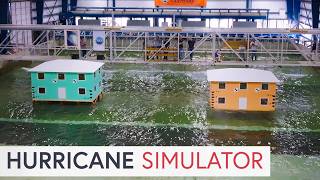
This video explores the devastating impact of hurricane storm surge on coastal buildings, using data from Hurricane Ian and a large-scale wave lab experiment to compare the performance of elevated vs. ground-level structures. It highlights the tradeoff between building higher for safety and the associated costs, showing that even a small increase in elevation can make a dramatic difference in survival.
In September 2022, Hurricane Ian caused catastrophic damage, especially from storm surge, which obliterated buildings and swept them off foundations.
FEMA analyzed over a thousand flood claims after Ian and found that elevated structures had insurance claims averaging one-third the cost of non-elevated buildings.
Elevating buildings adds significant upfront cost, and higher elevation reduces affordability. Balancing safety with economic viability is a key challenge for engineers and policymakers.
At Oregon State's O.H. Hinsdale Wave Research Lab, engineers built two one-third scale model houses at different elevations to simulate storm surge and wave action.
The models are identical except for elevation (one foot higher for the green house, equivalent to 3 feet in real life). Dynamic similarity ensures results translate to full scale.
The lower house suffered wall collapse under wave impact, but surprisingly, after initial damage, the structure stabilized and the upper floor remained intact for a while.
Eventually, the lower house collapsed completely, while the slightly elevated house showed almost no damage, demonstrating the critical importance of elevation.
Avoiding building in floodplains is ideal, but where development exists, small elevation increases can drastically reduce damage. Engineering must balance multiple tradeoffs.
The experiment clearly shows that even a modest increase in elevation can mean the difference between total destruction and near-complete survival during a hurricane. Data from such tests help refine building codes and floodplain regulations, ultimately saving lives and property.
What did FEMA find about insurance claims for elevated structures after Hurricane Ian?
Claims for elevated structures averaged about one-third the cost of claims for non-elevated buildings.
02:42
What is the main challenge in balancing building elevation and affordability?
Higher elevation adds significant upfront cost, reducing affordability for homeowners and renters.
03:28
What is dynamic similarity in the context of scale models?
It ensures that test results from scale models can be translated to full-size behavior by scaling wave periods, velocities, and structural stiffness appropriately.
09:02
How much taller was the green model house compared to the orange one in the experiment?
The green model was one foot (30 cm) higher, corresponding to 3 feet (1 meter) in real life.
08:17
What unexpected behavior did the lower house exhibit during testing?
After initial damage, the structure stabilized and the upper floor remained intact for a while, even as waves intensified.
15:12
What is the purpose of physical scale models in flood engineering according to Dr. Dan Cox?
Physical models are closer to reality than numerical simulations and help reveal complexity that computer models might miss.
12:08
Elevation Reduces Claims by Two-Thirds
This statistic dramatically illustrates the effectiveness of elevation in reducing flood damage.
02:42Balancing Safety and Affordability
It captures the core engineering challenge of designing resilient structures that are still economically viable.
04:11Wave Action vs. Simple Flooding
Highlights that storm surge is not just water rise but includes destructive wave forces.
05:42Unexpected Damage Stabilization
The progressive damage pattern surprised researchers, showing that real-world failure is not linear.
15:43Small Elevation Difference, Huge Impact
Visually demonstrates that a marginal increase in height can mean survival vs. total loss.
17:47[00:00] By the end of this video, one of these buildings will be knocked because there’s a lot we still don’t understand about hurricanes and their effects on buildings.
[00:14] In September 2022, Hurricane Ian tore across the Caribbean and southeastern U.S., Carolinas. It was one of the strongest and deadliest storms in modern history.
[00:28] We often think of hurricanes in terms of wind and rain. But in coastal areas, it’s the surge of seawater driven inland by the storm that causes the most catastrophic damage. Homes and buildings
[00:41] didn’t just get wet. Many were obliterated, swept from their foundations entirely. But unlike many storms of the past, Ian came with data, and lots of it. Today’s tools for collecting and analyzing information mean that even tragic disasters can lead to really important
[00:58] insights into how we can build safer and smarter in the future. After Hurricane Ian, FEMA analyzed more than a thousand flood claims, and what they found about building performance was remarkable. To dig deeper, I’m here at O.H. Hinsdale Wave Research Labratory at Oregon State
[01:14] University. A team of engineers is running a one-of-a-kind experiment to simulate storm surge and study how buildings actually respond. They invited me here to see it firsthand and share what they're learning with you. I’m Grady, and this is Practical Engineering.
[01:39] Everyone knows hurricanes are destructive, but storm surge often gets underestimated, not just by the public, but policymakers and planners too. We see footage of roofs ripped off and trees snapping like twigs. But just a few
[01:56] feet of storm surge can cause even greater damage. And waves amplify the destruction. If you’ve spent time in coastal areas, you’ve probably seen homes raised on stilts. Since the early 2000s, this has become one of the most common construction types
[02:12] in flood-prone coastal zones. The concept is straightforward: move the living space above the reach of storm surge. If a hurricane hits, the lower area used for parking, storage, or access might flood, but the critical parts of the building stay dry.
[02:26] All the devastating power of the waves flows through and around the stilts instead of slamming into walls and destroying the structure. It turns out this idea is remarkably effective. After Hurricane Ian, FEMA found that flood insurance claims for elevated structures in
[02:42] Fort Myers averaged about one-third the cost of claims for non-elevated buildings. That’s a staggering difference in performance. But zoom in, and things get more complicated. On one hand,
[02:54] this is pretty obvious stuff. You don’t need a massive wave laboratory to figure out that elevated structures survive storm surge much better than buildings at grade. But if you look at footage from Hurricane Ian, it paints a more nuanced picture, because some elevated buildings
[03:10] didn’t fare well at all. They weren’t all high enough to avoid the surge. And that gets to one of the most difficult questions in the entire field of hurricane engineering: Needless to say, it is expensive to lose your home in a storm. The conundrum is that it’s also
[03:28] expensive to build your home in such a way that it can withstand one. If it were easy, every building in Fort Myers would be a hundred feet above sea level. But the reality is that elevating a structure adds significant upfront cost, and the higher you go, the higher
[03:44] that expense climbs. It’s not just a cost for homeowners but also something that’s passed down to renters. Shifting the actual housing upwards shifts the affordability of housing downward for
[03:56] everyone. And because major hurricanes are relatively rare events, the return on that investment comes with a lot of uncertainty, with benefits that are invisible most of the time. That’s one of the biggest challenges for engineers and officials. In theory, you can
[04:11] design a structure that withstands anything. But in practice, no one’s building hurricane bunkers as homes. Codes and policies have to balance safety with economic viability and long-term
[04:23] risks with the upfront cost of resilience. Local governments want robust, resilient development, but they also need development to happen in the first place. Overly strict codes can scare off
[04:35] builders or price out developers. And while the National Flood Insurance Program might prefer fewer claims, stricter floodplain regulations also come with tradeoffs: reduced property tax revenue,
[04:47] limited housing supply, and the burden of compliance placed on individuals. but when you multiply them out along developed coastlines, the implications of each extra foot
[05:01] of elevation are monumental. So what you end up with is a delicate balancing act, shaped by competing priorities, enormous uncertainty, and billions of dollars on the line. Changing building codes or policies requires buy-in from a broad array of stakeholders,
[05:17] But there’s one more thing that makes this even more complicated. Of course, “stuff getting wet” is a problem with storm surge, but it’s more than just typical flood damage you’re
[05:30] dealing with when it comes to hurricanes. In a sense, the surge is a rise in sea level itself, and once your home is essentially IN the ocean, that brings wave action into play. Forces
[05:42] intensify. Structural systems are tested in ways that ordinary flood damage doesn’t account for. You can see why this idea of elevating structures is one of those engineering concepts that seems
[05:54] obvious on the surface, but gets way more complicated when you start looking into the details. And that’s why we’re here. Computer models are limited in their capabilities. And you can’t just call up an actual hurricane to knock over a test structure (and even if you could,
[06:08] it would probably violate the ethics rules). So we go to the next best thing: the wave lab. The OH Hinsdale Wave Research Laboratory is one of the largest facilities of its kind in the
[06:21] world. Since the 1970s, this lab has supported cutting-edge research into coastal engineering challenges like sediment movement, tsunami behavior, and wave-structure interactions.
[06:33] It actually has two major test beds. This is the Large Wave Flume. It’s used for all kinds of hydraulic experiments related to waves, coastal structures, and erosion. It’s basically a super-sized version of the flume I use in a lot of my garage demos. It can do a lot,
[06:48] but it has a limitation in that it’s inherently two-dimensional. Flow can really only move in the direction of the flume. That’s why the lab also has this: the Directional Wave Basin.
[07:00] Think of it as a wave pool turned up to eleven. This enormous tank uses dozens of piston-driven paddles, each with independent control, to generate complex, multi-directional waves.
[07:12] You can create a single tsunami-like pulse or dial in irregular wave trains to match the chaotic sea states found in real hurricanes. This facility is utilized in large-scale research projects on
[07:24] wave hydrodynamics, floating structures, and devices that harness wave energy to generate electricity. But, of course, it can also test coastal structures, like these houses.
[07:36] Dr. Dan Cox is a Coastal Engineer and Civil Engineering Professor at Oregon State. He explained to me why they chose the basin for this experiment. “The nice thing about the basin is, you can look at kind of a full 3-D picture, rather
[07:53] than just a slice. And I think for this set of tests, we really wanted to do an entire house, not just a wall, you know, a bit of the foundation. And that’s why we chose the basin for this one.”
[08:05] The research team has spent months building two incredibly detailed model homes, each one a near-perfect one-third scale replica of a real coastal house. Each foot is equivalent to
[08:17] three feet in real life. And the only difference (besides color) between them is elevation. The green model is a foot or 30 centimeters higher up than the orange one. That corresponds to 3
[08:29] feet in the real world or roughly one meter. In every other way, both structures are identical. They’ve got interior walls, windows, framing details, everything. At this scale, that means I’m about the size of an 18-foot-tall civil engineer… which is actually something I’ve had dreams about.
[08:46] One-third scale is still just a model. But this is not a toy experiment. The researchers have carefully accounted for all the physics involved. The wave periods and velocities have been adjusted to simulate full-scale conditions, and the
[09:02] structures have reduced stiffness to reflect the relative rigidity of real-world buildings. It’s all about maintaining dynamic similarity, a fancy term for making sure the test results
[09:14] actually mean something when translated back to full size. And that’s a tough thing to do: “On the structure side, it’s a lot more difficult to scale the structural behavior. So, for example,
[09:27] when we’re doing computer simulations, the simulations are primarily at scale - trying to get that difference in shaking. The forces can generally be scaled up as well, so we kind of know what the forces are. But I think the mode of failure - like how this structure failed - I’m not
[09:46] sure so much as like a quantitative scaling. It’s a little bit more like qualitatively, this is what we would expect to happen under these conditions.” small and build gradually, both in height and frequency, simulating the approach of a storm.
[10:05] The goal is to observe how both buildings respond as conditions get worse and worse. It’s mesmerizing to watch: the wave generators churn, sending pulse after pulse across the basin.
[10:17] Within seconds, the models are surrounded by rolling water, with each wave slapping against walls, flowing around supports, and rebounding off the basin walls and shoreline. Even now, researchers at the lab are measuring the behavior of the structures.
[10:35] you’ll notice targets for highly specialized cameras and lidar to carefully monitor the behavior of each structure. Sensors placed throughout the experiment are recording everything—wave height, velocity, pressure on the structure, accelerations,
[10:50] and even internal motion. The goal is to build a detailed, physics-based understanding of how each building absorbs and transfers energy from the storm surge. For one, this expensive and elaborate test is just two buildings. And there are a lot more types of
[11:09] houses in the world than that. So this data can be used to calibrate and validate computer models, making it easier for engineers to get reliable answers to questions without having to build scale buildings and put them through huge model tests like this.
[11:23] And some of those questions are big ones. When you’re looking at options for large-scale flood infrastructure, a major part of the process is estimating the differences in damage and loss of life between alternatives. Again,
[11:37] we can’t build infrastructure, call down a hurricane, and test it out in real life, then revise accordingly. Even engineers shouldn’t have THAT kind of power. So we have to be able to make predictions about how any proposal will work out. It’s educated guessing, essentially. But the
[11:54] better we understand the connections between all the variables (wave height, surge level, building elevation, movement, and damage), the more educated those guesses become. “I would say the physical model is closer to the real world.
[12:08] It's the best, in a numerical simulation, it's kind of the best we think we can do. always looks really cool. But there’s really - you have to verify it. You really have to
[12:22] show that it’s correct, not just looks cool. And I think when we get to the laboratory, like we’re seeing during this test, like okay, it’s not as simple as we think. So there’s a lot more complexity, I think, inherent in a physical model.”
[12:38] That’s why even though these tests seem pretty straightforward at first, they can have a profound impact on how we allocate public funds, regulate floodplains, and ultimately, keep people safe. You probably wouldn’t buy a car without giving it a test drive first;
[12:53] it’s too big a financial decision to take a risk. Imagine changing the building code or floodplain regulations without good data to back it up. We necessarily make high-stakes decisions
[13:05] about how to manage flooding in the face of equally enormous uncertainties. So, you can see why information like this would give more confidence to engineers and regulators to write building codes and improve floodplain regulations, knowing those decisions are grounded in truth.
[13:22] But it’s not just about the data. You might have noticed that these houses aren’t just bare minimum structures. The team has added details like roofing, window frames, and colorful paint jobs to make them look like real buildings, even though they don’t really affect the final results. That’s
[13:38] because this test is also a communication tool. Most people aren’t going to read the academic papers that get published as a result of this study, but this footage tells a story.
[13:50] You don’t need data to understand which of these two structures you’d want to live in when a hurricane comes. And the more people who take storm surge seriously, the better the outcomes we can expect when a big storm arrives.
[14:03] Each set of waves is programmed into the machine to simulate the variability of a storm, with the upper limit of wave amplitude increasing from one set to the next. After four sets of waves (delivered in about an hour),
[14:16] they raise the level in the basin using this massive bathtub faucet and repeat the process. It was actually pretty surprising how well both models were holding up for a while there. It’s hard to communicate in a video just how awe-inspiring it is when
[14:30] the directional wave basin starts really churning. And eventually, a particularly violent wave comes crashing into the lower house, and we see our first damage.
[14:42] You can see the wall underneath the window give way, and now waves start penetrating into the interior of the structure. In a real house, this would already be catastrophic damage. But of course, they don’t stop at the first sign of damage, and the team keeps hammering
[14:57] the models with more intense waves. Over the course of the experiment, the sea conditions just keep getting worse and worse, and the damage to the orange house does too. More and more of the first story of the lower house is swept away.
[15:12] Waves flow through the structure and knock out portions of the wall on the beach side, and everybody in the room fills with eager anticipation of a total failure. And then, something I didn’t quite expect happened. The model seemed to almost stabilize.
[15:27] The walls of the front and back of the structure were so totally obliterated that the first floor almost began to act like another level of stilts! Despite the first floor being utterly wrecked, the second story remained more or less fine for quite a while, even as the waves got stronger.
[15:43] Dan told us about a test at half this scale (one sixth of real life scale) that had shown similar progressive damage, but that led to collapse much earlier on: “In the previous study, we started to see the deterioration and then very quickly,
[15:59] well we'll see that again at larger scale, but we didn't.” That’s one of the cool things about moving up in scale and realism: you learn things that aren’t always expected. If we had cameras on every structure during Hurricane Ian,
[16:15] we likely would have seen similar results - damages from storms rarely follow a linear, progressive trend. It comes in fits and starts. For a while, it seemed like it might be the end of the experiment, since the stronger waves weren’t causing more damage.
[16:30] “…It was a tough problem, and I thought I knew the answer, and it turns out I didn’t. Little bit tough to swallow, but it also kind of highlights to me, like, okay this is a challenge. This is a hard problem. So for me, you know, I’m trying to put a positive spin on it, but
[16:45] I feel like that’s a success right there. To say hey, this is more complicated than we thought.” Of course, everyone watching (including me) and those participating in the experiment were hoping for that final blow that would knock the whole thing over so they could get
[17:00] the full range of data needed from safe to damaged to destroyed. And eventually, the moment came.
[17:12] The waves finally won, and the lower house collapsed. "Holy moly!"
[17:31] What’s probably more interesting than that is the condition of the other house. Take a look at that. Almost no damage whatsoever. This building sat in the exact same conditions as the other house and took almost no damage. And in a way,
[17:47] that’s kind of remarkable. Because there really wasn’t that big of a difference between the two. I said it’s expensive to elevate a structure, but the marginal cost between the green and orange models is almost negligible compared to the overall value of the structures.
[18:04] “In talking to people about flood risk, you know, we talk about the 100-year, 500-year. And I think there’s a misperception that the 500-year is like 5 times bigger,
[18:16] 5 times worse, I have to elevate 5 times greater. And I think just trying to show people it doesn’t take much. Like, there was not much of a difference in elevation between those two buildings. The one on the right is toast. The one on the left had a little bit of damage,
[18:33] but hardly any, and that was only after we really tried to... The researchers will be studying the data from this experiment for years to come. But the story's pretty clear. Same surge, same waves. A little difference in elevation
[18:48] can make a huge difference to a structure when it comes to surviving a hurricane. You might be watching these buildings get knocked about and thinking: “We don’t need more resilient structures in the floodplain; we just need them to not be there in the first place.”
[19:02] And in many ways, you’d be totally right. Often, the most economical way to reduce flood damage is to avoid building in flood prone areas, or if development has already happened,
[19:14] simply to buy out property, tear it down, and leave the land empty as a buffer. But where’s the line between flood-prone and not, especially when it comes to rare events like hurricanes, where the probabilities of occurring in a year are in the range of 1-in-100 or 1-in-500? And if there’s
[19:31] not a bright line between at-risk of flooding and not, what’s appropriate for the fringe? The truth is that there is no catch-all solution to flooding. We need options to accommodate the
[19:44] vast array of situations where development occurs, whether those areas are flood-prone, flood-free, or, most importantly, somewhere in the middle. And not just options, but also the data to determine which of them is truly the best path forward. Engineering is a balancing act;
[20:02] we need structures that are both strong and safe, but also affordable, easy to occupy, and maybe even architecturally pleasing. Using knowledge gained from tests like this helps us get a clearer definition of the edges of the problem we’re solving.
[20:18] Huge thanks to Dr. Dan Cox and his team of researchers for inviting us to see this happen. I love talking about the engineering of the built world that often goes unseen like this test. I
[20:33] can’t always travel to university labs, so a lot of my videos feature homebuilt demonstrations I build in my garage. And a lot of those models feature parts from today’s sponsor, Send-Cut-Send.
[20:46] Look at this list of materials they can cut for you. And this is so easy: design your part in your favorite CAD software or even Adobe Illustrator. Upload it to the platform. Choose any additional services like bending, countersinking, tapping, or even hardware insertion, and get an instant quote.
[21:04] I love the price transparency, and I even go back to the drawing board sometimes to make revisions. Parts are made in the USA, they’re out the door in a day or two, and there’s no minimum quantity, so the value proposition is hard to beat here: I could spend half a day in the shop making a part,
[21:20] or I could have Send-Cut-Send do it for me for a very reasonable price, freeing up my time for other stuff. I tried this once, and since then, it’s just unlocked this whole new world of possibilities for the stuff I build. If you’re in the US or Canada and want to
[21:36] give it a try click that link below. Thank you for watching, and let me know what you think!
⚡ Saved you 0h 22m reading this? Transcribe any YouTube video for free — no signup needed.