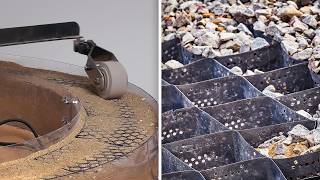

Trillion-Dollar Port's Secret Foundation
45sThe massive scale and cost of the port expansion, combined with the surprising 'plastic accordion' solution, creates an immediate curiosity hook.
▶ Play Clip"The title promises a doubling of strength, and the video delivers a solid explanation and demonstration of geocells' benefits, though the exact 'doubling' claim isn't explicitly proven."
This video from Practical Engineering explains how geocells, a 3D honeycomb-like plastic structure, can dramatically improve the bearing capacity and stability of weak soils. It covers the engineering principles behind soil failure, compares geocells to other geosynthetics, and demonstrates their effectiveness through a model test on a washboard track.
The Port of Long Beach, a major US gateway, needed to expand into an old dry dock with soft, water-logged silt. Traditional methods would be costly and slow, so engineers used geocells to transform the weak soil into a high-capacity platform.
Geotechnical engineers work with natural materials that are often poor. Soil fails by shearing, not crushing or bending, leading to bearing capacity failure where soil moves down, out, and up, causing structures to sink or tip.
Bearing capacity failure is a critical failure mode for soil. It occurs when friction between soil particles is insufficient to resist pressure, causing them to slide along a plane. This must be considered in designing any structure.
To prevent sinking, engineers use wide concrete footings to distribute weight, or replace weak subgrade with select-fill like crushed stone. However, concrete is expensive, and subgrade replacement requires significant digging and hauling.
Geotextiles are fabric sheets that act as separators, but lack strength and don't engage with soil. Geogrids are stiff plastic meshes that reinforce soil like steel in concrete, but they are 2D and only affect nearby soil.
Geocells are 3D honeycomb structures that encapsulate soil, preventing lateral movement and shear. This confinement spreads loads over a larger area, reducing stress on weak subgrade and allowing thinner base layers.
Geocells were pioneered by the US Army Corps of Engineers in the 1970s for building landing strips on soft soils. NASA has also researched using similar technology for lunar construction.
The video demonstrates geocells' effectiveness against washboarding on unpaved roads. A model track with geocells showed no washboard formation even at high speeds, compared to unreinforced sand which formed ruts and corrugations.
Geocells are made of HDPE, an inert material. They can reduce excavation, allow use of local materials, reduce haul distances, and sometimes eliminate the need for asphalt, providing net environmental benefits.
Geocells are not magic but fit a niche where cost, maintenance, and material availability constraints can be met cleverly. They demonstrate that sometimes a little geometry and dirt can outperform massive concrete or steel.
Geocells are a versatile geosynthetic solution that significantly improves soil bearing capacity and stability, offering both economic and environmental advantages. The video effectively demonstrates their effectiveness through a model test, highlighting their potential to transform weak soils into robust foundations.
What is the primary failure mode of soil under load?
Shearing, where soil particles slide along each other in a plane, causing bearing capacity failure.
03:40
What are the three main types of geosynthetics mentioned?
Geotextiles, geogrids, and geocells.
06:12
How do geocells improve soil bearing capacity?
They confine soil in a 3D honeycomb structure, preventing lateral movement and shear, which spreads loads over a larger area.
08:17
What material are most geocells made of?
HDPE (high-density polyethylene).
14:29
Who pioneered geocell technology and in what era?
The US Army Corps of Engineers in the 1970s during the Vietnam War.
09:55
What is the difference between geotextiles and geogrids?
Geotextiles are fabric sheets that act as separators but lack strength, while geogrids are stiff plastic meshes that reinforce soil but are 2D.
06:12
What is 'select-fill'?
An ambiguous term meaning whatever material the engineer determines will support the load, often high-quality crushed stone.
05:00
What is washboarding?
Rhythmic corrugations on unpaved roads that jostle vehicles and can cause loss of traction.
10:53
What environmental benefit do geocells provide?
They reduce excavation, allow use of local materials, reduce haul distances, and can reduce impervious cover, helping with flooding.
14:58
Soil shears, not crushes
Explains a fundamental concept in geotechnical engineering that is often misunderstood.
03:40Geocells encapsulate soil
Key differentiator from other geosynthetics, leading to superior load distribution.
08:17Military and space origins
Shows the technology's proven track record and potential for future applications.
09:55Small plastic, huge difference
Demonstrates the efficiency of geocells in transforming soil behavior with minimal material.
13:45Engineering as balancing act
Highlights the core of engineering: weighing competing factors to find clever solutions.
15:53[00:00] The Port of Long Beach in Southern California is the second-busiest container seaport in the United States, a major gateway for goods flowing to and from the west coast. Together with its
[00:13] next door neighbor, the Port of Los Angeles, roughly half a TRILLION dollars worth of trade moves through the port every year. To keep up with the staggering growth of shipping demand, the port is in a nearly constant state of improvement and expansion.
[00:29] In the early 2000s, Long Beach was expanding the container storage yard at the Pier T Marine Terminal, but engineers hit a problem. The area they were expanding into was an old,
[00:41] disused dry dock, much lower than the rest of the yard. They were going to need a lot of fill to bring it up. There aren’t many more difficult paving challenges than a container terminal. You have constant heavy traffic of cranes, forklifts, and yard trucks,
[00:58] and the local fill materials that are available are junk: soft, water-logged silt scraped from the bottom of the ocean that has the structural integrity of a cake in the rain. Traditionally, you would have to dig out all the muck, then haul in a literal mountain of
[01:14] expensive backfill, a process that would cost millions of dollars and take years. Instead, the engineers turned to a solution that looks more like a giant plastic accordion than a structural foundation. This 3D network did more than just hold the soil in place;
[01:31] it physically transformed those mushy dredged spoils into a high-capacity platform capable of supporting 100-ton machines and rows and rows of heavy container stacks.
[01:43] The prefix “geo” gets a lot of work in the world of engineering. Just tack it on something semi-technical-sounding, and there’s a good chance there’s a product out there. Geotextile, geogrid,
[01:57] geofoam, and more. Today I want to show you how geocells work, and of course I built a little model in the garage so you can see it in action. I’m Grady and this is Practical Engineering.
[02:18] When you think about engineering, it’s easy to conjure the typical materials we use: steel, concrete, bolts, gears, electrical components, pipes, beams, and so on. The first thing to come to mind typically isn’t dirt.
[02:33] Most geotechnical engineers prefer the alternative four-letter words of “rock” or “soil” to describe their medium of choice. But whatever they call it, they don’t really get to choose what it is.
[02:46] Where most engineers work with materials that adhere to stringent specifications, geotechnical engineers work with the materials nature gives them, which, by the way, are often terrible.
[02:58] So much of our built environment completely depends on our ability to predict and improve the behavior of soil and rock below our feet. And those materials are so entirely different
[03:10] from really anything else that engineers work with, particularly in how they fail. When you walk on the ground, you don’t really even consider that it can quote-unquote “fail” under load. But just like a bridge has a maximum weight limit, every patch of dirt, sand, clay,
[03:28] or loam has a specific amount of pressure it can take before it physically gives up. Of course, most soils can squish a little bit, what we normally call settlement. But it gets worse
[03:40] than that. Soil can’t just disappear under a vertical load, it doesn’t crush like concrete or bend like a steel beam. Instead, it shears. The friction between the soil particles isn’t enough
[03:53] to resist the pressure in the soil, so they slide along each other in a plane. Generally, it looks like this: the soil moves down, then out, then up, causing anything on top to sink or tip.
[04:06] This is called a bearing capacity failure. It’s one of the most important failure modes of soil, and it has to be considered when designing just about any type of structure (since everything sits on the ground). Engineers for buildings, dams,
[04:21] retaining walls, and of course, roadways have to contend with this limitation. If you’re wearing high heels on a muddy lawn, you sink; if you put down a wide piece of plywood and stand on that,
[04:36] you don't. In engineering, this means building wide concrete footings to distribute the weight over a larger area of the ground. The problem is that concrete is expensive. For many structures,
[04:48] spread footings make a lot of sense. But there’s a reason not every roadway is paved with it. Another option is just to replace the subgrade. If the dirt is mushy, you dig it all out and haul it
[05:00] away. Then you bring in so-called, “select-fill” an ambiguous term that really just means whatever material the engineer has determined will be able to support the load. For roadways,
[05:12] it’s usually high-quality, angular crushed stone. But you don’t want just large chunks of gravel; you need some finer particles to help lock everything together. That’s generally called
[05:25] “road base,” and it does most of the heavy lifting when it comes to both paved and unpaved roads. But how much of it you need is an important decision. The stress from a load spreads out with depth,
[05:38] dissipating as it reaches downward. The layer of road base has to be sufficiently thick that the remaining pressure from that “stress cone” is low enough for the native soil to support it without failing. The weaker the subgrade, the thicker the base. Sometimes that can be many feet,
[05:55] which requires an enormous amount of digging, hauling, placing and compacting. Footing and subgrade replacement are good solutions in many cases, but there are situations where it makes more sense to bring outside reinforcements to the soil we already have.
[06:12] These are often known as geosynthetics: humanmade materials meant to make the ground work harder. Geosynthetic option 1 is geotextiles, industrial strength fabrics that go down like a big bedsheet.
[06:28] These are used across the construction industry, mainly to act as a physical boundary to keep individual gravel or rock particles from sinking into the mud underneath. In some situations,
[06:40] they’re used as filters to let water flow through without carrying soil with it. But they don’t have a lot of strength, and more importantly, they don’t really engage with the layer above or below. Geotextiles can move relatively independently of the soil,
[06:56] meaning if the loads are heavy enough, the whole thing will still rut and sag. Option 2 is geogrid, which is exactly what it sounds like: a stiff plastic mesh used to
[07:08] reinforce layers of soil. And this basically works in the exact same way as the steel reinforcement used in concrete. The benefit over geotextile is pretty clear. Not only is the material much
[07:20] stronger, but the grid allows it to grab on to the material above and below. One of the first videos on this channel was about reinforced earth retaining walls. I built a cube of sand with
[07:33] layers of fiberglass window screen, and it could hold up one of my car’s wheels. A lot of the retaining walls you see in the world, especially on highway projects, use technology just like this. It really is pretty remarkable what it can do for even weak soils. But, that demo
[07:50] had multiple layers of it, pointing toward one of the limitations of geogrid: it’s inherently 2D. It can grab the soil near it, but the further away from the grid you get, the less it’s
[08:02] able to help. If you need to reinforce a thicker layer, that’s where option 3 comes in: geocells. If geotextile is a sheet and geogrid is a mesh, geocell is a 3D structure. It’s
[08:17] basically formed from plastic strips welded together in a somewhat-honeycomb shape. And these strips don’t just engage with the backfill like geogrid; they encapsulate it. I feel like
[08:30] this is pretty intuitive. If I drop a heavy weight on this unconfined sand, it sinks in pretty deep. But if you confine the sand to a small area, it you get a lot less sinking. Like
[08:42] I mentioned before, the soil can’t just disappear under a heavy load, it has to shear and shift in order to fail, but when it’s confined, there’s nowhere for it to go. If you put these confinement cells right next to each other, they start acting like the
[08:58] foundation footing we talked about earlier. It’s spreading the load out a lot more so, even with heavy vertical forces, you get a lot lower stress on the potentially weak soils below. And the advantages of this are a big deal. Road base may just look like dirt,
[09:14] but it’s actually a fairly expensive and specialized material. It has to be quarried, crushed, sorted, and sometimes hauled over a long distance. Not every place on earth has
[09:26] a rock or gravel quarry nearby that can produce the stuff in large quantities. Just through the added strength alone, geocells can significantly reduce the thickness of a base layer you need,
[09:38] but it’s more than that. Cellular confinement systems are a lot more flexible when it comes to the material properties of the infill. You’re no longer relying on that perfect interlocking of angular crushed rock and fines to distribute the load. The plastic does a lot of the work,
[09:55] potentially opening the door to use cheaper base materials or even using what’s already there This isn’t really a new thing. The technology was pioneered by the US Army Corps of Engineers in the 1970s during the Vietnam war when there was a need to quickly build landing strips and roads on
[10:13] soft soils. Even NASA has done research on using similar technology to build stuff on the moon. One idea is filling sandbags with regolith, making them into a sort of building block,
[10:25] but there is research happening right now on the use of actual geocells. Maybe they would be lunarcells? When you consider how light this stuff is, and how compact it can be for transport,
[10:37] it just makes sense that it might be a good fit for extraterrestrial infrastructure. Geocells can improve bearing capacity, but there’s another failure mode where they also shine. I released a video about washboarding on unpaved roadways. You’ve
[10:53] a dirt or gravel road has somehow formed rhythmic corrugations that jostle your vehicle and may even cause you to lose traction. I built this circular track with a motorized arm
[11:07] and wheel to simulate the phenomenon in real time. It's really fascinating how this works, and I definitely encourage you to check that video out after this. The one thing I didn’t really dig deep into in that video is potential solutions. Well it turns out that one of those solutions is
[11:25] geocells. So I got my trusty contraption back out. Let’s see if it really works. There’s not a lot of scientific rigor in this demonstration. I just looked at a few academic papers where engineers have done these tests in a lab and tried to recreate the setup they used. So
[11:41] I wasn’t really sure how much to scale my geocells down. But I’m pretty proud of this design. I had them printed in TPU which is a flexible material kind of like the real thing. In the real world,
[11:53] the cells can bulge a little bit under load, engaging the strength of the material and the passive resistance of all the neighboring cells. Let’s see how my model geocells do on the track.
[12:05] If you watched the previous video, you know that washboard formation is a very speed-dependent process. When the tires are moving slowly, it just leaves a rut, not a cyclical corrugation. But there’s kind of a threshold speed where it really starts to happen. In my model without the geogrid,
[12:22] that was about 35 rpm. I have a 10-to-1 gearbox between the motor and arm. So let’s start there. and you can see there’s basically no change in the profile of the track. Not even a rut.
[12:38] There’s a little bit of movement at some of the geocells, but this loose sand is basically a worst-case scenario when it comes to an unpaved roadway. There’s practically no situation where you would use loose sand for the surface of a road,
[12:52] except maybe on an actual beach, and there’s a reason tow trucks make good money in beach towns. Even in this worst-case material, there’s nothing even approaching the look of a washboard. So, let’s bump the speed up a bit. This is about as fast as I trust this homebuilt contraption to go.
[13:12] You can see that it’s still remarkably stable. After quite a few rotations, one of the geocell sections is starting to “float” a bit, but normally this would be underneath a layer of cover. I left the geocells at the top so you could see them better,
[13:27] and because it’s kind of a worst case scenario for the test. Compare the high speed footage between the unreinforced and the geocell setup. You can see there’s no skip and push of the particles with the geocells. The sand stays mostly confined in that grid. I hope this demo doesn’t feel mundane.
[13:45] It’s a little hard to show at scale, but this is a tiny amount of plastic. It’s almost negligible, at least compared to the weight of the sand in the track. But it completely transformed the
[13:57] behavior of the system. A small amount of plastic makes a huge difference. A while back, I made a video on geofoam and lightweight fills used on roadways projects to build tall embankments without overloading the foundation soil underneath. A lot of the feedback
[14:13] I got on that video was about the environmental considerations of putting styrofoam in the ground. People were just uncomfortable with that idea, and I totally get it. It’s something we definitely need to be thoughtful about. But it’s not something I really worry about with
[14:29] geosynthetics, and especially geocells. Most of the products out there are made of HDPE, the same material that we use for a lot of underground piping and
[14:41] conduits. It’s a relatively inert material, especially when it’s not exposed to UV light. And actually, when you look at the totality of the situation, there are times when geocells provide a net environmental benefit. They can substantially reduce the amount of excavation
[14:58] needed at a site. They expand the options for materials that can be used as road base. They reduce haul distance for specialized fills because you can often use local materials instead.
[15:10] In some situations, you might even forgo pavement like asphalt altogether when it otherwise would have been justified, because now you can build a road that’s just as strong and maintenance free for a lower cost. Geocells can also use cleaner fill with less fines,
[15:25] making it more permeable compared to something like an asphalt parking lot, reducing the amount of impervious cover that contributes to flooding. Since you're more able to use the native materials, you also are less likely to generate truckloads of muck that you need to
[15:41] ship somewhere as well. And there are so many applications, from roadways to retaining walls, protecting steep slopes from wind and rain erosion, and of course, shipping terminals.
[15:53] Geocells are not magic, and there are plenty of times where this technique isn’t the right choice, but they fit in a really interesting niche. The only reason engineering exists is because,
[16:05] in the real world, technical decisions aren’t simple. Engineers have a job because you have to weigh all these competing factors of cost, maintenance, material availability, traffic volume, and so on, and find the right balance between them. And I’m fascinated by
[16:22] innovations like this that find a little area of that multi-dimensional state space where all the constraints can be met in a clever way. Geocells are that for all kinds of geotechnical projects. Sometimes it’s not all about more massive concrete
[16:39] slabs or the brute strength of steel, but just a little bit of clever geometry and some dirt. Building this sand track was a pretty big project. I had to learn how to wire up stepper motors and
[16:52] controllers and work with polycarbonate. What I didn’t have to do is cut out and bend all the brackets that connect everything together because today’s sponsor, SendCutSend, did it for me. Designing a demonstration like this is the fun part. Fabricating,
[17:07] for me at least, is not. Don’t get me wrong, I love spending time out in the shop, but it is so nice to have a little help, especially when accuracy, precision, and quality matter.
[17:19] Send-cut-send makes the process so effortless. They give anyone with a CAD file access to laser cutting, CNC machining, bending, powder coating, and more. And you don’t even have to be a CAD expert, because they have a bunch of these premade templates you can modify to fit your needs.
[17:35] They don’t have minimum quantities. It’s super fast, super easy, and made in the USA. SendCutSend has completely changed my workflow out in the shop, and they support what I’m doing on the channel. This is the easiest recommendation I can make:
[17:50] If you need parts made from metal, acrylic, or any of the other materials they have available, the link below is going to give you a discount on your first order. I really appreciate their support, and I hope you give them a try. Thank you for watching, and let me know what you think.

⚡ Saved you 0h 18m reading this? Transcribe any YouTube video for free — no signup needed.