[00:02]
enough and eventually one hits. It's just luck. Right place, right time, right algorithm. Actually, I said that, too. So, I decided to prove myself wrong. But, if it's not luck, then why do creators with identical effort,
[00:15]
identical consistency, and identical quality get completely different results? I was spending 40 hours on a single video, hitting upload, and watching it go nowhere. And the most frustrating part wasn't actually the low
[00:29]
views. It was actually not knowing why. There's no patterns, there's no explanation, just inconsistency that felt completely random. If that sounds familiar to you, then you know how frustrating that is. But, here's the
[00:41]
thing. What if the inconsistency isn't random at all? And there's actually a specific measurable threshold that separates videos that gets pushed from those that don't. So, I ran an experiment. I deliberately sacrificed
[00:54]
six videos across 42 days to find that threshold. I called this threshold the invisible ceiling. The exact point in your analytics where the algorithm quietly decides whether your video lives or dies. And once I found mine, the
[01:09]
randomness disappeared completely. Let me walk you through exactly what I found, starting with the mistake I was making on every single video without realizing it. I'm going to show you that benchmark today, but it starts with this
[01:21]
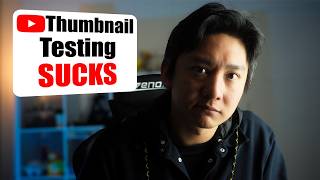
thumbnail. Looking at it now, the mistake is obvious, but at the time, I was convinced it was the solution. I've always struggled with thumbnails, so for this experiment, I built three different styles to see what the market actually
[01:35]
wanted. Two of those designs were professional, clean lines, perfect lighting, and the kind of stuff I'm actually proud to show people. But, both were complete failures. My first video actually started strong, 4.1% CTR over
[01:50]
2,000 views, and solid retention. Here's the thing, I thought this thumbnail looked terrible. It was awkward, unpolished, and didn't stand out at all. But, the data didn't care about my opinion. It worked somehow. One success
[02:05]
is just a fluke, though. I needed to identify a pattern. However, the next experiments were abysmal. I was hitting a wall of sub-3% click-through rates, and struggling to even crack 300 views. And those professional thumbnails I
[02:21]
And those professional thumbnails I loved, only 1.9% and 1.8%. Dead on arrival. But, me being stubborn as always, I tried one more time just to prove my taste wasn't the problem. And only 2.8% CTR. Another flop. So, yeah,
[02:37]
the problem is me. But, that's when the logic clicked. My audience wasn't looking for a polished pro thumbnail. They were drawn to a real person in a real environment, like this messy background and all. It wasn't to my
[02:50]
liking, but if I wanted to fix the channel, I had to stop being emotional and start being objective. But, just as I thought I found the answer, I hit another contradiction. If this messy background was the secret, then why did
[03:03]
the two other thumbnails using the exact same background fail to hit even 3% CTR? I realized the thumbnail wasn't the only variable here. It had a partner that was sabotaging the click, which is called the title. Think of them like a lock and
[03:17]
a key. If they don't line up perfectly, the door to your video stays shut. Now, as someone who likes clean data, titles are frustrating because there's no way to measure them in isolation. So, I had to look at the patterns. My Ali Abdaal
[03:30]
to look at the patterns. My Ali Abdaal video hit 4.1% CTR and 2,000 views, but it wasn't just the thumbnail. The title carried some of the weight, too. It posed a $1,000 question that people needed to answer to. But, for my other
[03:44]
experiments, I did something deliberate that backfired. In order to test the thumbnails fairly, I kept the titles generic. I wanted to isolate the visual variable, so I created titles that had zero curiosity. Look at these two
[03:58]
professional thumbnails again. Same style, same white background. One hit style, same white background. One hit 1.8% CTR, and the other hit 2.8%. That 1% jump is a massive difference in YouTube terms, and it happens because
[04:11]
one title was slightly more relevant to the viewer's problem than the other. The data was clear. You can have the best thumbnail in the world, but if the title is just a label and not a hook, the video is dead on arrival. However,
[04:25]
battle. If you get them through the door, but the house itself is empty, they still leave immediately. And that leads to the most painful data I found in this entire experiment, the retention. I've always assumed my
[04:40]
retention was low because my editing was unpolished. I thought I just wasn't YouTube enough. So, I decided to test that theory with my wallet. I paid a professional editor $255 to take over one of these videos, which
[04:55]
coincidentally became the top performer of the bunch. But, when I looked at the actual retention curve, I found something that's kind of shocked me. If you overlay the professional edit with my own bad editing, the graphs are
[05:07]
almost identical. The same steep drop in the first 30 seconds, the same steady decline in the middle. That means I didn't have an editing problem. I had a pacing and structure problem, and I always have. My viewers weren't leaving
[05:21]
because of a bad cut, they were leaving because the story I was telling wasn't moving fast enough. This experiment took me 6 weeks, but the data I've gained is invaluable. Before this, I was shooting blindly, following trends and praying
[05:35]
the algorithm would just pick me. But, when I laid these six videos out side by side, the pattern was actually pretty obvious. The first video, the only one that actually performed, had a 4.1% CTR. Everything else sat under 3%. It
[05:50]
suggests that for my channel, 4% could very well be the target I need to hit. If I hit that, I get 2,000 views. If I don't, the video stalls. That's just a guess, though. I'll need to verify that in another round of experiments. But,
[06:04]
CTR isn't just a design choice, it's also about the topic. I tested different levels of curiosities across these six weeks, and the results were pretty fascinating. First, the Ali Abdaal video. The topic is, is a $955
[06:21]
course actually worth it? That's a high-stakes question. It sparks a debate, and that curiosity is what drove the 4.1% CTR. Then, I tried, what big YouTube channels do now. I thought this was a great topic because I wanted to
[06:37]
know the answer, but the data showed that no one else was curious. It was a me topic, not a market topic. But, it got worse. This video, I paid $255 for a video editor. To me, that's a lot of money. To the viewer, they didn't care.
[06:53]
Again, I was the only one interested. And then, I have, I started YouTube in And then, I have, I started YouTube in 2021. Gosh, looking back, this is so self-centered. Why would a stranger care when I started? But, look at this one,
[07:06]
why AI-generated content feels so wrong. This wasn't about me, it was about the state of the world. It was provoking and sensitive, which is why it got the second highest views of the bunch. Finally, this last one. I still think
[07:20]
the topic is strong, but the data tells me the title just didn't do the work. The hook wasn't sharp enough to break the ceiling. If your channel feels as stuck as mine was, here are the three hard truths I learned from these six
[07:33]
stop playing it safe. If you don't experiment, you'll never find your channel's unique trigger point. You have to be willing to fail to find the data that actually matters. Second, isolate your variables. Don't change your
[07:47]
thumbnail and title at the same time, or you will never know which one actually did the work. Do them one at a time. Try styles you hate, try styles you love. The goal isn't to be right, it's to understand the game. And please, stop
[08:01]
over-editing, especially if you're experimenting. It's a waste of time to put your best edits on a video with a weak topic. Fix the curiosity gap with your title and thumbnail first. Once you have the click, then you can put your
[08:14]
best editing to good use, knowing they will be seen. But, I have one more thing to reveal. Even with all this data, I made one giant mistake. In every single video, I was running YouTube's official AB testing tool. I thought I was being
[08:29]
scientific, so I assumed it would help. Instead, it skewed my results so much that it almost invalidated the first half of my experiment. I didn't catch it until video number four, and by then, the damage was done. If you want to see
[08:44]
how YouTube's AB testing tool can actually mess up your experiments and give you bad data, I've broken that down in this video right here. So, that's all this. Thanks for watching, and I'll see you again.